


What is a Pareto Chart? Role, How to Create & Practical Examples


Named after the Italian economist Vilfredo Pareto, this chart is based on the 80/20 principle, which states that 80% of results often come from 20% of causes. By analyzing a Pareto chart, managers can easily identify the key issues that need to be addressed first, thereby optimizing resources and improving the organization’s operational efficiency. So, what is a Pareto chart, and what are its significance and applications in business management? Let’s find out with 1Office in the following article.
Mục lục
1. What is a Pareto Chart?
The Pareto frequency chart, also known as the 80/20 chart, is a statistical tool commonly used to analyze and evaluate the importance of various causes leading to a specific problem or outcome.
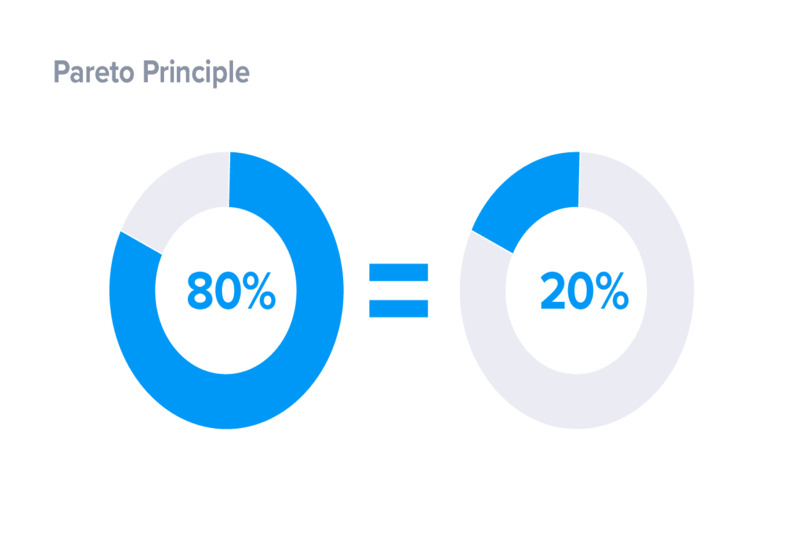
Based on the Pareto principle, or the 80/20 rule, this chart indicates that approximately 80% of results often stem from about 20% of causes. A Pareto chart is typically represented by columns, showing the frequency or impact of each cause, and is arranged in descending order from left to right.
The data and lines on the chart are displayed visually, helping to quickly identify the most important factors to focus on to solve the problem. The Pareto chart is a simple yet incredibly useful tool in the process of analysis, research, and strategy planning for businesses.
2. The Role & Significance of the Pareto Chart in Business Management
The Pareto chart has proven its effectiveness by helping many businesses identify weaknesses and limit the most common errors.
- For leaders: A good leader needs the ability to analyze and predict the future of the business. Studying the Pareto chart helps them distinguish which tasks to prioritize according to available resources and costs. Additionally, this chart helps managers grasp the company’s situation through the displayed data.
- For individuals: Employees will be assigned specific tasks, helping them clearly understand their responsibilities and perform their assigned duties well. Each individual completing their work well forms the fundamental basis for the business’s development.
- For businesses in general: Information about resources and their allocation is clearly shown through the columns and percentage lines. Through this, businesses can explain business results and draw lessons from each project, whether successful or not.
3. Guide to Creating and Analyzing a Pareto Chart
3.1 Values Represented on a Pareto Chart
A Pareto chart consists of 6 main components that work together seamlessly to create a detailed data table, helping managers identify the key factors contributing to a result or problem:
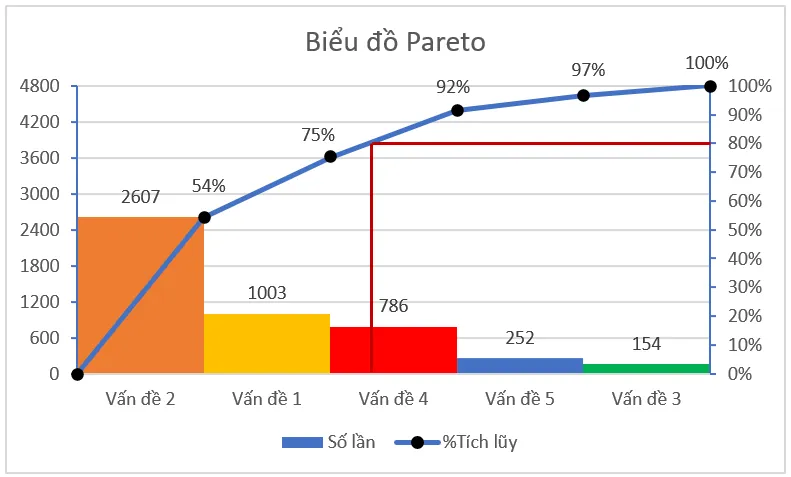
- X-axis: The X-axis contains the categories of factors to be analyzed. These factors can be very diverse, including website traffic sources, defective products, different types of errors, out-of-stock items, or any variable the business needs to study, such as reasons for declining revenue or causes of reduced employee productivity.
- Y-axis: The Y-axis represents the quantity or frequency of the factors being analyzed.
- Vertical bars: The vertical bars represent the value corresponding to each factor listed on the X-axis. The height of these bars, when referenced on the Y-axis, indicates their magnitude. The bars are usually arranged in descending order.
- Cumulative line: The cumulative line, or cumulative percentage line, is what sets the Pareto chart apart. This line represents the cumulative percentage value of the factors from left to right on the X-axis, helping the reader see the percentage impact of these factors relative to the total. The cumulative line usually starts at 0% at the first column and gradually increases to 100% at the last column.
- Secondary axis (if any): The secondary axis is a vertical axis on the right side of the chart (parallel to the Y-axis), showing the cumulative percentage value of the factors relative to the total. To find the cumulative percentage of a factor on the X-axis, simply reference from that factor up to the cumulative line and over to the secondary axis.
- Other elements
- Baseline: A baseline at the very bottom serves as a reference point to help measure the height of the vertical bars.
- Titles: Like other types of charts, each Pareto chart has a descriptive title that helps viewers understand the name, value, and unit of measurement of the presented data.
- Legend: Many Pareto charts display data from multiple sources or time periods, requiring a legend to clearly distinguish the values and data sources.
3.2 How to Draw a Pareto Chart
Step 1: Identify the problem to be solved
The first step in drawing a Pareto chart is to identify the problem that needs to be solved. This problem will become the title of your chart and the basis for finding the constituent causes in the next step.
For example, if the software your business operates has recently received continuous negative feedback from users for various reasons, the problem for which you need to collect information to find a solution is “Reasons for customer complaints about the software.” The data to be collected could include: lack of support from the operations team, slow connection speed, missing software features, etc.
Step 2: Collect and analyze data
The next step is to collect all data related to the problem from various sources and analyze it. This is where information gathering and market research skills need to be used effectively.
For example, if you are analyzing the problem of “Goods transportation costs for the company’s road freight operations,” the categories to research and collect information on could include: rising fuel costs, empty truck runs, repair and periodic maintenance costs, traffic conditions, loading/unloading times, etc.
Step 3: Draw the Pareto chart
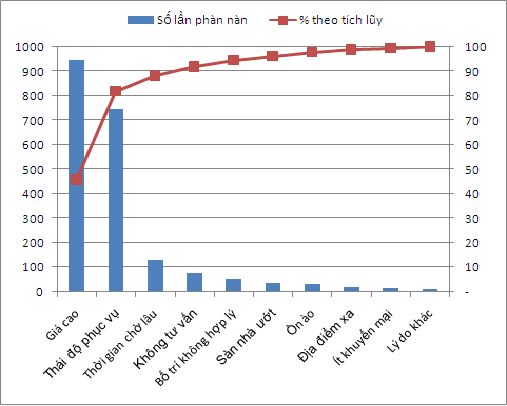
First, determine the value and frequency of occurrence for each problem, then rank them in descending order. After sorting and classifying the data, you can build the bar chart by marking points on the X and Y axes of the chart, then drawing vertical bars at the corresponding positions on the X-axis, with a height equal to the corresponding value on the Y-axis. After completing the value bars, the final step is to calculate the cumulative percentage for each factor:
Cumulative Percentage = Cumulative Total on Y-axis / Total of all values x 100%
Step 4: Analyze the chart
Looking at the chart, the taller bars correspond to the section of the curve where the cumulative frequency increases the fastest, representing the most frequent errors that need to be prioritized for resolution. Conversely, the shorter bars correspond to the section of the curve where the cumulative frequency increases more slowly, representing less critical and less frequent errors.
4. Basic guide to analyzing a Pareto chart
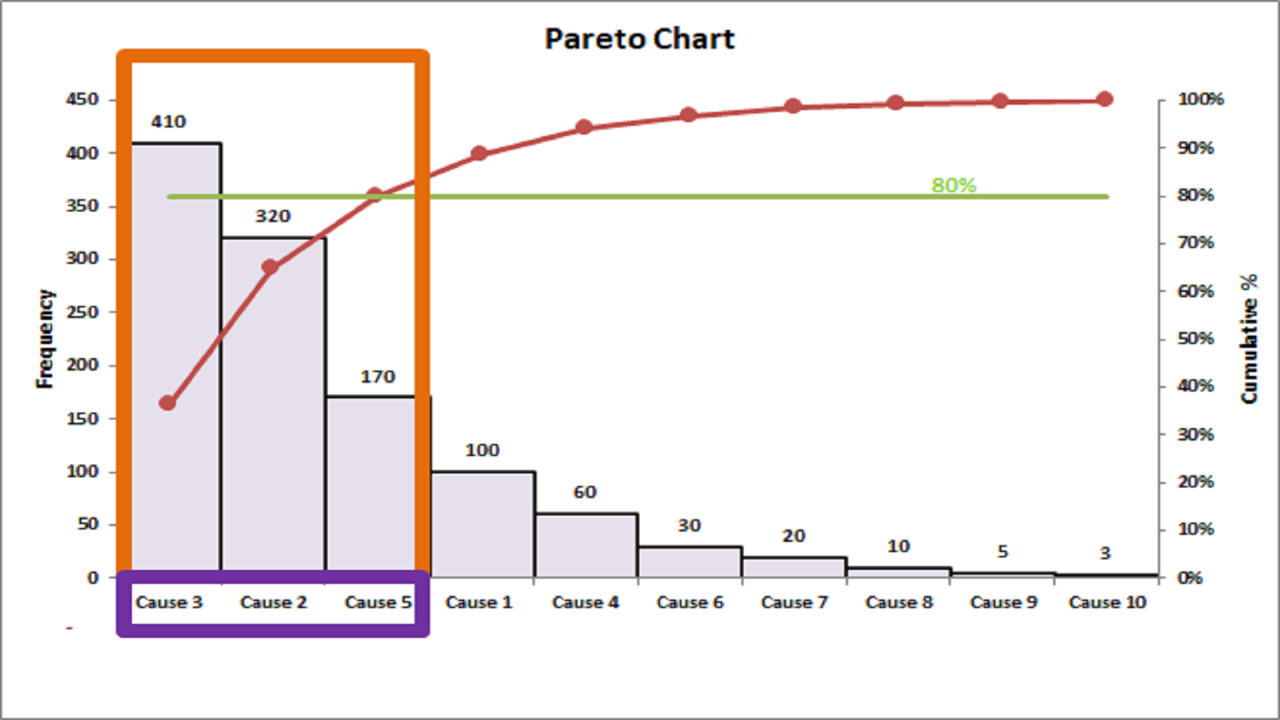
When analyzing a Pareto chart, we use the 80/20 Pareto principle, which means 20% of the problems lead to 80% of the consequences. The chart analysis is performed as follows:
- Identify the 80% position on the right-hand percentage vertical axis.
- Draw a horizontal line from the 80% position until it intersects the cumulative curve.
- From the intersection point of the line and the cumulative curve, draw a line perpendicular to the horizontal axis.
After completing these steps, we will have a chart that clearly identifies which factors belong to the 20% of primary causes that result in 80% of the consequences.
From this, we can deduce that the problems to the left of the line perpendicular to the horizontal axis cause 80% of the consequences and should be prioritized for resolution.
5. Applications of the Pareto chart
The Pareto chart is often used to analyze multi-factor events and determine the impact of each factor. Using a Pareto chart helps identify problems that need to be prioritized, supporting the most effective company management.
Many businesses often struggle when they have identified the biggest problems and their causes but don’t know where to start solving them. Creating a Pareto chart helps eliminate redundant factors and pinpoint critical issues. This optimizes resource allocation planning, reducing costs and time.
Additionally, the Pareto chart is an effective tool for communicating information to superiors or investors. With its visual data representation, leaders will better understand the reasons behind the company’s development directions.
See more:
6. Conclusion
We hope the article above has fully answered the question of what a Pareto chart is, its significance, and how to draw one accurately.




