


 11/05/2026
  147 views
Marginal cost is an important concept in management accounting and business decision-making, but not everyone clearly understands how to calculate and apply it in practice. If you want to know what marginal cost is, its formula, and how this indicator affects business profits, this article will help you quickly grasp the most core points.
Mục lục
- 1. What is Marginal Cost? Meaning and Role
- 2. Marginal Cost Formula
- 3. Example of Marginal Cost in a Business
- 4. Mistakes to Avoid When Analyzing Marginal Cost
- 5. Top 5 Effective Ways to Reduce Marginal Cost
- 6. How Does Marginal Cost Differ Across Business Models?
- 7. How do marginal cost and business profit differ?
- 8. Some terms related to marginal cost
- 9. Frequently Asked Questions
1. What is Marginal Cost? Meaning and Role

1.1. The Concept of Marginal Cost (MC)
Marginal Cost (MC), also known as marginal product cost or unit cost, is a term used in management accounting.
Marginal cost is the total cost a business incurs to produce one additional unit of a product or service. Marginal cost helps business owners determine the change in the total cost of the business or organization from producing an additional product/service.
Marginal Cost is determined by taking the total change in the cost of producing an additional unit of a good and dividing it by the total change in the quantity of goods produced. In today’s competitive business environment, a company will rely on marginal cost and selling price to calculate its output quantity.
Example: A company produces 100 pizzas at a total cost of 5,000,000 VND. If the company produces one more pizza, the total cost becomes 5,002,000 VND. The marginal cost of the 101st pizza would be calculated using the formula: (5,002,000 – 5,000,000) / (101 – 100) = 2,000 VND.

1.2. The Meaning and Role of Marginal Cost
Understanding marginal cost is crucial in business management because it helps managers evaluate the efficiency of the production process and set product prices. It also supports decision-making to enhance performance or cut costs to optimize profits. Here are the significances of marginal cost:
- In production: Marginal Cost helps businesses determine the optimal production level to achieve the highest profit. If the marginal cost is greater than the marginal revenue, the business will incur a loss when producing an additional unit. Conversely, if the marginal cost is less than the marginal revenue, the business will profit from producing an additional unit.
- In Marketing: Marginal cost helps businesses determine the optimal price to maximize revenue. If the marginal cost equals the selling price, the business will achieve maximum profit.
- In finance: It helps investors determine the optimal investment level to achieve the desired return. If the marginal cost is greater than the marginal profit, the investor will incur a loss when investing an additional unit of capital. Conversely, if the marginal cost is less than the marginal profit, the investor will profit from investing an additional unit of capital.
References:
- What is interest expense? Standard formula and conditions for deduction
- What is financial cost? Role and analysis experience
2. Marginal Cost Formula
The formula for calculating marginal cost (Marginal Cost) is:
Marginal Cost = Change in Total Cost / Change in Total Quantity
Formula notation: MC = (ΔTC/ΔQ)
Where:
- MC (Marginal Cost): Marginal Cost.
- ΔTC (Total Cost): The change in total cost from producing or providing one additional unit of a product or service.
- ΔQ (Quantity): The change in the quantity of products or service units added.
Note that this formula only calculates the additional cost for a specific unit of a product or service and does not calculate the total cost for the entire production or business operation.
Represented graphically, the marginal cost curve is typically U-shaped.
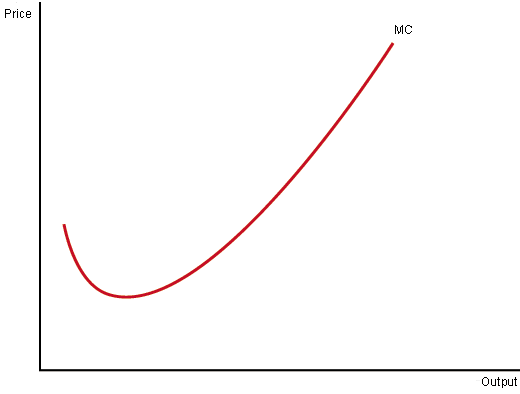
At the beginning of the curve, the marginal cost gradually decreases. This is because factors of production are utilized more efficiently as the company produces more. However, as production continues to increase, the marginal cost will begin to rise. This is because factors of production start to become scarcer and more difficult to utilize.
3. Example of Marginal Cost in a Business
A cookie manufacturing company has a fixed cost of 100 million VND and a variable cost of 10,000 VND for each cookie produced.
- If the company produces 100 cookies: the total cost will be 100 million VND + (10,000 VND * 100 units) = 200 million VND. The marginal cost of the 101st cookie is 10,000 VND (which includes the cost of raw materials, labor, and other variable costs).
- If the company sells each cookie for 15,000 VND: the revenue will be 15,000 VND * 100 units = 1,500 million VND. The marginal revenue of the 101st cookie is 15,000 VND (equal to the selling price of the cookie).
Since marginal revenue > marginal cost, if the company produces the 101st cookie, it will likely make a profit. This demonstrates the importance of analyzing marginal cost. A manager who understands marginal cost can help the business make optimal business decisions and achieve its goals.

4. Mistakes to Avoid When Analyzing Marginal Cost
The time factor is not included in marginal cost:
Marginal cost is the additional cost incurred when producing one more unit of a product. However, marginal cost can change over time. For example, variable costs may increase due to inflation. Therefore, when analyzing marginal cost, it is necessary to consider the time factor.
Not accounting for fixed costs:
Marginal cost only considers variable costs. Fixed costs are costs that do not change with production volume. However, fixed costs are also an important factor to consider when making business decisions.
Not considering other factors:
Marginal cost can be affected by factors other than production scale, such as production technology, the market, etc. Therefore, when analyzing marginal cost, it is necessary to consider other factors that may affect costs.
Not using marginal cost to make decisions:
Marginal cost is a useful tool for making business decisions, so managers need to use it carefully to make accurate decisions. Marginal cost is just one of many factors to consider when making business decisions. Other factors to consider include market demand, competitiveness, etc.

5. Top 5 Effective Ways to Reduce Marginal Cost
5.1. Optimize the Production Process
Optimizing the production process is the most effective way to reduce marginal cost. This can be done by improving the efficient use of raw materials, labor, and machinery. Some ways to optimize the production process include:
- Using advanced production tools and techniques
- Increasing automation
- Minimizing waste
- Optimizing the supply chain
5.2. Find Cheaper Suppliers
Raw material costs are a large part of marginal cost. Therefore, finding cheaper suppliers can help businesses save a significant amount of money. When searching for suppliers, businesses need to pay attention to product quality, service, and delivery time.
5.3. Increase Labor Productivity
Labor productivity is a measure of labor efficiency. Increasing labor productivity can help businesses reduce labor costs, thereby reducing marginal cost. Some ways to increase labor productivity include:
- Improving work processes
- Providing better tools and equipment
- Training and developing employees
- Using technology to automate tasks
- Creating an effective work environment
5.4. Minimize Unnecessary Costs
Review the company’s list of production costs and identify any unnecessary or wasteful expenses. This includes eliminating or reducing non-essential projects, saving energy and resources, and cutting unnecessary administrative costs.
5.5. Increase Investment in Modern Technology
Modern technology can help businesses improve production efficiency and reduce costs. Some modern technologies that can help reduce marginal cost include:
- Automation systems
- Inventory management systems
- Production management systems
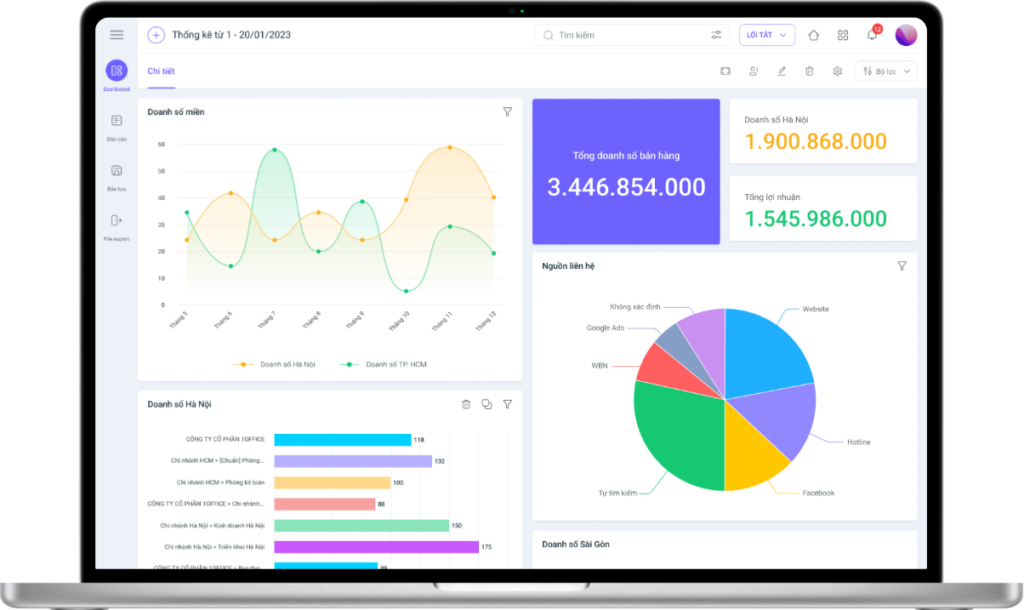
1Office CRM – A software that solves all the above problems, helping businesses manage the purchasing and sales process, manage inventory (exports, imports, stock),… along with many other smart integrated features. Get a trial of the 1Office CRM Sales Management feature today for a completely free consultation and support.
6. How Does Marginal Cost Differ Across Business Models?
Marginal cost is not the same across different business models. Each industry and type of business will have a different cost structure, leading to variations in how marginal cost is calculated and its impact on profit. Understanding this specificity helps businesses develop appropriate pricing, production, and cost optimization strategies.
Manufacturing businesses
- Characteristics: Marginal cost mainly comes from raw materials, direct labor, and machinery operating costs.
- Impact: As production volume increases, marginal cost usually decreases due to economies of scale. However, when optimal capacity is exceeded, marginal cost may rise again due to overloaded machinery and decreased labor productivity.
Trading businesses
- Characteristics: They do not produce directly but mainly buy and resell; marginal cost is associated with transportation, warehousing, and sales commissions.
- Impact: Marginal cost is more stable than in manufacturing but is heavily influenced by fluctuations in import prices and logistics costs.
Service businesses
- Characteristics: Marginal cost is often related to high-quality labor (consultants, engineers, experts).
- Impact: It is difficult to reduce marginal cost as it heavily depends on human expertise; it can only be optimized through technology or process standardization.
Digital technology businesses (SaaS, online platforms)
- Characteristics: Marginal cost is very low, nearly zero, once the digital product is created (e.g., software, online courses).
- Impact: Each new customer does not significantly increase costs, resulting in very high profit margins. However, the initial costs (R&D, infrastructure) are large.
Comparison table of marginal cost by business model:
| Business Model | Marginal Cost Characteristics | Key Impact on Business |
|---|---|---|
| Manufacturing | Fluctuates with production volume, decreases with economies of scale | Determines production capacity and selling price |
| Commerce | Depends on import & logistics costs | Supply chain optimization |
| Services | Tied to high-quality labor costs | Difficult to reduce, requires process optimization |
| Digital Technology (SaaS) | Very low, near zero after product creation | Extremely high profit margin |
Marginal cost has unique characteristics in each business model. Manufacturing businesses need to focus on process optimization to reduce costs; commerce focuses on logistics and supply chains; services need to improve labor productivity; and digital technology leverages low marginal costs for rapid expansion. Understanding these differences helps businesses choose appropriate development and pricing strategies, ensuring sustainable profits.
7. How do marginal cost and business profit differ?
In financial management, marginal cost plays a particularly important role because it is directly related to the level of profit a business can achieve when increasing output. If a business understands and controls marginal cost well, decisions on product pricing, production, or scaling will be more accurate and effective.
When marginal cost < product selling price
- The business has a positive marginal profit on each product unit.
- Increasing output will help increase overall profit.
- This is a sign that the business should continue to expand production if there is still market demand.
When marginal cost = product selling price
- Marginal profit is 0 → producing more does not create added value.
- This is often the marginal break-even point, and businesses need to consider it before increasing output.
When marginal cost > product selling price
- Each product made will cause the business to incur further losses.
- This is a warning to stop expanding production, optimize processes, or restructure costs.
Illustrative example:
- A shoe manufacturing company sells shoes for 500,000 VND/pair.
- When output is low, the marginal cost is only about 300,000 VND/pair → each pair brings in 200,000 VND in profit.
- When output reaches peak capacity, the marginal cost increases to 480,000 VND/pair → marginal profit is close to 0.
- If production is pushed further, the marginal cost jumps to 520,000 VND/pair → the business starts to incur losses.
- This example shows that maximum profit is achieved at the point where marginal cost is approximately equal to the selling price.
Significance for businesses:
- Helps determine the optimal output to achieve maximum profit.
- Provides an important basis for product pricing strategy.
- Supports businesses in financial forecasting and production planning.
The relationship between marginal cost and business profit acts as a guiding principle for production and business activities. By managing marginal cost effectively, a business not only ensures a stable profit level but also knows when to stop, avoiding the trap of expanding production at a loss.

8.1. Relationship between marginal cost and average cost
Marginal cost is the additional cost incurred when producing one more unit of a product. Average cost is the cost of one unit of a product, calculated by dividing the total cost by the number of products produced.
The relationship between marginal cost and average cost depends on the law of diminishing marginal productivity. This law states that when one factor of production is added to a fixed amount of other production factors, the marginal output will eventually decrease.
- When marginal cost is lower than average cost, the average cost will decrease.
- When marginal cost equals average cost, the average cost reaches its minimum value.
- When marginal cost is greater than average cost, the average cost will increase.
8.2. Relationship between marginal cost and marginal benefit
Marginal benefit is the additional benefit gained from producing one more unit of a product. The relationship between marginal cost and marginal benefit is demonstrated by the law of diminishing marginal benefit. This law states that when one factor of production is added to a fixed amount of other production factors, the marginal benefit will eventually decrease.
- If the marginal benefit is greater than the marginal cost, the business will profit from producing an additional product.
- If the marginal benefit equals the marginal cost, the business will break even on the additional product.
- If the marginal benefit is less than the marginal cost, the business will incur a loss on the additional product.
9. Frequently Asked Questions
How does marginal cost differ from average cost?
Marginal cost is the additional cost of producing one more unit of a product. Average cost, on the other hand, is the average cost per unit across the entire output.
Why is marginal cost important when deciding to increase production volume?
Because it helps businesses determine if producing more is still efficient. If the cost to make an additional unit remains reasonable, the business can consider increasing its production volume.
How does marginal cost affect the selling price?
Marginal cost helps businesses determine the minimum price at which to sell an additional product without incurring a loss. This is a crucial basis for making short-term pricing decisions.
What should a business do when marginal cost is higher than marginal revenue?
The business should reconsider increasing production, as producing more may no longer be profitable. Instead of continuing to expand, it should review its costs, processes, or selling price.
When should a business use software to track marginal cost?
A business should use software when it has multiple product lines, numerous expenses, and needs to track data faster and more accurately. If you want to manage costs, revenue, and business performance on a single system, you can check out the 1Office expense management software.
—————
We hope that through this article shared by 1Office, managers can better understand what marginal cost is and how to apply it to make business decisions or establish suitable strategies for their companies. We wish your business success
















