


 12/05/2026
  568 views
Measuring business performance is a monthly or annual activity that plays an essential role for every business. Among them, ARR and MRR are the two most important metrics that need to be measured accurately and carefully. So, what are ARR and what is MRR? What do businesses need to do to optimize these two metrics? Let’s find the answers with 1Office in the article below!
Mục lục
I. What are ARR and MRR? The difference between ARR and MRR metrics
1. What are ARR and MRR?
ARR is an abbreviation for the phrase Annual Recurring Revenue. ARR is understood as the total expected revenue a business will collect within one year. The ARR metric is a figure that businesses can fully predict due to its stable nature.
So, what is MRR? As we know, to get annual revenue, businesses need to measure from a smaller unit, which is Monthly Recurring Revenue, or MRR.
In business monitoring and evaluation, determining monthly and annual recurring revenue helps business managers/CEOs grasp the effectiveness and quality of the business strategy being applied, thereby gaining an overview and making appropriate decisions to develop the strategy.
Currently, most businesses apply the measurement of monthly and annual recurring revenue to evaluate business performance. Examples include SaaS software companies or those using the Subscription Business Model (operating on a subscription-based model).
2. The difference between MRR and ARR metrics
After answering the question of what ARR and MRR are, it’s easy to see that the fundamental difference between monthly recurring revenue and annual recurring revenue is the measurement period. Besides that, ARR and MRR also have differences in their objectives and the benefits of calculating them.
Specifically:
| Criteria | MRR | ARR |
| Calculation Period | Calculated monthly | Calculated annually |
| Calculation Objective | To help businesses regularly monitor and understand the short-term progress of their business operations. | To track the effectiveness of the business strategy and understand long-term performance. |
| Benefits of Measurement | Helps CEOs/managers get a regular overview and evaluate the effectiveness of the business strategy in the short term. | Evaluates the entire business strategy in the long term. It also supports CEOs in innovating business methods for further growth. |
II. 3 Reasons Why Businesses Need to Measure MRR and ARR Metrics
After understanding what ARR and MRR are, a question arises: why is it necessary to measure these metrics in business operations? Here are 3 specific reasons:
- Businesses calculate ARR and MRR metrics to get an overview of their growth rate
Monthly recurring revenue and annual recurring revenue are the two most optimal measures of a company’s growth rate due to their stability and, especially, their ability to predict business performance.
By comparing ARR and MRR figures over several months or years, managers and leaders can answer the question of whether the current business strategy is on the right track.
- ARR and MRR help businesses measure the effectiveness of their business model
As mentioned above, for businesses that operate on a subscription basis or provide software services, ARR and MRR are two powerful metrics for managers to evaluate the effectiveness and quality of their current business model. If the effectiveness is low, it means the model is not suitable, and the business needs to move in a different direction.
- ARR and MRR help businesses forecast profits effectively
Not only do they help businesses evaluate the effectiveness of their business strategy, but recurring revenue metrics also help managers make nearly accurate profit forecasts.
Specifically, a business can determine its sales revenue over a certain period. Then, by subtracting total costs from that revenue, they can calculate the monthly or annual profit.
III. The Most Accurate Formulas for Calculating MRR and ARR
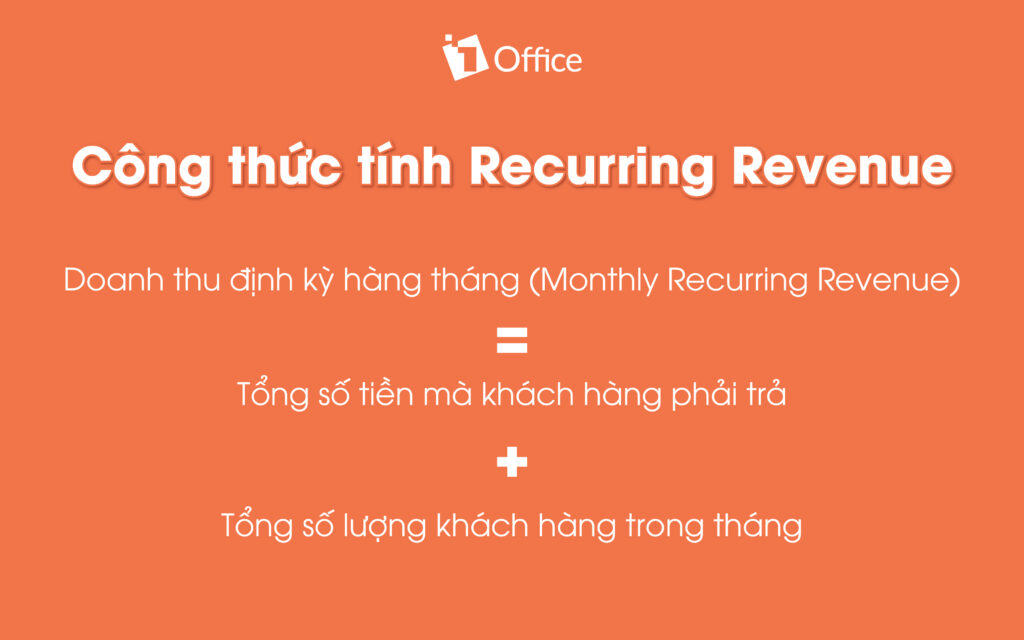
1. Formula for calculating Monthly Recurring Revenue (MRR)
| MRR = Amount paid per customer x Total number of customers in a month |
For example:
Company A’s software service is provided to customers at a price of $50/subscription. And there are a total of 100 customers who subscribe to use this software service package in 1 month.
=> Company A’s MRR = 100 * $50 = $5000
2. Formula for calculating Annual Recurring Revenue (ARR)
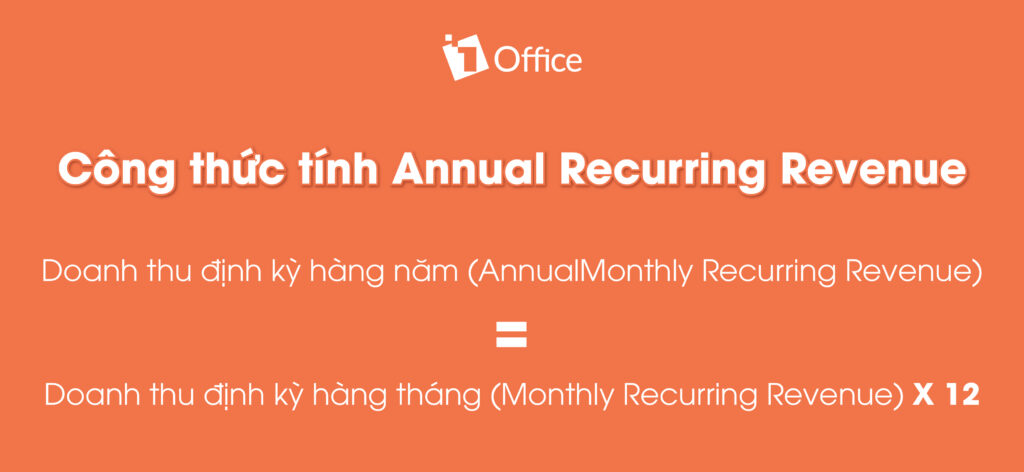
From the monthly recurring revenue formula, managers can easily calculate the annual recurring revenue using the formula:
| ARR = Monthly Recurring Revenue * 12 |
For example:
Company A’s monthly recurring revenue is $5,000 as calculated in the example above. Therefore, the annual recurring revenue is: ARR = $5,000 * 12 = $60,000
By applying these 2 fairly simple formulas, businesses can easily measure ARR and MRR metrics for specific periods to evaluate their business performance.
And as we all know, maximizing profit is the ultimate goal for every business. The principle of profit optimization is to increase revenue and reduce costs. That is why MRR and ARR metrics are always closely watched, and managers are always looking for ways to optimize them.
So, what are the ways to optimize monthly and annual recurring revenue metrics? Let’s find the answer in the next section.
IV. Revealing 5 effective ways for businesses to optimize MRR and ARR
In reality, there are many methods to help businesses optimize recurring revenue. However, not all businesses have the necessary and sufficient conditions to implement all of those methods.
The 5 ways to optimize recurring revenue shared below are the most common and highly feasible methods for all business models. Therefore, managers can select and implement the method that is most suitable for their business.
1. Reduce CAC costs
CAC is an abbreviation for Customer Acquisition Cost. This is the amount of money a business must invest and pay for the necessary expenses to acquire a customer.
In marketing and business operations, CAC is also an equally important metric for evaluating and measuring the quality of business and marketing campaign execution.
Customer acquisition costs include items such as:
- Payments for advertising, marketing, and sales activities
- Investment costs for software serving marketing campaigns
- Expenses for printing, social media, press, etc.
- Support allowances for the staff team
- Costs for renting venues, inviting speakers, and logistics for organizing events (if necessary)
Reducing customer acquisition costs is considered the most effective way to optimize recurring revenue, as this cost reduction is entirely within the business’s control.
To do this, businesses need to invest more heavily in employee expertise rather than spending too much on promotional activities. Because building and maintaining customer relationships is a necessary skill for the sales team, and the marketing team is responsible for attracting customers. When a business can optimally utilize its resources and develop Inbound Marketing in the right direction, the customer acquisition cost will certainly decrease significantly.
| Read more: What is Customer Acquisition? The Most Effective Method to Optimize Customer Acquisition Cost |
Note:
Optimizing customer acquisition cost is a fundamental step for businesses to increase monthly and annual recurring revenue. Based on CAC, managers can determine more suitable next steps:
- If the CAC is high, the business needs to review its business strategy; there is certainly an unsuitable point that needs to be replaced.
- If the CAC is low, business results improve, attracting more customers while maximizing profits.
2. Find ways to increase the average order value
The average order value is also known as AOV (Average Order Value). This is the average amount a customer pays in each transaction with the business, such as purchases, contract signings, service package subscriptions, etc.
Finding ways to increase the average order value means the business needs clever methods to encourage customers to purchase/subscribe to higher-priced products/service packages or persuade them to buy more products or subscribe to additional service packages in a single transaction.
Consequently, monthly and annual recurring revenue will also improve, and an increase in AOV directly impacts the optimization of ARR and MRR metrics.
So, what methods can businesses apply to increase the AOV?
- Build and optimize promotional packages that accompany products/services
- Regularly update customers with discount information
- Provide services that create customer loyalty, such as creating membership cards, upgrading cards based on purchase levels, etc.
By using these methods, businesses can attract more customers. Combined with improving product/service quality, the average order value will certainly be enhanced.
| Read more: What is AOV? 7 ways to optimize AOV to 3X your sales |
3. Optimize Customer Lifetime Value (CLV)
In business, the term Customer Lifetime Value (CLV) refers to the total value a customer brings to a company over the entire duration of their relationship. This is another key metric businesses can use to optimize ARR and MRR.
CLV is a metric that measures the total value a business achieves by building and maintaining mutually beneficial relationships with its long-term customers. The current reality shows that many businesses focus too much on attracting new customers and forget that it is the long-term, loyal customers who create long-lasting value for their business.

Optimizing customer lifetime value is crucial and relatively easy to implement. For existing customers, businesses don’t need to spend excessively on product promotion or marketing. Since they are already long-term users, the value they generate can be immense, provided the business can build trust and deliver sustainable benefits.
Therefore, a larger base of long-term customers increases a company’s ability to optimize recurring revenue while also saving costs.
To optimize the CLV metric, businesses need to:
- Apply the kaizen method to research and continuously improve product/service quality to meet customer needs
- Optimize sales and customer care services
- Provide diverse and positive customer experiences
- Utilize Email Marketing to build relationships through check-in emails, providing information, and sharing useful content
4. Maximize Upselling and Cross-selling
Upselling and cross-selling are two effective revenue-generating methods frequently used by the sales teams of many large enterprises.
Upselling is the practice of using offers and consultations to encourage customers to purchase an additional product or subscribe to another service package of equal or greater value than their previous purchase.
Example:
Encourage customers to subscribe to a software solution with a higher-priced feature package that is currently on special offer and includes more features.
Cross-selling is encouraging customers to purchase other related products/services in addition to their initial purchase, based on the customer’s stated needs and the seller’s advice.
When customers are inclined to upsell or cross-sell, the order value certainly increases, and recurring revenue is optimized as a result.
5. Apply Technology to Optimize Sales Operations
Today, with the explosive growth of technology and the trend of convergence between digital technology and business models in all fields from fashion and cuisine to construction, applying software solutions to optimize business operations is a popular and wise choice.
Instead of having to store customer records and track business performance manually, inaccurately, and rigidly as before, now thanks to CRM sales management software, sales teams can fully leverage customer potential, optimize the consultation and customer care process, and evaluate and improve business strategies to effectively boost revenue.
Through this article, we hope to have clearly and comprehensively explained the basics of ARR and MRR, the formulas for calculating these recurring revenue metrics, and the most effective methods for optimizing revenue.
And to optimize revenue and maximize profits in a fiercely competitive market, more than 5,000 large enterprises have chosen to implement the 1Office CRM customer management software and have achieved success. With features for managing customer care, sales activities, and operating and evaluating the effectiveness of marketing campaigns, 1Office CRM has ushered in a new era of digital business, where enterprises can optimize management and sales tracking on a single platform.
For more details, please contact:
- Hotline: 083 483 8888
- 1Office Fanpage: https://www.facebook.com/1officevn
- YouTube Channel: https://www.youtube.com/c/1OfficeNềntảngquảnlýtổngthểDoanhNghiệp
















