


 11/05/2026
  86 views
Building an effective human resource management process is always a top goal for HR professionals. To set up an optimal HR system, the first step is to master the human resource management process and know how to use supporting tools. If your business doesn’t yet have a professional and effective employee management process chart, let’s dive into the article below.
Mục lục
- 1. What is a human resource management process? Why is it important for businesses?
- 2. The role of an HR management chart in business operations
- 2. Steps to build a human resource management process flowchart in a business
- 3. How to Address Employees’ Lack of Respect for Ineffective Leadership?
- 4. How to Manage Talented Employees with Big Egos?
- 5. How to Handle Employees Who Are Frequently Late?
- 6. How to Manage Introverted Employees?
- 7. Build an effective human resource management process with 1Office
1. What is a human resource management process? Why is it important for businesses?
The human resource management process is a process of recruiting, selecting, and attracting employees, providing orientation, training and development, and evaluating employee performance. From there, decisions are made on compensation and benefits, motivating employees to work. Depending on the business model, this process will be built using different methods, which will be detailed in the following sections of the article.
>> See more useful articles:
2. The role of an HR management chart in business operations
An HR management chart is an important document that helps businesses:
- Provide a general overview
The chart allows leaders and HR staff to easily grasp the organizational structure, positions, and roles of each department. Instead of reading multiple reports, just looking at the chart provides an understanding of the sequence, objectives, and connections between tasks. - Clearly define tasks and progress
Employees know exactly which step of the process they are in and what tasks need to be completed, allowing them to work more effectively and cohesively. - Control and optimize the process
It helps managers monitor HR activities, identify strengths and weaknesses, and promptly adjust plans to improve operational efficiency.
| >> Read more: 7 steps to standardize the HR management process according to ISO standards |
2. Steps to build a human resource management process flowchart in a business
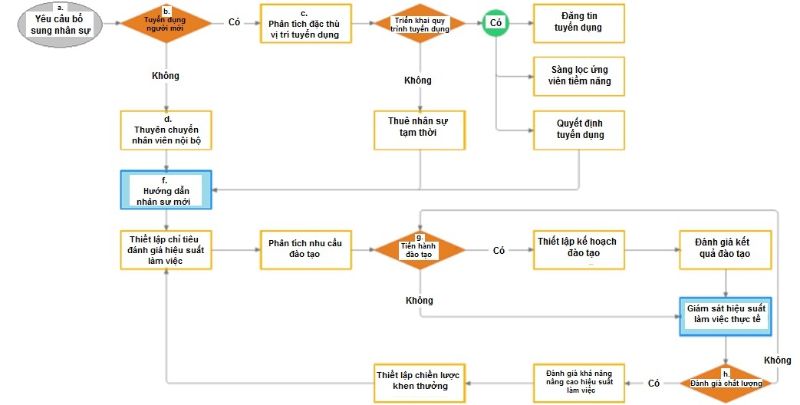
Human resource management is one of the most important tasks in the business management process. This is also a difficult problem that most managers face. Depending on the scale and organizational structure, each company will have a different management process. Below is a general human resource management process flowchart for businesses and the basic steps to build a human resource management process that businesses should apply.
Step 1: Human Resource Planning
Human resource planning (HR Planning) is the activity of identifying and managing a business’s recruitment needs. This process includes calculating human resources, forecasting future personnel needs and trends, and from there, building and implementing appropriate strategies. An effective human resource planning process requires the HR department to balance long-term and short-term personnel needs with business goals and the actual situation.
Step 2: Recruitment
This is the activity of finding and attracting qualified candidates to participate in interviews. The process begins with planning, identifying, and preparing methods to approach candidates. Through this, the HR department will post information on recruitment sites and simultaneously develop a salary and benefits system to retain and attract the most talented candidates.
Step 3: Employee Onboarding
Employee onboarding is an important step in the human resource management process to make them feel welcome and comfortable working in the new environment. To welcome employees on their first day, HR can organize a small party for new and existing employees to mingle, which is also a very warm way to welcome them. After that, introduce the rules, regulations, and departments so that new employees can grasp information about the various departments as well as the company’s corporate culture.

Step 4: Training
To help new employees quickly grasp information about the business, managers and the HR department need to prepare comprehensive documents for them. The training roadmap will vary depending on the employee’s position. In addition to professional training, employees need to be trained in soft skills to improve their conduct and attitude for better work performance.
Training is an ongoing process throughout an employee’s tenure, including internal training courses or providing funds for employees to attend extended training programs. Training activities and costs also need to be carefully planned, aligning with the employee’s development path within the company to meet the personnel needs of each period.
Step 5: Managing Employees During Probation
During the probationary period, the direct manager and HR need to cooperate closely to assess the employee’s potential, capabilities, and skills to determine if they are a good fit for the job. This helps in establishing a salary and bonus structure that corresponds to the employee’s performance and attitude.
Step 6: Periodic Performance Reviews
This is a crucial step that every individual, department, and especially the HR department, cannot overlook. Therefore, each department should use the ASK competency assessment model to accurately evaluate performance based on specific criteria, making it easier to track employee work progress.
As you can see, the human resource management process plays a vital role that directly impacts the company’s growth. However, manual HR management solutions are often inaccurate and inefficient when it comes to assessing employee competency. Therefore, finding a tool to digitize processes and manage personnel is essential. If your business is looking for a solution to build an HR management process, explore the content below.
3. How to Address Employees’ Lack of Respect for Ineffective Leadership?
In many businesses, the issue of employees not respecting their leaders is becoming more common, especially when superiors lack professional expertise or management skills. This leads to underlying conflicts, reduced productivity, and can even cause talented employees to leave the company. This is not just a personal issue, but a warning sign of flaws in the management system.
To handle this situation, businesses need to re-evaluate leadership competencies, implement management skills training programs, and create a two-way feedback mechanism to give employees a voice. For details on the causes, consequences, and specific solutions, you can read the article: What Should a Business Do When Employees Don’t Respect Ineffective Leaders?
4. How to Manage Talented Employees with Big Egos?
Many businesses have highly skilled employees who bring great value but also have big egos, making them resistant to feedback or management. Without a tactful approach, the business can suffer from internal disunity, reduced collaboration, and even the loss of top talent. This is a common challenge in modern human resource management.
To manage this effectively, managers need to clearly identify the value the employee brings while establishing boundaries and general principles to prevent them from overpowering the team. Combining smart delegation with constructive feedback will help the employee leverage their strengths while maintaining balance within the group. You can see a detailed analysis in the article: What to Do When You Have a Highly Skilled Employee with a Big Ego
5. How to Handle Employees Who Are Frequently Late?
Tardiness is one of the most common disciplinary issues in businesses. When the number of late employees increases, it not only affects individual performance but also fosters a mindset of “disregarding rules,” which undermines overall morale. Without appropriate measures, this can easily become a bad habit that drags down the company culture.
An effective approach often starts with identifying the root cause (whether it’s individual irresponsibility or a non-transparent timekeeping system), followed by a combination of reminders, disciplinary actions, and support to help employees change their habits. You can refer to the detailed guide in the article: What Should a Business Do About Frequently Late Employees?
6. How to Manage Introverted Employees?
Every business has introverted employees: they are quiet, hesitant to communicate, and dislike presenting in front of groups. This group is often highly focused, meticulous, and creative, but they can be easily undervalued due to their lack of proactive engagement. Without a suitable management approach, they might be overlooked within the team or fail to reach their full potential.
To effectively manage this group of employees, leaders need to create a safe environment for them to contribute ideas, assign tasks based on their professional strengths, and gradually encourage their participation in team activities. You can refer to the detailed article: A Strategy for Managing Introverted Employees to Help Your Business Thrive
7. Build an effective human resource management process with 1Office
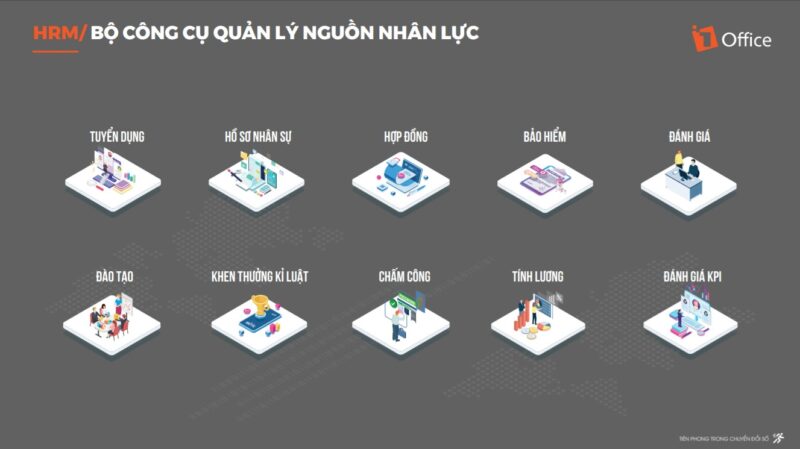
HRM Software – Human Resource Management is a human resource management toolkit within the 1Office comprehensive business management software. With many smart and outstanding features, the HR management software helps businesses manage the entire HR process from recruitment, profile management, timekeeping, to payroll quickly and conveniently, without having to use multiple cumbersome and complex software simultaneously.
Key features of the HRM module
-
Smart recruitment management: Create and send recruitment proposals directly on the software, with automatic approval notifications sent to relevant parties. The system provides instant report updates, helping managers evaluate the effectiveness of each recruitment channel and the performance of each specialist.
-
Centralized employee profiles: Store all employee information on a single platform, allowing for quick and accurate lookups and retrieval.
-
Timekeeping & payroll tracking: Manage timekeeping online, view payslips online, and synchronize data from all branches in real-time. Supports timekeeping via GPS location and automatically calculates payroll, with 24/7 bank transfers through partner banks.
-
Personnel change & competency assessment management: Update employee work status to track changes and devise plans to stabilize the workforce. Monitor competency development, assess progress each period to create suitable training plans.
-
Integration with other modules: Connects KPI data, sales figures, and other metrics to calculate payroll automatically, reducing errors and saving time compared to manual calculations.
The 1Office HRM software not only optimizes the human resource management process but also helps businesses save time and costs, improve operational efficiency, and retain talent. This is a comprehensive solution suitable for businesses of all sizes that want to manage their human resources professionally and sustainably
Register for a consultation: 083 483 8888 or click here
- For more details, please visit:
- Fanpage: https://www.facebook.com/1officevn/
- Youtube: https://www.youtube.com/channel/UCeTIRNqxaTwk0_kcTw6SxmA
















