What is the Pareto Principle (The 80/20 Rule)? How to Apply It in Business


The Pareto Principle, or the 80-20 rule in management theory, is an important principle. This idea was conceived by the Italian economist and sociologist Vilfredo Federico Pareto. In this article, we will explore the Pareto Principle and all the information related to this theory.
Mục lục
1. Overview of the Pareto Principle
The Pareto Principle, also known as the 80/20 Rule, is named after the famous economist Vilfredo Pareto. He discovered the Pareto Principle while studying the relationship between wealth and population in Italy.
He realized that 80% of the land in the country was owned by 20% of the population, a pattern that was repeated in many other countries. Notably, he also recognized that this principle could be applied to many different fields with high accuracy.
The Pareto Principle states that: 80% of consequences come from 20% of causes, indicating an unequal relationship between input and output. These percentages can vary slightly, such as 90/10, but the total always adds up to 100. Therefore, applying this principle to business management leads to the following observation:
- The Pareto Principle in business suggests that 80% of a given company’s profits typically come from just 20% of its customers.
- Business owners who use the 80/20 rule know that the best way to maximize results is to focus heavily on marketing projects for the 20% of the company’s most popular products.
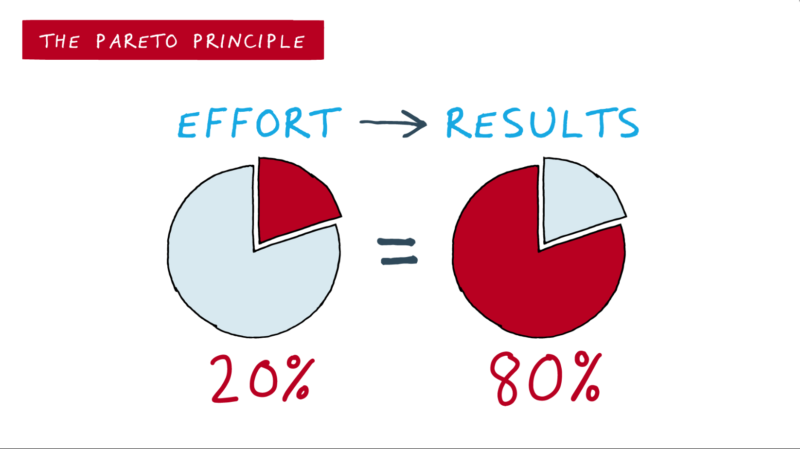
In marketing, a similar principle can be applied to show that about 20% of marketing methods yield 80% of your overall results.
Examples of the Pareto Principle:
- 20 percent of employees produce 80 percent of the company’s results.
- 20 percent of a given employee’s time produces 80 percent of their output.
- 20% of a company’s investments generate 80% of its investment returns.
| Read more about the effective continuous improvement theory: What is Kaizen? Examples and 6 Steps to Effectively Apply Kaizen in Business |
2. Pros and cons of the 80/20 Principle
2.1. Pros
When using the Pareto Principle, managers can easily gain benefits such as:
- Higher productivity
- Efficient energy use
- Better problem-solving skills
- Improved decision-making skills
- Can create maximum impact with the least amount of work
- Issues that need to be prioritized are more clearly identified
- Can break down work into manageable segments
- Can be informed about what needs to be fixed
2.2. Cons of using the 80/20 Principle
- Because it is not a mathematical formula or law but is based on observation, the Pareto principle may not be true in all cases
- Variations of the Pareto Principle can occur, for example, 30% of employers being responsible for 70% of sales, so the 80-20 rule is not always applicable.
- The 80/20 Principle only reflects past data and can be useful for planning, but it will not provide predictions for the future.
- The Pareto Principle’s focus on past data can sometimes cause managers to get stuck, preventing them from exploring and discovering new things.
For example: In business, this could mean focusing too much on improving sales from existing customers rather than exploring new markets or products.
| Learn more: How to manage your workload effectively to save time |
3. How to apply the 80/20 Principle in business
As a principle that serves the overall business management process, managers can apply the 80/20 Principle for specific objectives as follows:
3.1. Increasing productivity in the business
The 80/20 Theory is extremely useful for identifying which areas the business should focus on and which resources it should prioritize to achieve maximum efficiency. The increase in productivity is demonstrated through the following aspects:
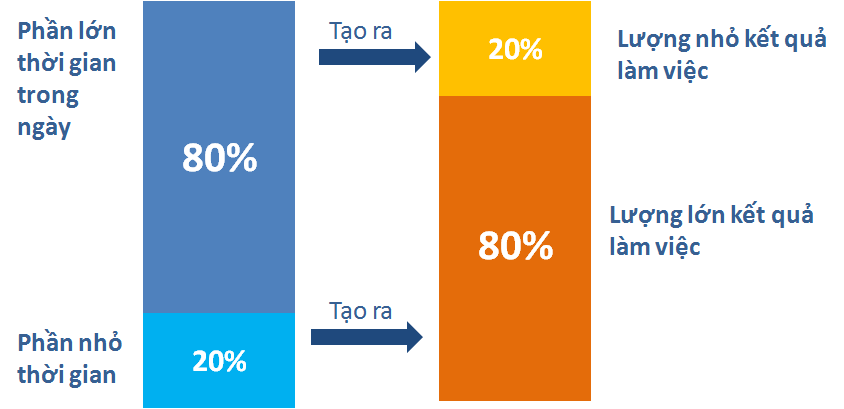
- Employees can prioritize their tasks to focus on the 20% of important tasks that generate 80% of the results.
- Identify the causes of inefficiency in the workplace.
- As a manager, you can use the 80/20 rule to identify the 20% of causes that lead to 80% of ineffective work and then take appropriate measures to address the issues causing the inefficiency.
For example:
- Distractions from social media
- Unskilled labor in their field or an unsuitable work environment.
| Discover 6 Methods to Increase Business Productivity – Successfully applied by 95% of businesses |
3.2. Increase profitability
In all types and fields of business, surveys and research have shown that approximately 20% of your sales staff generate 80% of sales. Increasing business profitability is demonstrated in aspects such as:
- Deciding whether to select the 20% of employees who generate the majority of sales to improve their skills, or to focus on the other 80% of employees who are struggling to bring in any sales.
- Identifying the 20% of products that bring in up to 80% of the company’s revenue to develop and enhance their value.
- Identifying which customer segments have generated the highest revenue, allowing the business to focus on pursuing potential customers and stop offering products that do not generate revenue for the organization.
3.3. Website optimization
The Pareto principle indicates that:
- 20% of the content on your website is attracting 80% of the overall traffic. Therefore, this is the key content that the business needs to focus on to serve website traffic.
- By focusing on high-traffic content, you not only help increase sales but also support your business’s growth potential.
- By building a business development strategy based on marketing projects that have proven to be effective, you can attract more attention to your business.
3.4. Identify and resolve issues
By using the 80/20 Theory for overall business management, the Pareto Chart is very useful for prioritizing problems so you can identify which issues have the greatest impact on the outcome of a given situation.
3.5. Improve customer service
Based on the Pareto principle, we can see that: 80% of customer complaints are related to 20% of a company’s products. Therefore, analyzing and correctly identifying these products can help you eliminate negative issues in the customer’s consumption experience. Additionally, analyzing a series of issues also helps managers identify which employees need to be addressed or handled.
| Learn more: What You Should Know About Customer Service |
4. Examples of Applying the Pareto Principle in Business
4.1. Peter Drucker
Just as the Pareto Principle highlights the vital 20%, Peter Drucker emphasized eliminating the trivial 80%. In his famous book, The Effective Executive, the management expert introduced the term “posteriorities” (the opposite of priorities) to indicate the things you should say “no” to because they yield few or no significant results.
4.2. Applying the Pareto Principle to Large Inventories
For inventory catalogs, applying the 80/20 rule helps you identify the 20% of goods that generate 80% of shipping and sales activities. From there, businesses can prioritize these items by implementing specific activities to boost product consumption.
4.3. Quality Control in the 80/20 Theory
Pareto charts are particularly useful in quality management and control. They show managers that 20% of the problems negatively impact 80% of the business’s processes. The chart can help you identify all the factors that combine to form a problem. You can also see which issues cause the most errors.
4.4. Sales and Marketing with the Pareto Principle
The Pareto Principle is highly relevant for Digital Marketing professionals. This is because they have access to data and analytics tools that provide detailed insights into their campaign performance. With this information, you can use the 80/20 rule to improve your digital marketing strategy. Knowing that 20% of your posts generate 80% of your traffic, identify which types of posts perform best. Then, design a content marketing strategy that incorporates more similar posts.
4.5. Occupational Health and Safety
A study by the Transportation Research Board’s Safety Committee showed that 20% of drivers are involved in 79% of all traffic accidents and 76% of all violations. Therefore, by clearly identifying the risk factors that can cause accidents, you can prevent the majority of violations from occurring.
Through this article, we have provided readers with a comprehensive overview of the Pareto Principle and its practical application in business operations. If you need any further information or answers, please contact us for a free consultation. Thank you!
For more detailed information, please see:
- Hotline: 083 483 8888
- Fanpage: https://www.facebook.com/1officevn/
- Youtube: https://www.youtube.com/channel/UCeTIRNqxaTwk0_kcTw6SxmA