


 10/05/2026
  165 views
To help a business grow and succeed in the market, managers need to set short-term and long-term goals. Short-term goals are the foundation and necessary stepping stones to achieving long-term goals. In this article, 1Office will explain more about the concepts, benefits, methods, and important considerations when building short-term and long-term goals for your business.
Mục lục
- 1. The difference between short-term and long-term goals
- 2. Short-term and Long-term Goals – The Starting Point to Lead a Business to Success
- 3. Methods for Building Short-term and Long-term Goals for a Business
- 4. Some Considerations When Building Short-term and Long-term Goals
- 5. Some examples of how to set short-term and long-term goals for each department
- 6. A Guide to Setting Short-Term and Long-Term Goals for Growth in the Manufacturing Industry
- 7. Example of Setting Short-Term and Long-Term Goals for a Manufacturing Business
- 8. When should a business review and adjust its goals?
- 9. 1Office Software – The Key to Helping Businesses Set Effective Goals
1. The difference between short-term and long-term goals
A goal is the destination a business aims for during its operations. However, to achieve larger and more ambitious business goals, managers need to establish both short-term and long-term goals.

1.1 What are short-term goals? When should you set short-term goals?
Short-term goals are objectives with a short deadline, typically ranging from a few months to a year. These goals often revolve around solving immediate issues to create stepping stones toward achieving long-term goals. Short-term goals can also involve completing a specific task, increasing sales, or improving product quality.
Short-term goals are often set to ensure that the business is operating effectively and meeting current demands. This is especially important for newly established companies, as they need to build a market presence and demonstrate the value of their products or services in a short period.
1.2 What are long-term goals? When should you set long-term goals?
Long-term goals are objectives set for a period of 3 to 5 years or more. These are major, crucial goals for a business, related to its future development. Long-term goals can include revenue growth, market expansion, building a major brand, or developing new products.
Long-term goals help a business aim for a more distant future, enabling managers to plan and develop long-term strategies to achieve them. They also help investors, partners, and customers get a clearer view of the company’s vision.
| >> Read more: What is planning? Effective business planning methods for enterprises |
2. Short-term and Long-term Goals – The Starting Point to Lead a Business to Success

2.1 Benefits of Setting Short-term Goals
Focus and Increased Work Performance: When specific short-term goals are set, employees will focus more on their work to achieve those goals in a short period. This helps increase work performance and improve product/service quality.
Easy Employee Performance Evaluation: With clear goals and specific deadlines, businesses can easily evaluate the performance of each employee and implement improvement measures if necessary.
Laying the Groundwork for Long-term Goals: Short-term goals are stepping stones to achieving long-term goals. Completing short-term goals helps the business stay on the right track and achieve long-term goals more easily.
2.2 Benefits of Setting Long-term Goals
Creating Direction and Developing Strategy: Long-term goals help businesses have a clear direction and plan for future development. As a result, business decisions will be made based on long-term goals, helping to increase consistency in financial reporting & synchronization in business operations.
Forecasting and Risk Management Capabilities: Long-term goals help businesses assess and forecast risks, thereby implementing effective risk management measures and protecting the business from potential risks.
Enhancing Creativity and Innovation: Long-term goals help businesses focus on researching, innovating, and developing new products/services to meet future customer needs. It helps the business achieve sustainable development and create a competitive advantage.
3. Methods for Building Short-term and Long-term Goals for a Business
3.1 The SMART Method
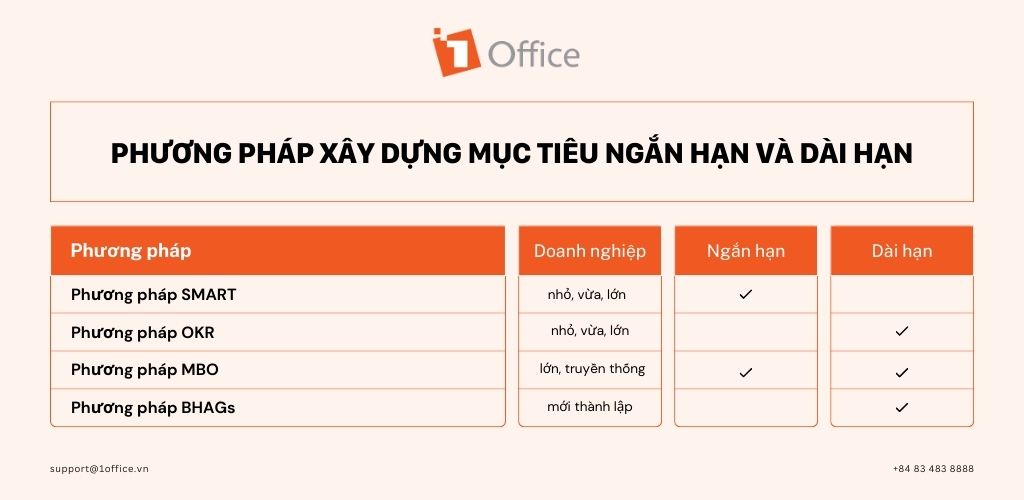
The SMART model is an acronym for 5 elements: Specific, Measurable, Attainable, Relevant, and Time-bound. This method requires goals to be clearly defined, measurable, achievable, relevant to the company’s overall objectives, and have a specific deadline. Therefore, the SMART goal-setting method is often used for setting short-term goals.
>> Read more: What is the Smart model? How to effectively apply SMART goals in a business
3.2 The OKR Method
OKR stands for Objective and Key Results. This method requires Objectives to be clearly and specifically defined and must be related to the company’s mission and goals. Key Results must also be measurable and achievable within a specific timeframe. This is a method often used by businesses for long-term goals because it focuses on the company’s strategic development direction and has a longer time horizon. Currently, the OKR method is being applied by many of the world’s leading technology companies such as Google, Intel, and Twitter…
>> Read more: What is the OKR method? The most accurate way to evaluate OKRs
3.3 The MBO Method
The MBO method is an acronym for Management by Objectives. This is a method that requires goals to be set in line with the company’s mission and strategy. MBO requires managers and employees to jointly participate in setting goals, monitoring progress, providing feedback, and improving the process. This method is often used in traditional businesses and large corporations, and is applied to both short-term and long-term goals. This is because it focuses on setting specific objectives for each employee or department within the business and managing by those objectives.
3.4 The BHAGs Method
The BHAGs (Big Hairy Audacious Goals) method requires goals to be clearly defined, bold, and challenging, yet still feasible and achievable. BHAGs often involve changing an entire industry or the way a business operates. In short, a BHAG focuses on setting a large, challenging, revolutionary goal that can be achieved over a period of 10 years or more. Therefore, this method is often used in newly established businesses and is primarily applied to long-term goals.
4. Some Considerations When Building Short-term and Long-term Goals
Define desires and the company’s development direction: To build short-term and long-term goals, managers need to have a clear and detailed business development plan. This requires managers to have a comprehensive overview of the market situation, financial situation, competitive landscape, and the company’s long-term development direction.

Set goals based on a suitable method: After establishing a development direction, the business needs to set specific goals for each stage. There are many methods for setting goals, such as SMART, OKR, MBO, BHAGs… managers need to choose the method that is appropriate for the company’s situation.
Arrange goals in order of priority: Arranging goals in order of priority helps the business easily decide on the necessary activities to achieve them. This arrangement also helps to clarify the priority of goals in cases where they overlap or conflict with each other.
Create a specific action plan: This plan needs to be presented in a detailed, clear manner, with specific timelines and resources. This helps focus resources and efforts on the most important activities, saving time and budget for the business.
Continuously monitor and evaluate goals: Monitoring and evaluating the goal implementation process helps managers identify the strengths and weaknesses of the plan, thereby making appropriate adjustments and improvements to achieve the company’s short-term and long-term goals.
| >> Read more: Analysis of 15 Business Performance Indicators Every Manager Needs to Know |
5. Some examples of how to set short-term and long-term goals for each department
Here are some specific examples of how to set short-term and long-term goals for each department in a business.
| Department | Short-term Goals | Long-term Goals |
| HR Department | Recruit 10 new employees within 3 months to meet the needs of other departments in the company. | Develop a training and talent development program to attract and retain talented employees in the company. |
| Sales Department | Increase sales revenue by 10% in the next quarter by focusing on developing new products and expanding the market. | Achieve sales revenue of 1 billion USD in the next 5 years by developing breakthrough products and expanding into international markets. |
| Accounting Department | Improve the cost management process and optimize expenses to reduce operating costs by 5% in the next quarter. | Ensure financial and legal standards are met to take the company public on the stock exchange within the next 3 years. |
| Production Department | Increase production productivity by 15% in the next month by optimizing the production process and training new employees. | Implement new production technology and improve product quality to meet market demands in the next 5 years. |
| Marketing Department | Increase website traffic by 20% in the next quarter by increasing advertising and developing engaging content. | Build a strong brand and enhance customer interaction on social media channels to increase sales revenue in the next 3 years. |
6. A Guide to Setting Short-Term and Long-Term Goals for Growth in the Manufacturing Industry
Are you a COO or CEO of a manufacturing plant, aspiring to lead your company to the top of the industry? Setting short-term and long-term goals is not just a guiding principle but also a lever to optimize processes, reduce costs, and conquer the international market.
-
Step 1: Assess the Current Situation to Build a Foundation
Analyze productivity, costs, and market trends (such as automation) using 1Office’s data analysis module.
Example: A furniture manufacturing company discovered through a 1Office report that raw material costs accounted for 40% of total expenses, providing a basis for setting cost optimization goals. -
Step 2: Set Short-Term Goals Using the SMART Method
Set specific, measurable, achievable, relevant, and time-bound goals, for example: increase production productivity by 15% in 3 months. Use 1Office to assign tasks (machine maintenance, employee training) and track progress through an intuitive dashboard.
Example: An electronic components factory reduced its product defect rate from 5% to 2% in 2 months thanks to automated reports on 1Office, saving 20% on inspection time. -
Step 3: Establish Long-Term Goals Using the OKR Method
Set ambitious objectives like becoming a top 3 furniture manufacturer in Southeast Asia by 2030, with Key Results: achieving 300 billion VND in export revenue, applying automation technology to 50% of production lines, and opening a new factory in Indonesia. 1Office supports project management, progress tracking, and legal document storage.
Example: A plastics manufacturing company used 1Office to manage its export goals, achieving 60% of its target revenue after 2 years. -
Step 4: Combine Other Methods (MBO, BHAGs)
Use MBO for management and employees to set goals together, such as increasing productivity by 15% next month (based on current context). With BHAGs, set bold goals like revolutionizing production with 3D printing technology by 2035. 1Office helps track progress and report effectively for both methods.
Example: A wooden furniture company uses MBO to improve short-term productivity and OKRs to guide its export strategy to Japan, all managed through 1Office. -
Important Notes
-
Prioritize in phases: Focus on improving short-term processes first, then target long-term technological innovation.
-
Rely on data: Use 1Office reports to ensure goals are achievable (e.g., don’t set a goal to reduce costs by 50% if the data only supports a 10% reduction).
-
Monitor continuously: Update progress weekly on 1Office to make timely adjustments.
-
Team collaboration: Ensure middle and senior management coordinate closely through 1Office’s communication module.
-
Read now: Top 10+ Business Management Software [ Latest 2026 ]
7. Example of Setting Short-Term and Long-Term Goals for a Manufacturing Business
A packaged food manufacturing company defines its goals on two levels, where short-term goals serve as the foundation for achieving long-term goals:
-
Short-term goal: In the next 3 months, optimize the production line to reduce the production time per batch from 3 days to 2.5 days, while increasing productivity by 15%. This activity helps the business shorten delivery times, reduce operating costs, and prepare production capacity for future export orders.
-
Long-term goal (BHAGs): By 2035, become the leading packaged food brand in Southeast Asia, exporting to at least 5 countries and achieving an annual revenue of 1,000 billion VND. Enhancing production capacity from the short-term phase is a prerequisite for meeting the standards and output demands of the international market.
Specific example: An instant noodle manufacturer sets a short-term goal to automate certain stages to reduce production time per batch by 10%. This helps increase the capacity to fulfill large orders, creating a stepping stone for the long-term goal of exporting to Thailand and Malaysia within 5 years, thereby enhancing its competitive position in the regional market.
8. When should a business review and adjust its goals?
Goals are only truly valuable when they remain relevant to the market context, internal resources, and the company’s development strategy. In reality, many businesses persist in pursuing outdated goals, leading to wasted resources and decreased team motivation. Reviewing and adjusting goals at the right time helps a business maintain flexibility and sustainable growth.
8.1. When the market fluctuates or a crisis occurs
The market always holds unpredictable fluctuations such as economic recessions, policy changes, supply chain disruptions, or global crises. During these periods, goals established based on the old context may no longer be feasible.
Adjusting goals helps businesses:
-
Prioritize preserving cash flow and resources
-
Shift focus from rapid growth to stability and adaptation
-
Reduce unnecessary pressure on the team
Instead of maintaining ambitious targets, businesses should review their goals to be more realistic and aligned with the new situation to ensure survival and recovery.
8.2. When goals are no longer aligned with available resources
A goal, even if well-constructed, becomes a burden rather than a motivator if it no longer aligns with available resources. Resource factors include:
-
Personnel (quantity, capability, engagement level)
-
Finances
-
Technology and management systems
When a business expands or downsizes, changes its organizational structure, or faces financial difficulties, maintaining old goals can lead to the team feeling overwhelmed or losing direction.
Reviewing goals in this case helps businesses:
-
Adjust expectations accordingly
-
Reallocate resources more effectively
-
Avoid the “chase goals at all costs” mentality
8.3. When the business changes its strategy
Strategy is the guiding principle for all business activities. When the strategy changes—for example, shifting market focus, changing the business model, restructuring the organization, or expanding into new areas—old goals will no longer reflect the correct development direction.
Reviewing and adjusting goals in this case helps to:
-
Ensure alignment between strategy and execution
-
Prevent departments from pursuing goals that are no longer a priority
-
Focus resources on new strategic goals
Goals should be seen as tools for implementing strategy, not as unchangeable elements.
8.4. When goals fail to motivate the team
A key sign that goals need adjustment is when the team lacks motivation, works passively, or is no longer concerned with results. The causes may stem from:
-
Goals that are too high, causing prolonged pressure
-
Goals that are too low, lacking challenge
-
Goals that lack meaning or are not tied to personal benefits
When goals no longer provide motivation, businesses need to:
-
Review their relevance and feasibility
-
Adjust how goals are broken down for each department and individual
-
Link goals to clear recognition and reward mechanisms
Effective goals are not just for measuring results; they must also inspire and drive action.
9. 1Office Software – The Key to Helping Businesses Set Effective Goals
1Office – the leading goal management and tracking tool for Vietnamese businesses. 1Office has a full range of features to digitize work processes and centralize management on a single platform.
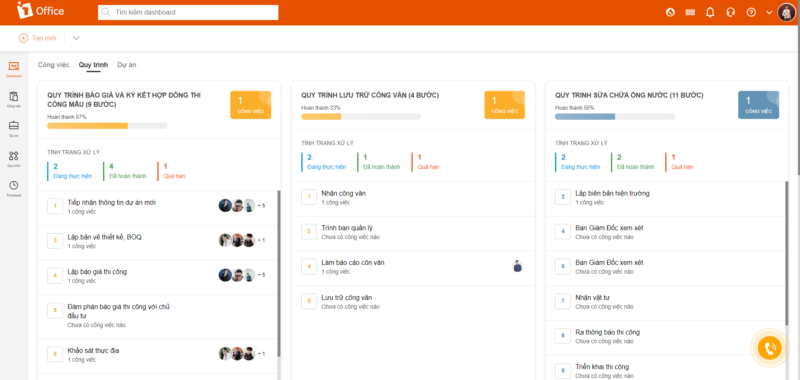
Using 1Office software, managers can easily and visually allocate and track the progress of set goals. Specifically, 1Office offers a full range of important features, including a Dashboard screen that provides an overview of processes and progress, reports by percentage of work completed, reports by workload completion rate, and reports by work item performed.
Thanks to these features, managers can evaluate goal achievement effectiveness based on quantitative and qualitative parameters, helping businesses achieve long-term and short-term goals more effectively and comprehensively.
As you can see, establishing short-term and long-term goals is an incredibly important and necessary process for a business. If your business is still struggling to choose the most suitable goal management software for its growth, contact 1Office for a consultation on effective business management solutions.
Contact information:
- Hotline: 083 483 8888
- Fanpage: https://www.facebook.com/1officevn/
- Youtube: https://www.youtube.com/channel/UCeTIRNqxaTwk0_kcTw6SxmA
















