


 10/05/2026
  21290 views
Human resource management is one of the key strategies that determines the success of an organization. To maintain stable operations, in addition to resources like finance, materials, and technology, businesses must proactively implement suitable human resource management strategies aimed at common goals.
Therefore, in addition to honing personnel management skills, managers also need to have a firm grasp of human resource management knowledge. This will also be the main focus of this article: Understanding human resource management and how to manage human resources effectively for a business.

Mục lục
- I. What is human resource management?
- II. Functions of human resource management
- III. Objectives of Human Resource Management
- IV. The Role of Human Resource Management
- V. Current Challenges in Human Resource Management
- VI. Metrics for evaluating the effectiveness of human resource management
- V. Human Resource Management Solution with 1Office
- Conclusion
I. What is human resource management?
Human resource management (HRM) is the process of utilizing people within an organization, encompassing all activities throughout the employee lifecycle: human resource planning; organizing, directing, and controlling activities to attract, utilize, and develop human resources to achieve the organization’s objectives.
This work requires managers to have a strategic vision aligned with the company’s business goals to plan and optimize the personnel management process.
>> See more: What is HRM software? The role and importance of HRM in business
II. Functions of human resource management
Human resource management is a very important activity for businesses, especially large-scale enterprises. The main functions of human resource management in businesses basically include:
1. Recruitment function
Recruitment is the process of identifying talent gaps in the company and finding the right people to fill those positions. There are four stages in the employee recruitment process:
- Job analysis – Through the job description, the HRM department is responsible for identifying the necessary requirements for a specific position the company is hiring for
- Sourcing candidates – This includes the various methods a company uses to attract potential candidates for a given position
- Screening and selection – This is the process of evaluating candidates based on skills, qualifications, abilities, and job-related experience to select the most promising ones
- Selecting the right candidate – Once the most suitable candidate has been chosen, the next step is to sign the contract and inform the candidate about the company’s policies so they have a clear understanding.

2. Training and development function
After investing time and money to hire new personnel, don’t let them stagnate in a single specialized role. Give them opportunities to develop new skills on the job, which will also help increase productivity for the entire business.
Training is also a crucial activity in motivating employees. A study shows that employees who develop new skills tend to be happier in their jobs. This is also a factor that contributes to increasing employee retention.
Training programs for employees can include:
- Job skills training
- Communication training
- Team-building activities
- Policy and legal training
3. Employee retention function
Human resource managers need to have suitable policies to retain and motivate employees to stay with the organization. Salary and benefits always have a significant impact on the work process and commitment to the organization, but they are not the only factors. 90% of employees have left their companies for the following reasons:
- Issues surrounding the job
- Conflicts with managers
- Not a good fit with the organizational culture
- A negative work environment
Try the professional HR software 1Office for free
III. Objectives of Human Resource Management
All management functions in a business, such as production management, financial management, etc., aim for specific goals. In particular, human resource management in a business aims for the following main purposes:
- Economic Objective: To help the business use its human resources most effectively, thereby increasing work efficiency and quality, and contributing to revenue growth.
- Social Objective: To meet the ethical and social requirements of the company and its employees. This includes legal issues such as equal opportunity and equal pay for equal work.
- Organizational Objective: To ensure the operational efficiency of an organization. Manage employee tasks transparently and effectively. This includes providing training programs, hiring the right number of employees for a given task, or maintaining a high employee retention rate.
- Functional Objective: To maintain the operations of the HR department within the organization. This means ensuring that all HR resources are allocated effectively and utilized to their full potential.
- Personal Objective: To support the personal goals of each employee. This includes providing opportunities for learning or career development as well as maintaining employee satisfaction.
IV. The Role of Human Resource Management
Human resource management plays a very important role in businesses. The main roles of human resource management are as follows:
Developing policies for retaining and nurturing human resources
As the department that directly manages all personnel-related issues, understanding the problems that need to be fixed, supplemented, maintained, or developed, human resource management plays a crucial role in building the company’s human resource policies.
Advising management
Human resource management is a useful tool for advising and proposing suitable plans and solutions for the business to handle existing personnel issues. Consequently, problems like staff shortages and failure to meet set goals will be effectively resolved, preventing any obstacles for the business.
A bridge between leadership and employees
Human resource management helps company leaders approach and learn about an individual or a department of employees when needed. This makes it easier for business leaders to make appropriate decisions and adjustments to maximize operational efficiency. Additionally, when employee information such as records, professional qualifications, and actual capabilities is well-understood, transfers and work assignments become simpler
It is clear that effective human resource management creates harmony among people in a collective, building an enthusiastic, dedicated, and long-term committed workforce. This, in turn, shapes the cultural identity of a more professional and reputable organization.
V. Current Challenges in Human Resource Management
In the context of a highly volatile labor market, human resource management is no longer just about recruiting, retaining, and compensating, but has become a strategic challenge. Below are the prominent challenges that most Vietnamese businesses are facing.
1. Difficulties in recruiting and retaining personnel
Businesses are facing increasing difficulty in finding suitable candidates, especially for positions that require high-level professional skills or practical experience. The reasons stem not only from fierce competition in the labor market but also from employees’ rising expectations regarding the work environment, income, and development opportunities.
Besides recruitment, retaining personnel is also a major challenge. Employees are willing to leave a company if:
-
They don’t see a clear development path
-
The compensation and benefits policy is not competitive
-
The corporate culture is not a good fit
This forces businesses to shift from a mindset of “hiring to fill positions” to “hiring right – retaining long-term – developing sustainably.”
2. Inconsistent work performance
A common reality in many businesses is a significant performance gap between individuals and departments. Some employees are highly effective, while others fail to meet expectations despite having the same working conditions.
The causes often stem from:
-
Unclear job objectives
-
Lack of a transparent performance evaluation system
-
Inefficient task assignment and resource allocation
When performance cannot be measured accurately, it is difficult for businesses to make the right decisions about training, transfers, or compensation, leading to a waste of human resources.
>> Suggestion: Top most effective human resource management methods for 2026
3. Lack of data in human resource management
Many Vietnamese businesses still manage human resources manually or have data scattered across different systems. This leads to:
-
Inconsistent personnel data
-
Difficulty in consolidating, analyzing, and making decisions
-
Human resource management relying heavily on intuition
The lack of data makes it difficult for the HR department to prove its strategic role to the leadership, while also reducing the ability to forecast and plan for long-term human resources.
4. Rising personnel costs
Personnel costs include not only salaries but also:
-
Recruitment costs
-
Training costs
-
Benefits and operational costs
In a context where revenue is not increasing proportionally, the pressure to optimize personnel costs becomes a major challenge. Businesses need to find a balance between controlling costs and maintaining employee motivation, otherwise they will easily fall into a cycle of cutbacks and declining performance.
5. Managing remote and multi-generational workforces
The rise of flexible work models and a multi-generational workforce (Gen X, Gen Y, Gen Z) presents new demands for human resource management. Businesses must:
-
Ensure work performance when employees are not working directly at the office
-
Adjust management styles to suit each generation
-
Maintain corporate culture in a distributed work environment
Without the right tools and processes, businesses can easily lose control over work efficiency and employee engagement.

VI. Metrics for evaluating the effectiveness of human resource management
To manage human resources effectively, businesses need to measure with data rather than relying solely on perception. Below are important HR Metrics that help accurately assess the effectiveness of human resource management.
1. Employee Turnover Rate
The employee turnover rate reflects the stability of the workforce. This metric helps businesses:
-
Assess employee retention capabilities
-
Identify issues in the work environment or compensation policies
-
Estimate employee replacement costs
A high turnover rate over a long period is a warning sign of instability in human resource management.
2. Cost of Recruitment
The cost of recruitment includes all expenses to hire a new employee, from advertising and interviewing to initial training. Tracking this metric helps businesses:
-
Evaluate the effectiveness of recruitment channels
-
Optimize the recruitment process
-
Reduce costs while ensuring the quality of personnel
A high cost of recruitment with low-quality personnel is a sign that the recruitment process needs to be reviewed.
3. Labor Productivity
Labor productivity reflects the value created by personnel compared to the resources invested. This is a crucial metric that helps leadership assess the contribution of human resources to business results.
Tracking labor productivity by department or individual helps businesses:
-
Identify performance bottlenecks
-
Adjust personnel allocation
-
Build fairer compensation policies
4. Employee Engagement Level
The engagement level reflects the attitude, morale, and commitment of employees to the company. Highly engaged employees often:
-
Work more proactively
-
Tend to stay with the company long-term
-
Contribute positively to the corporate culture
Businesses can measure this metric through internal surveys, regular feedback, or employee experience assessments.
5. ROI on Employee Training
Training ROI measures the effectiveness of investment in employee training and development activities. This metric helps businesses answer the question: does training truly bring value?
Tracking training ROI helps:
-
Prioritize effective training programs
-
Eliminate formalistic training activities
-
Align training with business goals
V. Human Resource Management Solution with 1Office
In the past, personnel management was primarily handled through traditional paperwork, documents, or Excel files. However, for large enterprises with hundreds or thousands of employees, how can managers keep track of every single activity of each employee? On what basis can a manager know if their staff is underperforming, overloaded with work, or handling a workload that doesn’t match their capabilities?
Employee management software 1Office is an effective solution that not only helps businesses keep up with the digital transformation trend but also optimizes resources, saving maximum time and operational costs.
With 1Office, businesses can manage and automate all HR-related processes such as recruitment, profile management, timekeeping, and payroll calculation quickly and easily on a single platform.
1. Recruitment Management
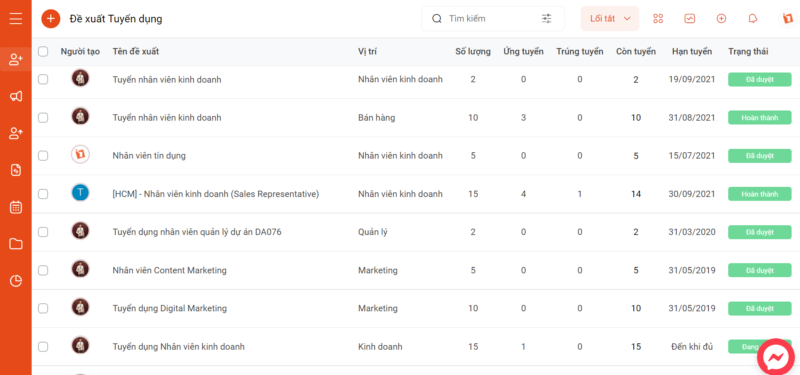
- Create recruitment proposals on the system. Relevant parties will immediately receive notifications for approval.
- Integrates with the recruitment Email feature, automatically updating candidate profiles to sync with the software.
- Stores the entire history of candidate interactions and unsuccessful CVs to plan for nurturing and future campaigns.
- Automatically updates real-time reports for managers to evaluate the effectiveness of each recruitment channel as well as the performance of recruitment specialists
2. Employee Profile Management
- Digitize all employee information (contracts, insurance, working hours, etc.), storing data centrally on the employee profile management system. Managers can look up and retrieve information quickly and easily.
- Keep track of employee work status, helping managers get a better overview of personnel fluctuations to devise stabilization plans.
3. Effective Timekeeping Management
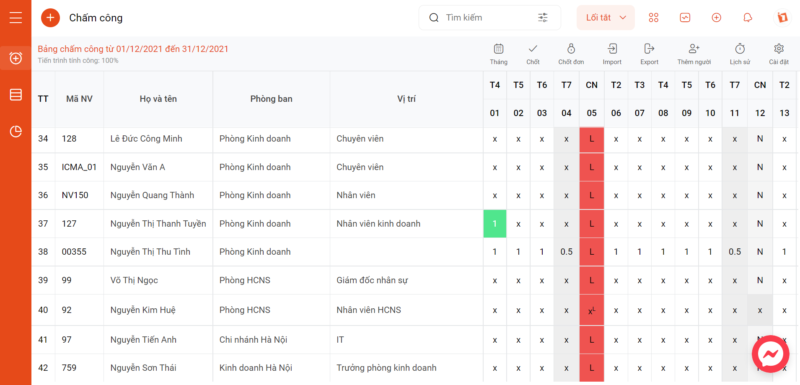
- Connect and synchronize time clock data from all branches with actual clock-in/out times.
- GPS location-based timekeeping feature. Simply set up smart GPS check-in locations, and users can easily clock in right on their smartphones.
- Track employee attendance details and view online payslips, saving managers maximum time.
4. Payroll Management
- Digitize all administrative forms, automatically updating them to the timesheet to generate payroll.
- Connect with other modules like KPI, sales, and leave requests to consolidate data for payroll calculation, shortening the time-consuming and error-prone manual process.
- Finalize and approve payroll quickly online. Businesses can execute salary payments 24/7 directly on the software via MB Bank.
Conclusion
A business, no matter how abundant its financial resources, rich its material resources, or modern its machinery, will become useless if it doesn’t know how to manage its human resources properly. Besides applying a suitable HR management model, building a human resource management software system is one of the optimal solutions to help businesses optimize operating costs and manage personnel more professionally.
If you are a manager looking for an effective human resource management solution for your business, then 1Office management software is the tool for you.
For more details, please contact:
Hotline: 083 483 8888
Fanpage: https://www.facebook.com/1officevn
YouTube Channel: https://www.youtube.com/c/1OfficeNềntảngquảnlýtổngthểDoanhNghiệp
















