


A Guide to Calculating Salary by Coefficient: Easy to Understand and Most Accurate


One of the top concerns for both employees and businesses is the salary coefficient, as it directly affects the legal rights and benefits of each individual. Although salary grades and coefficients are adjusted to suit objective conditions, there is still a fixed and accurate calculation formula. In this article, we will share with you the easiest and most accurate way to calculate salary based on the coefficient.
Mục lục
- 1. Overview of Salary Coefficients
- 2. The Most Accurate Way to Calculate Salary Based on the Salary Coefficient
- 3. Legal principles governing coefficient-based salary calculation
- 4. What factors affect the salary coefficient?
- 5. Automated salary calculation solution with 1Office software
- 6. Frequently Asked Questions about coefficient-based salary calculation
- 7. Conclusion
1. Overview of Salary Coefficients
-
What is a salary coefficient?
The basic salary coefficient is an index that reflects the difference in salary levels between different job positions and ranks based on qualifications and degrees. This coefficient is used to show the salary disparity according to rank, salary grade, and the regional minimum wage.
The method of calculating salary based on the coefficient and the method of calculating allowances based on the coefficient are regulated and adjusted periodically to align with the country’s development conditions. They are used as a basis for calculating the basic salary, allowances, and other benefits for employees in businesses.
-
What is the base salary?
The base salary is the salary level used as a basis for calculating salaries in employee payrolls for each position, as well as allowances and other benefits as stipulated by law for specified subjects.
-
What is the regional minimum wage?
The regional minimum wage is the lowest level that serves as a basis for businesses and employees to negotiate and pay salaries. This salary is for employees working under normal labor conditions, ensuring they complete the standard working hours in a month and fulfill the agreed-upon work quotas or tasks.
See more: The latest basic salary calculation formulas for businesses in 2025
2. The Most Accurate Way to Calculate Salary Based on the Salary Coefficient
The calculation of salary based on the coefficient is based on the formula:
Basic Salary = Base Salary * Current Salary Coefficient
Where:
For the base salary: According to Resolution No. 128/2020/QH14, the base salary in 2021 was 1.49 million VND/month. This salary is usually adjusted annually, but in 2021, due to the impact of the COVID-19 pandemic, the Government decided to keep the base salary the same as in 2020.
For the current salary coefficient: This coefficient will vary by industry group and position. The salary coefficient for each grade level will be different.
The current method of calculating the basic salary coefficient is also divided by salary grades depending on different occupational groups, whether in the public or private sector, or it can also be divided by regions:
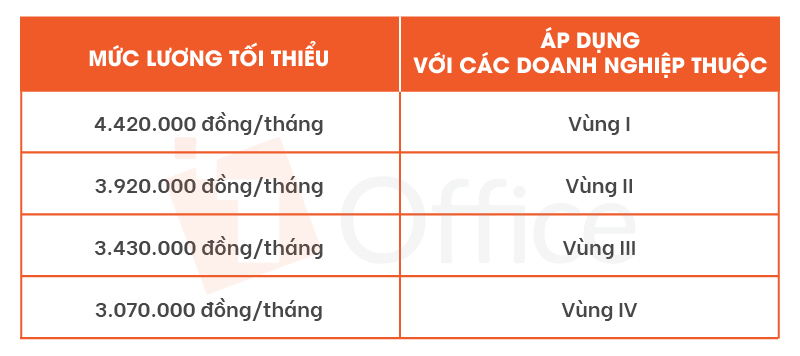
- Region I: includes cities and urban/rural districts/towns in central areas with developed economies such as Hoai Duc, Thach That, Quoc Oai, Thanh Oai… (in Hanoi); Thu Dau Mot city, Thuan An, Di An, Ben Cat in Binh Duong.
- Region II: includes cities, provinces, and suburban districts with relatively developed economies such as Ba Vi district, Hai Duong city, Hung Yen city, Vinh Yen district, Phuc Yen.
- Region III: includes areas with a decent economy but still lower than Region II.
- Region IV: includes the remaining areas, difficult or particularly difficult regions where the economy is underdeveloped.
| Read now: What is piece-rate pay? Is it subject to Social Insurance and Personal Income Tax? |
3. Legal principles governing coefficient-based salary calculation
In practice, the method of calculating salary by coefficient, and calculating salary by allowance coefficient is always based on legal principles, specifically:
- Principle of respecting the parties’ agreement on wages in labor relations: the law allows and ensures that parties have the right to agree on wages in labor relations, including both individual and collective labor relations.
- Principle of adjusting wages within certain limits: this is implemented in correlation with the principle of respecting the parties’ agreement in labor relations to ensure state management objectives and regulate the labor market.
- Principle of ensuring fairness and non-discrimination in wages: the law on wages is adjusted with specific regulations on paying employees as a principle, whereby wages paid to employees are based on productivity and work quality.
Read more: Process for employee salary advances according to the latest regulations in 2025
4. What factors affect the salary coefficient?
The salary coefficient is an index that reflects the value of labor based on a combination of professional qualifications, job responsibilities, and depth of experience, serving as a fair measure to establish a corresponding income level for each individual.
-
Seniority:
The more years an employee works, especially in the same field or company, the salary coefficient is usually adjusted upwards. This is how businesses recognize the experience and long-term contributions of employees. -
Job title and position:
Management positions or higher job titles will have a higher salary coefficient to reflect their responsibilities, roles, and scope of work. For example, a department head will have a higher coefficient than an employee performing similar tasks. -
Professional qualifications and degrees:
The salary coefficient is also adjusted according to degrees, certificates, or professional qualifications. Employees with higher degrees or specialized expertise are often given a higher coefficient to encourage competency development and continuous training. -
Accompanying allowances:
In addition to the basic salary coefficient, employees also receive various allowances such as position allowance, seniority allowance, responsibility allowance, or special bonuses. These allowances increase the total actual income, accurately reflecting the value of the job and the employee’s contribution.
Combining all these factors helps businesses calculate salaries fairly, encourages work performance, and at the same time helps employees clearly understand how their income is determined.
5. Automated salary calculation solution with 1Office software
1Office’s payroll solution offers enough flexibility to meet the constantly changing salary and bonus policies of a business. With a system that links data between modules, the software will automatically calculate and pay salaries via bank accounts. This completely eliminates the process of compiling forms, fingerprint logs, etc., as well as complicated manual calculations, saving significant time and costs for the business.
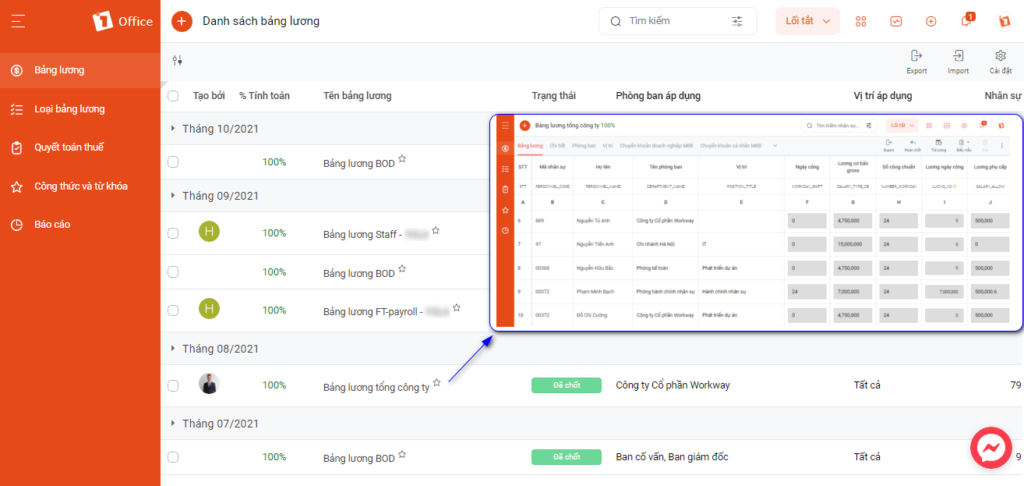
- Allows flexible definition of various payroll types for users to choose the one that suits their business.
- Integrates all Excel formulas into timekeeping and payroll calculation – suitable for all businesses today.
- Flexibly set permissions for who can view and edit salaries/allowances in employee profiles.
6. Frequently Asked Questions about coefficient-based salary calculation
When changing ranks or getting promoted, how is the salary coefficient adjusted?
When appointed to a higher position, the employee will be placed in a new salary rank/grade with the next highest coefficient compared to the old one, or according to the regulations on the salary framework corresponding to the new title.
Is it permissible to pay a salary lower than the regional minimum wage after applying the coefficient?
No. After applying the coefficient, the actual salary received (under normal working conditions) must absolutely not be lower than the regional minimum wage stipulated by the State at that time.
Does the salary coefficient change when an employee’s qualifications change?
Yes, if the company’s regulations or state regulations classify coefficients based on qualifications. When an employee obtains a higher degree (such as from a Bachelor’s to a Master’s), they can go through the procedures to be considered for a salary grade/level increase.
Why are the salary coefficients of private enterprises often different from those in the public sector?
Private enterprises have the right to build their own salary scales and coefficients that are suitable for their financial capacity and industry specifics, as long as they comply with the legal minimum wage requirements.
How can errors be minimized when calculating salary coefficients for hundreds of different employees?
Manual calculations using spreadsheets often lead to mistakes regarding seniority and salary levels. Therefore, businesses should use 1Office 1HRM to automate coefficient updates, calculate allowances, and synchronize employee profile data accurately and quickly.
7. Conclusion
Through this article, we at 1Office hope to have provided useful information on how to calculate salary based on coefficients for our readers. If you need any further information or consultation, please contact us for a free consultation.
For all inquiries, please contact:
- Hotline: 083 483 8888
- Fanpage: https://www.facebook.com/1officevn/
- YouTube: https://www.youtube.com/channel/UCeTIRNqxaTwk0_kcTw6SxmA




