


 10/05/2026
  174 views
A competency framework is an important tool that helps businesses recruit the right people, train according to needs, and evaluate personnel more clearly. If you want to understand what a competency framework is and how to build one systematically, 1Office will provide the most accurate information.
Mục lục
- 1. Mistakes in the process of building a corporate competency framework
- 2. Structure of the competency framework model
- 3. Application of the competency framework in HR activities
- 4. 5 Steps to Build an Effective and Easy-to-Apply Competency Framework for Businesses
- 5. Benefits and Importance of a Competency Framework
- 6. Professional Competency Assessment Tool in the Digital Age – 1Office HRM
1. Mistakes in the process of building a corporate competency framework
A competency framework is a system that includes the knowledge, skills, attitudes, and characteristics an employee needs to perform. Based on the competency assessment framework, managers will have a general overview of an employee’s capabilities in relation to the job requirements.
However, many organizations have failed in their efforts to build a framework to proactively manage employee competencies.
The main reason for failure is that competency frameworks are developed and implemented without a clear business purpose. Without a business purpose, there are no goals to base design decisions on when building the framework. The resulting design is often flawed, serves too many masters, and is discontinued after a year or two of use.

Second: A common mistake many organizations make is confusing competencies with tasks. Tasks are better positioned in the job description. Frameworks that confuse tasks with competencies often have forty to fifty competencies described. This is because each job description now tends to have twenty to thirty competencies assessed for an employee.
Third: Lack of commitment and support from leadership. It’s clear that in a business, leaders act as pioneers and role models, helping their employees learn and follow the established competency framework. If leaders only introduce the professional competency framework but do not seriously implement it and avoid assessment meetings, it will certainly not be successfully deployed.
To build a successful competency assessment framework, it requires not only the determination of the leadership but also the compliance of all employees with the principles of competency measurement to ensure fairness and transparency.
2. Structure of the competency framework model
Building a competency framework structure helps businesses establish a solid foundation for human resource management activities… Below are 4 common competency assessment framework structures that help each employee complete their assigned tasks well and develop necessary competencies.
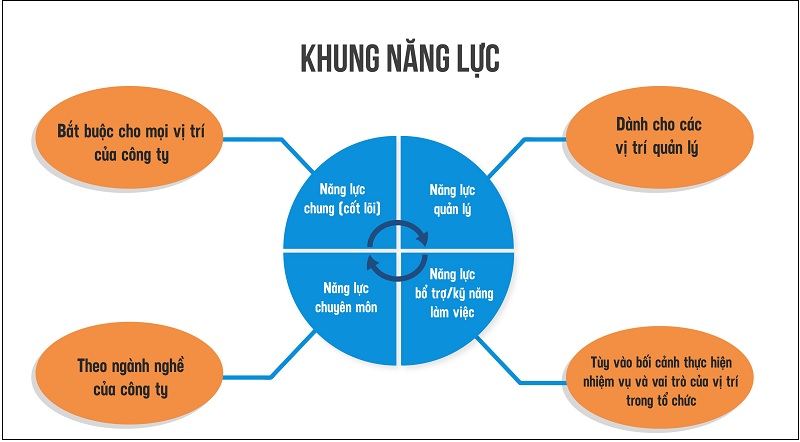
- Role-specific competencies: Includes competencies serving specific positions within an organization, such as leadership competency and strategic thinking competency.
- Core competencies: This type of competency includes skills necessary for all positions, such as problem-solving skills, communication skills, IT skills, etc.
- Technical competence: Includes the specialized knowledge and skills required for a specific position or field, playing a crucial role in performing designated professional tasks. For example: Programming skills, Sales skills, Data processing skills, etc.
- Behavioral competencies: These are specific individual competencies defined in terms of behavior to ensure application capability and proficiency level.
As you can see, dividing the competency framework into different structural groups helps managers identify necessary competency criteria, avoid overlap, and assess employee capabilities transparently and accurately.
3. Application of the competency framework in HR activities
The competency framework is a crucial tool that helps businesses optimize all HR activities, from recruitment and training to assessment and compensation. By clearly defining the skills, knowledge, and attitudes required for each position, the competency framework helps employees develop appropriately and improve job performance, while also supporting the business in making accurate and strategic personnel decisions.
3.1. Application of the competency framework in recruitment (with examples)
For recruitment activities, the competency framework becomes a guiding criterion that helps businesses quickly select potential candidates. This helps the organization avoid investing essential resources in recruiting individuals who lack the appropriate skills for the job.
Additionally, applying the competency framework to recruitment activities helps managers get a comprehensive view of a candidate’s strengths and weaknesses. This makes it easier for HR to distinguish which candidates are suitable and meet the job requirements. Furthermore, you can learn more about recruitment support tools that help HR find the highest quality and most suitable candidates.
3.2. Application of the competency framework in employee training
Based on the professional competency framework, managers can identify training needs and develop training program content to develop their workforce. To effectively apply the personnel training process, businesses need to have a clear understanding of their employees’ competencies and skills to conduct regular assessments for their staff and employees.

For example: For the sales department, the business can train employees in some important skills such as: sales skills, deal-closing skills, persuasion skills, etc., to help them improve their sales abilities.
| Read more: 5 steps to build an effective internal training process for businesses |
3.3. Evaluating and Building an Employee Compensation and Benefits Policy
Besides being applied in recruitment and training, the competency framework also plays a crucial role in employee evaluation. It serves as the basis for determining salaries, bonuses, and implementing compensation and benefits policies for both employees and management levels within the company.
Managers can develop a set of competency assessment criteria to evaluate job completion levels and measure employee performance. This helps leaders establish a human resources policy to reward the right people for the right work transparently and accurately.
Read more: What is MBTI? Applying Personality Tests to Evaluate Employees and Candidates
4. 5 Steps to Build an Effective and Easy-to-Apply Competency Framework for Businesses
To build an effective competency framework that meets the practical needs of your business, you can refer to the steps shared by experienced experts below:
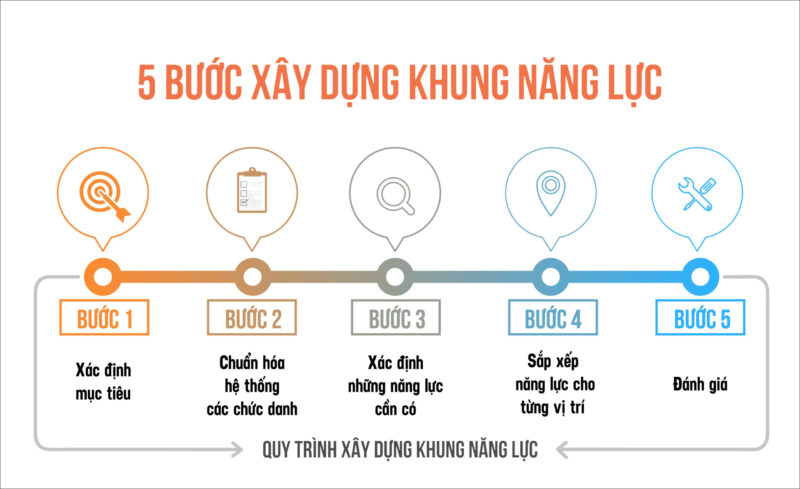
Step 1: Define the Purpose
First, the business needs to determine the purpose of building the competency framework. For example:
- Recruiting personnel
- Training personnel
- Evaluating personnel
- Building a compensation and benefits policy for personnel
Different purposes will lead to the identification of different types of competencies.
Step 2: Standardize Job Roles in Each Department
Standardizing the organizational structure and job title system helps the business clearly define the duties and functions of each position. Since competencies are directly related to job performance and various activities, a clearer organizational structure makes it easier to define a suitable competency framework, helping employees complete their work in the best possible way.
Step 3: Identify Necessary Competencies
Next, we need to identify the competencies that may be required. To determine the necessary competencies, businesses can refer to the following methods:
– Develop a set of required competencies
– Group them by professional level
– Refer to some globally popular competency sets, such as the “42 Competencies by Harvard University” or the “Competency Framework developed by CIPD in the UK,” and then adjust them to fit your business’s needs.
Step 4: Assign Competencies to Each Position
Once you have a complete set of competencies with different levels, the next step is to define the competencies and proficiency levels for each position in the company. To assign appropriate competencies to each job role, managers can use various methods such as creating surveys or holding internal discussions to gather opinions and build the most standard competency set.
Example: The Media department needs to be proficient in using video editing and photo editing software to perform their job.
Step 5: Evaluate
In the final step, we need to implement the competency sets and develop assessment tools for each individual and department. However, this is a task that requires a high level of expertise. If the company lacks the necessary skills, it can hire experts or professional consulting firms to create the competency assessment framework.
|
Read more: Standard human resource training and development process for businesses |
5. Benefits and Importance of a Competency Framework
A competency framework is a crucial strategic tool that helps businesses develop their human resources in a systematic, transparent, and structured manner. It is not just a criterion for employee evaluation, but also a foundation for businesses to optimize work performance, allocate resources effectively, and build long-term personnel development roadmaps. When implemented correctly, it helps businesses proactively manage current competencies, guide future development, and maintain a sustainable competitive advantage in the market.
Strategic Personnel Development
One of the greatest benefits of a competency framework is that it helps businesses clearly define the skills, knowledge, and attitudes required for each job position. This not only helps in recruiting the right person for the right position but also creates a basis for establishing suitable personnel development roadmaps. The framework allows businesses to identify potential employees, thereby building appropriate training, development, or promotion programs.
Real-world example: A technology company uses a competency framework to identify key competencies such as project management, analytical thinking, and technical skills for its management team. As a result, the company can build a structured promotion path, advance employees with outstanding abilities to leadership positions, and ensure that its personnel are always ready to meet the company’s development needs.
Enhance Productivity and Optimize Resources
A competency framework is also a tool for improving work efficiency and optimizing resources. When businesses use competencies to assign tasks and evaluate performance, they ensure that the right people are doing the right jobs, minimizing errors, saving time, and increasing overall efficiency.
Real-world example: A company’s sales department identifies employees who excel in communication, persuasion, and customer care. This allows the company to assign suitable tasks, increase sales, and simultaneously reduce unnecessary training costs for skills that employees have already mastered.
Tips for Implementing a Competency Framework
To maximize the benefits of a competency framework, businesses should:
-
Start with clear objectives, linking the competency framework to the company’s strategy and development direction.
-
Be flexible and update it periodically to ensure the framework remains relevant to changes in jobs, technology, and the market.
-
Use HRM software or digital tools to measure, evaluate, and track employee competency effectiveness accurately and quickly.
-
Communicate clearly internally to help employees understand the purpose, apply the framework to their work, and develop their personal competencies.
Thus, a competency framework is not just a set of employee evaluation criteria but also a strategic tool for personnel development, productivity enhancement, and resource optimization, helping businesses achieve sustainable goals and compete effectively in the market. When implemented systematically, the competency framework becomes an indispensable part of modern human resource management, helping businesses both ensure work efficiency and develop their people strategically.
6. Professional Competency Assessment Tool in the Digital Age – 1Office HRM
1Office is currently an effective total business management solution in Vietnam, chosen by over 5,000 businesses and more than 450,000 users. Featuring many smart and outstanding features, the personnel competency assessment software helps you manage all business operations such as: human resource management, customer management, work management, and more. Specifically, the HRM module provides an ASK employee assessment model framework that helps businesses:
<iframe title="
Manage and Store Assessment Criteria:
- Build competency assessment criteria and manage them centrally right on the software.
- Customize the competency framework to suit each individual and department in the business.
- Allows for the creation of diverse, visual assessment forms for faster evaluations.
Evaluate Competency Results:
- Easily set up competency assessments on a weekly, monthly, quarterly, or yearly basis.
- Set up formulas for calculating criteria and average competency scores.
- Based on the results, managers can assess employee competencies to create clear development roadmaps.
In summary, this article has introduced you to the competency framework, as well as its structure, models, and methods for building one in human resource management. We hope this information will be useful in helping you quickly build the most suitable and effective competency assessment framework for your business.
For more detailed information, please see:
Hotline: 083 483 8888
Fanpage: https://www.facebook.com/1officevn/
Youtube: https://www.youtube.com/channel/UCeTIRNqxaTwk0_kcTw6SxmA
















