


What is payroll management? 4 effective ways to optimize the process


Mục lục
- 1. What is payroll management?
- 2. 3 effective payroll management methods
- 3. 4 Ways to Optimize the Payroll Management Process
- 4. Notes for Effective and Accurate Payroll Management
- 5. Common Mistakes in Payroll Management
- 6. 1Office – The Market-Leading Payroll Management Software
- 6. Frequently Asked Questions
1. What is payroll management?
To understand the concept of payroll management, businesses need to grasp the nature of wages. A wage is the amount of money an employer pays to an employee and is the employee’s main source of income. In addition, wages are also a cost factor that constitutes the value of the products and services created by the business.
Therefore, wages are a concern for both employees and employers. Typically, wages include base salary, sales bonuses, overtime pay, etc.

Payroll management is not only a crucial part of human resource management but also plays a decisive role in employee morale. Paying an appropriate salary not only encourages a sense of responsibility and enthusiasm but also promotes diligence at work. This not only brings added value to the business but also builds a long-term, committed relationship between employees and the company.
Wages are often divided into several types, including:
- Salary by grade: Reflects the salary level based on the employee’s job grade within the company. Each grade has a different salary level, which typically increases with promotions such as staff, manager, department head, director, and higher levels.
- Salary grade coefficient: Businesses use this coefficient to distribute graded salaries fairly, helping to resolve potential disputes.
- Pay rate: The amount of money a business pays an employee for a specific period (hour, day, month, etc.), which often depends on the employee’s grade.
- Salary scale: Used to evaluate the salary ratio between different grades; each step on the scale has a different coefficient compared to the base salary.
- Technical grade standards: Defines the required work skills for each grade, setting the technical criteria that employees must meet to work at that level.
2. 3 effective payroll management methods
2.1 Manual payroll
This is a manual payroll management method that many businesses still choose to implement. Manual payroll is considered the most effective way to manage salaries within businesses.
Advantages:
- The biggest advantage of this method is saving internal labor costs for the business.
- Self-managing, handling payroll manually, or running the system in-house helps businesses feel more secure about information confidentiality because it is handled by internal staff rather than an external party.
Disadvantages:
- The disadvantage of the manual payroll method is that it involves a large amount of procedures and paperwork. It is not just a simple salary calculation process; the person in charge must also be well-versed in regulations from various agencies to calculate and prepare tax and Social Insurance (SI) reports, while also ensuring timely tax payments and full SI contributions.
- Managing HR and payroll using traditional methods requires a lot of time and effort from HR staff. To minimize errors when processing financial records, businesses need specialized employees or a professional team to manage this area.

2.2 Outsourcing
Managing payroll by outsourcing offers many benefits; however, many businesses remain cautious due to existing challenges.
Advantages:
- Businesses can save a significant amount of time by using external providers to manage payroll issues.
Disadvantages:
- This method has a significant disadvantage: high cost, which makes many businesses “hesitant”. Finding a reputable unit to entrust with the responsibility of managing HR, payroll, and finances is a challenge for businesses wanting to adopt the outsourcing method.
- Managing payroll in a business not only involves legal compliance but also requires high accuracy and absolute confidentiality.
2.3 Using Software
Using payroll management software is increasingly becoming the preferred choice for many businesses, replacing manual management methods.
Advantages:
- Using software to calculate and manage payroll can be considered a solution that balances the pros and cons of the two previous methods.
- It helps businesses save more costs compared to outsourcing, while still ensuring that potential errors are minimized thanks to automated systems.
Disadvantages:
- Modern software, although convenient, mostly still depends on the Internet. Therefore, payroll management data within the business can be affected if the software does not support backup or synchronization functions.
Read more: 15 best payroll management software for businesses
3. 4 Ways to Optimize the Payroll Management Process
3.1 Implement Automated Payroll
Calculating salaries manually not only requires significant time and effort from the HR department but also carries a high risk of errors in data entry and calculations.
Therefore, the emergence of automated payroll software is essential. This helps enhance efficiency in payroll management while ensuring the accuracy and security of the calculation processes.
Employees in the company can also easily access their payments and salary history online. Thus, automating the payroll management process truly benefits both parties.
3.2 Consolidate Pay Periods
Consolidating pay periods is a challenge when a business has employees with various types of employment contracts, including permanent staff, interns, seasonal workers, or shift workers. This leads to different payment schedules for each group of personnel, increasing the likelihood of duplicate errors in payroll management.
To minimize risks and ensure proper payroll processing, consolidating pay periods is crucial. You need to choose a specific time frame and pay all employees on the same schedule.

3.3 Build a Transparent Salary Policy
Payroll management can face numerous challenges such as incorrect employee classification, underpayment or overpayment of taxes, etc. Therefore, it is important to establish a clear, easy-to-understand, and easily accessible salary policy for all employees in the company. This applies to both current employees and future candidates.
3.4 Get Feedback from Employees
Another way to optimize payroll management in a business is to collect feedback from employees. Their feedback can help the business identify unclear issues in the payment process. From there, the business can recognize and promptly adjust any problems before they become more serious. This also helps limit conflicts that could lead to the loss of human resources.
Read more: 6 steps to standardize the employee salary management process in a business
4. Notes for Effective and Accurate Payroll Management
- Update regulations related to payroll
Payroll policies and regulations are always subject to change. Therefore, businesses need to continuously monitor and update information to adjust salaries for their employees. Failure to update payroll regulations can lead to a loss of trust from employees, reduced work performance, and an increased likelihood of them leaving the company.
- Manage HR information scientifically
Managing HR information in a large-scale enterprise can involve thousands to hundreds of thousands of people. Therefore, applying scientific HR management solutions and information management is crucial. This will significantly contribute to making the management process smoother.

- Maintain a close connection with the timekeeping process
An employee’s salary is naturally calculated based on the number of days they work. Therefore, during the salary and bonus calculation process, it is necessary to closely follow the timesheet to ensure the accuracy and completeness of the employee’s compensation. This will build trust with employees, helping the business develop a sustainable workforce.
- Online tax reporting and declaration
Today, tax declaration and payment can be conveniently done through online platforms. Take advantage of this to carry out the tax declaration process completely and accurately over the internet. This helps you save human resources, time, and reduce incurred costs. Online tax declaration also simplifies all procedures and reduces the risk of errors.
- Limit disputes
Always listen to feedback and contributions from employees to find reasonable solutions and avoid disputes. Business owners need to show a willingness to negotiate and offer reconciliation agreements to limit disputes, strikes, and mass resignations. This will negatively affect the company’s image in the minds of employees and its reputation with partners.
See more: HR and Payroll Management Software for Automated Timekeeping and Payroll Management, Best of 2023
5. Common Mistakes in Payroll Management
Payroll management may seem like a simple process, but in reality, it holds many potential risks. A small error in calculation, data management, or internal communication can lead to employee dissatisfaction, loss of business reputation, and even violations of labor and tax laws.
Below are common mistakes many businesses make, along with solutions to help you thoroughly resolve them:
5.1. Not updating salary and bonus policies in a timely manner
One of the reasons employees leave a company is that the salary policy is no longer competitive with the market.
Many organizations still use salary scales or bonus levels from years ago, which do not accurately reflect the capabilities, responsibilities, and actual contributions of employees. As a result, talented individuals feel unappreciated, and it becomes difficult to attract new talent.
Consequences:
-
Talented employees are more likely to “job hop” to competitors offering more competitive salaries.
-
Morale decreases, and overall performance is affected.
-
The business loses its advantage in recruiting and retaining talent.
Solution:
-
Periodically review and adjust salary and bonus policies every 6 months to 1 year.
-
Compare internal salary levels with the market average using HR reports (e.g., Navigos, Talentnet, Mercer).
-
Link salary and bonuses to KPIs or OKRs to ensure fairness based on performance.
5.2. Manual payroll calculation causes errors and is time-consuming
In many small or medium-sized enterprises, payroll is still calculated manually using Excel. This method may seem cost-effective, but it is prone to formula errors, missing data, or mistakes in workdays, allowances, and insurance.
As the number of employees grows, these errors can lead to discrepancies of tens of millions of VND or cause disputes between employees and the company.
Consequences:
-
Time-consuming checks and reconciliations between departments.
-
Reduces employee trust if paid salaries do not match.
-
Risks during data audits by tax or insurance authorities.
Solution:
-
Use payroll management software to automate the process from timekeeping to salary calculation, tax deductions, and payslip generation.
-
Connect the software with time clocks, HR management software, and accounting software to synchronize data in real-time.
-
Establish standardized salary calculation formulas to limit manual intervention.
5.3. Unclear salary structure and deductions
Many businesses only announce the total income but are not transparent about the individual components like basic salary, allowances, bonuses, insurance deductions, personal income tax, etc. This makes it difficult for employees to understand why their net pay is lower than expected.
Consequences:
-
Employees suspect the company is “withholding salary” or miscalculating taxes.
-
Lack of transparency, affecting internal culture.
-
Prone to labor disputes or complaints to regulatory agencies.
Solution:
-
Provide detailed monthly payslips, clearly showing each income and deduction item.
-
Publicly explain the mechanism for calculating bonuses, allowances, and penalties to ensure transparency and fairness.
-
Use HR software with an Employee Self-Service (ESS) portal for them to look up their payslips anytime.
5.4. Late or delayed salary payments
Late salary payment is an extremely serious issue that directly affects employees’ financial lives.
When a business fails to pay on time, even by just a few days, it can cause employees to lose trust and view the company as unprofessional.
Consequences:
-
Decreased morale, increased turnover.
-
Damages the employer brand’s reputation.
-
May be penalized under Article 17 of Decree 12/2022/ND-CP for violating labor laws.
Solution:
-
Establish a fixed payroll schedule and a streamlined approval process.
-
Use automated salary payments through the bank to ensure timeliness.
-
Have a contingency plan in case the accounting or banking system encounters issues.
5.5. Lack of payroll data security
Salary is sensitive information. If leaked, it can lead to internal conflicts, loss of trust, and even violations of personal data protection regulations (Decree 13/2023/ND-CP).
Consequences:
-
Seriously affects the company’s image.
-
Legal risks due to violation of employee privacy rights.
-
Can easily lead to comparisons and jealousy, causing disunity within the organization.
Solution:
-
Implement clear access permissions for salary data, allowing only HR or senior leadership to view it.
-
Encrypt or store data on a platform with enterprise-grade security.
-
Train employees on HR information security, avoiding sending payroll sheets via email or shared files.
6. 1Office – The Market-Leading Payroll Management Software
1Office is one of the top HR payroll management software solutions on the market today. With 1Office, businesses are equipped with a specialized toolkit to solve all challenges in employee salary management, including:
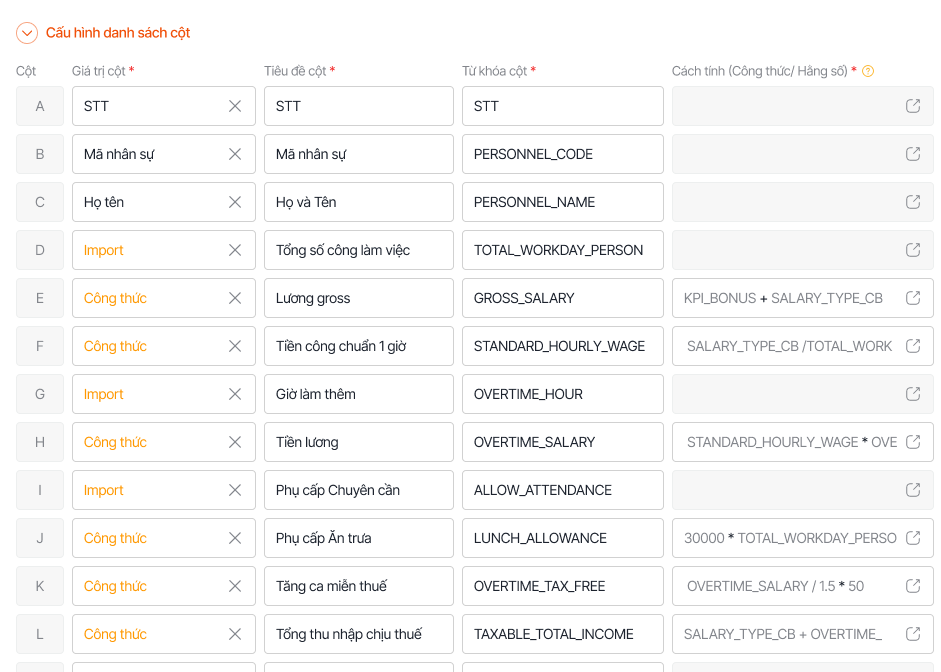
- Build flexible payrolls according to the company’s salary structure, supporting the setup of multiple salary structures suitable for each department.
- The system automatically calculates salaries based on 3 data sources: Internal system data (Basic salary, allowances, insurance, salary advances, timesheets, KPIs, revenue, etc.), importing data from external systems via API library, and functions and formulas set up similarly to Excel.
- Automatically calculates payroll and synchronizes with HR profile data.
- Employees can track their own payslips on the software, ensuring information transparency.
- Supports direct 24/7 salary payments on the software through MBbank.
- A flexible payroll management system capable of adapting to continuous changes in the company’s salary and bonus policies.
6. Frequently Asked Questions
6.1 What are the consequences of incorrect salary calculation?
Incorrect salary calculation not only creates conflicts between employees and employers but can also lead to legal issues, especially if the business is sued. The consequences of incorrect salary calculation can be significant, not only causing the business to lose employees but also damaging its reputation in the labor market.
6.2 Are there penalties for late salary payments?
In cases where a business pays salaries 15 days late or more (which may occur due to objective reasons that the employer has attempted to resolve but still cannot pay on time), the employer is responsible for paying compensation.
This amount must be at least equal to the interest on the late payment, calculated based on the 01-month term deposit interest rate announced by the bank where the business has opened its payroll account for employees.
The above is all the information related to payroll management and guidance for effective salary management in businesses, provided by 1Office. We hope that these insights can help your business solve its payroll management challenges.




