11/05/2026
  17749 views
In construction investment project management, designing a construction project management chart is a crucial step. It systematizes the construction organization’s structure and guides all subsequent operational activities. So, how is a Construction Project Management Board organized? What are the responsibilities and functions of each position? Refer to the effective project management organizational chart template provided by 1Office below to better understand this department.
Mục lục
- 1. What is a construction project management chart?
- 2. What are the functions of a construction project management board?
- 3. Construction Project Management Organizational Chart
- 4. Construction Project Management Board Chart
- 5. Weekly Checklist to Ensure Your Project Management Chart Stays Accurate
- 6. Tips for using charts for effective communication between departments and contractors
- 7. Professional Construction Project Management: 2X Efficiency with 1Office
- 8. Frequently Asked Questions When Creating a Construction Project Management Diagram
- 9. Conclusion
1. What is a construction project management chart?
A construction project management chart is a diagram that systematizes the organizational structure of a construction project management board, clearly delegating authority for positions and roles from top to bottom.
The construction project management board is the contractor responsible for the entire construction of the project and operates under the direct supervision of the investor (usually the management company). The construction project management board will undertake all responsibilities related to the project work, from the preparation phase, developing the project management process, and carrying out construction, to the acceptance and commissioning of the project.
In the construction project management organizational chart, each department within the management board will have clearly defined roles and specific tasks, and they will have a close, supportive relationship to achieve work objectives.
See also: 10 Best Project Management Software for Progress Tracking
2. What are the functions of a construction project management board?
The construction project management board plays a role in helping the investor realize the design, bringing the project to life. The project management board is responsible to the investor and the law for executing and controlling all project stages according to the assigned tasks and delegated authority, as specified in the Construction Law as follows:
- Organize, coordinate, manage, and supervise the construction of the project in accordance with the contract
- Control operational costs within the approved budget, ensuring economic efficiency for the project
- Implement strict management to meet standards for quality, volume, labor safety, and environmental protection of the construction project
- Implement activities to ensure adherence to the schedule
- Update and report on the implementation status regularly as requested by the investor
- Be responsible for explaining and clarifying any arising issues or deviations to the investor and proposing timely solutions
- Coordinate closely with specialized departments throughout the construction process
- Organize acceptance, inspection, and handover of the construction project to the investor upon project completion

| Latest update: Latest Construction Project Management Regulations: What Project Owners Must Know |
3. Construction Project Management Organizational Chart
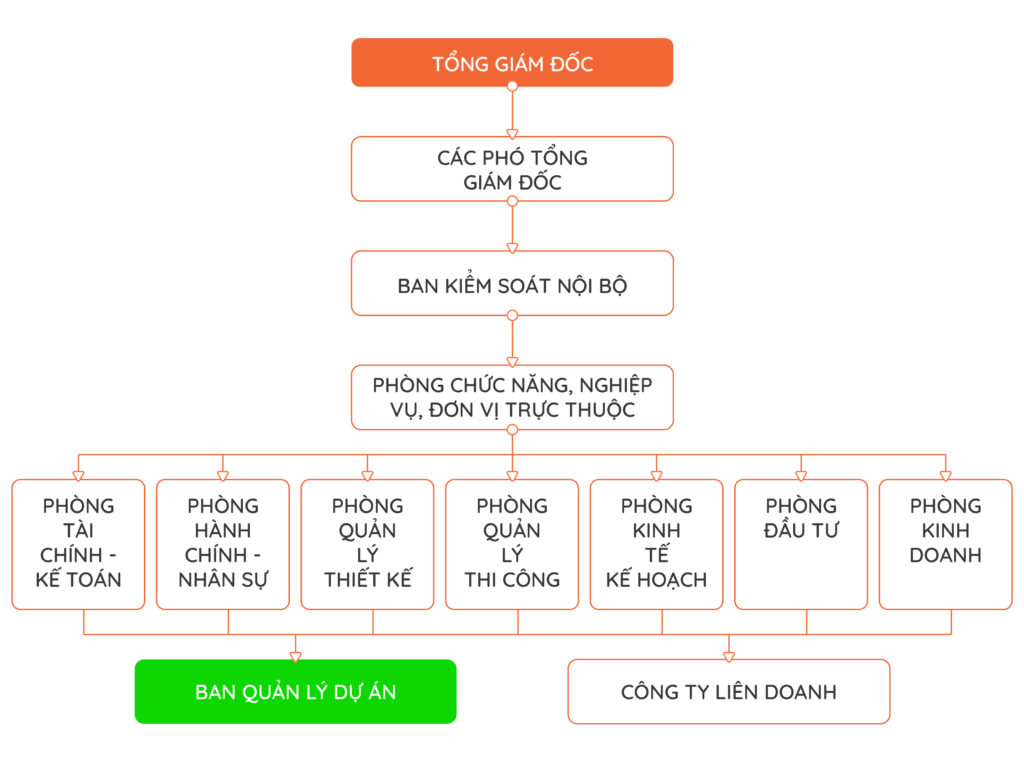
The construction project management board is a functional unit within the organizational structure of a construction company. In many cases, the company is also the project investor. The project management board receives direct guidance from the Board of Directors and coordinates with other functional departments to implement the construction work. The position and relationship of the construction project management board with other departments are illustrated in the following chart:
See more: What is Project Schedule Management? Effective Project Schedule Management Process for PMs – PMAs
4. Construction Project Management Board Chart
In construction projects, the management board plays a central role in coordinating human resources, monitoring progress, and ensuring the quality of the work. To operate effectively, a construction project management board chart is established to clearly define the functions, tasks, and responsibilities of each position. This is a tool that helps optimize workflows, mitigate risks, and enhance transparency in project management.
4.1 Organizational Structure of the Construction Project Management Board
The structure of the construction project management board is illustrated in the project management organizational chart below:
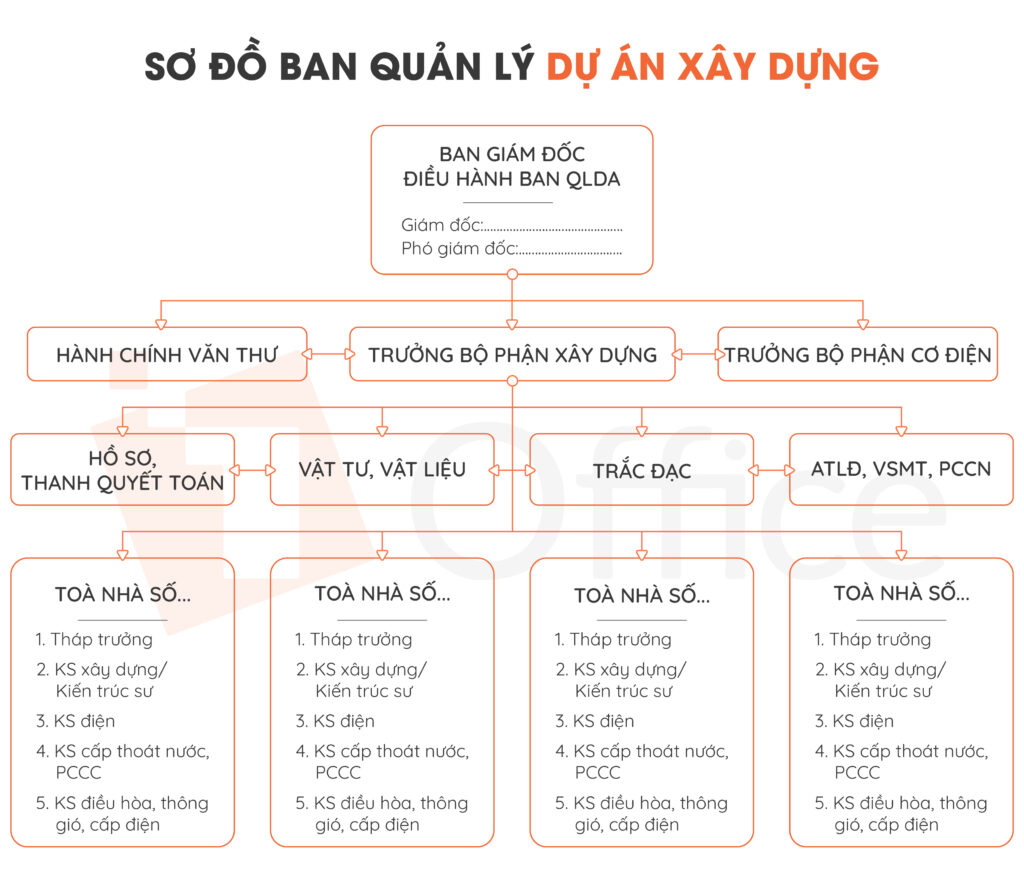
The project management board operates through specialized departments under the direction of the Board of Directors. The specific authorization system clearly defines the roles and responsibilities of each department as follows:
| Department | Function |
| Board of Directors | Directs and manages all activities of the construction project management board. Performs management functions such as strategic planning, resource allocation, and monitoring and evaluating the activities of all departments. |
| Construction Department | – The main department responsible for organizing project construction
– Develops construction plans, including implementation schedules, construction methods, construction procedures, and construction rules and regulations. – Manages and coordinates the activities of subordinate departments – Holds primary responsibility for the acceptance and handover of the project |
| Mechanical & Electrical (M&E) Department | – Surveys the project site and coordinates with design consultants to design the mechanical and electrical system for the project
– Implements the installation of the mechanical and electrical system – Supervises the construction process to ensure compliance with technical specifications and standards as per the design drawings – Coordinates with relevant parties for project acceptance – Creates operational guidance documents for the mechanical and electrical system and hands them over to the investor |
| Administrative & Clerical Department | – Prepares budget estimates for each specific item in the project
– Responsible for managing and archiving all documents and records related to the project – Manages vouchers, revenues, expenditures, and accounts for funds used during the construction process – Processes payments for employee salaries, internal expenses, procurement of materials and equipment from suppliers, etc. – Prepares financial reports and construction progress reports as requested by the Board of Directors and the investor |
| Supplies, Materials, and Equipment Department | – Responsible for managing all supplies and equipment used during the construction process
– Conducts periodic inventory checks of supplies and equipment – Creates proposals for the supply of equipment and materials – Maintains and is responsible for the operational condition of machinery and equipment |
| Records Management and Final Settlement Department | – Prepares and gathers all necessary documents for payment and final settlement
– Confirms whether the acceptance results comply with the agreements specified in the contract – Proceeds with the final settlement with the investor |
| Surveying Department | – Conducts direct topographical surveys, performs measurements, and collects and processes geodetic data for construction planning
– Guides and supervises the construction process to ensure the construction team accurately follows the drawings – Marks and checks benchmarks throughout the construction process, monitoring geodetic changes through different construction phases – Archives geodetic data records |
| Occupational Safety, Environmental Hygiene, and Fire Prevention Department | – Establishes regulations on occupational safety, environmental hygiene, and fire prevention in accordance with legal provisions
– Trains, guides, and disseminates rules and regulations to workers – Enforces and closely supervises the compliance of all departments with the rules and regulations during the construction process – Works with local government agencies to implement measures ensuring safety, security, order, and environmental hygiene within the project area |
Learn about the features of the best project management software, 1Office
4.2 Responsibilities of job titles in the project management chart
Project Management Director
- Set strategic goals and create project plans
- Allocate resources and assign job responsibilities to each department
- Inspect and monitor construction progress and report the situation to the Board of Directors
- Approve all project documents and respond to official correspondence from related departments and units
- Has the authority to appoint, dismiss, reward, and discipline positions under the Project Management Board
- Act as a representative to work with local authorities and state management agencies to resolve related issues during project implementation
- Be responsible to the company and the law for all activities of the Project Management Board
Department Heads
- Assign and provide specific task guidance to each staff member in the department
- Supervise and urge personnel under their charge to correctly perform assigned tasks and meet targets
- Update and report the situation, implementation progress, and any arising issues of the department to the Project Management Board
- Coordinate with other departments to implement the Board’s general tasks
- Be responsible for recording construction logs, collecting data, and reviewing all documents and records under their charge to submit to superiors and hand over to the Administration Department
Project Staff
- Carry out construction work according to assigned tasks
- Ensure work is completed on schedule and meets quality standards
- Report work status to the Department Head
Save for later: A-Z Guide to Effective Construction Investment Project Management
5. Weekly Checklist to Ensure Your Project Management Chart Stays Accurate
A construction project management chart that is not updated regularly will quickly become outdated and ineffective. To ensure its accuracy and ability to reflect the actual situation, you should apply the following weekly checklist:
5.1 Update Work Progress
Progress is the most critical element of any project management chart. If not updated regularly, the chart loses its meaning.
-
Check each item: classify into three statuses: completed, in progress, overdue. This helps to see the “big picture” instead of focusing on just one part.
-
Cross-reference with reality: compare the data on the chart with acceptance records, construction logs, or reports from the site command. This helps avoid a situation where the numbers on the chart look “good” but the reality is far different.
When progress is updated accurately, the chart becomes a tool for leadership to monitor without needing to visit the construction site frequently.
5.2 Check Resources
A project only runs smoothly when personnel, machinery, and materials are secured on schedule.
-
Personnel: check if the number of workers, engineers, and subcontractor teams is sufficient for the upcoming week’s workload. If there is a shortage, coordinate immediately to avoid delaying progress.
-
Equipment and materials: review the delivery schedule for materials and machinery to see if it matches the needs on the chart. If a risk of delay is detected (e.g., materials have not yet been transported to the site), mark a warning to find an alternative solution.
Controlling resources from this week will help avoid “piling up” work at the end, reducing pressure on the entire project.
5.3 Review Costs
Costs are a sensitive factor and can easily exceed the budget if not controlled in a timely manner.
-
Compare actual incurred costs with the projected budget: each week, review invoices, new contracts, and overtime labor costs to see if they exceed the cost frame for the item.
-
Mark items that are over budget: when a discrepancy is found, provide an early warning on the chart to report to the investor or leadership. This allows for timely renegotiation or budget adjustments.
Checking costs weekly helps prevent the project from “going broke” and creates transparency with investors.
5.4 Adjust the timeline if necessary
In reality, not every task is completed on time. Therefore, the timeline needs to be continuously adjusted to accurately reflect the situation.
-
Handle delayed tasks: add more time, work overtime, or assign more personnel to get back on schedule.
-
Update changes on the chart: all adjustments must be reflected directly on the chart so that all stakeholders (investors, subcontractors, internal departments) are aware.
Adjusting the timeline promptly helps departments coordinate smoothly, avoiding misunderstandings or overlapping work.
5.5 Standardize weekly reports
The project management chart is not just for internal tracking, but also serves as a visual report for leadership or clients.
-
Export the latest chart: in PDF, image format, or directly from the software as a dashboard.
-
Note important changes: highlight delayed milestones, items completed early, or cost changes. This helps superiors grasp the overall picture in just 5 minutes of reading the report.
Standardizing weekly reports makes the project more transparent, professional, and builds trust with partners.

6. Tips for using charts for effective communication between departments and contractors
A project management chart is not just a tool for tracking progress, but also a common language that connects engineers, accountants, managers, and subcontractors. The following tips will help you make the most of it:
6.1 Use the chart as a “master map” during meetings
In weekly or briefing meetings, instead of relying on lengthy text reports, managers can directly display the project management chart.
-
All departments and contractors look at a single source of data.
-
The progress of each item is displayed visually, making it easy to see which items are completed and which are behind schedule.
This makes meetings more focused, reduces time spent on explanations and rambling debates, and helps all members understand the big picture.
6.2 Color-code responsibilities
Using different colors to represent each department or subcontractor is a simple yet highly effective method.
-
For example: Engineering department in blue, finance department in yellow, foundation subcontractor in red…
-
Just by glancing at the chart, everyone can immediately see who is in charge of which task.
This clear demarcation helps avoid “passing the buck” when incidents occur and increases transparency throughout the entire process.
6.3 Integrate notes directly on the chart
During implementation, there are always unexpected changes: delayed material deliveries, new items added, or timeline adjustments.
-
Instead of sending separate emails or communicating verbally, these changes can be updated directly on the chart.
-
Project members just need to open the chart to immediately understand the current context and the reasons for the changes.
This helps minimize the risk of missing information and also supports faster onboarding for new members.
6.4 Use the chart to resolve conflicts
Disputes in a project are hard to avoid, especially when progress is delayed. Instead of emotional debates, the chart will act as “visual evidence.”
-
For example: If a contractor claims they completed their part on time, the updated chart will show the exact completion time and acceptance status.
-
This helps to clearly identify the root cause, allowing conflicts to be resolved based on data rather than emotions.
As a result, all stakeholders feel more secure and confident in the project’s transparency.
6.5 Export diagrams as quick reports for partners/clients
Partners and clients often don’t want to view scattered, hard-to-follow Excel files. With a project management diagram, you can:
-
Export data into a visual dashboard or a PDF with highlighted progress.
-
Present information concisely and visually, helping clients grasp the situation in just a few minutes.
This professional presentation not only enhances the company’s image but also builds trust with clients and investors.
7. Professional Construction Project Management: 2X Efficiency with 1Office
In the flow of national industrialization and modernization, the construction industry has been making strong technological strides to optimize construction efficiency and increase productivity. Project management tasks such as designing construction project management organizational charts, project planning, task assignment, and progress monitoring are all comprehensively digitized on software to maximize management capabilities.
1Office is the leading construction project management solution on the market for construction companies. With 7 years of experience in successfully guiding the digital transformation of leading companies in the construction sector such as Phu Cuong Group, Hong Ha Beton, Mekong, etc., 1Office is confident in solving most of the difficult challenges in construction project management today:
Project Task/Process Management
- Create detailed plans for each item and automatically assign tasks to specific positions and departments
- Define and digitize 100% of project processes
- Closely manage and monitor construction progress with visual chart reports like Gantt charts, Kanban, etc.
Project Material and Budget Management
- Control and update the project’s cash flow situation accurately and promptly in real-time
- Manage all receipts/payments and detailed payment/advance information
- The process of issuing/receiving materials and assets is strictly managed on the software, minimizing the risk of loss
8. Frequently Asked Questions When Creating a Construction Project Management Diagram
Is this diagram mandatory for all construction projects?
Yes. Whether the project is large or small, creating a diagram helps to clearly define who leads and who executes, avoiding overlapping tasks or neglected responsibilities.
What should be done with the diagram if there are personnel changes?
It needs to be updated immediately. The diagram must accurately reflect the person currently holding the position so that all stakeholders (contractors, investors) know the correct point of contact.
Can one person hold multiple positions in the diagram?
Yes, for small-scale projects. However, the functions of quality supervision and cost control should be separated to ensure objectivity.
How can we ensure everyone adheres to the established diagram?
A detailed job description for each position should be attached, and the diagram should be publicly displayed at the site management office so that all members are aware of their authority.
Does the organizational chart change according to the construction phase?
Yes. For example, the foundation phase requires a focus on surveying personnel and machinery, while the finishing phase will prioritize the electrical, plumbing, and interior decoration departments.
9. Conclusion
Through the article above, 1Office provides managers and operators of construction investment projects with a professional construction project management diagram template applicable to all project types. We also introduce a technology solution to help businesses manage and execute construction projects effectively. For a free consultation and a trial of the leading business management software today, please contact us using the information below:
- Hotline: 083 483 8888
- Fanpage: https://www.facebook.com/1officevn/
- Youtube: https://www.youtube.com/channel/UCeTIRNqxaTwk0_kcTw6SxmA