


 11/05/2026
  870 views
In the modern work environment, skills play a crucial role alongside professional knowledge. A good employee or manager not only needs to understand their job but also must possess the right skills to adapt and grow. In this article, 1Office will summarize 15 essential job skills to help you improve performance and create a competitive advantage.
Mục lục
- I. What are the groups of essential job skills?
- II. A compilation of 15+ essential job skills – The key to success for any position
- 1. Professional Skills
- 2. Goal-setting and planning skills
- 3. Communication Skills
- 4. Effective Listening Skills
- 5. Teamwork Skills
- 6. Leadership and Problem Analysis Skills
- 7. Problem-Solving Skills for Any Situation
- 8. Organizing and Planning Work
- 9. Creativity and ideation skills
- 10. Adaptability to any work environment
- 11. Information research skills
- 12. Personal and team financial management skills
- 13. Decision-making skills
- 14. Ability to maintain confidence, enthusiasm, and emotional control
- 15. Ability to work under any pressure
- 16. Skills in using digital technology for work
- III. Typical examples of applying essential job skills
- IV. Methods for practicing job skills
- V. Trends in essential skills in the digital age
- VI. “Future” skills according to global forecasts
- VII. Frequently Asked Questions
I. What are the groups of essential job skills?
A skill is the ability to apply one’s knowledge and understanding to perform a task, which can be a technical or professional job, or related to emotions, survival, communication, etc.
In the office environment, essential job skills are divided into 2 main groups:
1. Professional Skills
Professional skills, also known as hard skills, are knowledge or experiences of a highly specialized nature, skills that help perform specific tasks. Professional skills are honed through learning and working.
Hard skills – one of the essential skills for work, can be assessed through degrees, certificates, or a test. For example: drafting skills, degrees, foreign language proficiency, etc.
2. Soft skills in the workplace
Unlike hard skills, which focus only on expertise or other necessary job skills, scientific or technical knowledge, soft skills in the workplace are more about personality and the ability to interact with society and the surrounding environment.
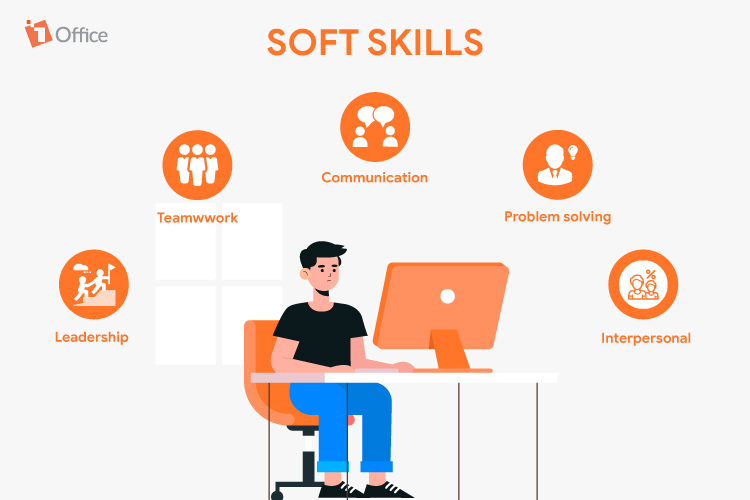
Soft skills are not tied to a specific job like hard skills, and they cannot be assessed by how one resolves or handles a specific work situation. In reality, a person with good hard skills is not necessarily better than a person with good soft skills.
So the question is, should one focus more on investing in hard skills or soft skills? For a good employee who wants to develop systematically to succeed in their career and reach higher positions, both professional skills and soft skills play an important role. You should focus on developing both in parallel to make your work as smooth as possible.
Read more: Multitask – Is multitasking the solution to the productivity problem?
II. A compilation of 15+ essential job skills – The key to success for any position
1. Professional Skills
No position exists that doesn’t require professional skills. Human resources administration needs knowledge of recruitment, the product development team needs knowledge of the product/service to devise strategies… Without professional knowledge, all work will be based on feeling, not logic.
Professional skills play a crucial role because:
- They create a solid knowledge foundation for each individual.
- They help improve productivity and work efficiency.
- They make a good impression on a CV, attracting the attention of recruiters.
- They provide clear promotion opportunities that match one’s abilities.
Professional skills are long-term and stable, and are often academic and theoretical in nature. They require in-depth professional expertise. For positions within a company, the higher your professional skills, the more opportunities you have for salary and position growth.
2. Goal-setting and planning skills
Moving on to the group of soft skills, this is the ability to clearly define what you want to achieve, where you are going, what the steps for promotion are… Many people simply go to work for the sake of it without any goals to strive for, which is very unfulfilling.
Each person will have different goals at different stages of their life. Therefore, simply setting reasonable, feasible goals and trying to do things every day to get closer to them gives you the first condition for career advancement.
Along with that, to realize the goals you have set, you need to make a plan to achieve them. Define short-term, mid-term, and long-term goals, then be determined to follow the plan.
Some criteria for setting goals and planning correctly:
- Clearly understand your own thoughts and aspirations
- The strengths and weaknesses in your personality
- Specific and achievable timelines
- Identify the opportunities and challenges from external conditions you will face
| Read more: What is Planning? Effective Business Planning Methods for Businesses |
3. Communication Skills
According to research by the American Society for Training & Development (ASTD), communication is one of the key soft skills for achieving success at work.
Good communication is not just about casual conversation; it’s about knowing how to appropriately express your actions, words, attitude, and gestures to everyone, from colleagues and superiors to customers.
Communication is one of the essential skills for work, and it includes two forms: verbal and non-verbal communication. It’s not just your words; your gestures and eye contact during work interactions also indicate how good your communication skills are.
Among the necessary skills for work, regardless of your position, you interact with many people daily. They could be your boss, colleagues, customers, or partners. With good communication skills, you can easily and accurately convey what you want to say to your listeners.
4. Effective Listening Skills
Anyone can listen, but each person’s attitude and way of absorbing information are certainly different. Listening is also one of the incredibly important work skills that we need to practice.
Mastering effective listening skills will help you know how to listen and understand the speaker’s emotions. You will also be more proactive in conversations, making the other person feel cared for and valued.
Especially for employees, effective listening helps in absorbing knowledge and honing experience. For managers and leaders, knowing how to listen helps in understanding employees, reviewing shortcomings, and making improvements.
5. Teamwork Skills
Teamwork skills are the ability to cooperate and work together with a group of people, who could be friends, colleagues, etc., to achieve the best results for a common goal. This essential work skill is always a focus for recruiters when interviewing candidates.
This skill will help you practice listening to others, contributing ideas, and having the courage to voice your own opinions, creating opportunities to demonstrate your professional competence while also helping you build closer relationships with colleagues.
The role of teamwork skills at work:
- Improve communication and understanding among members
- Solve problems and increase work productivity
- Promote creativity and sound decision-making
- Cultivate discipline in each member
Manage team tasks – Communicate effectively with:
6. Leadership and Problem Analysis Skills
If you are a good leader, people will do what you ask, whether you are there to supervise them or not.
If you are an excellent leader, they will follow your requests, try their best to do a great job, enjoy working for you, and always strive to do more than you ask just to please you.
Therefore, leadership is one of the essential work skills that each of us needs to cultivate. Even if you are an employee, if you have ambitions for promotion, you should start practicing this skill early on.
7. Problem-Solving Skills for Any Situation
At work, there will always be problems and difficulties that you need to solve, so you should equip yourself with problem-solving skills as soon as possible.
By mastering the ability to handle any situation, you will always be in a proactive position to quickly find the most reasonable solutions.
8. Organizing and Planning Work
Mastering organizational and planning skills will help you know how to allocate important and unimportant tasks according to different priority levels and complete them within reasonable timelines.
Organizational and planning skills are demonstrated by:
- Clearly defining your goals
- Developing feasible and effective strategies
- Organizing implementation scientifically to achieve each set goal
Overlapping tasks are the beginning of disorientation and wasted resources. When you arrange work in a sequential and scientific manner, you help the work process run smoothly and easily.
| Read now: Work Plan Template to 2X Your Work Performance |
9. Creativity and ideation skills
Thinking and creativity are among the top skills highly valued by business organizations. This is because it’s a skill that no one can teach you; it requires you to explore and practice persistently on your own.
Essential job skills like creativity are most valuable when old solutions are no longer effective. At this point, you need to think creatively to come up with new solutions that bring higher efficiency to your work.
10. Adaptability to any work environment
Adaptability in any work environment is considered a top skill in the new era, where societal development is constant.
To work long-term in a business, you need to equip yourself with good adaptability skills for new environments. When an employee reaches the specialist level or higher, adaptability to new environments becomes essential.
This is the skill that helps you integrate and adapt quickly to change. People with good adaptability are often described as flexible and able to work easily in various environments.
11. Information research skills
The ability to find information anytime, anywhere is indispensable for both employees and business leaders. The market is always changing with new developments, and failing to keep up will surely leave you behind. This is one of the most important skills needed for work.
This competency includes the ability to identify the most valuable news, books, videos, training programs, and countless other information sources that can help you stay updated in your professional field as well as in other areas that closely impact you.
12. Personal and team financial management skills
If you want to become a key leader in your unit, you should understand the importance of mastering the unit’s financial matters.
This skill includes capital raising, cash flow, asset management, tax planning, financial budgeting, currency valuation, joint ventures and their outcomes, credit management, and the impact of government regulations.
13. Decision-making skills
Among the essential skills for work, decision-making plays a crucial role as it is the key to an organization’s success or failure. Not only leaders but also employees need to practice this skill to be flexible in various situations.
A good leader who guides a company to the pinnacle of success does so through decisive decision-making, accompanied by confidence and fearlessness when making a decision on any issue.
14. Ability to maintain confidence, enthusiasm, and emotional control
Confidence, proactiveness, and inspiration are three components that determine a person’s success. A confident employee is willing to accept any job and challenge assigned, showing their superiors that they are responsible and will complete tasks excellently.
Next, controlling your emotions to handle everything with a “cool head” is an essential job skill, especially for managers. Only when they are calm can they make appropriate decisions.
15. Ability to work under any pressure
Every job in every field has its own pressure. High-paying jobs require a strong mentality because the trade-off is that the job demands you to handle work pressure well.
The ability to work under high pressure is demonstrated by your willingness to face challenges and your ability to allocate time reasonably to complete tasks with the highest quality. This is a necessary soft skill for work that everyone needs to practice.
16. Skills in using digital technology for work
Absolutely! In the digital age, knowledge and skills in technology are indispensable. This is especially true as businesses today are always seeking technological solutions to optimize their operational systems.
Technology application skills are often taught by companies if you are a new employee. However, during the learning process, all employees and managers need to be proactive to keep up with the 4.0 working style.
See more: Standard and latest 2022 work result report template
III. Typical examples of applying essential job skills
To help readers better understand the importance and prevalence of essential job skills, here are some typical examples.
1. Applying leadership skills
A person who knows how to handle issues when working in a team will know how to direct, coordinate people to perform tasks, and inspire the team to complete the work in the best way possible.
You have to manage a team of 5-10 people with the task of organizing a Digital Transformation webinar. In this case, leadership ability is demonstrated by:
- You create a plan and build a timeline
- Assign tasks to each person according to their expertise and strengths
- Organize internal meetings to exchange ideas
- Proceed with implementation according to the established plan
2. Applying communication and presentation skills
Some jobs require you to speak and present in front of a crowd, so recruiters will observe a candidate’s communication style throughout the interview. Your gestures, eye contact, and smile during the interview will tell those around you whether you are suitable for the job.
Alternatively, for candidates, communication and presentation skills are very evident during a face-to-face interview. If you are an open, sociable, friendly, and approachable person, recruiters will easily see it. When at work, people with these skills also find it easier to get acquainted and adapt to a new environment.
3. Applying digital technology skills to work
For example, you are an HR specialist, the company has a recruitment drive, and you need an assistant to help screen candidate CVs for objective evaluation and to save as much time as possible.
In that case, recruitment management software will help you do this. By applying software to your work, the recruitment process has become easier.

IV. Methods for practicing job skills
Depending on the individual and their circumstances, adjustments will be necessary. To become a professional and master the skills mentioned above, you must not overlook the following points during your training.
1. Regularly set clear goals
To become an outstanding employee in any organization, you must create a specific plan and detailed work goals for yourself every day.
Once your work is planned in detail, you can easily determine the amount of work to be done and the time needed to complete it. This will help you avoid mistakes and prevent wasting too much time on unnecessary tasks.
2. Always be action-oriented, not just a thinker
All thoughts and ideas become meaningless without action to achieve results. You need to practice this habit thoroughly so you can develop and maintain an agile and prompt work style, helping you eliminate fear and perform tasks at maximum capacity.
3. Practice seeing the big picture for planning
You should develop the habit of getting a clear direction for your work. From there, you just need to arrange your time reasonably, prioritize important tasks, and perform your work continuously and regularly. This will help you complete your work in the most favorable way.
4. Diligently build healthy relationships
Everyone knows that to succeed in your career, you must understand the importance of building relationships, and this is true.
A large part of your work is done through relationships, and to maintain them, you need to have those connections. Building a network of relationships will greatly benefit your work.
5. Be strict with yourself
Everything you plan and all your goals will become meaningless if you do not discipline yourself strictly. Although this habit is not too difficult to develop, not everyone can do it easily without being truly serious.
You need to know how to manage, master, and control your actions and mood well so that your work productivity and personal life are not affected.
Above is a summary of the necessary skills for work and how to practice them so that you can succeed in any position or role. We hope this information will be useful for employees, candidates, or any business administrator.
V. Trends in essential skills in the digital age
Unlike in the past, where skills primarily revolved around professional expertise and practical experience, the digital age sets entirely new demands. Technology, artificial intelligence, big data, and the internet have changed how businesses operate, how people communicate, and how markets compete. This makes the “standard” skill set for effective work today vastly different from that of previous generations.
In this context, acquiring new skills is not just an option but a matter of survival. To adapt and grow, workers need to learn how to combine traditional skills with digital skills to meet the demands of modern work.
Essential skills in the digital age:
- Digital technology skills: Helps in proficiently using management platforms, online collaboration tools, and work support software, thereby enhancing performance.
- Data analysis skills: Allows for understanding and leveraging data to make accurate decisions, supporting business strategy.
- Online communication skills: Ensures clear and effective information exchange when working remotely or in a multi-platform environment.
- Continuous learning skills: Helps in updating new knowledge, keeping up with the rapid changes in technology and market trends.
- Digital time management skills: Supports work-life balance, especially in a flexible work environment.
- Information security skills: Helps personnel avoid cybersecurity risks, ensuring data safety for individuals and the business.
The digital age has reshaped the “ideal employee profile.” Beyond professional expertise, everyone needs a set of digital skills to adapt, innovate, and break through. This is the key to helping workers avoid falling behind and become valuable human resources in the technological era.
VI. “Future” skills according to global forecasts
Unlike the present, where skills primarily focus on digital technology and work efficiency, the future is predicted to be drastically changed by automation, artificial intelligence (AI), socio-economic fluctuations, and globalization. This means that many skills that are “hot” today may become commonplace, while newly emerging skills will become core requirements.
Major organizations such as the World Economic Forum (WEF, 2023), the LinkedIn Learning Report (2024), and Deloitte Insights all predict that personnel in the next 5–10 years will need to focus more on creative thinking, human skills, and continuous adaptability.
Forecasted skills to equip for the future:
- Data analysis and AI literacy skills: You don’t need to be an AI engineer, but employees need to understand how AI and data work, and know how to read dashboards and analytical reports to make decisions. According to WEF 2023, “AI and Big Data literacy” is among the top 10 most important skills by 2030.
- Advanced critical thinking skills: This is not just about “logical thinking,” but also includes the ability to ask counter-questions, analyze risks, and evaluate various scenarios before making a decision.
Harvard Business Review (2022) emphasizes this as a key skill for managing in a volatile environment. - Creative Problem Solving skills: Knowing how to apply design thinking, brainstorming, and rapid experimentation to create new solutions. The LinkedIn Learning Report 2024 ranked “Creativity & Problem Solving” among the top 3 skills most sought after by employers.
- Change Management & Agility skills: This includes adjusting processes, reallocating resources, and maintaining team morale during transition periods. Deloitte (2023) reports that 70% of businesses fail in digital transformation projects due to a lack of this skill.
- Cross-cultural collaboration and global communication skills: Communicating clearly in an international language (especially English), understanding cultural differences, and knowing how to work in multinational teams. McKinsey (2022) indicates that companies with a culturally diverse workforce are 36% more profitable than average.
- Emotional Intelligence (EQ) in leadership and teamwork: This includes the ability to self-manage emotions, empathize with colleagues, and motivate the team. This is a skill that is difficult for machines to replace. Daniel Goleman (author of EQ) shows that 90% of outstanding leaders have high EQ scores.
- Lifelong Learning & Self-learning ability: The future of work is constantly changing, so those who can learn quickly, adapt to new technologies and processes will always lead. According to WEF 2023, “active learning” and “learning strategies” are pillar skills for the next 10 years.
These “future” skills are not just recommendations, but forecasts based on global research. Businesses and individuals who invest in data analysis, AI, critical thinking, change management, cross-cultural collaboration, and continuous learning from today will have a sustainable competitive advantage in the upcoming labor market.
Workplace skills are factors that help employees develop and successfully complete tasks of various natures. In addition, skills such as operational management and using work management software are also particularly important in the current trend of business digitalization. 1Office provides comprehensive work management solutions that offer a detailed and intuitive perspective for managers and staff in executing and monitoring work progress.
VII. Frequently Asked Questions
For more details, please contact:
- Hotline: 083 483 8888
- Fanpage: https://www.facebook.com/1officevn/
- Youtube: https://www.youtube.com/channel/UCeTIRNqxaTwk0_kcTw6SxmA
















