


 11/05/2026
  860 views
The IRR index stands for the English phrase “Internal Rate of Return”. This index indicates the profitability of a company’s potential investments. So how is IRR calculated? Let’s find out with 1Office in the article below!
Mục lục
- 1. What is the IRR index?
- 2. What is the IRR formula?
- 3. The Significance of the IRR Index
- 4.Below is a table evaluating the advantages and limitations of the IRR: Evaluation Criteria Advantages Disadvantages Target Users Can be used by large, medium, and small enterprises Not suitable for small-scale investment projects with low parameters Representation Expressed as a percentage (%) for easy and intuitive comparison Feasibility – Measures the effectiveness of the project/investment – Easily determines the appropriate interest rate for the project – Calculation is independent of capital. – Provides a basis for businesses/investors to make investment decisions – The indicators are calculated based on assumed data, so they are only relative and not 100% accurate. – Does not accurately reflect the rate of return of the investment project – Time-consuming to calculate, potentially missing investment opportunities with high net profits. – The IRR indicator is heavily influenced by the time factor
- 5. The Relationship Between IRR and NPV
- 6. Guide to using IRR for businesses
- 7. Practical applications of the IRR indicator
- 8. Comparing IRR with other financial indicators
- 9. Common Mistakes When Using the IRR Metric
- 10. Frequently Asked Questions (FAQs) about the IRR Metric
- 11. Conclusion
1. What is the IRR index?
The IRR index stands for the English phrase “Internal Rate of Return”. This index indicates the profitability of a company’s potential investments.

Example: Company A invests 1 billion in project B, which has an IRR = 8%. This index indicates that the annual rate of return for the company is 8%, corresponding to a profit of 80 million/year that the company can earn from investing in project B.
>> See more: 4 Most Accurate Ways to Calculate Payback Period for Investors (Formula + Examples)
2. What is the IRR formula?
The IRR formula is the solution to the equation:
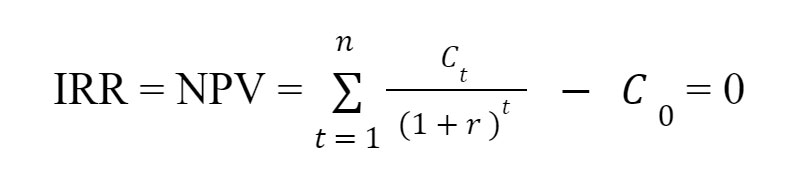
Where:
- IRR: Internal Rate of Return
- NPV: Net Present Value of the project’s cash flow
- Ct: Net cash inflow during the period t (Usually calculated annually)
- r: Discount rate
- t: Project implementation time / investment period
- C0: Initial investment cost of the investor (t=0)
The formula above shows that IRR is the solution to the equation where NPV = 0.
Based on the results of the financial indicators and the calculated IRR, a company can decide whether to invest by comparing the IRR with the discount rate as follows:
- IRR < r: reject
- IRR = r: reject or invest
- IRR > r: invest
Example: Company A plans to invest in project B with an initial investment of 6 billion over 4 years. In the first 2 years, the company needs to add 500 million in working capital. It is estimated that the working capital will be recovered in the final year of the project. Thus, for each year from 1 to 4, the project will generate 2 billion/year. Should the company proceed with the project? Given that r = 10%.
Solution
We have r = 10% => NPV = 0.23 > 0
Therefore, the company needs to choose a discount rate > 10% to be able to calculate NPV.
Assume: r = 15%, we have: NPV = – 0.44
=> IRR = 10% + 0.23 x (15% – 10%) / (0.23 + 0.44) = 11.7%
It is clear that IRR > r (i.e., 11.7% > 10%)
=>> Conclusion: The project has high profitability; the company should invest.
3. The Significance of the IRR Index
The significance of the IRR index for each specific user group is as follows:

– For businesses: IRR provides an important basis for businesses to make their investment decisions. They will know which projects are feasible and will quickly recoup their capital. Additionally, businesses can calculate IRR to evaluate and compare multiple projects in different fields. From there, the business can select the most profitable projects/investments.
– For securities: Investors in stocks or bonds use it to compare the IRR of different investment options. This helps them build an optimal investment portfolio. Based on this, they will allocate their investment funds intelligently to diversify financial risk.
In general, the IRR index helps businesses/investors make more effective and accurate investment decisions. By evaluating and measuring the capital recovery potential of projects/investments, businesses/investors can also significantly mitigate investment risks.
4.Below is a table evaluating the advantages and limitations of the IRR:
Evaluation Criteria
Advantages
Disadvantages
Target Users
Can be used by large, medium, and small enterprises
Not suitable for small-scale investment projects with low parameters
Representation
Expressed as a percentage (%) for easy and intuitive comparison
Feasibility
– Measures the effectiveness of the project/investment
– Easily determines the appropriate interest rate for the project
– Calculation is independent of capital.
– Provides a basis for businesses/investors to make investment decisions
– The indicators are calculated based on assumed data, so they are only relative and not 100% accurate.
– Does not accurately reflect the rate of return of the investment project
– Time-consuming to calculate, potentially missing investment opportunities with high net profits.
– The IRR indicator is heavily influenced by the time factor
– Easily determines the appropriate interest rate for the project
– Calculation is independent of capital.
– Provides a basis for businesses/investors to make investment decisions
– Does not accurately reflect the rate of return of the investment project
– Time-consuming to calculate, potentially missing investment opportunities with high net profits.
– The IRR indicator is heavily influenced by the time factor
However, in practice, cash flow control is easily affected by contract execution progress and payment terms.
For example, in the transport infrastructure construction industry, each project can involve dozens of contractors with hundreds of different contracts, lasting for many years. If the investor cannot control the acceptance terms, payment timing, or changes in raw material prices adjusted through contract addendums, the cash flow will be disrupted. This directly affects the payback period and makes the initially calculated IRR inaccurate.
Therefore, for the IRR to accurately reflect the project’s financial efficiency, businesses not only need to build a tight cash flow plan but also must closely monitor the entire contract execution and payment process.
5. The Relationship Between IRR and NPV
IRR and NPV are mathematically related. Simply put, IRR is the root of the equation where NPV = 0. The specific relationship between IRR and NPV is as follows:
| Evaluation Criteria | IRR | NPV |
| Unit of Comparison | – IRR is expressed as a percentage. | – NPV is expressed as a monetary amount. |
| Purpose | – IRR reflects the ability to recover capital. | – NPV reflects the feasibility of cash flow. |
| Dependency | – IRR calculation is time-dependent. | – NPV calculation is capital-dependent. |
In general, businesses/investors can flexibly use the IRR and NPV indicators to assess the feasibility of a project. Depending on the needs and characteristics of each investment project, businesses can consider selecting appropriate indicators as a basis.
>> See more: 7 steps to create an effective financial plan specifically for CFOs [Template included]
6. Guide to using IRR for businesses
Once you understand “what is IRR,” you can apply IRR to your business by following these instructions:
After clearly defining the purpose of using IRR, businesses can proceed to calculate and evaluate the IRR indicator in 6 simple steps as follows:
- Step 1: Determine the cash flow the business expects to invest over a specific period. (This includes revenue from sales, fixed costs, variable costs, and other cash flows related to the business.)
- Step 2: Determine the expected return from the project/investment.
- Step 3: Use the IRR formula for calculation.
- Step 4: Compare the IRR value calculated in step 3 with the discount rate (r).
- Step 5: Evaluate and consider other related factors such as risk, market, business strategy, and other financial factors to get a comprehensive view of the business’s potential for success.
- Step 6: Make the final decision.
Note: The IRR indicators are only relative and based on assumed data. Therefore, businesses should use them in combination with other methods and indicators to most accurately assess and measure the feasibility of a project.
Thus, the IRR indicator is an important metric that helps businesses/investors make more effective and accurate investment decisions. Based on the information shared in this article, 1Office believes you have found the answer to “what is IRR?” and know how to effectively apply IRR in your business’s investment activities. We wish you success!
7. Practical applications of the IRR indicator
The IRR indicator is not just a textbook concept but a practical tool that helps businesses make decisions. When applied correctly, IRR helps managers avoid inefficient investments and choose profitable opportunities. Here are a few common scenarios in business:
- Production expansion: A garment company wants to open a new factory with 5 billion in capital. The projected net cash flow is 1.5 billion/year for 5 years → the calculated IRR is about 18%. If the cost of capital is only 10%, this project is feasible and should be invested in.
- Comparing investment channels: A business has 10 billion VND and is deciding between investing in real estate (IRR 14%) and corporate bonds (IRR 8%). The IRR shows that real estate offers a higher return, but it comes with market risks.
- Purchasing machinery and equipment: The cost is 2 billion, expected to generate an additional cash flow of 600 million/year for 5 years → IRR is about 16%. Compared to a loan interest rate of 10%, the project is profitable and should be pursued.
Conclusion: IRR is a tool that helps managers quantify the benefits and costs of specific investment decisions, rather than relying on intuition.
8. Comparing IRR with other financial indicators
A common mistake is to rely solely on IRR to evaluate a project. In reality, IRR should be considered alongside other financial indicators for a comprehensive view. Each indicator has its own strengths and weaknesses, and they complement each other:
| Metric | Description | Difference from IRR | When to use |
|---|---|---|---|
| ROI (Return on Investment) | Calculates the percentage of profit on the total investment cost | Does not consider the time factor | Quickly evaluate short-term effectiveness |
| ROE (Return on Equity) | Profit on owner’s equity | Measures the efficiency of the entire enterprise, not for a specific project | Compare the efficiency of businesses in the same industry |
| Payback Period | Calculates the capital recovery time | Does not consider the time value of money | Small projects that require a quick payback |
| NPV (Net Present Value) | Measures the net present value of cash flow | NPV indicates whether the project creates additional value | Long-term investment analysis |
Conclusion: IRR is a powerful tool for evaluating the annual rate of return, but without combining it with ROI, ROE, Payback, and NPV, businesses can easily make one-sided decisions.
9. Common Mistakes When Using the IRR Metric
Although it is an important metric, IRR is not a “one-size-fits-all” tool for investment evaluation. Overusing IRR while ignoring related factors can lead to flawed decisions. Here are three common mistakes:
Focusing only on IRR while ignoring NPV
A high IRR does not mean the project creates value. If the NPV is negative, the project is actually reducing the company’s value.
Example: IRR is 18% but NPV = -200 million → the project is not financially efficient.
Applying IRR to projects with unconventional cash flows
For projects with alternating negative and positive cash flows, there can be multiple IRRs, causing confusion in the evaluation.
Example: A mining project with large maintenance costs in the third year can lead to multiple different IRR values.
Not comparing IRR with the cost of capital (WACC)
IRR is only truly meaningful when it exceeds the cost of capital. If IRR is lower than WACC, the project cannot cover the cost of capital.
Example: IRR = 12% while WACC = 14% → do not invest as the financial efficiency does not meet requirements.
10. Frequently Asked Questions (FAQs) about the IRR Metric
What is a good IRR?
There is no specific number for every project, but in principle, the higher the IRR, the better. A project is considered feasible when its IRR is greater than the company’s cost of capital (r). The further the IRR exceeds the discount rate, the greater the project’s margin of safety and profitability.
Why is a project with a high IRR still rejected?
There are two main reasons: First, the project has a high IRR but a negative or very low NPV (Net Present Value), not bringing significant surplus value. Second, the project’s scale is too small; a project with 100 million in capital and a 50% IRR is often less attractive than a project with 10 billion in capital and a 20% IRR in terms of total profit returned.
IRR vs. NPV: Which metric is more important for project appraisal?
NPV is considered the superior metric in financial analysis because it directly measures the amount of money (added value) that the project generates for the business. However, IRR is more intuitive for comparing the rate of return between different projects. Ideally, managers should use a combination of both metrics to make a comprehensive decision.
When should the IRR metric not be used?
You should not rely solely on IRR when a project has unconventional cash flow fluctuations (alternating positive and negative cash flows multiple times during the project’s life cycle). In this case, the equation NPV = 0 can yield multiple different IRR results, leading to inaccuracies in evaluating investment efficiency.
What is the fastest and most accurate way to calculate IRR?
Instead of time-consuming manual calculations using the trial-and-error method, you should use the =IRR function in Excel or comprehensive management software like 1Office to replace separate spreadsheets with a centralized data system, ensuring all investment decisions are based on real and transparent figures.
-
- Automate cash flow, integrate sales and expense data
- 1AI Agents for analysis, forecasting, and financial risk warnings
- Centralized contract management, optimizing cash flow and payback period
- No-code customization of financial reports for specific needs
Register for a free feature demo!
11. Conclusion
IRR is a key “yardstick” that helps businesses quantify profitability and select optimal investment projects. However, to make the most accurate decisions, managers need to consider IRR in close relation to NPV and other financial metrics.
Instead of struggling with manual figures, the 1Office platform helps you control cash flow automatically and transparently in real-time. This is the solid foundation for businesses to eliminate risks, master data, and confidently make breakthrough investment decisions.
















