


 11/05/2026
  259 views
VUCA is a term that is gradually becoming familiar to all businesses operating and growing in the 21st century. Along with the daily changes across the globe, VUCA has become one of the prominent issues that businesses must face. So, what is VUCA? How does it affect businesses, and how can they overcome it? Let’s delve into the details with 1Office in this article.
Mục lục
1. What is VUCA?
VUCA is an acronym for four factors: Volatility, Uncertainty, Complexity, and Ambiguity. In the context of modern life, the concept of VUCA is used by business leaders and strategic managers to describe the modern business environment, especially in an era where change is rapid, unpredictable, and often intertwined with many complex factors.

2. Example of VUCA
The term VUCA was previously used by the U.S. military to describe the new world context—an environment where challenges are no longer fixed but have become unpredictable, complex, and rapidly changing. Today’s business world faces similar changes, especially in the context of globalization, rapid technological development, and economic fluctuations. Therefore, VUCA has become a tool for organizations to better perceive and respond effectively to constant changes.
The explosion of artificial intelligence technology is a clear illustration of VUCA in the modern work environment. Volatility occurs as AI technologies, such as ChatGPT and automation, develop at an extraordinary pace in a short time, forcing many industries to change their operations or face the risk of labor replacement. Uncertainty is demonstrated by the difficulty in accurately predicting the speed and scope of AI adoption, as well as the legal and social impacts it brings. Complexity lies in the fact that businesses must balance investing in new technology, retraining staff, and maintaining business efficiency. Meanwhile, Ambiguity arises when it is unclear how the labor market trend will change: Will AI create new jobs or increase the unemployment rate?
This example shows that businesses not only need to update their technology but also must build long-term strategies to manage human resources, protect their competitive advantage, and ensure sustainability in a volatile and unpredictable environment.

3. Factors that help identify a VUCA era
The factors that help identify a VUCA era typically revolve around the four main characteristics of the environment that a business or organization is facing. Specifically:
Volatility
Volatility: This represents the rapid and unpredictable changes of factors in the operating environment. These can be changes in technology, markets, or economic conditions without prior warning signs. Volatility demands a high degree of flexibility and quick response, as delays can cause a business to miss opportunities or suffer heavy losses.
Uncertainty
The VUCA environment affects Vietnamese businesses in various ways, and its consequences can be significant. Here are some specific impacts:
- Market Volatility: Businesses must face rapid changes in demand and prices. Flexibility and agility in adjusting business strategies are necessary, but this can lead to increased costs and reduced operational efficiency.
- Difficulty in Market Forecasting: Uncertainty in the market and economic policies. Businesses find it difficult to forecast and make long-term plans, which can lead to inaccurate decisions and higher risks.
- Complexity in Management: Economic, political, and social factors are becoming more complex. Businesses need to invest more in managing and solving complex issues, increasing management costs and reducing overall efficiency.
- Ambiguity in Information: Information is unclear and difficult to understand. The ability to analyze and make decisions is affected, leading to decisions based on limited and inaccurate information.
- Reduced Competitiveness: In a volatile and uncertain environment, businesses struggle to maintain and enhance their competitiveness. Businesses can be left behind by competitors if they do not adapt and innovate in a timely manner.
- Difficulty in Attracting and Retaining Talent: The VUCA environment can create pressure and stress for employees, making it more difficult to attract and retain talent. A talent shortage can reduce performance and creativity, negatively impacting the long-term development of the business.
5. 5 Mindsets Managers Need to Face VUCA
Flexibility is the Key to Stability
In the rapidly changing VUCA era, flexibility becomes a key factor in ensuring stability and success. Contrary to the belief that stability only comes from steadfastness and “standing still,” flexibility allows us to adapt easily, maintain stability, and avoid the risk of being left behind. Every business needs to continuously update to adapt to the “new normal” appropriate for each stage.
Flexibility is demonstrated through the ability to accept change, adapt to new things, and continuously learn and develop. A flexible person can view problems from multiple perspectives, solve situations creatively, and make quick, effective decisions.
Simplify Complexity with a Multi-dimensional Perspective
As society becomes increasingly chaotic, unofficial and misleading sources of information are also booming. We can easily get caught up in various information streams, leading to negative impacts on ourselves and those around us.

Therefore, when receiving information, pause to think carefully before commenting or making a final decision. The best approach is to listen, filter information from an objective and multi-dimensional perspective, and ensure the authenticity of the matter.
Manage Risks to Limit Losses
In today’s increasingly complex business environment, with the interaction of many factors and fields, risk management helps to analyze and understand these complex factors, thereby identifying potential risks and implementing measures to mitigate negative impacts.
In the VUCA era, to cope with rapid change, risk management helps leaders establish flexible mechanisms, ready to adapt to any situation that may arise. This skill not only helps minimize negative impacts but also seeks opportunities to capitalize on, turning risks into advantages. Sometimes, uncertain situations can even open up opportunities for businesses to get ahead and create a competitive edge over rivals.
Leverage Technology to Stimulate Creativity and Innovation
Digital transformation has penetrated every corner of modern society. In this trend, to enhance efficiency and flexibility, every individual, organization, and business needs to understand and apply new technologies such as artificial intelligence, automation, and blockchain in their daily operations.

Technology helps accelerate information processing, data transmission, and customer interaction, thereby shortening response times and enabling more flexible decisions and actions. At the same time, technology provides a platform to promote innovation and creativity, from artificial intelligence and machine learning to data analytics and the Internet of Things (IoT). Technology also fosters a collaborative environment and workflows, stimulating creativity and improvement.
Especially in the VUCA era, technology expands access to information and knowledge from all over the world. The Internet and connectivity technologies provide a rich repository of resources, from online learning to market research, helping individuals and organizations grasp the latest information and apply it to their business operations.
Build a Collaborative Network for Development
Building a network with people who share similar viewpoints and goals is crucial. Collaborating with others and leveraging diversity will help in learning and achieving common objectives.
In the VUCA era, creativity and innovation are essential for adapting and creating new value. Collaboration between individuals, organizations, and networks plays a key role in creating an environment that encourages creativity and the sharing of new ideas.
A strong network allows for the sharing of knowledge and experience among its members. In the context of VUCA, information and knowledge spread rapidly and can change constantly. Strong collaboration and networks help people grasp the latest information and learn from each other to adapt and achieve greater efficiency. By working together, sharing resources, and supporting one another, individuals and organizations can form a powerful force to cope with uncertain and complex situations.
6. Effective Management Strategies in the VUCA Era
VUCA presents many challenges for businesses, forcing leaders to build suitable and effective strategies to ensure the organization’s survival and growth. Below are 4 important management strategies that businesses should pay attention to in the VUCA era:
6.1 Counter Volatility With Vision
In the VUCA era, businesses need to define a clear and flexible vision to adapt to rapid market changes. Forecasting trends and developing contingency scenarios for unexpected changes is crucial, helping businesses prepare flexible action plans. Clear and transparent communication ensures that the vision and strategy are conveyed to all employees, building trust and engagement between management and staff.
Enhancing flexibility in management and operations, being ready to adjust strategies according to the actual situation, along with continuous innovation, encourages creativity within the business to find new and effective solutions. Investing in upgrading employees’ skills and knowledge helps them prepare to face changes and challenges, creating an attractive work environment and development opportunities to attract and retain top talent.
One of the solutions to help businesses Counter Volatility With Vision is to build a Business Continuity Plan (BCP). This is an important tool that helps businesses maintain operations in the event of a disruption, such as the COVID-19 pandemic. Developing and implementing a BCP helps businesses minimize damage and recover quickly after an incident.
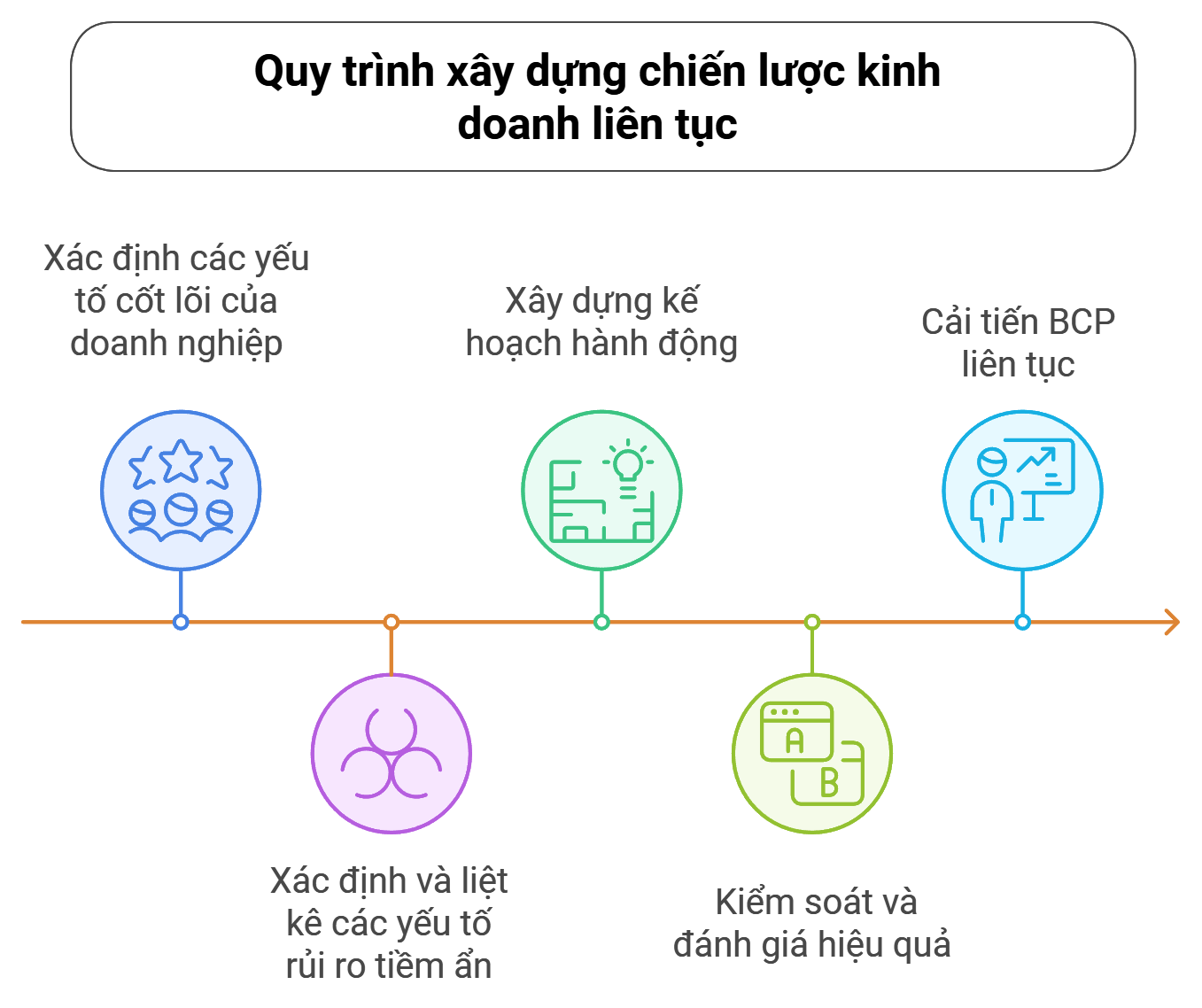
Step 1 – Business Impact Analysis
Identify critical business functions and assess the impact of their disruption. This step helps determine which activities need to be prioritized for recovery and the maximum acceptable recovery time.
Step 2 – Risk Identification and Control
Identify potential risks that could disrupt business operations, including factors like natural disasters, fires, cyberattacks, and other risks. Then, evaluate existing control measures and propose additional ones to mitigate these risks.
Step 3 – Develop an Action Plan
Businesses should start by reassessing their strategic vision and identifying risks and opportunities. Prioritize adopting agile management methods, building a team with rapid adaptation capabilities, and investing heavily in technology and data to make timely, informed decisions.
Some strategies that businesses can implement:
- Diversify products and markets to minimize concentration risk
- Establish flexible response scenarios for each situation;
- Maintain transparency in internal communication to enhance consensus.
- Focus on innovation and building a culture of continuous learning, helping the business not only survive but also thrive sustainably in an unstable environment.
Step 4 – Control and Performance Evaluation
Control and evaluate the effectiveness of the BCP to ensure it is implemented efficiently and meets its objectives. This includes ensuring the BCP aligns with the current business direction and potential risks, ensuring employees and stakeholders adhere to the BCP procedures, and assessing the BCP’s success in mitigating risks and recovering from disruptions.
Step 5 – Continuous BCP Improvement
The BCP needs to be continuously improved through periodic reviews and enhancements based on control and evaluation results. In particular, the BCP must be updated immediately when a new incident occurs and the BCP is ineffective, when employees do not comply with the procedures and guidelines in the BCP, or when there are changes in the company’s business operations.
Additionally, diversifying suppliers and maintaining inventory reserves are two important strategies to help businesses mitigate risks from supply chain disruptions. By not depending on a single supplier and leveraging price and quality advantages from various sources, businesses can ensure smooth production and business operations.
Meanwhile, setting flexible goals for personnel, which can be modified as needed, helps the business adapt quickly to the actual situation. Flexible goals not only motivate employees and increase productivity but also build a good relationship between the company and its workforce, ensuring mutual success for both the organization and individuals.

6.2 Meet Uncertainty With Understanding
First, businesses need to gather comprehensive information. This includes monitoring market trends, economic policies, and other factors that can affect business operations. Data analysis tools and advanced technology can assist in efficiently collecting and processing information, helping businesses gain a comprehensive and detailed view of the business environment.
Next is analyzing and interpreting information. Businesses need the ability to analyze the collected information to identify potential opportunities and challenges. This process requires a combination of experience and analytical skills, as well as the ability to interpret data to make accurate and timely assessments.
Third, businesses must develop scenarios and contingency plans. This helps prepare for unexpected situations and minimize negative impacts. Contingency scenarios must be flexible and adjustable based on the actual situation. Contingency planning includes identifying the necessary measures to maintain continuous business operations in various situations.
Finally, businesses need to enhance adaptability and innovation. In an uncertain environment, the ability to adapt quickly to changes and continuously innovate is a key factor in maintaining competitiveness. Businesses need to encourage a spirit of creativity and flexibility within the organization, while also building a corporate culture that supports innovation and change.
6.3 React to Complexity With Clarity
The “React to Complexity With Clarity” strategy emphasizes the importance of clarity in handling complex situations. This is an approach that helps businesses reduce confusion and create a solid foundation for solving complex problems.
- Identify and clearly understand the problem: Analyze and clearly identify relevant factors, using analytical tools to understand the root cause and impact of the problem.
- Communicate information transparently: Provide accurate and easy-to-understand information to all stakeholders, building trust and strengthening engagement.
- Develop and implement clear processes: Establish clear operational processes, providing direction and specific guidance for each step.
- Create a transparent work environment: Build an open work culture where employees feel comfortable sharing opinions and discussing ideas, encouraging collaboration and creativity
In this way, the complexity within a business’s operational machinery can be broken down into smaller problems, and each problem can be thoroughly solved with a specialized tool.

6.4 Fight Ambiguity With Agility
The “Fight Ambiguity With Agility” strategy emphasizes the importance of flexibility and adaptability in an ambiguous business environment. Below are the main steps of this strategy:
- Adapt quickly: The ability to adjust strategies and operations quickly when new information or situations arise.
- Flexible decision-making: Apply agile thinking in decision-making, being ready to experiment and adjust strategies based on actual results.
- Continuous learning: Encourage a culture of continuous learning and development within the business, thereby improving the ability to cope with ambiguity and uncertainty.
- Clear communication: Maintain transparent and effective communication within the organization to ensure everyone clearly understands goals and direction.
By applying this strategy, businesses can overcome ambiguous challenges and maintain competitiveness in the VUCA era.
7. Conclusion
This article covers the concept of VUCA, its meaning, and the four core management strategies for the VUCA era. Clearly, VUCA is an unavoidable reality in the modern business environment. However, businesses need to recognize and leverage both the challenges and opportunities that VUCA presents, while using advanced knowledge and technology to adapt and thrive in this volatile and uncertain business landscape.
















