


 12/05/2026
  247 views
Effective sales staff management is one of the most challenging problems for many managers. If a business understands the methods to effectively manage its sales team, it can easily increase revenue and employee productivity. So, what is the most optimal way to manage sales staff today? Join 1Office to explore detailed ways to manage a sales team in the article below.
Mục lục
- 1. Criteria for Evaluating Sales Staff Effectiveness
- 2. Benefits of Effective Sales Staff Management
- 3. 10 Most Optimal Ways to Manage Sales Staff Today
- 3.1 Building the Profile of a Great Salesperson
- 3.2 Provide regular training to enhance professional skills
- 3.3 Build a professional sales process
- 3.4 Set sales plans and goals for each individual
- 3.5 Establish appropriate reward policies and systems
- 3.6 Standardize management methods
- 3.7 Training communication skills for sales staff
- 3.8 Regularly evaluate and check work performance
- 3.9 Applying 1HRM software to support sales staff management
- 4. Manage sales staff effectively with 1HRM
1. Criteria for Evaluating Sales Staff Effectiveness
Each business will have its own criteria and evaluation factors to measure the work effectiveness of its sales team, but the following evaluation factors are commonly used:
1.1 Work Attitude
Attitude is one of the most important factors when evaluating an employee’s work performance. For new employees, a lack of knowledge and experience can be trained and accumulated over time. However, their attitude towards work is a factor that is difficult to change. There are many criteria related to attitude, such as honesty, enthusiasm, diligence, and respect for colleagues and customers,…
1.2 Professional Expertise
Regardless of what product you are selling, understanding the product is essential to provide accurate information and persuade customers. If you don’t understand the product, you may struggle to answer customer questions and fail to offer suitable solutions. This is also one of the reasons many salespeople fail to close deals.
1.3 Customer Interaction
Communication is one of the most crucial skills a salesperson must have. The interaction between staff and customers occurs not only through messages and consultation calls but also through direct exchanges in-store and post-purchase. An excellent salesperson always knows how to listen, empathize, and understand the customer’s true desires, thereby providing suitable advice and recommendations.
1.4 Level of Task Completion
To evaluate a salesperson’s performance, you can rely on the following criteria: the volume of assigned work and completion time, and monthly, quarterly, and yearly sales KPIs. Evaluating based on actual data not only ensures a fair process but also creates transparency and persuasiveness.
2. Benefits of Effective Sales Staff Management

Why do managers need to manage sales staff, and how can it be done most optimally and effectively? This is certainly a question many managers ask today. To clarify this issue, let’s explore the following 4 benefits:
2.1 Optimize Human Resource Management
A company’s growth depends on optimizing human resource management, especially in the sales and business sector, as salespeople are considered the core force for effectively tapping into potential markets. Effective sales staff management also makes business operations easier and faster to grow, saving time and effort for managers.
2.2 Increase Customer Conversion Rates
The customer conversion rate reflects the number of potential customers who become successful purchasing customers. This factor directly determines the number of orders and the company’s revenue. Improving this rate is an excellent method to enhance sales performance in both online and offline business.
2.3 Retain Existing Customers
One of the advantages of effective sales staff management is enhancing the customer’s shopping experience and building a sustainable relationship between employees, the business, and customers. Dedicated and transparent consultation and care help customers become loyal brand advocates.
2.4 Reduce Costs, Increase Profits
Effective management helps accelerate business growth. A professional and standardized work system connects all activities of the sales staff, making support and sales planning easier, thereby boosting revenue growth. Additionally, effective human resource management also helps reduce the risk of financial losses and costs related to personnel administration.
3. 10 Most Optimal Ways to Manage Sales Staff Today
3.1 Building the Profile of a Great Salesperson
Effective sales staff management begins with identifying the characteristics of an excellent salesperson. Once these are recognized, managers can look for salespeople with these qualities to add to the team, thereby building a strong sales force.
Some characteristics of a great salesperson include:
- Critical thinking
- Empathy
- Listening skills
- Good persuasion
- Effective communication
- Good problem-solving skills
3.2 Provide regular training to enhance professional skills
Employee training is extremely important as it helps employees improve their knowledge and skills in the sales field. This is also an effective sales staff management method that managers should apply.
Managers should focus on establishing training and guidance programs for new employees, then test them by asking them to perform a demo of a sales script for a new product or a plan to boost sales. Afterward, the manager needs to provide evaluation and feedback. Sometimes, new hires are not familiar with the new work environment, so they need time to adapt and work effectively. In this case, the manager is responsible for helping them adapt quickly and identifying their strengths to leverage.
During the training process, managers should focus on enhancing the following skills for sales staff:
- In-depth product knowledge
- Prospecting skills
- Communication skills
- Questioning skills
- Listening skills
- Understanding customer psychology
- Customer relationship-building skills
- Persuasion skills
- Overcoming objections skills
- Closing skills
- Time management skills
3.3 Build a professional sales process
A sales process is a series of specific, visual actions that a salesperson needs to take to convert a prospect into a customer.
Many businesses have not yet implemented a professional sales process, leading to a situation where salespeople handle customer care based on personal experience. As a result, some customers may make a purchase within a week, while others take 3-4 months to decide. This inconsistency in customer approach and care leads to low sales efficiency.
Most salespeople operate based on experience. If the team has many experienced employees, sales performance will be higher. This makes it difficult for new employees to integrate and adapt, and it can take several months before they can start selling the product. The lack of a common sales process makes it difficult to expand the team, creating obstacles to business growth.
Building an effective sales process is a method managers should adopt for the following key benefits:
- Helps managers and leaders easily control and evaluate the activities and performance of the sales department.
- Reduces the gap in sales skills and proficiency between new and existing employees.
- Makes it easier to expand the sales team and scale the business.
See more:
- The 8-step basic sales process to double employee efficiency
- 8 steps to create a sales plan and 5 common mistakes businesses make
- The standard 7-step B2B sales process for every business
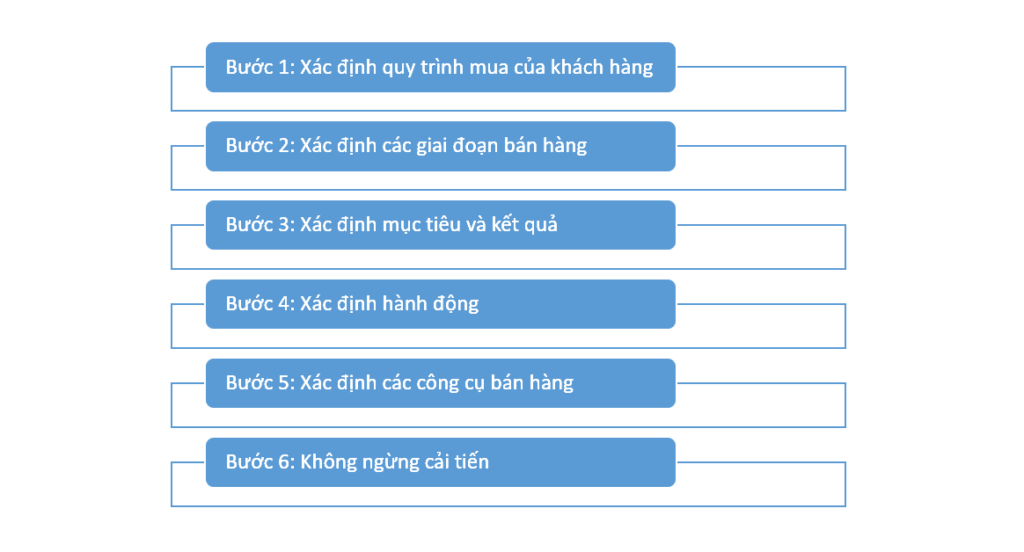
Building a sales process will bring many benefits to the business. Essentially, the most optimal sales process today includes the following steps:
3.4 Set sales plans and goals for each individual
Defining projected sales goals and creating specific plans for each period, such as weekly, monthly, quarterly, or yearly, is crucial in sales operations. Managing employees without a clear understanding of the work process can lead to confusion and delays, making it difficult to identify the root causes of problems. Furthermore, writing down specific goals helps you easily and quickly assess the success of sales activities.
3.5 Establish appropriate reward policies and systems
Establishing a clear and fair reward system will help guide salespeople in the right direction for development and stimulate their motivation to work. They will clearly understand why they need to strive and what they must do to achieve that goal. However, for easier management, you need to categorize salespeople based on criteria such as job position, sales method (online or in-person), etc.
3.6 Standardize management methods
Building trust between managers and employees is crucial to becoming an excellent manager. One of the best ways to show you are trustworthy and respected is to maintain consistency in your actions. When you commit to doing something, do it immediately. At the same time, ensure that any changes in sales processes and plans are clearly communicated to all employees to avoid unnecessary risks and blame later on.
3.7 Training communication skills for sales staff

For sales staff, communication skills are considered the key to success, helping them execute assigned plans well and build strong relationships with customers. In many cases, salespeople become the public face of the entire company, so perfecting communication skills is extremely important. When consulting for online sales, speaking fluently and maintaining a positive attitude are essential basic requirements. Additionally, body language should be used when consulting with customers directly in-store.
3.8 Regularly evaluate and check work performance
Regular performance evaluation and feedback is one of the most effective methods for managing sales staff, as encouragement and affirmation from the manager are the motivation for them to continue excelling at their work. Furthermore, fair assessments help salespeople recognize their weaknesses and improve them promptly in their work process.
3.9 Applying 1HRM software to support sales staff management
As people who frequently work in the field, salespeople often have freedom in their work and are not closely monitored by their managers. Therefore, it is inevitable that employees will take time for personal tasks. As a result, at the end of the month, they might inexplicably increase the number of customers or split orders to ensure sales figures do not drop.
To address the issues above, managers can apply technology solutions to their sales staff management. Specifically, when using the sales staff management solution 1HRM within the 1Office total enterprise management solution suite, managers can easily assign monthly/quarterly/yearly targets to each employee and monitor the team’s performance through automated reports that provide specific information such as sales target progress, number of new opportunities created, win/loss rates, completion rates, and opportunity conversion rates.
This allows managers to track the performance of KPIs assigned to employees, understand the interactions between salespeople and customers, determine whether customer contact and care have been carried out, assess the employee’s reach with customers, and measure the sales achieved.
4. Manage sales staff effectively with 1HRM
1Office HRM is one of the best human resource management software on the market today. This software is an ideal solution suitable for all Vietnamese businesses, from small-scale (>10 employees) to large-scale (>300 employees). The 1Office HRM software has many smart features that help thoroughly solve problems related to recruitment management, HR, timekeeping, payroll, and performance evaluation accurately and quickly,…
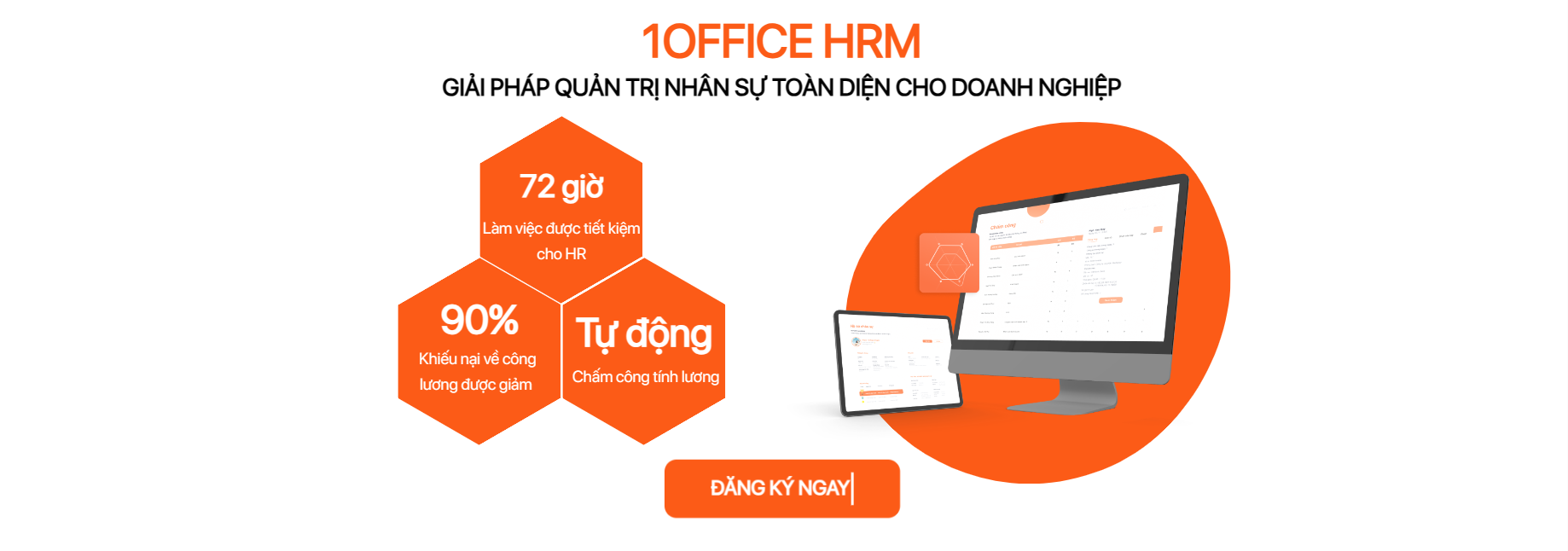
When using the 1Office HRM human resource management software, managers will easily see the following outstanding advantages:
- The employee profile management software helps digitize information and administrative forms, and quickly updates them into the timekeeping and payroll sheets
- Connects with over 90% of time clocks on the market, making it convenient to check employee hours. Timekeeping data is entered into the timesheet, and the system automatically syncs to generate information. This helps accountants save a significant amount of time in calculating and managing employee work hours, as well as salaries and bonuses…
- Quickly links with other modules to extract data for calculating work and salary, such as: KPIs, sales figures, etc., helping HR save up to 85% of the time spent queuing at the bank to process payroll
- Updates the working status of personnel, helping managers understand internal staff fluctuations and make the best decisions and solutions
- Tracks employee development through performance review periods
- Timekeeping via GPS location, so users only need to set the timekeeping location at a custom position
- Pay salaries directly on the software through MB Bank quickly and conveniently.
Register for a free Demo account to try 1Office’s features!
Some outstanding features of 1Office HRM that help CEOs and HR managers implement a more effective and convenient sales staff management process include:
- Recruitment process management: A comprehensive recruitment management system, including creating recruitment requests, managing and evaluating candidates from various job websites. Customizable criteria are integrated to find suitable candidates for the job position.
- Training and development management: 1Office HRM allows tracking the training and development process of employees, providing an overview of work performance, employee quality, and other important metrics. This helps managers assess the capabilities of each employee to create personalized training plans.
- Employee profile management: 1Office HRM digitizes and stores data related to employee profiles, labor contracts, insurance information, leave management, and other information on a cloud computing platform. It supports the HR and accounting departments in calculating insurance costs and managing insurance procedures according to state regulations.
- Benefits and reward/penalty policy management: Integrated with the work management system and KPI management feature, the software automatically calculates criteria and targets. Managers can evaluate employee performance, track work completion progress, and automatically apply reward and penalty policies to employee payroll.
——————–
Above are 1Office’s insights on the 10 most optimal ways to manage sales staff today. We hope the information in this article will help your business understand the importance and useful methods for managers to effectively manage their sales teams. We wish you success!
















