


 12/05/2026
  443 views
ISO is a set of standards that many businesses are interested in when they want to standardize processes, improve quality, and increase reliability with partners and customers. But what is ISO, what standards are there, and what do businesses need to understand before applying them? This article will help you quickly grasp the most important points.
Mục lục
What is ISO?
ISO is an abbreviation for the International Organization for Standardization. This organization was founded in 1947 and is headquartered in Geneva, Switzerland.
As of 2023, ISO has 169 member countries, with Vietnam being the 77th to join. While ISO standards are issued under international names, in Vietnam they are often known as TCVN (Vietnam Standards).
ISO plays a crucial role in facilitating the exchange of goods, services, and trade, both domestically and internationally. Applying ISO standards brings high efficiency and enhances the value of a business in the international community.
To date, ISO has published over 20,000 standards applicable to a wide range of fields such as manufacturing, technology, services, agriculture, food, and the environment. Each ISO standard sets out specific requirements and regulations corresponding to its field. For example, ISO 9001 focuses on quality management, while ISO 14001 focuses on environmental management. These standards play a vital role in defining and improving the performance, safety, security, and social responsibility of organizations.
What is an ISO standard?
ISO is a set of internationally standardized rules aimed at helping organizations achieve sustainable development and build capacity to add value in all areas of production, trade, and services. Applying ISO standards helps ensure that products meet users’ quality requirements.
ISO standards are the global criteria that organizations and businesses must meet to receive ISO certification. Implementing ISO standards within a business or organization requires applying them to all aspects of operations, not just the production process but also management and human resources organization.
ISO plays a crucial role in creating a common platform and international standardization, supporting a more efficient exchange of goods, services, and trade both domestically and abroad. Adhering to ISO standards not only builds trust and credibility in the international community but also increases the value of the business. For this reason, ISO plays a vital role in promoting and perfecting business operations, while also opening up opportunities for expansion in the international market.
Applications of ISO standards
A standard, once created and widely accepted in most countries around the world, plays an important role for both parties: The business and the consumers of that business’s products.
For consumers, choosing a product or service based on a standard is important, as it serves as a measure of the reliability of the businesses or organizations they choose. This standard plays a crucial role as an objective factor for assessing an organization’s trustworthiness and also provides a basis for comparison between different organizations.
For businesses
- Enhance competitiveness in both domestic and international markets.
- Increase access to new markets.
- Save costs thanks to standardized processes.
- Build brand reputation and customer trust.
For consumers
- Ensure the quality and safety of products.
- Easily differentiate when comparing similar products.
- Save time in choosing suitable products.
Examples of ISO standard applications
Some examples of practical applications of ISO standards:
- ISO 9001: Applying an advanced quality management system to improve business production efficiency.
- ISO 14001: Building a sustainable and friendly environmental management process.
- ISO 22000: Applying measures to ensure food safety and hygiene.
- ISO/IEC 27001: Securing customer information and data assets.
- ISO 13485: Meeting the strict requirements for medical devices.
Why should you apply ISO standards?
Organizations and businesses should implement ISO for several important benefits:
- Improve quality: Applying ISO helps businesses control and improve production and service delivery processes. As a result, product and service quality is significantly improved, better meeting consumer needs.
- Enhance work performance: ISO standards for system management help optimize workflows, increase efficiency, and reduce waste for the business.
- Comply with laws and regulations: Implementing ISO standards means complying with industry and legal regulations, helping to reduce legal risks for the organization.
- Build organizational credibility: ISO-certified organizations have a higher reputation in the market. ISO compliance demonstrates the organization’s reliability to customers, partners, and regulatory bodies.
- Expand business opportunities: ISO certification helps expand opportunities for collaboration with large foreign partners or government agencies. Applying ISO standards gives businesses more opportunities to access new markets with many potential customers.
What are the conditions for achieving ISO certification?
Each type of ISO standard has its own requirements and conditions for certification. You can research the specific conditions for each type that suit your business needs. However, some basic, preliminary conditions for obtaining ISO certification in general include:
- Develop a documentation system: This includes a quality manual, work procedures, technical instructions, etc., that comply with the required ISO standard.
- Train employees: Organize training so that employees understand the requirements and are able to apply the ISO standard.
- Practical compliance: ISO requirements must be consistently implemented in all of the business’s actual operations.
- Maintain the system: After certification, the business must maintain and improve the system to ensure it remains relevant over time.
- Undergo periodic surveillance: The certification body will conduct periodic surveillance audits to ensure the business is maintaining the system properly.
Popular ISO standards today
3.1 ISO 9000 Standard
ISO 9000 is a system of quality management standards widely applied globally. It plays a crucial role in helping organizations build and maintain an effective quality management system, ensuring their products and services fully meet customer requirements. ISO 9000 is not just a set of standards but also an important tool for enhancing and strengthening reliability and delivering customer satisfaction.
Some benefits of applying ISO 9000:
- Improve the quality of products sold in the market
- Minimize costs due to errors and resource waste
- Increase efficiency and labor productivity through clear processes
- Build credibility with customers, partners, and investors
- Promote accessibility and expansion into new markets
ISO 9000 sets out the minimum requirements for a quality management system:
- Clearly define the responsibilities of top management
- Establish a quality policy and improvement objectives
- Plan and document work processes
- Train and develop human resources to implement the system
- Measure, analyze, and continuously improve processes
Reference: HR management process flowchart with 7 steps according to ISO standards
3.2 ISO 9001 Standard
ISO 9001 is part of the ISO 9000 system, focusing on specific standards related to the quality management system. ISO 9001 is designed to assess the entire quality management process, from planning and control to continuous improvement. In this way, ISO 9001 helps organizations improve performance and enhance their competitiveness in the market.
3.3 What is the ISO 13485 Standard?
The ISO 13485 standard is an international standard applied to organizations that manufacture medical devices. This standard sets out quality and safety requirements for the production and control process of medical devices. ISO 13485 supports organizations in complying with quality control procedures and meeting legal regulations in the medical field, from the design process to the production and distribution of medical products.
ISO 13485 is very important for businesses operating in the medical device industry, with benefits including:
- Ensuring the quality and safety of medical devices
- Complying with European and US medical device regulations
- Building credibility with customers
- Promoting the export of medical devices to the international market
3.4 ISO 14001 Standard
ISO 14001 is an environmental management system standard that helps businesses control the environmental impact of their production and business activities.
ISO 14001 encourages and promotes sustainable environmental protection, creating favorable conditions for organizations to comply with environmental procedures and regulations:
- Minimizing costs from resource waste and waste treatment
- Increasing the efficiency of raw material usage
- Improving the corporate image with the community and partners
- Accessing customer markets that are environmentally conscious
3.5 ISO 20000 Standard
The ISO 20000 standard is an Information Technology Service Management (ITSM) standard. It sets out the requirements for establishing and maintaining an effective IT service management system. ISO 20000 helps businesses improve the quality of IT services, enhance their ability to serve consumers and customers, and meet both technical and procedural requirements when operating in the information technology field.
3.6 ISO 22000 Standard
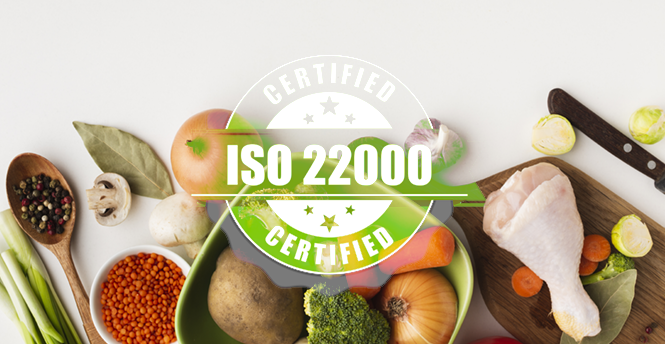
The ISO 22000 standard is a food safety standard applied to organizations in the food supply chain. This standard sets out requirements for food safety management, covering processes from production, transportation, and storage to food processing. ISO 22000 helps organizations ensure the safety and quality of food products, while enhancing reliability and reputation in the market.
3.7 ISO 26000 Standard
ISO 26000 is the international standard for social responsibility of organizations. It defines principles and guidelines for organizations to implement social responsibility, including areas such as business ethics, community interaction, and environmental protection. ISO 26000 helps organizations achieve a balance between economic, social, and environmental interests.
3.8 ISO/IEC 27000 Standard
The ISO/IEC 27000 standard is an information security management standard applied to organizations that manage and protect information. This standard defines the requirements and procedures for an organization to protect important information and ensure its confidentiality. ISO/IEC 27000 helps organizations identify and mitigate information security risks, while enhancing reliability and reputation in information management.
3.9 What is the ISO 45001 Standard?
The ISO 45001 standard is a standard for occupational health and safety management. It sets out the requirements for establishing and maintaining an effective occupational health and safety management system. ISO 45001 helps organizations ensure a safe working environment, protect employee health, and comply with legal regulations related to labor safety.
3.10 What is the ISO/IEC 17025 Standard?
ISO/IEC 17025 is an international standard for laboratories and testing organizations. This standard sets out requirements for technical competence and quality management processes in conducting tests and analyses. ISO/IEC 17025 plays a crucial role in ensuring the accuracy of test results, while enhancing the reliability and reputation of laboratories and testing organizations.
1Office Software Achieves ISO/IEC 27001:2013 Certification
Based on the results of evaluation, assessment, and the decision to certify compliance with standard requirements, the certification body TUV NORD CERT GmbH confirms that 1Office Joint Stock Company operates a management system in accordance with the requirements of the ISO/IEC 27001:2013 standard. Scope of certification: Development and provision of an all-in-one business management platform including human resource management (HRM), customer relationship management (CRM), and a digital workspace. Statement of applicability from July 21, 2023.
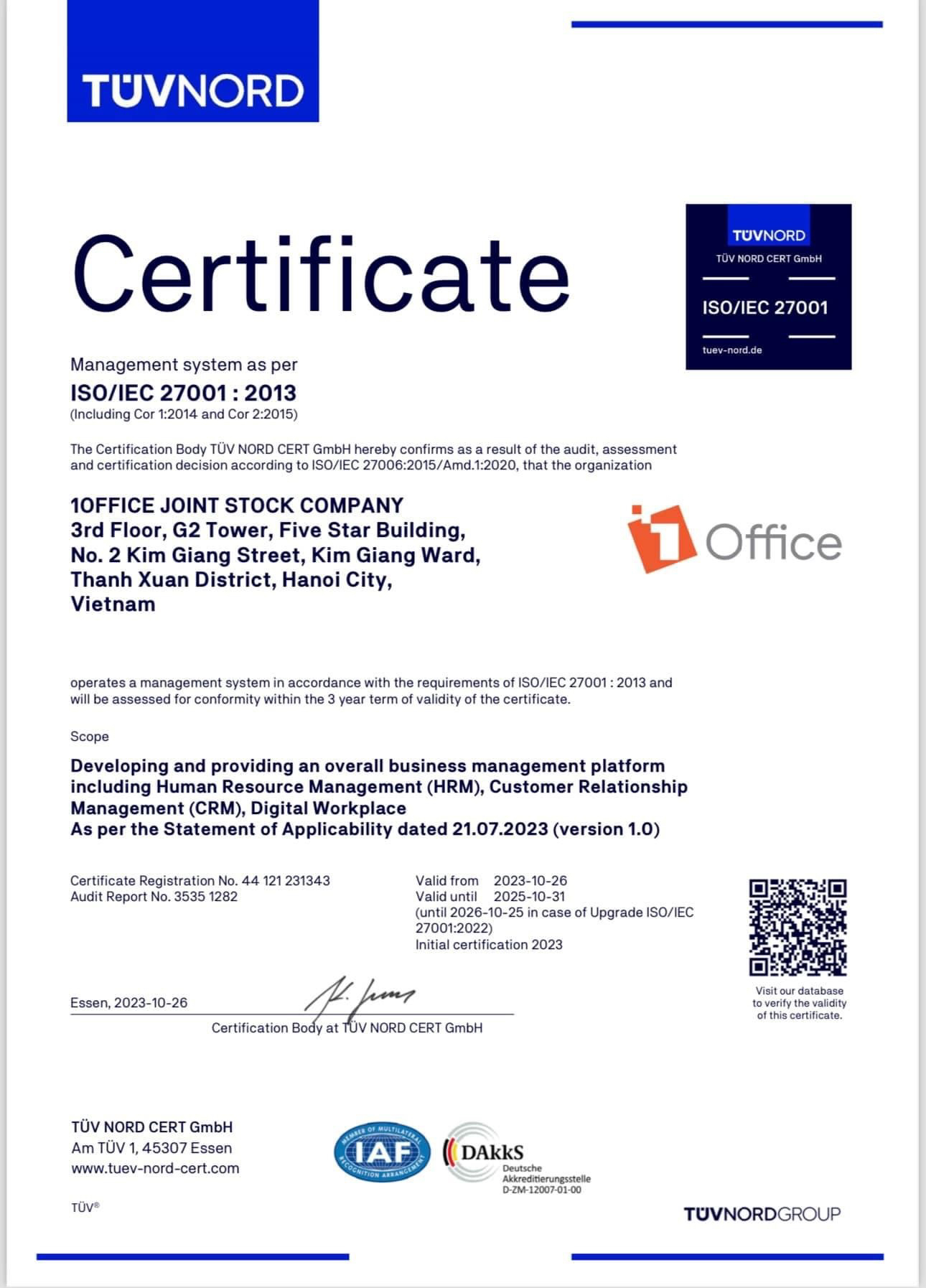
Information is an asset “more precious than gold.” Therefore, 1Office always values:
- Information security risks are fully identified. The information security awareness of employees at all levels is enhanced.
- Security, system setup, control establishment, and processes to minimize threats and risks.
- Proactivity in work thanks to a response plan for crisis/disaster situations.
- Ensuring that 1Office’s business operations are not interrupted by information security incidents.
- Meeting the requirements of the law and relevant parties.
Not only do we focus on developing products that solve the “pain points” of businesses in operations and management, we also prioritize the safety and security of our customers’ information, demonstrating our commitment and partnership with businesses on their digital transformation journey. Customers come to 1Office with trust, and we reciprocate with reliability and quality.
The international ISO/IEC 27001:2013 certification affirms the credibility of 1Office, promoting globalization and expanding opportunities for international cooperation. 1Office is constantly striving on its journey towards the goal of bringing “made in Vietnam” technology products beyond Vietnam’s borders, reaching one million users by 2025, and becoming the number 1 business management platform in Southeast Asia.
Experience our internationally ISO-certified software!
Above are some concepts and knowledge about what ISO is, why ISO standards should be applied, and the 10 most common ISO standards in Vietnam today. We hope that by complying with and applying these standards, businesses can improve product quality, enhance operational efficiency, and fully meet the demands of customers and the market. We wish your business success!
















