


 13/05/2026
  431 views
The payroll process is one of the most complex processes, requiring the highest level of expertise and accuracy in a business. If this process is not implemented transparently and scientifically, it can easily affect employee morale and the company’s reputation. To help businesses standardize the employee salary calculation process, 1Office provides you with the most scientific and systematic timekeeping and payroll process template, along with detailed implementation instructions in the following article.
Mục lục
1. Principles to note when implementing the payroll process
Each business will have its own payroll process to suit the specific nature of the work, policies, and personnel structure within the company. However, regardless of the process implemented, businesses must adhere to the following fundamental principles to ensure legal compliance:
Principles regarding salary components
- Salary calculation method: Calculate salary for employees based on the standard working days in a month
- Base salary: The salary paid to employees working administrative jobs under normal conditions (Decree No. 153/2016/ND-CP)
- Allowances:
-
- Positions such as Director, Deputy Director, Chief Accountant, and Department Head will receive responsibility allowances
- For official employees with labor contracts of more than 3 months: The allowance amount will depend on the job title and will be agreed upon and specified in the contract
- For employees with labor contracts of 3 months or less: The allowance amount will be agreed upon by both parties and specified in the contract
- Subsidies: The subsidy amount is agreed upon by the employee and the employer and is clearly and specifically stipulated in the contract
- Piece-rate salary: Salary applied to employees performing seasonal work
- Time-based salary: Salary applied to all personnel in the company
- Probationary salary: Salary applied to employees during their probationary period, stipulated to be no less than 85% of the official salary
- Salary for social insurance contribution: The salary for SI contribution is stipulated in Circular 59/2015/TT-BLDTBXH
>> See more: How to create a social insurance calculation sheet compliant with the latest 2022 regulations
Principles of salary calculation and payment
- The payroll calculation and payment process must be accurate in terms of figures and ensure that employees are paid on time as per regulations
- Basis for salary calculation: The basis for salary calculation is the working time of personnel on the timesheet
- Payment deadline: Depends on each company’s regulations
- Monthly salary = Base salary + Allowances, subsidies / 26 X actual working days
- Overtime pay:
-
- Weekdays = Salary x 150% x number of overtime hours
- Sundays = Salary x 200% x number of overtime hours
- Public holidays = Salary x 300% x number of overtime hours
2. Detailed guide to implementing the employee timekeeping and payroll process
A standard payroll calculation and payment process will require 7 steps with close coordination between departments in the company, from the accounting and HR departments to the director. The 7 implementation steps are shown in the following payroll process flowchart:
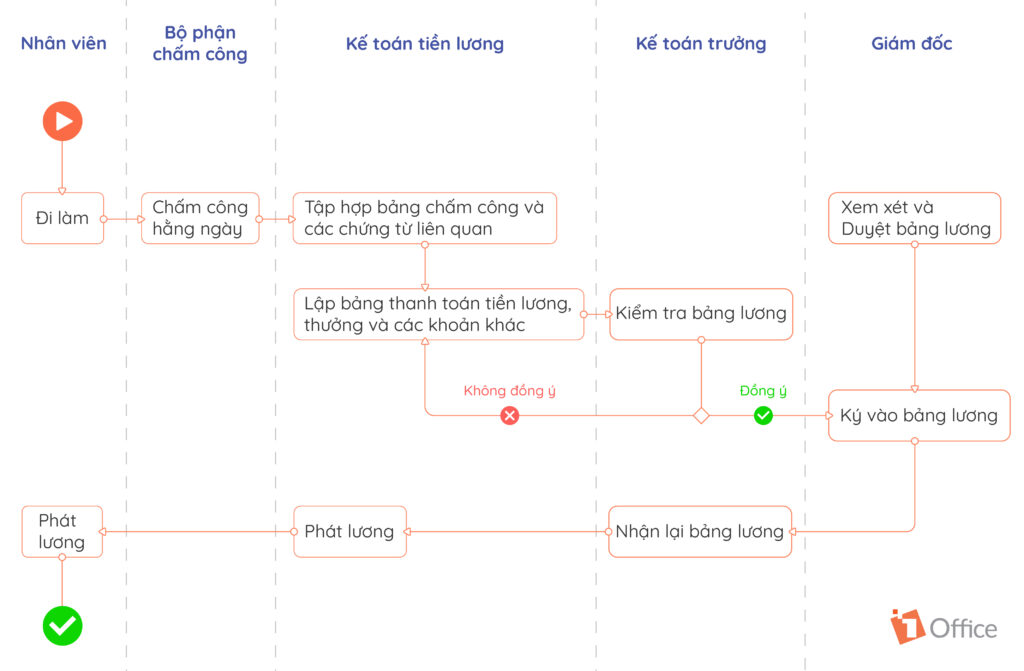
Detailed explanation of the employee payroll process flowchart
| Phase | Responsibility | Phase Implementation Description | Performance Standard | Applicable Forms & Documents |
| Step 1: Collect data for payroll calculation | Timekeeping department, Department heads | – Record time attendance for each employee
– Confirm the volume of products and work completed – Track and record employee KPI completion progress – Consolidate and create reports to send to the HR & Admin Department |
– Record attendance fully and for the correct individuals
– If an employee has missing workdays, they must submit a request to their department head for processing – The report must clearly state confirmation with the department head’s signature |
Timesheet, production & sales log |
| Step 2: Reconcile and confirm data | Human Resources & Administration Department | – Reconcile data based on the time clock, timesheets, and employee leave requests
– Review product, work, and KPI reports for each employee |
Requires confirmation from the administration department, person in charge | Timesheet, Confirmation form |
| Step 3: Calculate payroll | Payroll Accountant | Based on the number of workdays, quantity of completed products, product piece-rate, KPIs, etc., calculate the total salary, wages, and other amounts (allowances, social insurance, etc.) in detail for each employee | Calculate correctly, completely, and for the right individuals | Payroll sheet |
| Step 4: Review and approve | Chief Accountant, Director | – The Chief Accountant reviews and approves the payroll sheet, then submits it to the Director
– The Director reviews and signs to approve the payroll sheet |
– If reasonable: Sign for approval
– If not reasonable: Request an explanation from the accounting department and related departments, then approve |
Payroll sheet |
| Step 5: Create salary payment voucher | Payroll Accountant | Write payment voucher | Salary payment sheet, payment voucher | |
| Step 6: Pay salaries | Cashier | Disburse funds and pay salaries to employees | Pay in full, to the correct individuals, and on time | Salary payment sheet, payment voucher |
| Step 7: Archive payroll records and data | Payroll Accountant, Cashier | – Record in ledgers and account for salary payment transactions
– Archive all records and documents used throughout the process |
Salary payment sheet, payment voucher |
>> Read more: Top 13 Best Free Timekeeping Software in 2023
3. FREE DOWNLOAD: 5+ Most Accurate Employee Payroll Templates
In the payroll process, the payroll sheet is the most important form. This is the document submitted to the director for approval and serves as the basis for paying employees. The payroll sheet can be constructed using different methods depending on the payment method and the salary calculation formula that the company applies. Currently, there are 5 most common types of payroll sheets used in the payroll calculation and payment process, including:
- Employee payroll by workday: Salary is calculated based on the actual number of working days of the employee in the month
- Employee payroll by product: Calculated based on the actual quantity of products the employee produces during the period. Payroll by product is often applied to the production department to enhance labor productivity.
- Employee payroll by sales: In addition to a fixed salary, employees will receive an additional commission based on the sales revenue they achieve during the month. This payroll sheet is often applied to sales and business departments to promote revenue growth.
- Employee payroll by the 3P rule: This is a salary calculation method based on 3 factors: Position, Person (Professional Competence), and Performance. Learn more about the 3P salary rule in the article:
Applying the 3P salary method effectively for businesses
- Lump-sum payroll: The lump-sum salary is paid for a specific volume of work, used to calculate salaries for seasonal job positions.
To help businesses simplify the employee payroll process, 1Office provides you with the 5 most accurate Excel templates for employee payroll calculation and payment:
4. Automate the Employee Payroll Process with 1Office HRM
The timekeeping and payroll process is considered the “backbone” of human resource management. Building a scientific and systematic payroll process will help businesses establish standards to perform payroll tasks in the correct order and help departments clearly understand their responsibilities to achieve the set goals. However, the current salary management process in businesses still has many shortcomings with manual operations, such as:
- Managers and directors find it difficult to track which stage the payroll process is at, making it hard to control progress, leading to delays in paying employees and causing dissatisfaction among staff.
- When errors or payroll fund deficits occur, it is very difficult to assign responsibility to any department or individual because tasks are not clearly defined, leading to a loss of trust among personnel.
A loose, disconnected process is the cause of disruptions in business operations, reducing the productivity and efficiency of the employee timekeeping and payroll process.
Understanding the “pain points” of managers, chief accountants, and key business operators, 1Office has developed and launched the BPA – Business Process Automation feature. BPA is the only solution on the market that helps standardize and automate all types of processes within an organization.
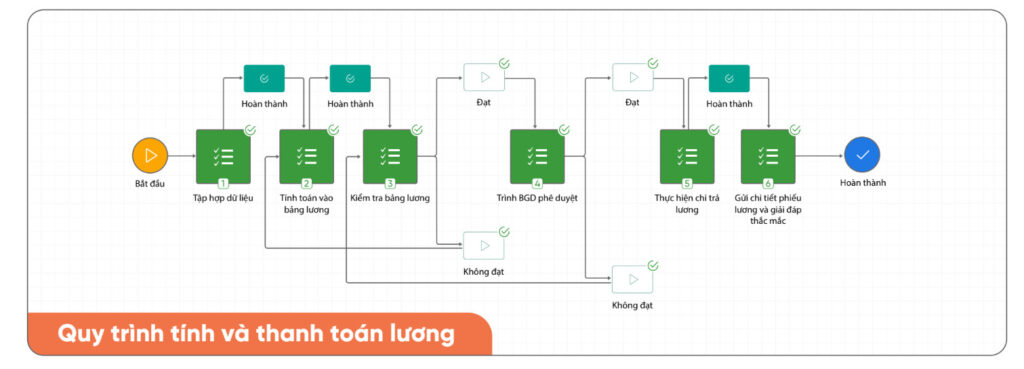
With the superior BPA feature, your business’s payroll process will become a simple task, saving up to 80% of your time:
- Define 100% of the payroll process with a full range of tasks and duties.
- Link all records and documents serving the timekeeping and payroll process, such as: Timesheets, payroll sheets, and payment slips.
- The digital signature feature directly on the process allows the Director to sign and approve payroll sheets anytime, anywhere.
- Clearly define the departments and individuals responsible for tasks within the process.
- Detailed reports on progress and the number of tasks at each step of the process.
In the article above, 1Office has guided readers on how to implement the most systematic and detailed employee payroll process, as well as provided a solution to automate the payroll process to double work productivity. For a free consultation and to experience a trial of the leading business management software today, please contact us using the information below:
- Hotline: 083 483 8888
- Fanpage: https://www.facebook.com/1officevn/
- Youtube: https://www.youtube.com/channel/UCeTIRNqxaTwk0_kcTw6SxmA
















