


 13/05/2026
  247 views
When you manage a team or a program, you’ll likely find yourself with multiple projects in progress at the same time. But controlling all the related factors can be complex and require quick decisions. Without a good process to manage countless projects, it’s very difficult to determine priorities, support the team in managing resources effectively, and confirm that deadlines are still being met.
Fortunately, solutions always exist. Whether you’re struggling to manage multi-project work or ensuring your team isn’t overloaded, these ten strategies will lead your business in the right direction.
1. Choose one place to store all your projects
- Problem: You lack visibility into all of your projects.
- Solution: Plan and manage all your projects in one place.
After weeks of planning and confirming projects, your team is finally ready to deploy. However, if your plans are scattered across various documents and spreadsheets, and you coordinate work through emails and meetings, project management becomes extremely time-consuming. You might even forget necessary information simply because you don’t have access to certain files or they weren’t attached to an email. Ultimately, your team ends the day with duplicated tasks because they have no way of knowing that the work is already being done by another employee.
For example, to manage a product roadmap that includes multiple launches, you need to know the exact number of launches, what they involve, and when they are scheduled. Planning and managing all your launches in one place will give you immediate visibility into all ongoing activities and an overview of your roadmap’s status. So, what tool should be used to manage projects? If you don’t have one for your business yet, choose the ideal tool now: a work or project management platform that offers flexibility, ease of use, and collaboration. At 1Office, we (obviously) consider our own tool an excellent alternative.
Read more: The secret to storing documents permanently without fear of loss, just do it once!
2. Define goals, plans, responsibilities, and expectations from the start
- Problem: You find inconsistencies in delivery and processes.
- Solution: Clearly define goals, plans, and responsibilities.
Without a “standard” element in the project planning process, each project might be managed differently, leading to inconsistent delivery, wasted time with each new process implementation, and a greater risk of missing or forgetting information.
To fix this, you must ensure clarity on plans, processes, and responsibilities within your team from the very beginning. At the project level, this requires clearly defining each goal, each step, and the elements of work to be completed, when these steps are scheduled, and who will be responsible for them. Additionally, make sure to schedule time for feedback and approvals. If you rush to complete your projects without a clearly established plan, it’s almost certain that things will be overlooked.
Next, clarify the plans, processes, and responsibilities at the program level. Set goals for the team and communicate clearly about the projects that will help you achieve them. In this process, the project goals will help your team achieve their own goals, which in turn helps your business achieve its goals.
To create a cohesive project management process, establish a few conventions for the whole team. For example, for large projects, require the project manager to prepare a brief before creating the project plan. Additionally, create templates for routine projects. This helps you always get off to a good start with your project execution, so you won’t have to worry about all the small steps that need to be taken each time.
Read more: 4 New Year’s goals for HR
3. Prioritize high-impact work
- Problem: You’re not sure which projects to prioritize for your team.
- Solution: Observe how projects lead to business goals. Which one will allow you to move forward the most? You can start there.
It’s tempting to tackle the easiest projects first—resist! Instead, prioritize by looking at which projects have the biggest impact on your company’s business goals. Writer Kasey Fleisher Hickey said, “Your top priorities should align with those goals and get you one step closer to achieving them.” Therefore, prioritize work strategically at both the macro level (e.g., pushing a low-impact project to the next quarter) and the micro level (e.g., setting up your daily task list in order of importance).
For example, your team is working on five product launches at the same time. Although there are similarities in the effort and amount of work required, one of them is more likely to generate more customer revenue than the other four. However, another product will have a greater impact on customer retention and long-term value. Since you know that the customer lifecycle is a more important priority for the company, you need to ensure that this second product is equipped with the necessary resources before you determine who has time for lower-priority projects.
Not only will you allocate time and resources better, but you will also no longer wonder if your projects are contributing to the company’s goals.
Read more: Manage time and work effectively with 1Office
4. Give your team flexibility when priorities change
- Problem: Your team doesn’t have the tools to easily track changes in priorities and reassigned work.
- Solution: Get a “bird’s-eye view” of your team’s activities.
The key is to set priorities and coordinate team activities, but also to have the flexibility to adapt to unforeseen events. But if you track your work in spreadsheets and to-do lists across multiple tools, it’s hard to know which tasks your team is working on at any given time. As a result, with every change in priority, you’ll struggle to locate tasks that need rescheduling, determine individual workloads, or see which tasks are on hold.
By sharing a single source of truth with your team, you can manage multiple projects without worrying about shifting priorities. Because everyone’s work is public, you’ll get a quick overview of the team’s current workload and tasks. You also have the ability to review the priority of certain tasks without worrying about them getting lost.
Finally, don’t forget to maintain communication flow, both online and face-to-face. Whether through your project management tool or regular 1-on-1 meetings, keep your team members updated on their workload and ensure everything is on track.
Read more: 7 HR trends to watch in 2021
5. Manage your expectations and communicate them clearly
- Problem: You and your collaborators don’t know what will happen and when.
- Solution: Communicate where the work happens.
Why do some teams have communication problems? It’s simply due to a lack of visibility into their own work, their colleagues’ work, their partners’ work, and ultimately, the work of various cross-functional stakeholders. When you don’t have information about what your colleagues are doing, you lack the context to explain why there are changes in the timeline, whether priorities are being maintained, or what the project’s progress is.
But when you manage communication where the work happens, you provide your team and stakeholders in different departments with the tools to understand the details and context surrounding your work. With real-time updates, anyone can assess the overall progress of activities.
The best way to do this consistently is to adopt a work management tool, which will allow you to share the status of different activities and progress information right where you work. So, no more data and updates scattered across spreadsheets, documents, and other tools. You can easily gather all the information you need and share it with the right people in just a few clicks.
Read more: 7 secrets to confident communication for success
6. Get an overview of work across all projects to balance workloads and deadlines
- Problem: You’re not sure how much work each team member can take on (too much or too little?).
- Solution: Find a way to visualize each employee’s workload across all projects.
Scheduling each project in a different place hides another trap: it’s impossible to visualize all of a person’s work across all your projects. You become dependent on your team to know if their workload is too high or too low. This makes it difficult for you to anticipate problems, especially missed deadlines, before they get out of control. Conversely, you will also have difficulty identifying unused talent.
Managing all your projects in one place is the first step to solving this problem. But then, you will be able to see all the tasks in each project, know who they are assigned to, and when the deadlines are, to identify overworked employees and conflicts in the project schedule. Then, you can postpone, delete, or reassign tasks to keep your projects on track. Not all tools have the right filters, so choose one that offers these features.
Let’s take an example: a designer responsible for a small task for your next product launch, like editing a few photos, is also responsible for managing the preparation, printing, and distribution of brochures, business cards, and posters for a conference held next month. During this same period, another designer has a fairly free schedule. By viewing each other’s workloads side-by-side, you can quickly identify this inconsistency and reassign work accordingly.
Read more: The secret to managing projects and monitoring details with just a smartphone!
7. Adjust project schedules to optimize team productivity
- Problem: Project start dates are not coordinated. The result is overloaded employees, stalled work, and delayed projects.
- Solution: Plan each project with your entire portfolio in mind.
Even a carefully planned project can be derailed if you haven’t considered the full scope of your team’s work for the next month, quarter, or even year. For example, if you try to run three web updates at the same time, they might get in each other’s way and fall behind simply because your team is doing too much at once.
To avoid this, plan and coordinate your team’s work with your entire program scope in mind. Here are some tips to follow:
- Stagger start dates for similar projects: Especially if the same team is working on multiple projects, it’s better to rearrange start dates and deadlines so that each member isn’t trying to complete tasks from five different projects at once. It’s better to focus on one project before moving on to the next.
- Check for dependencies: is it necessary to complete the infrastructure overhaul before designing the new website? If so, schedule the deadline for the first project before the dependent project begins.
- Identify overlapping tasks: If the same work needs to be done for two different projects, group them together. Whether it’s confirming a new vendor or purchasing video equipment for marketing purposes, make sure this work is done on time so that both projects can move forward.
Proper time allocation can make all the difference in successfully executing multiple projects at once and allowing your team to work in the most efficient way.
Read more: 7 tips to help you manage time effectively at work!
8. Delegate work while maintaining visibility
- Problem: There’s a fine line between micromanagement and being an absent manager. How do you walk it?
- Solution: Share a single source of truth with your team and monitor activities as needed.
Does any manager want to be a micromanager? No one! But, losing sight of your team’s current tasks and progress can make you an ineffective manager. Fortunately, there’s hope!
Sharing a reliable source of reference with your team will give you the necessary tools to track everyone’s activities. Since all the team’s work is gathered in a common project, you can easily see everyone’s progress and workload, as well as task deadlines. You can step in on certain tasks if necessary without having to micromanage everything.
Read more: 5 teamwork mistakes to avoid so your project doesn’t go off the rails
9. Track and document your processes so you don’t have to reinvent the wheel every time
- Problem: you have to recreate your processes from scratch at the start of each project.
- Solution: Create templates and simplify your project planning process.
Just imagine: you’ve just completed your quarterly marketing campaign and you’re ready for the next one. The problem is, you can’t remember exactly how you organized your work. A lot has changed since then, and you’ve had several projects to manage, so it’s hard to recall the initial elements. How can you repeat this campaign if you can’t be sure you’re not missing essential things?
What if you stopped reinventing the wheel every time you started a project? There’s a more practical way: create a model and simplify your project launches. This way, you can reuse your processes as much as you want. When you need to coordinate a new project, all you have to do is rely on your custom template. Perfect for getting started quickly and working efficiently!
Also, remember to regularly update your templates by incorporating new tasks and steps that you’ve added to existing or developing processes. Your model is a living document: you must update the template with best practices and new insights. Finally, make sure to keep your template in your team’s central source of truth so that everyone has access to it and can start projects easily.
Read more: The process of building a standard KPI system based on reality
10. Manage multiple projects at once, anytime with 1Office
Managing multiple projects at once is a team leader’s daily job. 1Office will always accompany and support businesses in managing their projects in the most optimal way. We hope these tips will help you follow all the elements of your program, stay organized, meet deadlines, and achieve your business goals, no matter what.
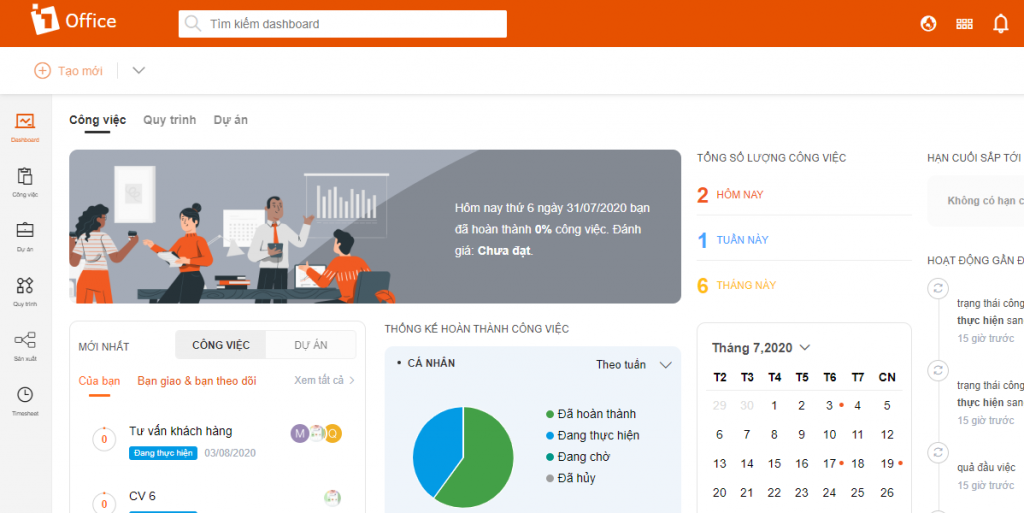
Manage your projects in 1Office today.
Read more: 5 basic steps for digital transformation in business
Task Management and Project Management: What’s the Difference?
Mistakes to watch out for in the personnel recruitment process!
















