


 12/05/2026
  270 views
According to reputable global studies, 70% of employee motivation is often influenced by their leader. This makes people management one of the most important skills that any leader needs to cultivate. The article below will help you better understand the concept and role of people management, and provide you with practical skills to make managing people easier.
Mục lục
- What is people management?
- The role of management skills in people management
- Differentiating between people management and performance management
- 10 Successful People Management Skills Every Leader Should Know
- 1. Supportive Skills
- 2. Listening Skills for “Deep and Clear Understanding”
- 3. Asking Development-Oriented Questions
- 4. People Management Skill: Providing Direction
- 5. Fostering Internal Competition
- 6. People Management Skill: Managing Pressure
- 7. Fair Praise and Criticism Skills
- 8. Effective Empowerment
- 9. Care for Employees
- 10. Propose Promotion Opportunities
What is people management?

Understanding people has always been a timeless topic that many find difficult to grasp. But when you have deep insight, combined with your own skill and sincerity, managing personnel becomes easier than ever. From there, you can foster sustainable and effective relationships, and your efforts will be deservedly rewarded in the future.
According to John Maxwell – an expert in management & leadership, there are 5 levels for evaluating a leader’s capabilities:
- Level 1 – Position: Leadership relies on job title to establish authority and respect from employees.
- Level 2 – Permission: Leadership focuses on building relationships with employees to gain their support and compliance.
- Level 3 – Production: Leadership is geared towards achieving results, based on employees’ understanding and trust in their abilities.
- Level 4 – People Development: Leadership is concerned with developing employees, helping them become excellent managers and create a positive impact.
- Level 5 – Pinnacle: Leaders at this level are celebrated for their outstanding achievements and ability to create positive change in the organization, earning the respect and admiration of their employees.
A leader must not only ensure that employees complete their assigned tasks well but also foster unity, inspire creativity, and ignite the passion of each individual. As a result, a leader with skillful people management abilities will always be trusted, respected, and followed by their employees.
The role of management skills in people management
Leaders play a crucial role in connecting employees to the organization’s development. Therefore, if you have comprehensive personnel management skills, the business will reap the following benefits:
- People management helps leaders guide their teams to complete tasks and achieve the goals set by the business.
- Leaders can assign and coordinate work reasonably, helping to save time, ensure deadlines are met, and improve business efficiency.
- Thanks to skillful and subtle management, leaders can earn the affection and loyalty of their employees, leading to a reduction in sudden turnover rates. This means the business can build a stable and loyal workforce, thereby promoting the organization’s sustainable development.
Differentiating between people management and performance management
People management and performance management are both important aspects of leadership skills, but they have fundamental differences.
| People Management | Performance Management |
| Focuses on employee satisfaction and engagement | Focuses on evaluating and improving employee work performance |
| Builds a comfortable and respectful work environment | Defines clear goals and expectations for employees, tracks progress, and provides regular feedback |
| Happy and engaged employees will have higher motivation | Supports career development planning and helps employees achieve personal goals |
| The goal is to create higher performance for the organization | The goal is to ensure employees achieve desired results |
10 Successful People Management Skills Every Leader Should Know
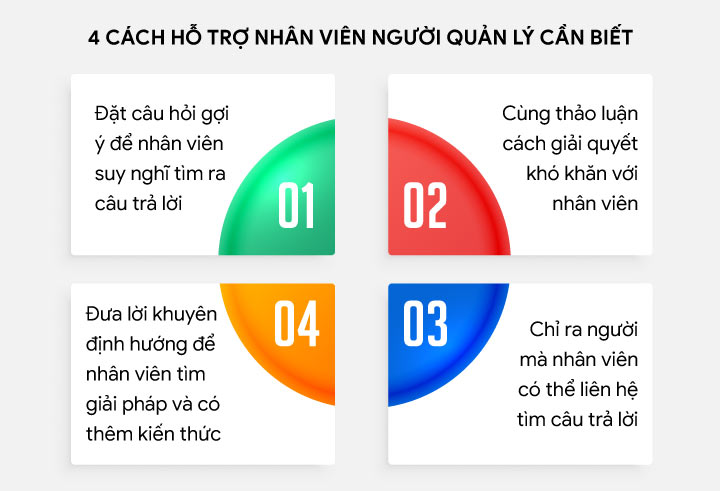
1. Supportive Skills
In an organization, there are both long-experienced individuals and new employees just starting to get acquainted with their work. Therefore, timely support from a leader is crucial.
A leader needs to help the team overcome difficulties quickly while building relationships to motivate them to achieve common goals with determination.
2. Listening Skills for “Deep and Clear Understanding”
One of the obstacles that makes subordinates hesitant to communicate and seek help from their leaders is ineffective communication.
Research shows that when listening to someone else’s story, most people tend to focus only on analyzing the problem from their own perspective, judging who is right and who is wrong. However, it is crucial to inquire and gather information from the speaker to understand the story from their point of view.

To improve this situation, you need to learn to listen and respect your employees’ opinions. When they receive sincere feedback, employees will feel more confident and motivated to improve their work.
This skill is often demonstrated through small actions by the leader, such as not interrupting during a conversation and always providing feedback after listening. This is also one of the golden rules from “How to Win Friends and Influence People” for creating a positive work environment and more effective communication with staff.
3. Asking Development-Oriented Questions
To encourage employees’ thinking and problem-solving abilities, leaders can apply a people management method by asking open-ended questions.
Instead of just providing specific directions, these questions require your team to research and explore on their own to propose the best solutions. As a result, they will develop an autonomous, proactive work style and will not shy away from challenges.
4. People Management Skill: Providing Direction
In the process of personnel management, helping employees define the purpose of their work is very important. According to research from Harvard, not everyone is clear about what they want to achieve in their job. Therefore, leaders need to create conditions for employees to better understand the meaning of their work. By providing direction and long-term operational strategies, managers help employees easily identify personal goals and shape their career paths.

Sharing work direction and linking it to career orientation is another important step in personnel management. By sharing information about the organization’s goals, strategies, and vision, managers help employees better understand their position and contribution to the organization’s overall objectives. This not only supports the personal development of employees but also promotes their job satisfaction and commitment.
Finally, creating short-term and long-term plans is an indispensable part of personnel management. By providing a concrete plan with clear steps and goals, leaders help employees proactively learn and enhance their skills to achieve assigned objectives. This fosters employee confidence and commitment, while also boosting work performance and organizational growth.
5. Fostering Internal Competition
Managers should encourage healthy competition between individuals and teams to boost overall morale. This method helps all members contribute their efforts and simultaneously drives the business to achieve business results quickly.
However, to ensure the work environment does not become stressful and to maintain work quality, you need to establish strict regulations. This helps prevent fierce competition and ensures that employees prioritize the quality of work, not just winning or losing.
6. People Management Skill: Managing Pressure

In reality, work environments with high sales pressure or overly strict cultures often lead to high turnover rates. Constant fluctuations in the workforce create difficulties for businesses as they have to spend significant resources on training and developing new teams.
Therefore, business administrators should consider and create a balance between goal-oriented pressure and a comfortable, friendly work environment. In addition to dedicated work time, cultural or extracurricular activities can be organized to reduce stress for employees.
7. Fair Praise and Criticism Skills
Individuals and teams who perform excellently should be specially honored during the company’s team meetings. This people management method helps employees always feel valued and encourages them to be more determined in their work.
If an employee makes a mistake or does not complete their work well, you should provide timely feedback and support them in correcting the errors. Furthermore, managers can use these experiences as lessons to remind the team not to repeat the same mistakes in the future.
8. Effective Empowerment
The management practice of empowering employees is an effective method that helps leaders identify potential candidates and encourages creativity and proactive improvement in the team’s work quality. To implement empowerment effectively, managers can apply the Skill and Will model – a model of skill and willingness, compiled from the practical experience of experts at 1Office.
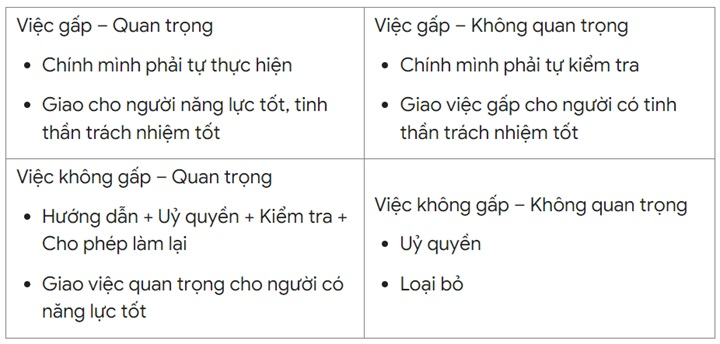
From this model, we can see that for tasks that are urgent but not important, empowering proactive employees is a reasonable choice. Proactive employees will complete the work efficiently in a short amount of time, ensuring the task is completed as required and are willing to take responsibility in urgent situations.
Conversely, for tasks that are not urgent but important, empowering competent employees is the right choice. Competent employees will complete the task accurately, with high quality, and effectively thanks to their knowledge, skills, and experience.
Overall, empowering employees according to their individual competence and willingness will create a positive work environment, encourage development, and maximize the potential of each individual, thereby bringing good results for the organization.
9. Care for Employees
Besides work, concerns about family, health, etc., also have a significant impact on an employee’s morale. Therefore, a leader needs to be empathetic and share with employees if they notice signs of decline or lack of focus.
Showing timely concern demonstrates that you are an understanding person who is willing to listen. This way, employees will not only admire you but also have a more positive impression of you, and will be willing to support you in your career.
10. Propose Promotion Opportunities

An essential people management skill for a leader is the willingness to support employees in improving their professional skills and professionalizing. In the future, you also need to propose promotion opportunities such as becoming a team leader, department head, etc., for individuals with outstanding achievements.
This is an attractive condition that helps the business build a top-tier team of employees. Furthermore, when they see a clear promotion plan, employees will feel motivated and tend to stay for the long term, thereby increasing their work efforts.
—————–
Through these insights on the human resource management skills a leader needs, 1Office hopes you have gained a deep understanding of the importance of people management. Only when you truly understand and know how to maximize your employees’ capabilities, can you fully harness this powerful resource to drive your business forward.
















