10/05/2026
  2721 views
Minutes of a Party cell meeting are important documents for fully recording the content, proceedings, and conclusions of Party activities. A clear, properly formatted minutes template not only facilitates convenient storage but also ensures transparency and accuracy in reporting.
In this article, 1Office has compiled 3+ standard templates for Party cell meeting minutes, including free downloadable Word files, and provides detailed, easy-to-apply instructions on how to write them.
Mục lục
- I. What Are Party Cell Meeting Minutes?
- II. Common Types of Party Cell Meeting Minutes
- III. Detailed Guide on How to Write Standard Party Cell Meeting Minutes
- IV. What Content Does a Complete Set of Party Cell Meeting Minutes Include?
- V. Các Lỗi Thường Gặp Khi Lập Biên Bản Họp Chi Bộ
- VI. Câu Hỏi Thường Gặp về Biên Bản Họp Chi Bộ
I. What Are Party Cell Meeting Minutes?
Party cell meeting minutes are an important administrative document within the organizational system of the Communist Party of Vietnam, created during or immediately after a Party cell meeting to record the entire process, content, discussion points, conclusions, and decisions of the meeting in a complete, accurate, and objective manner.
This is a document that faithfully reflects the proceedings of the meeting, including:
- Time, location, and attendees (Party members present, absent, and reasons for absence).
- Meeting agenda (reports, discussions, contributions).
- Statements from Party members (recorded verbatim or summarized fully and objectively).
- Conclusions, resolutions, and decisions of the Party cell (voting, balloting if any).
- Tasks assigned and deadlines for completion.
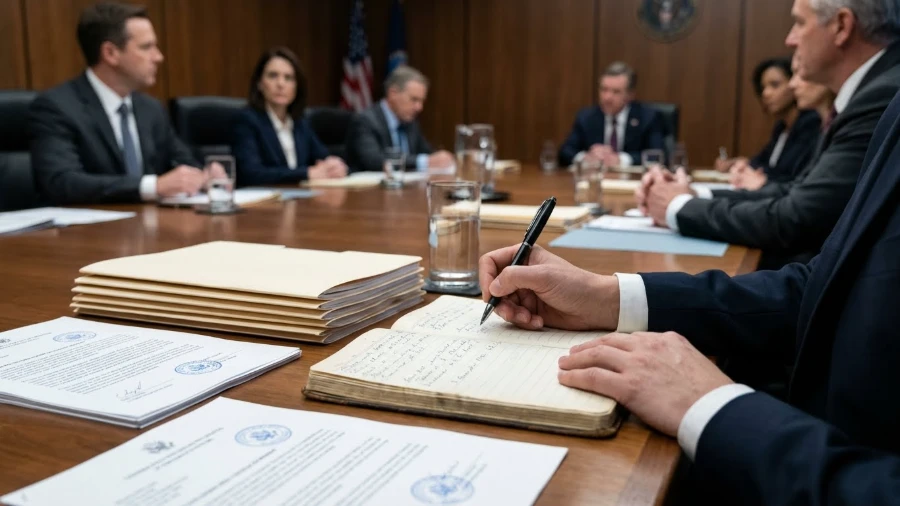
The purpose of Party cell meeting minutes:
- To record the entire content and process of the meeting to serve as a basis for monitoring, inspecting, and supervising the implementation of the Party cell’s resolutions.
- To serve as an archival document for the annual review, assessment, and classification of Party members and the Party cell.
- To serve as a basis for higher-level Party committees to monitor and direct the Party cell’s activities.
- To serve as important evidence during inspections, audits, or the resolution of complaints and denunciations related to the Party cell’s activities.
The importance of creating Party cell meeting minutes
Party cell meeting minutes are an official document with the highest internal legal value within the Party for cell activities.
- If the minutes are recorded incompletely, inaccurately, biasedly, or not objectively → it can lead to errors in assessing Party members, classifying the Party cell, and may even result in the higher-level Party committee demanding a rewrite or disciplining the minute-taker.
- Accurate minutes help the Party cell strictly implement the principle of democratic centralism, where democracy is coupled with discipline, ensuring that the democratic rights of Party members are respected.
- It is an important document for inspecting and supervising the implementation of resolutions, avoiding situations of “all talk, no action” or “action without record.”
Legal Basis
The creation, recording, and storage of Party cell meeting minutes are strictly regulated in the Party’s document system:
- Charter of the Communist Party of Vietnam (13th Congress): Requires Party cells to hold regular meetings and record complete and accurate minutes.
- Guideline 12-HD/BTCTW dated January 18, 2022, from the Central Organization Commission on specific issues regarding the implementation of the Party Charter: Provides detailed regulations on the content, format, and requirements for recording Party cell meeting minutes, and the responsibilities of the minute-taker (usually the secretary or an assigned Party member).
- Guideline 09-HD/BTCTW dated February 1, 2021, from the Central Organization Commission on Party cell activities: Provides specific guidance on creating, storing, and reporting minutes to higher-level Party committees, and handling cases where minutes do not meet requirements.
- Regulation 37-QĐ/TW dated October 25, 2021, from the Central Committee on things Party members are not allowed to do: Requires truthful and objective recording, without distorting or misrepresenting the meeting’s content.
Party cell meeting minutes are not just ordinary records but are official Party documents with high internal legal value, serving as the basis for assessment, inspection, supervision, and resolution of issues related to the Party cell’s activities. Creating accurate, objective, and complete minutes is a mandatory responsibility of the Party cell secretary and the person assigned to take them.
II. Common Types of Party Cell Meeting Minutes
Party cell activities are the most basic form of Party organization, where members directly discuss, contribute opinions, and decide on important issues. Party cell meeting minutes are official documents with high internal legal value, faithfully recording the process, content, and resolutions of each type of activity. In this section, we compile the most common types of Party cell meeting minutes (updated according to Guideline 12-HD/BTCTW and practices in 2026), from regular meetings and thematic sessions to Party cell committee meetings – complete with standard structures, specific content, and note-taking tips to ensure the minutes are transparent, objective, and comprehensive, effectively serving the work of inspection, supervision, and evaluation of the Party cell.
Minutes of a regular Party cell meeting
Regular Party cell meetings (usually once a month) are a basic form of activity, focusing on evaluating the implementation of political tasks, ideological work, Party cell building, and task assignment. The minutes of a regular meeting fully record reports, discussion points, conclusions, and resolutions, serving as an important document for higher-level Party committees to monitor the Party cell’s regular activities. This template is designed according to Guideline 12-HD/BTCTW, with detailed sections for recording the list of attendees, the content of statements, and voting results, helping the Party cell strictly implement the principles of democratic centralism and democracy coupled with discipline.
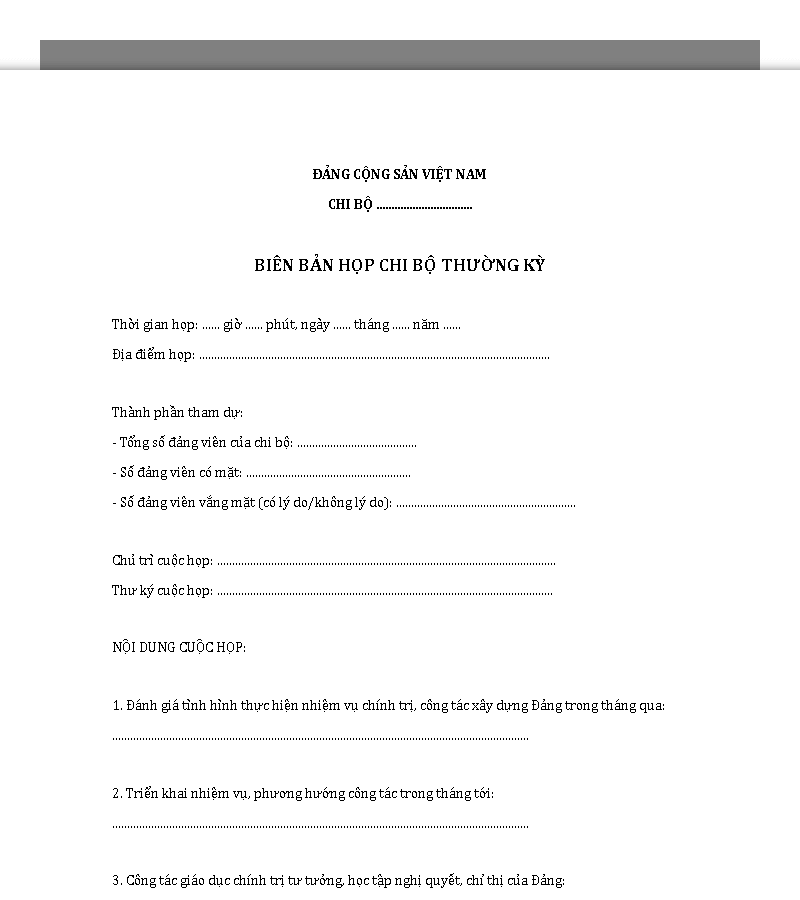
Download the Regular Party Cell Meeting Minutes Template Now
Minutes of a thematic Party cell meeting
Thematic Party cell meetings focus on a specific topic (studying resolutions, in-depth reviews, discussing key tasks, admitting new Party members, disciplining Party members, etc.). The minutes of a thematic meeting require more detailed and in-depth recording, especially of contributions, debates, and voting results. This template is suitable for important thematic meetings, ensuring objectivity and truthfulness, and serves as a basis for evaluating the quality of Party cell activities and handling related issues according to Party regulations.
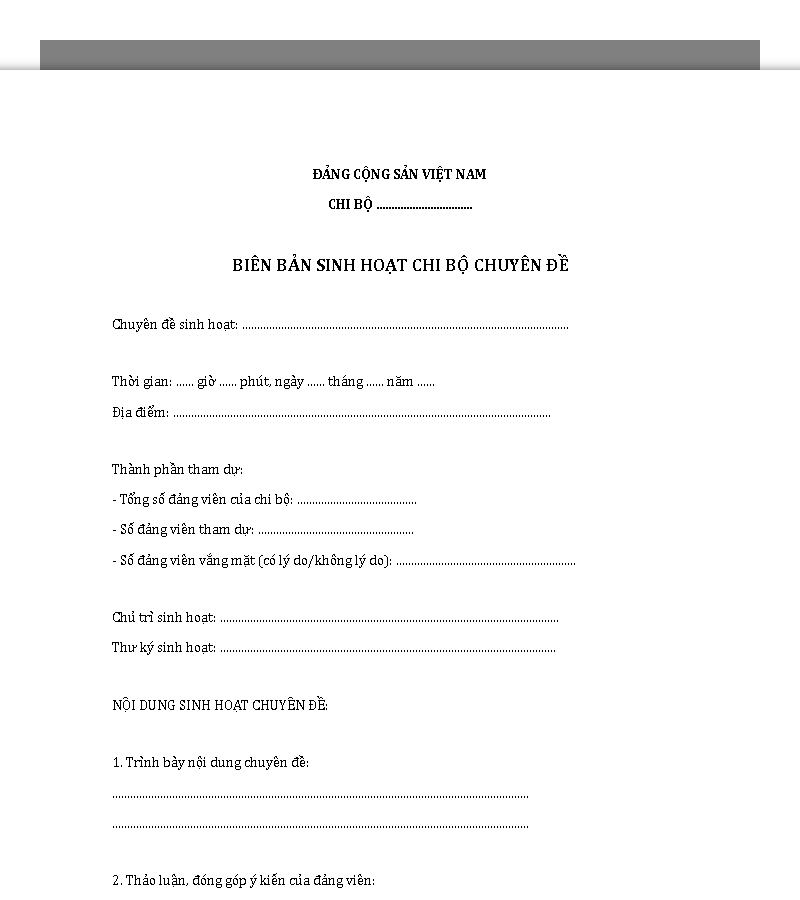
Download the Thematic Party Cell Meeting Minutes Template Now
Minutes of a Party cell committee meeting
A Party cell committee meeting (if the Party cell has a committee) is a meeting of the Party cell’s leadership to discuss important issues before presenting them to the entire cell for a decision, or to handle urgent tasks. The minutes of a Party cell committee meeting record the opinions of the leadership, directional guidance, and task assignments, serving as a valuable reference for the Party cell secretary. This template emphasizes leadership, focusing on the preparation of the Party cell’s agenda, conclusions, and assigned tasks, helping the Party cell committee operate effectively, transparently, and in compliance with the principle of democratic centralism as per the Party Charter.

Download the Party Cell Committee Meeting Minutes Template Now
III. Detailed Guide on How to Write Standard Party Cell Meeting Minutes
Party cell meeting minutes are an official document with the highest internal legal value within the Party for cell activities, and must be created accurately, completely, objectively, and in strict compliance with the Party’s administrative document format (according to Guideline 12-HD/BTCTW and Guideline 09-HD/BTCTW). Proper recording not only ensures transparency and democracy but also serves as a basis for inspection, supervision, evaluation, and resolution of issues related to the Party cell later on. Below is a detailed guide on the standard process for writing Party cell meeting minutes, divided into 3 stages: before, during, and after the meeting.
1. Preparation before the meeting
Thorough preparation is a decisive factor in the quality of the minutes, helping the secretary take notes quickly, accurately, and without omitting important content.
- Designate a meeting secretary: Usually appointed by the Party cell secretary (often the secretary themselves or a Party member with good note-taking skills). The secretary needs to clearly understand the meeting agenda, the reports to be presented, and the issues to be discussed.
- Check the minutes template and related documents: Use the standard Party cell meeting minutes template according to Guideline 12-HD/BTCTW (available from the Organization Commission of the higher-level Party Committee). Prepare:
- List of Party cell members (present/absent).
- Reports, proposals, discussion materials (printed or digital files).
- Party cell activity regulations, relevant higher-level resolutions.
- Prepare note-taking tools:
- Pen and paper, computer (preferred), voice recorder (if permitted by the Party cell and with the consent of Party members).
- Phone/tablet for quick notes (for support only, not as a substitute for official note-taking).
- Note: Recordings are only for assisting in completing the minutes and must not be distributed or used for improper purposes.
2. During the meeting
The secretary must take notes continuously, truthfully, and objectively, without adding, omitting, or including personal comments.
- Record administrative information clearly:
- Time: Start and end (to the minute).
- Meeting location (meeting room, headquarters, online if applicable).
- Attendees: List all Party members present, absent, and the reason for absence (with or without leave).
- Chair: Secretary or Deputy Secretary of the Party cell.
- Secretary: Clearly state the full name of the person taking the minutes.
- Record the meeting content truthfully, completely, and objectively:
- Summarize reports: Briefly record the main content of the report (do not transcribe verbatim unless necessary).
- Clearly record the speaker’s name and the core content: For example: “Comrade Nguyen Van A stated: I propose that the Party cell focus on implementing task X and coordinate closely with Y…”.
- Record discussions and debates: Fully note different opinions, especially counter-arguments, without bias.
- Decisions, conclusions, and resolutions passed: Clearly record voting results (for, against, abstained, percentage % if needed).
- Tasks assigned: Clearly state the person responsible, the task content, and the completion deadline.
- Notes on language and style:
- Be concise, clear, accurate, and use standard Party terminology.
- Do not include the secretary’s personal opinions in the minutes.
- Transcribe important opinions verbatim, especially those of the Party cell Secretary or Party committee members.
3. After the meeting
Finalize the minutes on the same day or within 24–48 hours at the latest to ensure accuracy.
- Finalize the minutes, check for spelling and grammatical errors:
- Reread the entire minutes, add, and edit for clarity and coherence.
- Double-check the attendee list, statements, conclusions, and assigned tasks.
- Submit to the chair/Party cell Secretary and relevant members for review:
- The Party cell Secretary reviews it first.
- If there are corrections, clearly note the changes and re-sign for confirmation.
Signatures for confirmation by the Chair and Secretary:
- Approve the minutes before the Party cell (for regular meetings): According to Guideline 09-HD/BTCTW, the minutes must be read aloud or summarized at the next meeting for the Party cell’s approval (if corrections are needed, an addendum should be recorded).
- Store and preserve the minutes according to regulations:
- Store the original copy at the Party cell (in a confidential file cabinet).
- Report to the higher-level Party committee as required (usually by sending a copy of the regular meeting minutes).
- Archive for at least 5–10 years, or permanently for important minutes (according to the Party’s document archiving guidelines).
General notes when writing Party cell meeting minutes:
- Do not record audio/video without the Party cell’s consent.
- Do not disclose meeting content outside the Party cell (confidentiality as per Party regulations).
- If meeting online: Clearly state the meeting platform (Zoom, Teams), login list, and participation times.
Standard Party cell meeting minutes are important documents for higher-level Party committees to monitor, evaluate, and direct the Party cell. Following the correct procedure helps the Party cell seriously implement the principle of democratic centralism, where democracy is coupled with discipline.

IV. What Content Does a Complete Set of Party Cell Meeting Minutes Include?
Party cell meeting minutes are official documents with the highest internal legal value within the Party’s activities, and must strictly adhere to the Party’s document format according to Guideline 12-HD/BTCTW and Guideline 09-HD/BTCTW. The structure below is a standard, complete template widely used in grassroots Party cells in Vietnam (updated for 2026 practices), ensuring transparency, democracy, and ease of inspection and supervision.
Opening Section
National Emblem and Motto Presented at the top of the page, centered, bold, in a large font size:
COMMUNIST PARTY OF VIETNAM
Independence – Freedom – Happiness
Name of the superior authority and the Party cell Written immediately below the motto, centered or left-aligned:
PARTY COMMITTEE: [Name of the superior Party Committee – e.g., Party Committee of Ward X, District Y]
PARTY CELL: [Name of the Party cell – e.g., Party Cell of Residential Group 1]
Title of the Minutes Bold, font size 14–16, centered:
MINUTES OF THE REGULAR PARTY CELL MEETING
(Month … 2026)
A reference number can be added: No.: …/BB-CB (if the Party cell has a numbering regulation for minutes).
Basic Information
- Time: Start and end (to the minute). Example: From 19:30 to 21:15, on January 1, 2026
- Location: Party cell meeting room, headquarters of the Party Committee of Ward X… (or specify online meeting if applicable).
- Attendees:
- Total number of Party members: … comrades
- Present: … comrades
- Absent: … comrades (reason: on business, sick, on leave… – specify the name and reason for each person).
- Chair: Comrade [Full Name] – Secretary of the Party Cell
- Secretary: Comrade [Full Name] – Party Member (or Deputy Secretary of the Party Cell)
Main Content Section
Meeting Content/Agenda Clearly list the items in order according to the meeting agenda (announced in advance):
- Item 1: Report on the status of Party members and ideological work during the month.
- Item 2: Report on the implementation of political tasks and Party cell development.
- Item 3: Discussion and feedback.
- Item 4: Conclusions, resolutions, and task assignments.
Reports
- Briefly summarize the content of the report (presented by the Secretary or an assigned Party member).
- Example: “Comrade [Full Name] – Secretary of the Party cell reported: In December 2025, the Party cell had 25 members, with no members violating discipline; 95% of assigned political task targets were completed; the ideological situation of Party members is stable…”
Discussion and feedback from Party members
- Record the name of the speaker (do not record anonymously).
- Summarize the core content, transcribe important opinions and heated debates verbatim.
- Example: “Comrade [Full Name] stated: I agree with the report and propose that the Party cell increase inspection of the implementation of political tasks in residential group 1…” “Comrade [Full Name] suggested: We need to add propaganda measures for young Party members…”
Conclusion and Resolution Section of the Party Cell
- Clearly record the conclusion of the Party cell Secretary after the discussion.
- Resolution passed (by vote, show of hands):
- Ratio of for/against/abstained (if any).
- Tasks assigned: Clearly state the person responsible, content, and completion deadline.
- Ví dụ: “Chi bộ biểu quyết thống nhất: Thông qua báo cáo tháng 12/2025; giao đồng chí [Họ tên] phụ trách kiểm tra nhiệm vụ X trước ngày 15/01/2026…”
Phần kết thúc
Thời gian kết thúc cuộc họp
Cuộc họp kết thúc hồi 21 giờ 15 phút cùng ngày.
Chữ ký và họ tên
CHỦ TRÌ CUỘC HỌP
Bí thư Chi bộ
(Ký, ghi rõ họ tên, đóng dấu chi bộ nếu có)
Lưu ý quan trọng khi lập biên bản:
- Ghi chép trung thực, khách quan, không thêm bớt, không đưa quan điểm cá nhân của thư ký.
- Không tẩy xóa → nếu sai thì lập phụ lục bổ sung hoặc biên bản mới.
- Lập thành 02–03 bản: Bản gốc lưu tại chi bộ, bản sao gửi Đảng ủy cấp trên (nếu yêu cầu).
- Lưu trữ ít nhất 5–10 năm hoặc vĩnh viễn đối với biên bản quan trọng.
- Nếu họp trực tuyến: Ghi rõ nền tảng họp, danh sách đăng nhập và thời gian tham gia.
Cấu trúc trên là mẫu chuẩn, đầy đủ theo Hướng dẫn 12-HD/BTCTW, đảm bảo tính dân chủ, tập trung và kỷ luật trong sinh hoạt chi bộ.
V. Các Lỗi Thường Gặp Khi Lập Biên Bản Họp Chi Bộ
Biên bản họp chi bộ là tài liệu chính thức, có giá trị pháp lý nội bộ Đảng cao nhất, nhưng trong thực tiễn, nhiều chi bộ vẫn mắc phải các lỗi phổ biến dẫn đến biên bản thiếu chính xác, mất tính khách quan hoặc không đáp ứng yêu cầu kiểm tra, giám sát của cấp ủy cấp trên. Việc nhận diện và khắc phục kịp thời các lỗi này giúp biên bản trở thành tài liệu đáng tin cậy, minh bạch và hỗ trợ hiệu quả cho công tác xây dựng Đảng.
Dưới đây là các lỗi thường gặp nhất (dựa trên thực tiễn kiểm tra, hướng dẫn của Ban Tổ chức Trung ương và kinh nghiệm các chi bộ cơ sở năm 2026), kèm theo cách khắc phục cụ thể:
Lỗi thiếu thông tin
Biểu hiện phổ biến:
- Không ghi đầy đủ danh sách đảng viên tham dự (có mặt, vắng mặt, lý do vắng).
- Thiếu thông tin thời gian bắt đầu/kết thúc chính xác đến phút.
- Không ghi rõ chủ trì, thư ký, hoặc người phát biểu.
- Bỏ sót một phần nội dung chương trình nghị sự.
Hậu quả:
Cấp ủy cấp trên khó kiểm tra tính dân chủ, số lượng đảng viên tham gia, dẫn đến yêu cầu làm lại biên bản hoặc không công nhận kết quả sinh hoạt.
Cách khắc phục – Cách ghi đầy đủ mà không lan man:
- Sử dụng mẫu chuẩn theo Hướng dẫn 12-HD/BTCTW: Ghi phần “Thành phần tham dự” theo danh sách chi bộ (có mặt/vắng mặt, ghi rõ tên + lý do vắng như “công tác”, “ốm”, “nghỉ phép”).
- Ghi thời gian: “Hồi 19 giờ 00 phút đến 21 giờ 15 phút”.
- Không lan man: Chỉ ghi tên người phát biểu + nội dung cốt lõi (tóm tắt trong 1–3 câu), không ghi nguyên văn mọi lời nói trừ ý kiến quan trọng.
- Mẹo: Trước họp, chuẩn bị sẵn danh sách đảng viên và checklist chương trình nghị sự để đánh dấu từng mục.
Lỗi sai sót về số liệu, nội dung
Biểu hiện phổ biến:
- Sai số lượng đảng viên tham dự, tỷ lệ biểu quyết.
- Ghi sai tên người phát biểu hoặc nội dung ý kiến (thêm bớt, nhầm lẫn).
- Sai ngày tháng, số hiệu văn bản, chỉ tiêu nhiệm vụ.
Hậu quả:
Làm sai lệch kết quả sinh hoạt, ảnh hưởng đến đánh giá, phân loại chi bộ, đảng viên.
Cách khắc phục – Kỹ thuật kiểm tra chéo, xác nhận thông tin:
- Trong họp: Ghi nháp nhanh, sau mỗi phần quan trọng (biểu quyết, kết luận) – đọc lại ngắn gọn để chi bộ xác nhận “Có đồng ý với nội dung ghi nhận không?”.
- Sau họp: Đọc lại toàn bộ biên bản với bí thư chi bộ duyệt trước khi hoàn thiện.
- Sử dụng ghi âm (nếu chi bộ đồng ý) để đối chiếu khi cần.
- Kiểm tra chéo: So sánh với danh sách chi bộ, lịch họp, báo cáo cấp trên.
- Mẹo: Sử dụng bảng Excel mẫu để ghi số liệu (số lượng đảng viên, tỷ lệ biểu quyết) – tránh ghi tay sai.
Lỗi về văn phong, trình bày
Biểu hiện phổ biến:
- Văn phong dài dòng, lan man, lặp lại.
- Sai chính tả, ngữ pháp, dùng từ không chuẩn mực.
- Trình bày lộn xộn, không đánh số mục, không gạch đầu dòng.
Hậu quả:
Biên bản khó đọc, khó tra cứu, mất tính trang trọng, cấp ủy cấp trên có thể yêu cầu làm lại.
Cách khắc phục – Sử dụng ngôn ngữ chuẩn mực, rõ ràng:
- Ngôn ngữ: Ngắn gọn, trang trọng, dùng từ ngữ chuẩn mực của Đảng (“đồng chí”, “chi bộ thống nhất”, “biểu quyết thông qua”).
- Trình bày: Đánh số mục rõ ràng (1., 2., 3.), dùng gạch đầu dòng cho ý kiến phát biểu.
- Sau họp: Kiểm tra lỗi chính tả, ngữ pháp bằng công cụ (Word) trước khi in ký.
- Mẹo: Sử dụng mẫu biên bản Word chuẩn (từ Ban Tổ chức Đảng ủy cấp trên), chỉ điền nội dung, tránh tự thiết kế lại.
Lỗi chủ quan, áp đặt ý kiến cá nhân
Biểu hiện phổ biến:
- Thư ký thêm ý kiến cá nhân (“ý kiến này hay”, “tôi thấy…”).
- Ghi thiên vị một bên (chỉ ghi ý kiến đồng tình, bỏ qua ý kiến phản biện).
- Ghi tóm tắt ý kiến theo hướng chủ quan của thư ký/bí thư.
Hậu quả:
Vi phạm nguyên tắc tập trung dân chủ, dân chủ đi đôi với kỷ luật; biên bản có thể bị cấp ủy cấp trên bác bỏ hoặc yêu cầu làm lại.
Cách khắc phục – Nguyên tắc ghi chép khách quan, trung thực:
- Chỉ ghi nguyên văn hoặc tóm tắt trung thực ý kiến phát biểu (không thêm thắt, không bình luận).
- Ghi đầy đủ cả ý kiến đồng tình lẫn phản biện, không thiên vị.
- Thư ký không đưa quan điểm cá nhân vào biên bản.
- Mẹo: Khi ghi ý kiến, luôn ghi “Đồng chí [Họ tên] phát biểu: …” để đảm bảo khách quan.
Lỗi không lưu giữ hoặc lưu giữ sai quy định
Biểu hiện phổ biến:
- Chỉ lưu bản nháp, không in ký gốc.
- Không lưu trữ theo thời hạn (mất mát sau 1–2 năm).
- Không báo cáo cấp ủy cấp trên (nếu quy định).
Hậu quả:
Không có tài liệu để kiểm tra, đánh giá chi bộ; khó xử lý khiếu nại, tố cáo liên quan đến sinh hoạt chi bộ.
Cách khắc phục – Quy định về thời hạn và cách thức lưu trữ:
- Lập thành 02–03 bản gốc có chữ ký: Bản lưu chi bộ (tủ hồ sơ bí mật), bản sao gửi Đảng ủy cấp trên (nếu yêu cầu).
- Lưu trữ ít nhất 5–10 năm (hoặc vĩnh viễn với biên bản quan trọng như kết nạp, kỷ luật).
- Scan màu PDF lưu điện tử (đám mây an toàn hoặc hệ thống quản lý văn bản Đảng).
- Mẹo: Lập danh mục lưu trữ biên bản theo năm/tháng, kiểm kê định kỳ.
Các lỗi trên đều có thể tránh được nếu thư ký chi bộ tuân thủ nghiêm ngặt nguyên tắc trung thực – khách quan – đầy đủ – chuẩn mực và sử dụng mẫu biên bản chuẩn từ Ban Tổ chức Đảng ủy cấp trên. Biên bản họp chi bộ hoàn chỉnh không chỉ là tài liệu ghi chép mà còn là “bằng chứng sống” cho hoạt động sinh hoạt Đảng, đảm bảo tính dân chủ, kỷ luật và hiệu quả thực hiện nghị quyết.
VI. Câu Hỏi Thường Gặp về Biên Bản Họp Chi Bộ
Who signs the party cell meeting minutes?
Typically, the party cell meeting minutes require the signatures of the meeting chair and the minute-taker.
How do party cell meeting minutes differ from a party cell resolution?
These are two types of documents that are easily confused. Party cell meeting minutes are used to record the proceedings of the meeting: who attended, what was discussed, and what conclusions were reached. Meanwhile, a party cell resolution is a document that expresses the decisions or directions agreed upon after the meeting. Simply put, the minutes are a document reflecting the process, while the resolution is a document showing the results and implementation direction.
Can one template for party cell meeting minutes be used for all types of meetings?
It is not advisable to use the exact same template for every situation. Although they are all party cell meeting minutes, regular meetings, thematic activities, or committee meetings can differ in purpose, discussion content, and how information is presented. Therefore, you can use a general template framework and then adjust the title, agenda, main content, and conclusion sections to be suitable.
Are there other types of party cell meeting minutes?
Other types of party cell meeting minutes can include: Minutes of the year-end party member review meeting, Minutes of the meeting to consider Party admission, Minutes of the meeting to consider disciplinary action against a party member, Minutes of an online party cell activity, Minutes of a periodic party cell meeting, Minutes of a monthly party cell meeting, etc.
Should the framework for the party cell meeting minutes be prepared before the meeting takes place?
Yes. Preparing the minutes framework beforehand helps the minute-taker save time and avoid missing important sections. You can pre-fill fixed sections such as the unit name, minutes title, scheduled time, location, agenda, and signature positions. When the meeting takes place, the minute-taker only needs to focus on adding the proceedings, discussion points, and conclusions.