


 10/05/2026
  29485 views
Planning is a crucial step that helps businesses clearly define goals, allocate resources reasonably, and better control implementation progress. But what are the steps for planning, and where should you start to avoid creating an unrealistic plan? This article will help you understand the 5-step process and how to apply it more effectively in your business.
Mục lục
- I. What is the strategic planning process?
- II. The steps to create a strategic plan for a business
- III. Example of Upward Airlines’ Strategic Planning Steps
- IV. Secrets to Effective Strategic Plan Execution
- V. Frequently Asked Questions (FAQ)
- V. Automated Work Planning Software – Supporting Easy Task Management
I. What is the strategic planning process?
1. Definition
Strategic planning is the process of helping a business set goals and build a feasible plan to achieve them. Typically, a plan can include goals for the entire organization or for a specific department within the organization, created by a manager and implemented with their subordinates.
When creating a strategic plan, managers and leaders must adhere to the planning steps to ensure clear direction, specific goals, and so on.
2. Key aspects of building a strategic plan
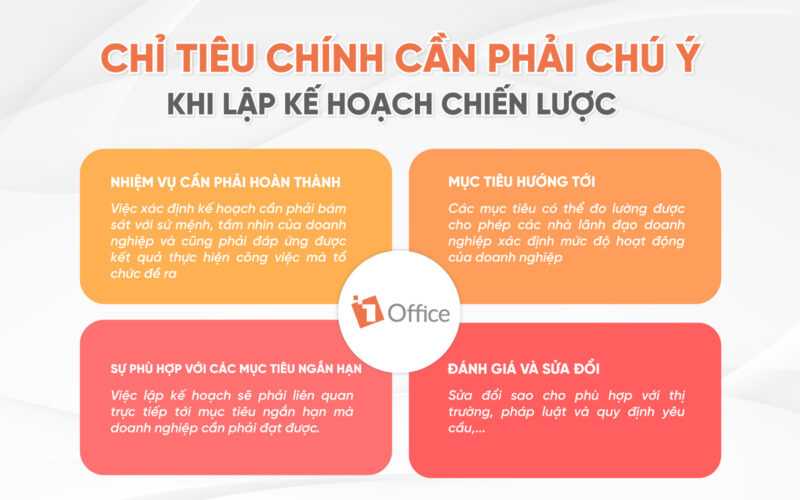
When building a strategic plan, managers need to pay attention to the following 4 aspects to create the most accurate and efficient administrative planning steps:
-
Tasks to be completed
A strategic plan begins with a mission that gives the company a sense of purpose and direction. When implementing a plan, its definition and construction must align with the organization’s mission and vision.
For example: A business in the education industry might seek to become a leader in online education tools and services – one of the new and popular forms of education.
-
Target goals
Typically, when defining an organization’s goals, managers often use the SMART model. Measurable goals are very important because they allow business leaders to determine how well the company is performing against its overall goals and mission.
For example: Setting goals for a fictional education business could include releasing the first version of a virtual classroom platform within two years or increasing sales of an existing tool by 30% in the next year. This is also a way to build a KPI system for the business.
-
Alignment with short-term goals
Planning must be directly related to the short-term goals the business needs to achieve.
For example: For the fictional education business, leaders might choose to strategically invest in communication and collaboration technologies, such as virtual classroom software and services, while declining opportunities to establish physical classroom facilities.
-
Evaluation and revision
Having a specific work plan helps the organization regularly evaluate implementation progress and work quality, and promptly adjust the work plan to suit market demands.
For example: Legal and regulatory restrictions may affect a company’s ability to operate in certain geographical areas. Therefore, the business may need to revise its strategic plan to redefine goals or change metrics to measure progress.
According to one study, 86% of managers spend less than 1 hour per month on strategic planning, which results in 96% of employees not understanding their company’s plan. Therefore, in the next section, managers can read and follow the planning steps we have developed to improve information dissemination and shorten their own planning time.
| Read now: An Accurate and Effective Strategy for Defining a Target Market for Businesses |
II. The steps to create a strategic plan for a business
In an organization, strategic planning is carried out at the management and executive levels. Typically, the simplest scenario for strategic planning will include 5 main steps:
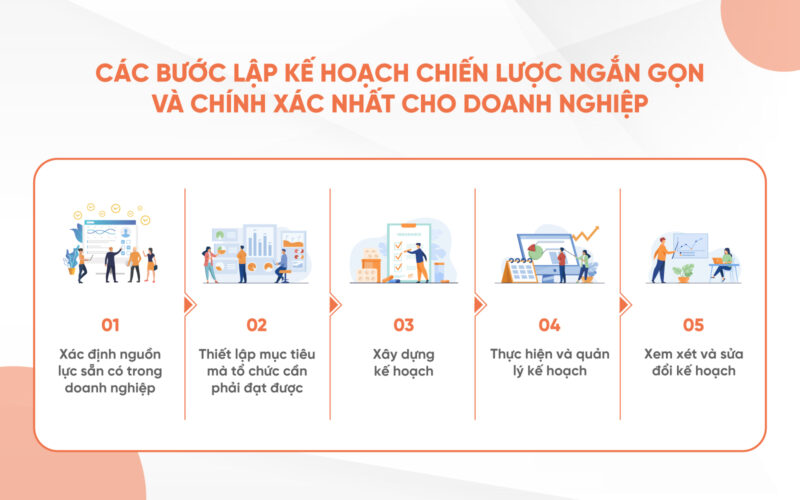
1. Identify available resources within the business
This is the preliminary stage for building a company’s strategic plan. Reviewing and evaluating an organization’s internal and external resources will give you a more specific and accurate view during the planning process. Typically, when identifying and evaluating a company’s resources, you can perform a SWOT analysis. Readers can refer to the elements of the SWOT model in the image below:
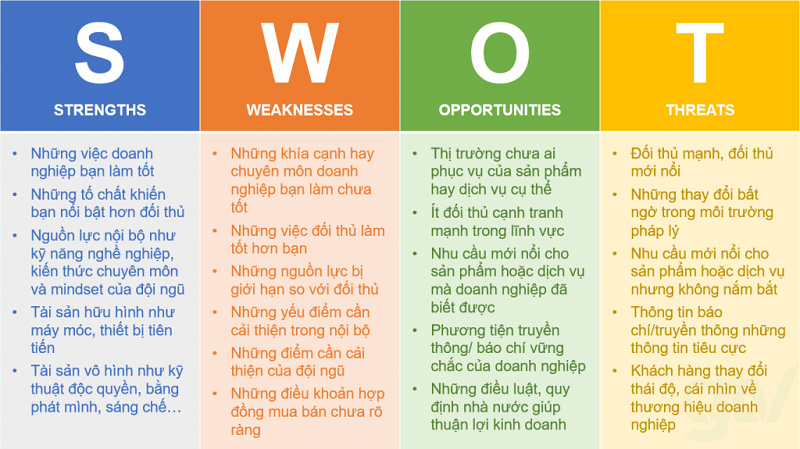
SWOT elements:
- SO (Maxi-Maxi): Aims to maximize advantages to create opportunities
- WO (Mini-Maxi): Overcome weaknesses to leverage strengths
- ST (Maxi-Mini): Use strengths to eliminate threats
- WT (Mini-Mini): Hypothesize all negative issues and focus on devising solutions to mitigate risks.
When developing a business strategy, the manager will assign tasks to each individual and clearly outline the specific roles and responsibilities of each person. Clearly identifying available resources, both internal and external, will help the organization understand the company’s current position at the time of planning.
Read more: A guide to creating the most methodical and detailed business plan
2. Set goals for the organization to achieve
After clearly identifying the organization’s current position, goals will be the tool to meet the expectations of managers and company leadership. Goals can be set for individual departments as well as for the entire business, depending on their purpose.
In reality, an organization’s goals can be general, serving only as a guideline for all business activities. However, when you set goals for a department, you need to be detailed and specific so that your team members understand what they need to do to achieve them.
Prioritizing goals can be done by asking questions such as:
- Which of these initiatives will have the greatest impact on achieving the company’s mission/vision and enhancing its market position?
- What types of impact are most important (e.g., customer conversion vs. revenue)?
- How will competitors react to the plan the business will implement?
- Which goals are urgent and need to be implemented immediately?
- What will the business need to do to achieve the set goals?
- How will we measure our progress and determine if we have achieved our goals?
Example: Increasing profit might be a business goal. Individual departments will need more detailed goals related to driving profit, such as: Increase revenue by 100,000,000 VND in Q2/2022 compared to Q1.
3. Develop the plan
After identifying the fundamental elements a plan needs, in this section, we will look at developing the plan and its importance.
Developing a plan is about painting a picture of the company’s future operations. Therefore, when creating the plan, managers must pay attention to developing both the organization’s internal and external resources.
The internal basis is based on the company’s internal operations and factors. Some examples of the internal basis include:
- The resources you expect to have available
- Company policies that you need or will have to implement
- How management levels will interact with the plan
External factors are anything outside the company that can affect the plan and the ability to achieve set goals. Some examples of external factors include:
- Political and social environment
- Technological advancements
- Competition from other businesses
In addition, when building a plan, managers can also create a Strategy Map for the business to visualize your entire plan.
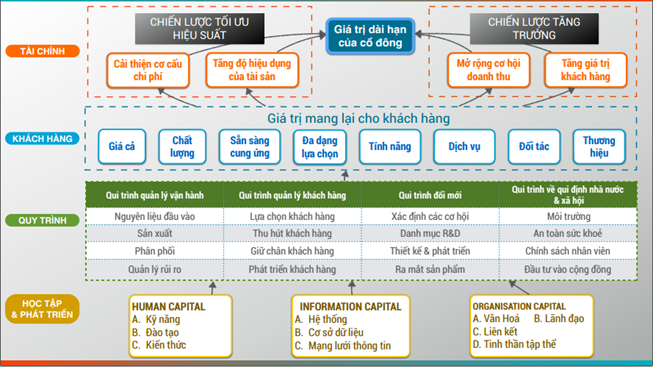
The four perspectives presented on the strategy map were developed by experts Robert S. Kaplan and David P. Norton. They include:
- Financial
- Customer
- Internal processes
- People / Learning and growth
The first two perspectives can be described as: “what we get”, while the bottom two perspectives are “what we are doing”. Typically, the map can be read from top to bottom or bottom to top, but the “story” of the strategy will often flow better when read from the bottom up because what you do directly affects what you get.
| Read more: Blue Ocean and Red Ocean Strategy: Which is the optimal choice? |
4. Plan Implementation and Management
There are usually several different ways for a business to achieve its goals. Therefore, it is crucial to research various solutions to accomplish the set objectives, as this provides managers with flexibility in implementing the established plan.
To select the right implementation method, managers must carefully consider the strengths and weaknesses of each solution, especially in relation to the company’s objectives.
By mapping out processes, broader strategies can be translated into a concrete plan. Throughout the implementation process, KPI criteria will be used to communicate responsibilities from management to staff.
5. Plan Review and Revision
The strategic plan and priority objectives should be reviewed and revised periodically to align with market trends, regulations, and policies relevant to the company’s industry.
Specifically, review KPI achievement rates each quarter to assess the company’s performance. This helps in proposing new solutions and identifying what needs to be adjusted or changed to adapt to the market.
Evaluating strategic effectiveness typically includes: performance measurements, a consistent review of internal and external issues, and more. Any successful strategic evaluation begins by defining the parameters to be measured.
| Learn more: How to build an effective business strategy map for leaders |
III. Example of Upward Airlines’ Strategic Planning Steps
Identify Available Resources
When Upward Airlines identified resources in its strategic plan outline, it found several things to inform its 2019-2024 strategy:
- Several new low-cost airlines have emerged, increasing competition on routes to major cities.
- Larger, more established airlines have added perks like free Wi-Fi and extra seating upgrades.
- Flight prices have changed significantly across the industry over the past five years.
- Upward Airlines has saturated its current geographical footprint since its last plan.
SWOT Analysis
Upward Air’s SWOT analysis revealed:
- Strengths — Consistent marketing message about not charging for checked baggage and a standardized in-flight experience.
- Weaknesses — Most of the aircraft are old and technologically outdated.
- Opportunities — The fleet can be modernized with new seating that allows for an increased number of passengers per flight.
- Threats — Competitors also have marketing programs with a “low-cost” message, but they add hidden fees at the last minute, creating a negative impression on consumers.
Develop the Plan
Continuing with our strategic plan example, Upward Airlines decided it needed to change customer perception to grow and improve how customers view their brand. The company proceeded to change consumer perception of the brand from a “no-frills airline” to “freedom in the skies.” A marketing shift was also necessary, positioning Upward Airlines as having “no hidden extra costs,” rather than just “low-cost,” and focusing on standardizing customer expectations.
Strategy Map
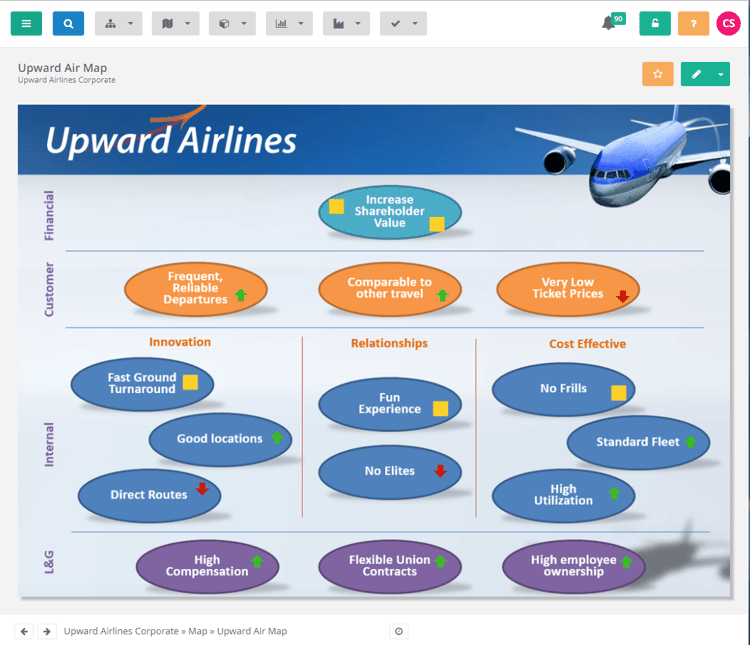
Creating a strategy map helped the organization put all information into a single record, making it easiest for managers to track and monitor.
Upward Airlines’ management-level strategic planning map shows several key lessons:
- Set new financial goals with a different model that includes international flights and online purchases.
- Provide straightforward pricing for customers with no extra costs.
- Improve operational efficiency by retrofitting aircraft and optimizing the consumer check-in and boarding process.
- Invest in technical training and enhancing customer service for employees.
This is just the beginning for Upward Airlines — next, the airline will create its measures and projects. And it will likely implement technology to manage its strategy.
IV. Secrets to Effective Strategic Plan Execution
A strategic plan only truly creates value when it is properly executed and closely monitored. Many businesses have good plans but find them difficult to implement due to a lack of clear mechanisms, measurement tools, or an organizational culture that doesn’t support innovation. Below are the secrets to help businesses ensure their strategic plan is put into practice and achieves the desired results:
1. Assign clear responsibilities to each department
-
Identify the person who is accountable for each objective, project, or task.
-
Assign specific authority, resources, and deadlines to avoid “scattered responsibility.”
-
Ensure all employees clearly understand their role in the overall strategic picture.
When responsibilities are transparent, employees are more proactive, reducing delays or confusion during execution.
2. Use KPIs and dashboards to track progress
-
Establish Key Performance Indicators (KPIs) that align with each strategic objective.
-
Use intuitive dashboards to monitor progress, performance, and receive alerts when issues arise.
-
Periodically review and report to ensure the plan stays on track and issues are addressed promptly.
Continuous measurement helps businesses react quickly, adjust plans in a timely manner, and maintain transparency with stakeholders.
3. Ensure flexibility and timely adjustments
-
The plan should not be rigid; it should be adjustable based on market fluctuations, personnel, or resource changes.
-
Regularly review and update the plan on a weekly, monthly, or quarterly basis to change direction promptly.
-
Encourage departments to propose adjustment solutions when new risks or opportunities are identified.
Flexibility does not mean constant change, but rather intelligent adjustments based on data and real-world situations.
4. Foster a culture of participation and idea contribution from employees
-
Encourage employees at all levels to propose improvements to enhance execution efficiency.
-
Establish a mechanism to recognize, evaluate, and reward useful contributions.
-
Build an open, “no-fear-of-failure” environment that helps employees confidently experiment with new ideas.
A strategy is most effective when employees feel proactive, responsible, and recognized for their contributions to the organization’s common goals.
5. Link the strategic plan with operational processes and resources
-
Ensure strategic objectives are integrated into the daily processes of each department.
-
Assess existing resources (personnel, finances, technology) to ensure feasibility during implementation.
-
Identify potential bottlenecks and create contingency plans.
Linking strategy with operations helps reduce waste, increase feasibility, and ensure all objectives have a basis for execution.
Successful strategy execution depends not only on a paper plan but also on clear responsibilities, regular measurement, flexible adjustments, a culture of participation, and effective resource management. When a business applies these secrets cohesively, the strategic plan becomes a practical tool for sustainable growth and improved organizational performance.
V. Frequently Asked Questions (FAQ)
What is a reasonable timeframe for a strategic plan?
There is no “fixed number” that applies to all businesses; however, in practice:
-
Long-term strategic plans typically span 3–5 years
→ Used to define the vision, development direction, and the company’s market position. -
Mid-term strategic plans are usually for 1–3 years
→ Suitable for implementing growth objectives, market expansion, and internal restructuring. -
Short-term strategic plans are often for 6–12 months
→ Used to translate strategy into specific initiatives, projects, and action plans.
The strategy can be long-term, but the implementation plan must be broken down by quarter or year for easy monitoring, measurement, and adjustment.
Do small businesses need a strategic plan?
Yes, and they may need it even more than large enterprises.
Small businesses often have the following characteristics:
-
Limited resources (people, money, time)
-
Highly dependent on the business owner’s decisions
-
Easily get caught up in daily tasks without a long-term direction
Without a strategic plan, small businesses can easily:
-
Work a lot but fail to generate real growth
-
Expand in the wrong direction, leading to overload or losses
-
Depend entirely on the leader’s intuition
For small businesses, a strategic plan doesn’t need to be complicated, but it should answer 4 core questions:
- What does the business want to achieve in the next 1–3 years?
- What can be done with current resources?
- What are the priorities, and what should be dropped?
- How will progress and effectiveness be measured?
When should you adjust the strategic plan?
A strategic plan is not something you “set and forget.” Businesses should consider adjusting it when one of the following signs appears:
-
Significant market volatility
(economic crisis, changes in customer behavior, new technology) -
Goals are no longer aligned with current resources
(lack of personnel, budget shortages, insufficient capabilities) -
The strategy fails to motivate the team
(employees don’t understand, aren’t engaged, or don’t see the purpose) -
Actual results deviate significantly from set goals
despite proper plan implementation
Best practices:
-
Review periodically every 3–6 months
-
Adjust implementation methods and resources first
-
Only change strategic goals when absolutely necessary
Should you use OKRs or KPIs for strategic management?
Both OKRs and KPIs are important, but they serve different purposes:
KPIs (Key Performance Indicators) are suitable when:
-
The business is operating stably
-
You need to measure specific work performance
-
You want to monitor daily and monthly progress and results
OKRs (Objectives & Key Results) are suitable when:
-
The business is growing rapidly or undergoing a transformation
-
You need to create focus on strategic goals
-
You want to drive innovation and breakthroughs
The most effective approach in practice:
-
Use OKRs for the strategic level (company, department)
-
Use KPIs for the execution level (project, individual)
-
Link OKRs ↔ KPIs to ensure the strategy doesn’t “break” during implementation
V. Automated Work Planning Software – Supporting Easy Task Management
Work planning software is a module within the 1Office comprehensive business management platform, trusted by over 450,000 users from more than 5,000 Vietnamese businesses. With many smart features, the software helps you manage and organize multiple tasks simultaneously, effectively, and easily. Some key features of the task management software include:
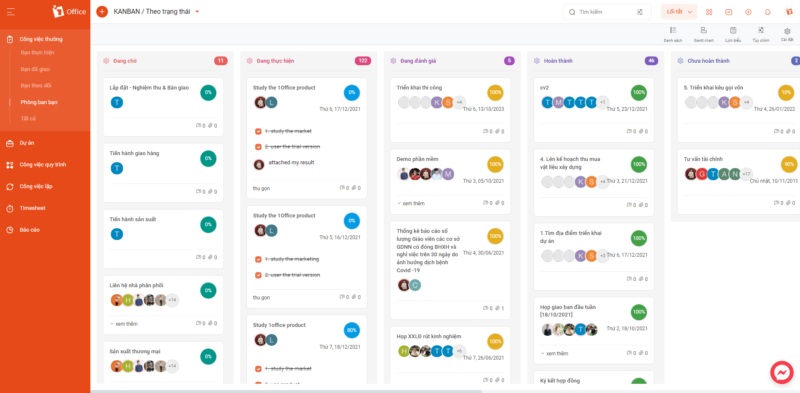
- Create specific work plans: The software automatically updates personal schedules, helping users proactively carry out assigned tasks.
- Track status and manage work progress on a Gantt chart screen, a Kanban-style task management system
- Easily drag and drop task statuses like: in progress, completed… helping you grasp the details of each different work item.
- Automatic alerts and reminders help individuals proactively perform their work.
Through this article, we hope to have provided readers with the most comprehensive overview of the strategic planning process and the simplest, quickest steps to build a complete strategic plan.
For more detailed information, please see:
Hotline: 083 483 8888
Fanpage: https://www.facebook.com/1officevn/
Youtube: https://www.youtube.com/channel/UCeTIRNqxaTwk0_kcTw6SxmA
















