12/05/2026
  515 views
Office 5S is a familiar method that helps businesses build a tidy, clean workspace and improve operational efficiency. But what is Office 5S, what principles does it include, and where should you start applying it? This article will help you understand everything from the concept and benefits to how to implement Office 5S in your business.
Mục lục
I. What is Office 5S?
Since the 1980s, the 5S concept originated in Japan. By 1986, the 5S rule became more popular in countries such as Singapore, China, Poland, etc. And it was first applied in Vietnam in 1993 with Japan’s investment expansion and at Vikyno.

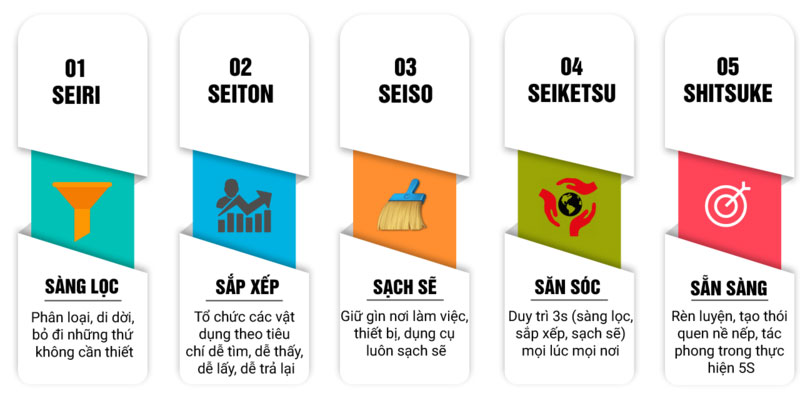
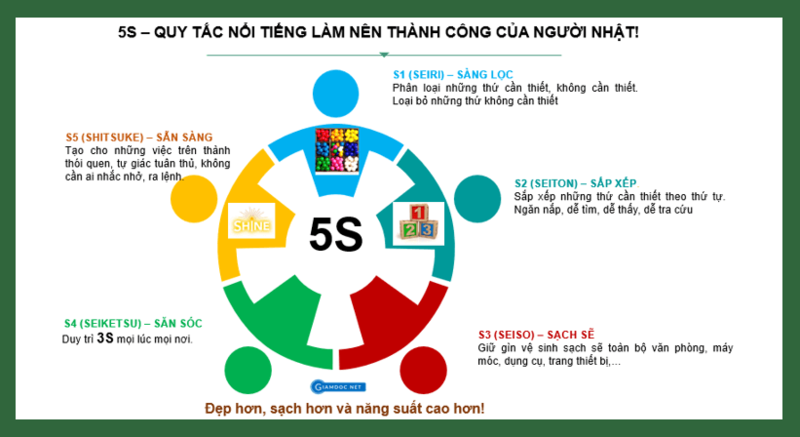
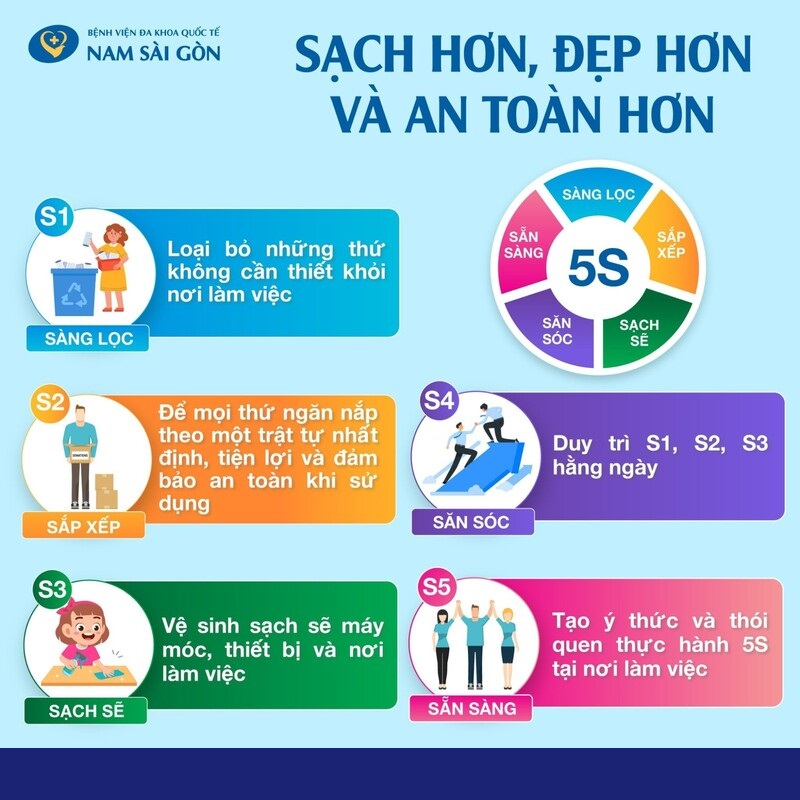
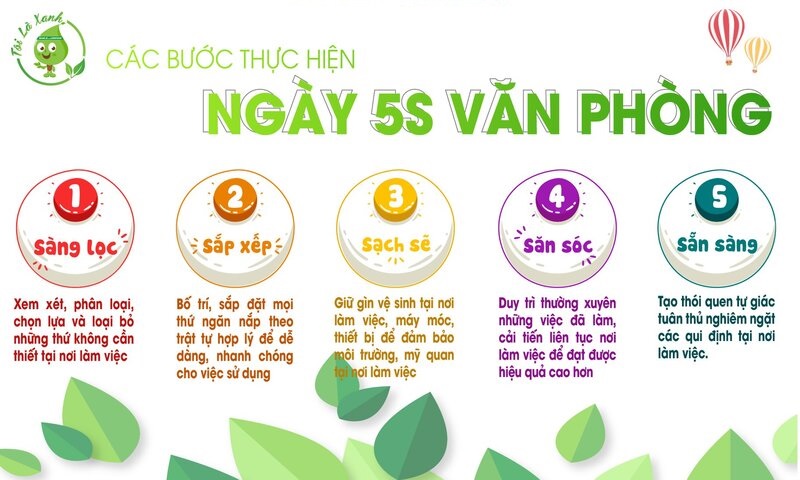
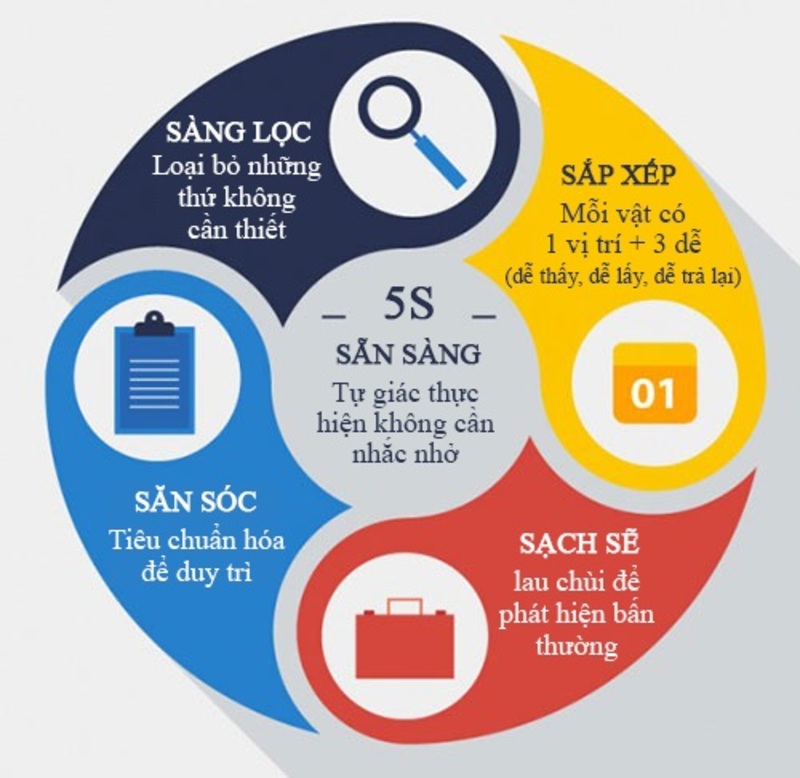
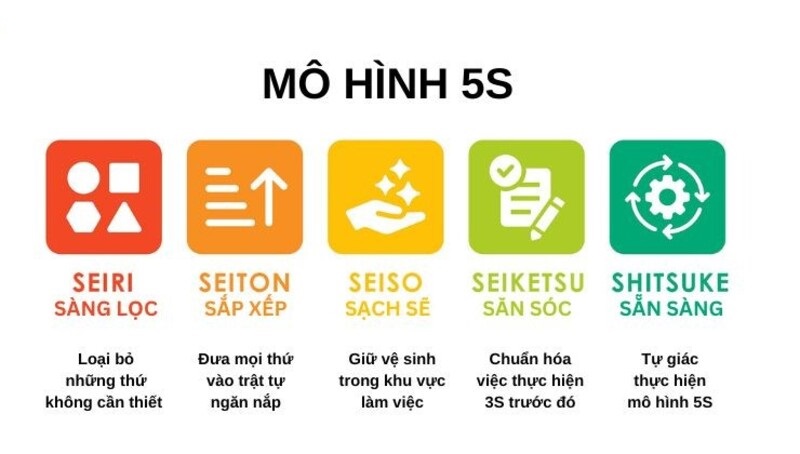
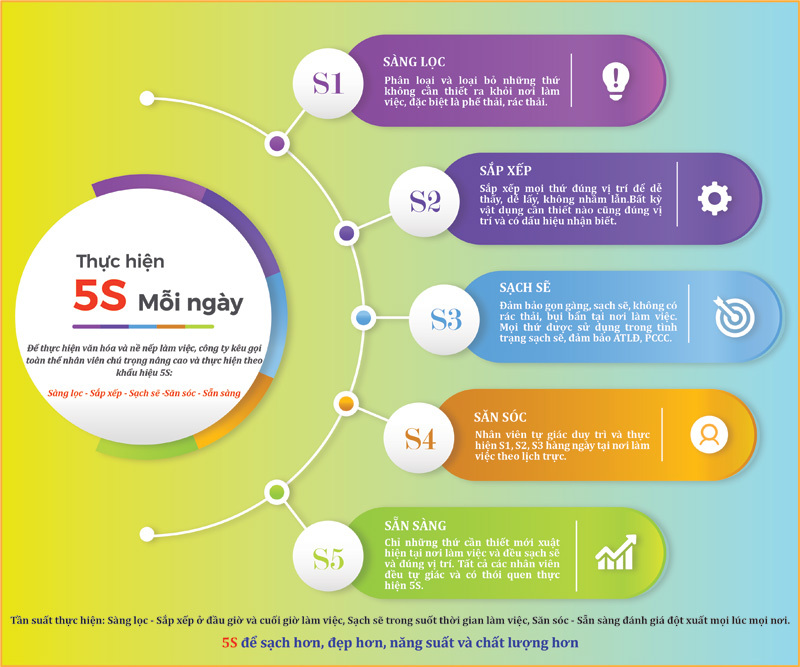
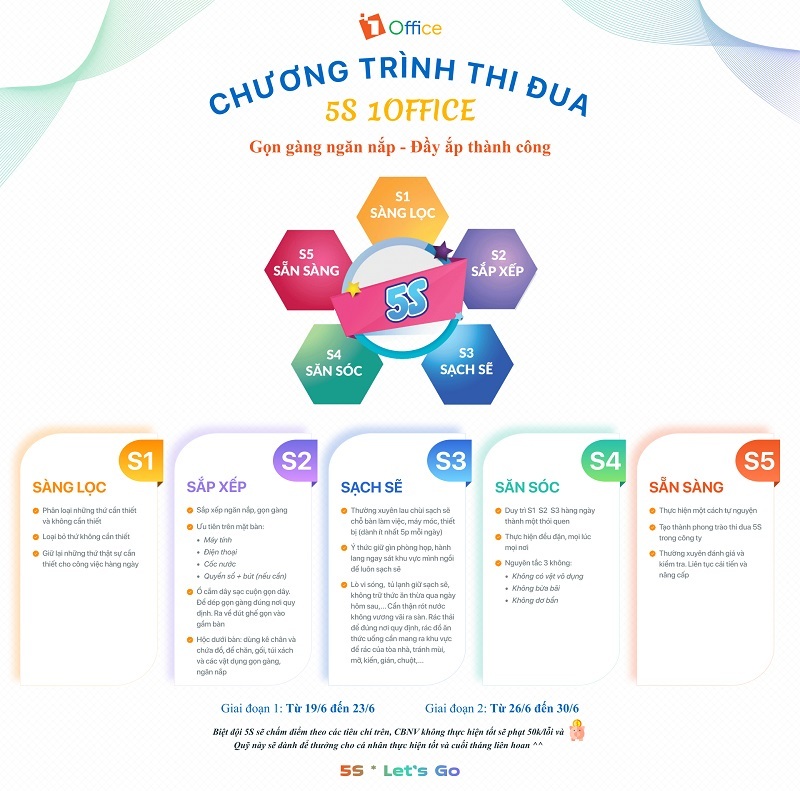
Office 5S is a method of managing and organizing the workplace in an office environment, aiming to create an efficient, clean, and tidy workspace. Office 5S is composed of 5 principles that start with the letter S in Japanese, including:
- 整理 (Seiri) – Sort
- 整頓 (Seiton) – Set in order
- 清掃 (Seiso) – Shine
- 清潔 (Seiketsu) – Standardize
- 躾 (Shitsuke) – Sustain
II. Benefits of Implementing Office 5S
The 5S principles are being increasingly and strongly applied by many businesses. According to practical surveys on the effectiveness of 5S in businesses, 5S has brought many benefits, such as:
- Building a neat, clean, and tidy work environment: Workstations and the overall workspace become comfortable and positive through the arrangement and organization of physical and informational resources such as data files, documents, machinery, equipment, etc., all stored scientifically for easy retrieval.
- Improving work efficiency and quality: Each employee can focus more on their work. At the same time, the process of searching for data and processing information becomes easier. This leads to smarter work organization to complete tasks quickly.
- Forming good habits, building corporate culture: All members of the company must comply daily, creating habits in their lifestyle and work. This creates a positive environment that boosts the capabilities of each employee, which in turn unleashes the company’s internal strength to achieve breakthrough business performance.
- Increasing the discipline and responsibility of each employee: Each employee participates in and is responsible for maintaining and applying this method, thereby increasing personal discipline and responsibility. This helps the business minimize risks during work implementation.
- Creating a good impression on customers and partners: A clean, neat, and tidy work environment demonstrates professionalism and creates a good impression on customers and partners.
- Minimizing storage costs: Streamlining items/goods that are unnecessary or no longer have value.
Therefore, applying Office 5S is something that every business should promote and develop. Applying 5S is also an effective method for increasing productivity in a business.
III. A Guide to Applying Office 5S Most Effectively
To apply Office 5S most effectively, businesses should follow these steps in order:
Seiri – Sort
The first step in the 5S principles is to sort. Sorting here means that the business classifies the necessity of resources to proceed with elimination. This sorting system is divided into 3 levels, including:
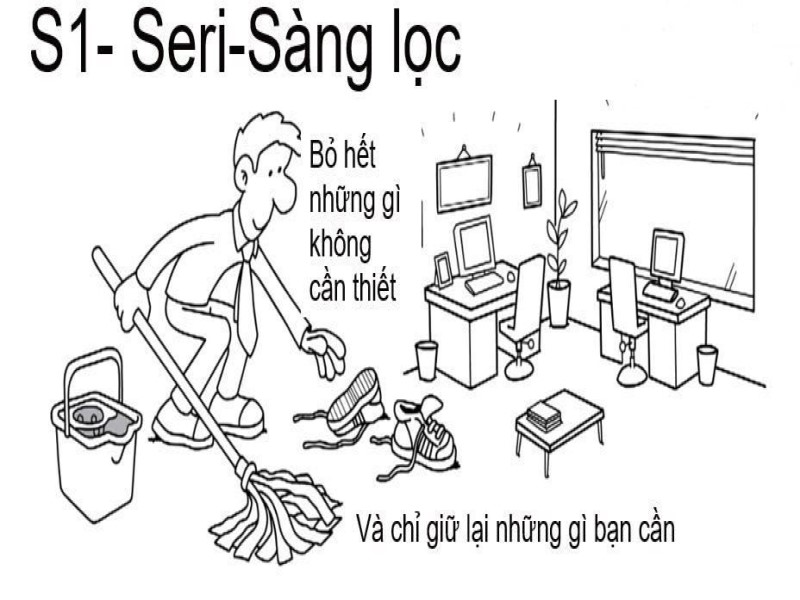
- Necessary (Keep)
- Unnecessary (Eliminate)
- Necessity undetermined (Keep for a while longer; if it remains unused and provides no value, move it to the unnecessary category. Then proceed with elimination.)
Based on the sorting results, the business proceeds to eliminate unnecessary resources. The seiri activity brings many benefits, such as: streamlining storage space, reducing unnecessary tools, etc.
Example: An office cabinet at Company A is full of items: new notebooks, old cardboard covers, pens, personnel files, flyers, and plastic bottles. The company proceeds to sort the items in the cabinet as follows:
– Necessary: personnel files, pens, new notebooks
– Unnecessary: old cardboard covers, plastic bottles.
– Necessity undetermined: flyers.
The office cabinet will then have more empty space after removing the old cardboard covers and plastic bottles. The items kept by the company are: personnel files, pens, new notebooks, and flyers.
>> Read more: What is a 5S reward and penalty regulation? A simple internal reward and penalty regulation template for businesses
Seiton – Set in Order
Next, the business proceeds to arrange the resources that were previously sorted. The resources are arranged neatly, tidily, and scientifically. This helps improve the office’s aesthetics and makes it more convenient to use the resources.
The arrangement of resources is based on their frequency of use, following this principle:
- Frequently used: arrange in a place that is easy to see and easy to get.
- Infrequently used: arrange in a place that is easy to find.
- Rarely used: store in the warehouse or other storage areas as specified by the company.
This activity helps employees easily find and use resources conveniently. Other related tasks can also be implemented and executed quickly.
Example: A company determines that the items to be kept in the office cabinet are: personnel files, pens, new notebooks, and flyers. Among them:
- Notebooks and pens: Frequently used to distribute to new employees.
- Personnel files: Infrequently used.
- Flyers: Rarely used.
The company’s office cabinet has 3 shelves corresponding to 3 compartments. Thus, the order of arrangement will be as follows:
– Shelf 1: Notebooks and pens
– Shelf 2: Personnel files
– Shelf 3: Flyers
Seiso – Shine
In 5S for the office, the Seiso (shine) element holds an important position. This step determines whether the work environment is clean. The company needs to guide employees to clean their workplaces, including the equipment and tools that support their work.
A clean workspace creates a comfortable feeling, boosting the morale of every employee. Employees can unleash their creativity and perform at their best. This is also a way for the company to impress new employees, customers, and partners.
At the same time, by properly implementing Seiso, the company can also minimize risks such as machinery and equipment breakdowns.
Every employee needs to participate in this activity to ensure consistency and maintain general hygiene. Therefore, the company should establish general regulations for everyone to follow. Here are a few suggestions for companies when applying the shine principle:
– Clean individual workspaces at three intervals: the beginning, middle, and end of each work shift. Specifically: wipe down the desk, put away unnecessary items on the desk, dispose of waste paper in the designated trash bin, check the surrounding work area, etc.
– Regularly clean machinery, equipment, and tools that are owned by or under the responsibility of the employee to maintain and use. For machinery, equipment, and tools used during the day, they should be cleaned after each work shift. Specifically: wipe/wash machinery with specialized cleaning solutions, etc.
Seiketsu – Standardize
The Seiketsu element plays the role of maintaining and developing the three activities: sort, set in order, and shine.
To perform this activity well, the company needs to build a set of regulations similar to work regulations regarding aspects such as: time, objectives, actions, etc. This is the only way to ensure that members participate in implementing 5S fully and seriously. Specifically:
– Develop an implementation process.
– Establish evaluation standards and principles for the activities.
– Monitor, inspect, evaluate, and urge the process of employees implementing the 5S principles.
Example: When applying 5S in the office, ABC Company outlines the implementation process as follows:
Step 1: Prepare for implementation
Step 2: Officially announce the launch of the program
Step 3: Everyone conducts a general cleaning
Step 4: Start with SEIRI (Sort)
Step 5: Implement SEIRI, SEITON, SEISO daily (sort, set in order, shine)
Step 6: Conduct periodic evaluations
Shitsuke – Sustain
Here, the business carries out activities to ensure all members are ready to participate in the company’s 5S activities. This process is not simple if the business does not clearly identify the participants in the 5S activities.
Typically, participants in an organization and business will be divided into 3 main groups:
- 5S initiators and implementers (Organizing, operating, and monitoring committee)
- Heads of departments/divisions (Implementers and supervisors of subordinate staff)
- Individual employees (Implementers)
For each different group, the business will clearly define their authority and responsibilities, ensuring each group understands the information and performs correctly. The business can apply activities such as:
– Plan and organize training sessions – implementation guides for office 5S.
– Develop a set of documents for employees about the 5S process.
– Regularly inspect and evaluate the level of 5S implementation by personnel.
>> See more: Set of PROCESS TEMPLATES to standardize operations for every business
IV. Collection of 10+ images of the best standard office 5S models
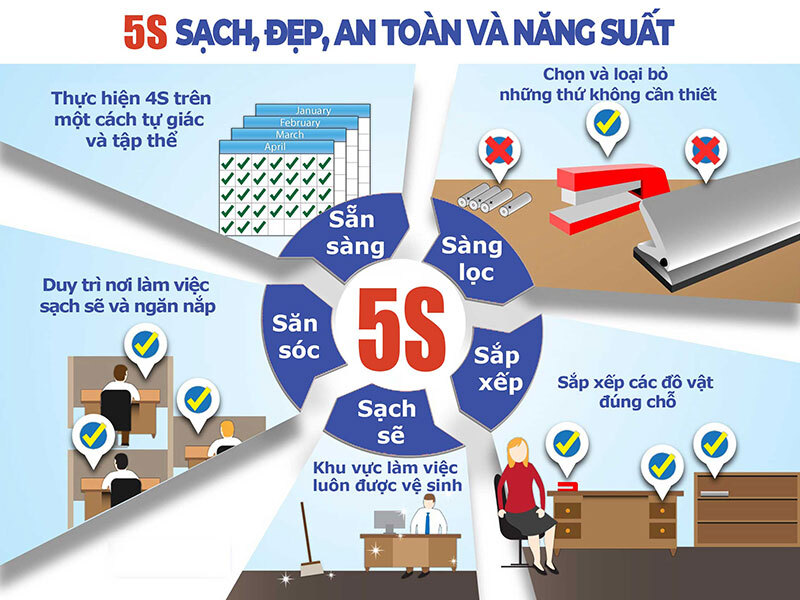
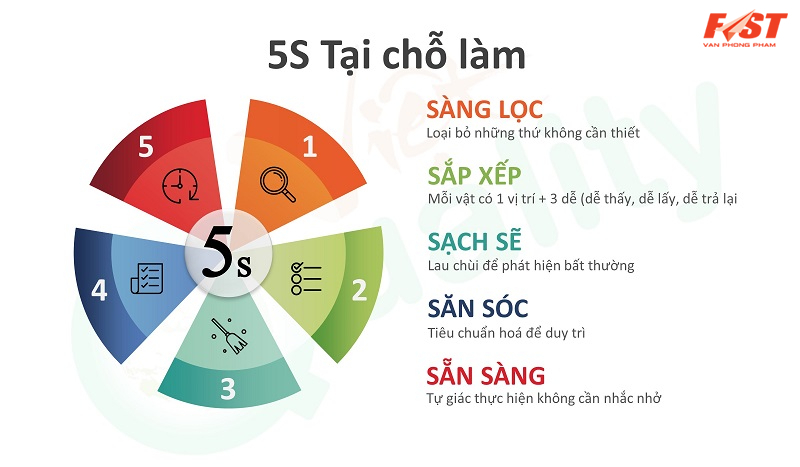
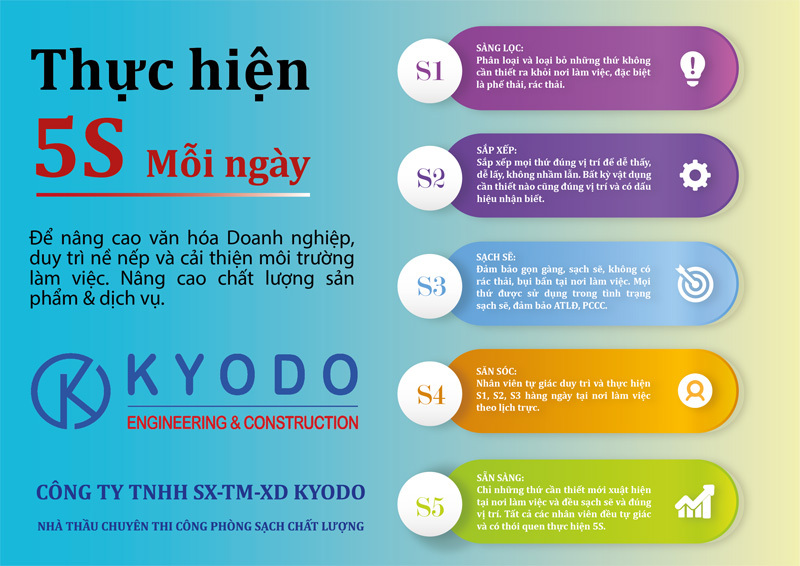
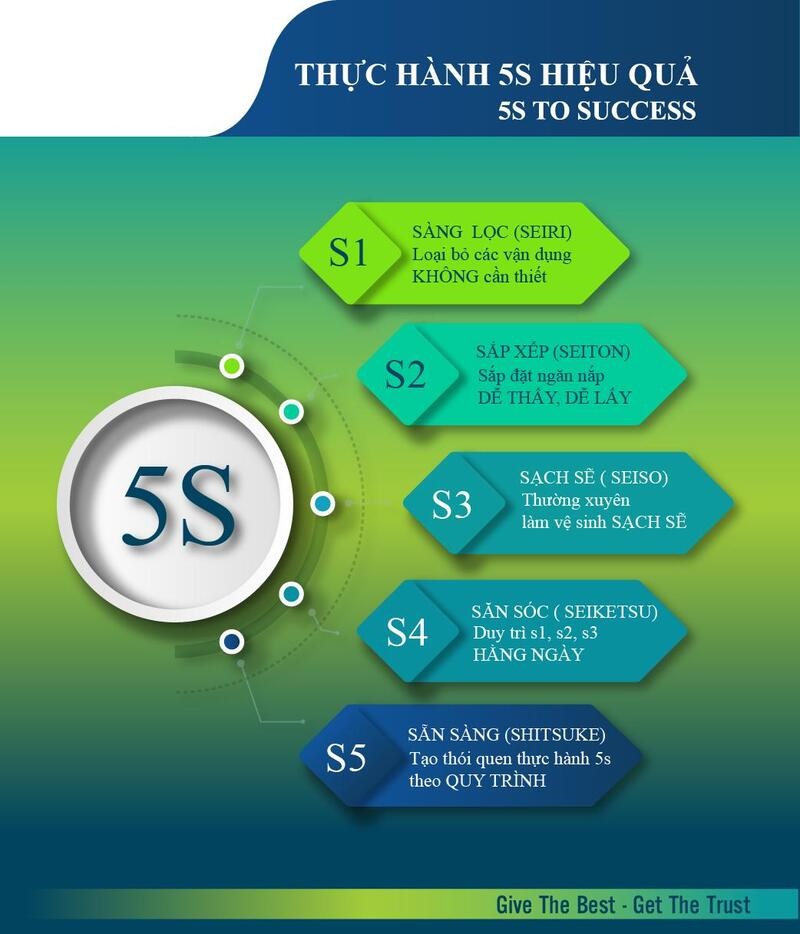
Refer to 10+ images of the best standard office 5S models right below:
V. Who is in charge and responsible for implementing 5S?
In the 5S model, success doesn’t come from a single department but is the result of synchronized coordination between leadership, management, HR, and employees. Each role takes on a clear responsibility to ensure 5S operates stably, is maintained long-term, and becomes the company’s work culture.
1. Department Head – The “5S Leader” in Each Area
The Department Head acts as the leader and is primarily responsible for 5S within their scope of management. They are the bridge between leadership and staff, directly ensuring that all 5S activities are implemented according to standards.
Key Responsibilities:
-
Plan the 5S implementation for the department in line with the company’s overall goals.
-
Clearly assign responsibilities to each employee in each position.
-
Check and evaluate the level of 5S compliance daily/weekly.
-
Resolve issues that arise related to layout, cleanliness, and procedures.
-
Report results and propose improvements to leadership or the HR department.
-
Inspire and boost morale for 5S implementation within the team.
The Department Head is ultimately responsible if their area violates or fails to maintain 5S standards.
2. Employees – The Ones Who Directly Implement 5S Every Day
If the department head is the implementer, then the employees are the ones who operate 5S. 5S is only truly effective when each employee voluntarily and proactively participates.
Key Responsibilities of Employees:
-
Practice all 5 steps: Sort – Set in Order – Shine – Standardize – Sustain.
-
Keep desks and work areas tidy and clean according to established standards.
-
Report abnormalities or risks related to cleanliness, safety, and organization.
-
Participate in mandatory 5S training sessions.
-
Propose improvements to help optimize space and work processes.
-
Maintain the 5S spirit as a daily habit, not just as a formality.
Employees are the “executors,” directly determining the quality of 5S maintenance.
3. The HR Department – Coordinating, Controlling, and Standardizing 5S Company-Wide
In many businesses, HR not only handles personnel matters but is also the department that manages the work environment. Therefore, HR plays a central role in coordinating 5S among departments.
Role and Responsibilities of HR:
-
Develop a set of 5S standards, application regulations, and evaluation checklists.
-
Organize periodic training for new employees and the entire company.
-
Coordinate 5S activities between departments to ensure consistency.
-
Inspect, score, and compile reports weekly/monthly.
-
Implement a reward and reminder mechanism to motivate compliance.
-
Propose investments in equipment and tools to support 5S, such as cabinets, labels, and sorting boards.
HR helps 5S become a cultural standard, not just a short-term campaign.
4. Leadership – Directing, Sponsoring, and Promoting the 5S Culture
Without commitment from leadership, 5S can easily be implemented superficially or be disrupted. The role of leadership is strategic, creating the foundation for long-term 5S operation.
Role of Leadership:
-
Define the importance of 5S for operational efficiency and business development.
-
Issue a policy for 5S application and commit to its implementation.
-
Approve the budget for 5S training, tools, and support equipment.
-
Communicate and spread the value of 5S to all employees.
-
Periodically monitor results and incorporate 5S into departmental KPIs.
-
Create an environment that encourages continuous improvement (Kaizen) from 5S.
The leadership acts as a “sponsor,” helping 5S become part of the organization’s development direction.

This is all the information about office 5S. We hope this information is useful to you. We wish you success!