


 10/05/2026
  160 views
In the context of the increasing demand for short-term labor, seasonal employment contracts have become an indispensable tool for businesses, HRM, HRD, and employers. However, how can you draft a standard seasonal contract that ensures legal compliance and avoids risks? Let’s find out with 1Office in the article below!
Mục lục
- What is a seasonal employment contract?
- Standard seasonal employment contract template
- Employer’s responsibilities in a seasonal employment contract
- Conditions for creating and signing a seasonal employment contract
- Differentiating Seasonal Contracts from Other Types of Contracts
- Common mistakes when creating seasonal contracts
What is a seasonal employment contract?
A seasonal employment contract is a type of labor contract signed between an employer and an employee to perform temporary, non-regular work. This is one of the forms of labor contracts stipulated in the 2019 Labor Code.
Key features of a seasonal employment contract:
- Short term: According to Article 22 of the 2019 Labor Code, a seasonal employment contract has a term of less than 12 months.
- Nature of work: Serves seasonal, temporary, or project-based work.
- No mandatory social and health insurance contributions: This is a major difference compared to other types of labor contracts; however, the employer must still contribute to occupational accident and disease insurance for the employee.
Standard seasonal employment contract template
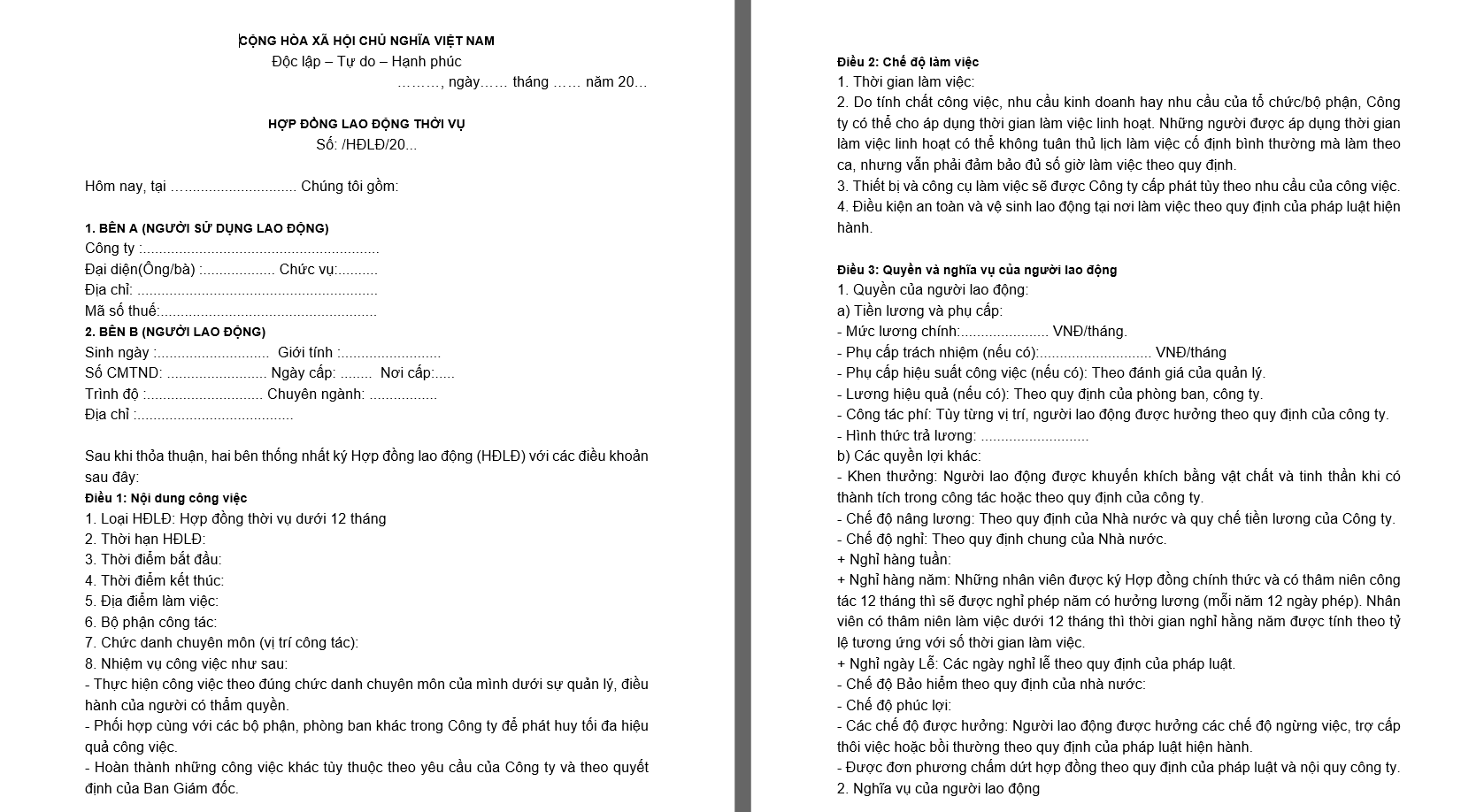
Download the free seasonal employment contract template here!
A standard seasonal employment contract template should include the following basic contents:
Information of the involved parties
- Full information of the employer: business name, head office address, tax code, representative, position
- Information of the employee: full name, date of birth, address, ID card/Citizen ID card number, date of issue, place of issue
Job description and working hours
- Detailed description of the work the employee will perform
- Work location
- Working hours per day, per week
- Contract term (specific start and end dates)
Rights and obligations of the parties
- Salary, form of payment
- Working conditions, equipment provided
- Rest and leave policy, labor protection
- Regulations on labor discipline
Contract termination clauses
- Cases of early contract termination
- Responsibilities of the parties upon contract termination
>> See more: Job offer letter template HERE
Employer’s responsibilities in a seasonal employment contract
In a seasonal employment contract, the employer plays a crucial role in ensuring legality and protecting the employee’s rights. Adhering to these responsibilities not only helps the business avoid legal risks but also builds a transparent and fair human resource management system.
Below are the main responsibilities:
- Provide transparent information: Clearly present the job, salary, and benefits before signing so the employee understands and agrees.
- Ensure basic rights: Pay salary on time, not below the regional minimum wage, and contribute to insurance if the working period is 1 month or longer.
- Adhere to the contract term: Do not exceed 12 months and avoid signing multiple consecutive contracts to evade long-term responsibilities.
- Make full payment upon termination: Settle any remaining salary and allowances and do not create difficulties for the employee after the contract ends.
Conditions for creating and signing a seasonal employment contract
To ensure a seasonal employment contract is created and signed legally and effectively, employers need to comply with the important conditions below. Understanding these regulations not only helps avoid legal violations but also ensures the rights of both parties.
Conditions regarding the work
Seasonal contracts are only applicable in specific cases related to the nature and duration of the work:
- The work must be seasonal, temporary, or project-based: This is a prerequisite, for example, harvesting agricultural products seasonally, supporting short-term events, or temporarily replacing personnel.
- The duration of the work must be less than 12 months: According to Vietnamese law, a seasonal contract cannot exceed 12 months for a specific job.
- Do not use seasonal contracts for regular, ongoing work: If the work is stable and long-term, the business must sign a fixed-term or indefinite-term labor contract instead of misusing seasonal contracts.
Conditions for Employees
Employees entering into a seasonal contract must meet basic requirements to ensure legality:
- Employees must be 15 years of age or older: The law stipulates the minimum age for signing a labor contract is 15, except for special cases involving workers under 15 which require the consent of a guardian.
- Have full civil capacity: The employee must be capable of understanding and taking responsibility for their actions when signing and executing the contract.
- Meet the health requirements suitable for the job: Depending on the nature of the work, the employee must be in adequate health to complete the assigned tasks.
Conditions on Form and Content
The form and content of the contract are crucial factors that determine its transparency and legal validity:
- The contract must be in writing: According to the Vietnamese Labor Code, seasonal contracts must be in written form; verbal agreements are not accepted.
- The contract must contain all basic clauses: This includes information on the term, job description, salary, working hours, and the rights and obligations of both parties. Omission of these clauses can lead to future disputes.
- The language used in the contract must be clear and easy to understand: The contract should be drafted in Vietnamese or a language that both parties understand, avoiding ambiguous or misleading terminology.
Signing Process
The signing process for a seasonal contract must be carried out in accordance with regulations to ensure fairness and legality:
- The employee must fully understand the contract’s content before signing: The business is responsible for clearly explaining the terms, benefits, and obligations so that the employee understands them before signing.
- The contract must be signed by an authorized representative of the employer: The signatory must be a legally authorized person (e.g., director, HR manager) for the contract to be legally valid.
- Each party keeps one copy of the contract: After signing, both the employee and the employer must keep an original copy of the contract for reference when needed.
>> Read more: 10 most effective recruitment interview methods today 2026
Differentiating Seasonal Contracts from Other Types of Contracts
In human resource management, choosing the right type of labor contract is particularly important, as it not only affects the rights of employees but also determines the level of legal risk for the business. Seasonal contracts are often confused with other forms of contracts, leading to incorrect application and disputes.

Differentiating Between Seasonal Contracts and Fixed-Term Contracts
Seasonal contracts and fixed-term labor contracts both share the common feature of having a specific duration, but their legal nature and scope of application are entirely different.
-
Regarding the purpose of use:
-
A seasonal contract is signed to perform work that is temporary, short-term, arises seasonally, or is based on sudden demand.
-
Fixed-term contracts are used for regular work, but the business does not yet have the need to sign an indefinite-term contract.
-
-
Regarding contract duration:
-
Seasonal contracts are typically used for short-term work that is not long-term or stable.
-
Fixed-term contracts have a duration of 12 to 36 months.
-
-
Regarding legal risks:
-
If a seasonal contract is used for regular work, the business may be considered to be circumventing labor laws.
-
Fixed-term contracts are clearly recognized by law for stable positions.
-
Differentiating Between Seasonal Contracts and Piecework Contracts
These are the two types of contracts most commonly confused in practice.
-
Legal nature:
-
A seasonal contract is a labor contract, governed by the Labor Code.
-
A piecework contract is a civil contract, governed by the Civil Code.
-
-
Management relationship:
-
With a seasonal contract, the employee is under the management, direction, and supervision of the business.
-
With a piecework contract, the contractor is autonomous in terms of time and method of execution; the business is only concerned with the result.
-
-
Rights and obligations:
-
Seasonal workers are entitled to basic benefits such as salary, holidays, occupational safety, and insurance (if eligible).
-
Piecework contractors are not entitled to labor benefits.
-
If a business signs a piecework contract but in practice manages the worker like a seasonal employee, the contract may be reclassified as a labor contract.
Differentiating Between Seasonal Contracts and Freelancer/Collaborator Contracts
Freelancer/collaborator contracts are often used flexibly, but they carry many potential risks if not applied correctly.
-
Nature of work:
-
Seasonal workers work according to specific requirements, for a defined period, under the supervision of the business.
-
Freelancers/collaborators usually work irregularly, on a per-product or per-project basis.
-
-
Legal relationship:
-
A seasonal contract constitutes a labor relationship.
-
A freelancer/collaborator contract is usually a civil or service relationship.
-
-
Business risks:
-
If a freelancer/collaborator works on a fixed basis, with a set time, location, and clear management → there is a risk of it being considered a disguised seasonal labor contract.
-
Common mistakes when creating seasonal contracts

Improper use
Seasonal contracts are only suitable for temporary, short-term jobs. However, many businesses misuse this type of contract, leading to serious violations:
- Signing seasonal contracts for regular, continuous work: This violates Vietnamese labor laws, as stable jobs must be covered by fixed-term or indefinite-term contracts.
- Signing multiple consecutive seasonal contracts with the same employee: Intentionally extending the working period through multiple short-term contracts to avoid the responsibility of signing a long-term contract is against the law. According to regulations, if the total working time exceeds 2 consecutive months, the contract must be converted into a formal labor contract.
- Using seasonal contracts to evade social insurance obligations: Some businesses intentionally do not pay social insurance and health insurance for seasonal workers, even though the law requires contributions for work periods of 1 month or more.
Shortcomings in the contract content
The contract content is the core element that ensures transparency and clarity between the two parties. However, many contracts suffer from the following shortcomings:
- Not clearly stating the contract’s start and end dates: This can easily lead to disputes over working hours and benefits upon contract termination.
- Vague or unclear job description: If the duties and scope of work are not clearly stated, the employee may not fully understand their responsibilities, causing difficulties in execution and tracking work progress
- Not clearly defining the salary and payment method: The lack of information on salary, bonuses, payment schedule, or payment method (cash, bank transfer) can lead to employees experiencing delayed or incomplete payments.
Violations of employee rights
Seasonal employees are still protected by law with basic rights, but many businesses intentionally violate them:
- Paying below the regional minimum wage: According to regulations, the salary for seasonal employees must not be lower than the minimum wage set by the government for each region.
- Failure to provide personal protective equipment: For jobs with potential risks, businesses must provide adequate protective equipment, but many places overlook this, endangering employees.
- Failure to pay for occupational accident and disease insurance: This is a mandatory obligation for businesses, but many intentionally evade it to cut costs, affecting employees’ rights in the event of an incident.
————————————-
Seasonal contracts are a flexible human resource management tool, helping businesses meet labor demands for seasonal work or short-term projects. However, to use them effectively and in compliance with the law, employers must understand the relevant regulations and fulfill their responsibilities towards their employees.
















