


 13/05/2026
  215 views
HR strategy is one of the key factors influencing a business’s success or failure. If a business has poor human resource management and lacks a plan or direction for human resource development, it will face many potential risks. Therefore, a business needs a rigorous strategy-building process with a long-term orientation that is connected to its business strategy to foster growth. So, what are the steps to create a strategy, and which models should businesses apply for HR management? Let’s explore in the content below.
Mục lục
I- General Overview of HR Strategy
1. What is an HR strategy?
An HR strategy is a comprehensive roadmap for a business that helps solve the organization’s pressing issues through people-centric solutions. It helps the business set a direction for all its areas, including recruitment, talent management, compensation, succession planning, and corporate culture. Therefore, a human resource strategy is a long-term plan that governs HR activities within the organization.
2. Why do businesses need to build an HR strategy?
Every organization needs to build a long-term human resource strategy to have a clear direction for business development. One of the main benefits of aligning the HR strategy is that it helps organizations allocate their budgets in ways that will maximize their return on investment (ROI). Implementing an employee strategy will help businesses:
- Increase revenue
- Increase employee engagement
- Increase work productivity
- Attract outstanding talent
- Enact better policies
- Minimize business disruptions
See more: A-Z Guide to the proper steps of human resource planning for businesses
II- Some popular HR strategy models
There are many HR management models available today that suit the needs and scale of different organizations. But fundamentally, there are 7 popular models developed based on famous HR management theories that businesses can refer to:
1. The Harvard Model
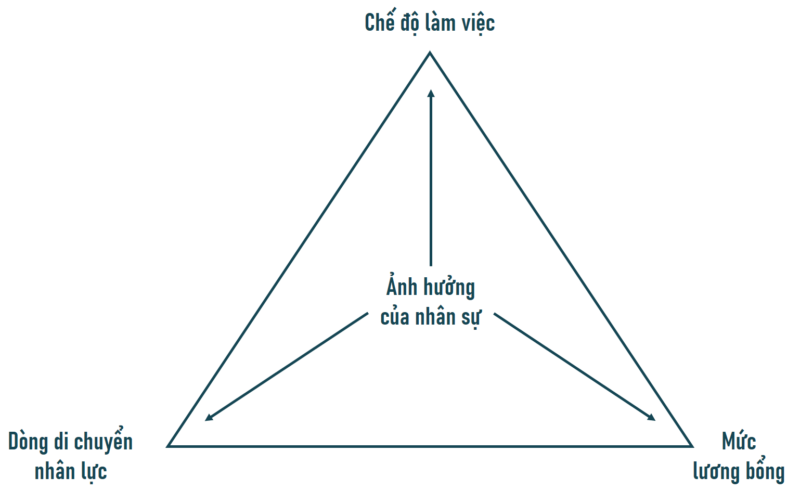
The Harvard Framework of HRM is a comprehensive HR management model that focuses on resolving people-related issues. This model primarily concentrates on the relationship between people, emphasizing communication, motivation, and leadership roles.
Additionally, the Harvard model fosters collaborative and motivational methods and empowers general managers to participate in the HR aspect of the business. This model is built on the belief that human resources provide any organization with a significant competitive advantage, so employees are always valued above all else.
2. The Warwick Model
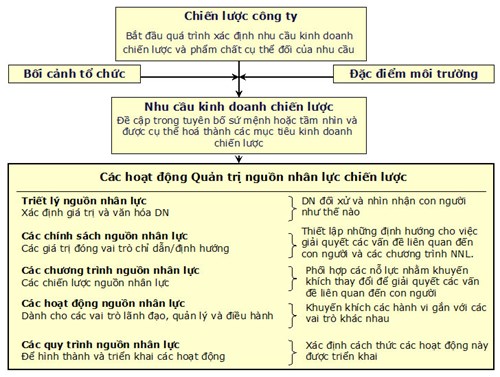
The Warwick Model was developed by researchers Hendry and Pettigrew of the University of Warwick (hence the name Warwick Model). Similar to other human resource management models, the Warwick model revolves around five elements:
- Outer context (macro-environmental forces)
- Inner context (company-specific or micro-environmental forces)
- Business strategy content
- HRM context
- HRM content
This model focuses on HR and organizational issues. It is a framework centered on achieving company performance and growth by striking the right balance between the inner and outer contexts.
3. The 5P Model
The 5P HRM Model is an HR strategy model developed in 1992 by Randall S. Schuler. As its name suggests, the 5P model is based on the following 5 aspects: Purpose, Principles, Processes, People, and Performance. Within this model, aligning and balancing these principles will lead to organizational success.
The 5P model defines:
- Purpose is the organization’s vision, mission, and main objectives;
- Principles are understood as pre-established operational protocols that lead to achieving results;
- HR training processes, including: knowledge, organization, systems, and operational methods;
- People are the key factor in implementing the specified principles and processes;
- Performance is the result that can be measured by appropriate standards.
4. The Fombrun Model
The Fombrun model is considered a simple HR strategy model, serving as a primary experiential framework to explain the nature and importance of key activities. This model’s perspective is that the HR system and organizational structure must be managed in a way that best aligns with the organizational strategy, encompassing four core functions: selection, competency assessment, development, and rewards. As you can see, the Fombrun model focuses on HRM functions and overlooks environmental factors that influence the HR function.
5. The Advanced HR Value Chain Model
In this model, the HR department’s role is to create value for the organization, which is formed by three main perspectives: the customer, process, and organizational perspectives.
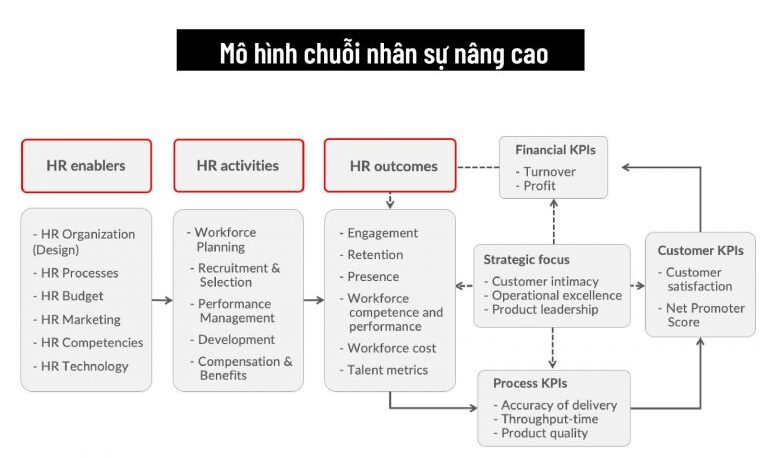
- HR enablers: These include factors that govern HR activities, such as budget, HR competencies, and other related factors.
- HR activities: This includes core HRM tasks such as planning, performance management, recruitment, and selection decision-making.
- HR outcomes: These are the goals that HR and other departments must strive for. HR outcomes can be measured by employee engagement, retention, performance, and workforce costs.
To achieve its goals, an organization needs to align with its HR values. For example, if a business has a low HR budget, it may lead to lower employee salaries. This can reduce employee retention rates and affect key performance metrics.
6. The Deloitte HR Operating Model
This HR operating model by Deloitte includes detailed plans for an HR function, built on adaptability and expertise. Here are the four core elements of the model:
- HR Customers: HR is at the center of the model and directly influences the employee experience.
- Digital Workplace: Represents the empowerment and connection of the workforce.
- Workforce Insights: This information is obtained through digital solutions and HR analytics and is used to build business strategies.
This is an effective HR development strategy that describes how to transition from current work methods to a high-impact workforce within a framework that includes: capabilities, capability development, community empowerment, and enhancing credibility.
7. The HPWS HR Strategy Model
The HPWS HR strategy model, also known as the high-involvement work system, best human resource management practices, and high-commitment work system, was first described by Huselid in 1995.
A High-Performance Work System (HPWS) is a specific combination of HR practices, work structures, and processes aimed at enhancing employees’ skills, knowledge, commitment, engagement, and adaptability. Within this, HPWS includes many interrelated and complementary subsystems to achieve the goals of an organization, whether large or small.
| Read more: Effective Business Strategy Map for Leaders |
III- Steps to build an effective HR strategy
Each individual and department will have different job requirements and HR foundations. Therefore, depending on the current personnel situation and long-term orientation, businesses can take different steps. Below are 5 basic steps in the HR strategy planning process that you can apply:
Step 1: Analyze business needs
Every human resource management strategy requires business effort, so the first step is to align both strategies. Simply put, you need to have a 100% understanding of the business objectives to create an effective strategy so that everyone knows what they are aiming for and is motivated by rewards.
Once you have a clear idea, you need to define it more clearly. This means identifying a Key Performance Indicator (KPI), which you can then discuss with managers to ensure that all personnel are aligned. This is the first crucial step in laying the foundation for a strategic partnership.

Step 2: Forecast future personnel requirements
Personnel forecasting is a crucial step in defining your market and any potential changes. When the organization acquires new clients or finds itself in a position to attract more talent, you need to create a personnel plan and adjust the company’s human resource functions. This helps managers determine the quantity and quality of human resources needed and the timeline for when the business requires new personnel.
Reference: Important HR policies according to corporate standards – how to build them effectively
Step 3: Analyze the gap between future needs and resources
Compare your future personnel needs from step 1 with your current personnel capabilities from step 2 and identify any significant gaps that appear. These gaps can develop in several common areas, including policies, procedures, and resource allocation capabilities. To better understand this issue, start with the following questions:
- Where do significant gaps appear between the present and the future?
- How can these gaps be categorized?
Step 4: Create an action plan and implement it
In the next step, the HR department needs to create an action plan to forecast personnel fluctuations within the business. In this plan, the business needs to measure the number of employees who will be working in the future and their employment status (e.g., promotion, transfer, or retirement), or when they might take on a new role and potentially change in the near future.
Step 5: Evaluate the HR strategy
After implementing the HR plan for a certain period, you need to evaluate whether the plan has yielded successful results. How is the strategy helping you execute the organizational strategy and achieve goals in areas such as productivity or maintaining employee satisfaction, etc.? Through this evaluation, you can also understand how changes affect employees and make timely adjustments.
1Office HRM – An effective solution for building HR strategy
Today, as manual HR management methods have become outdated and inefficient, HR management software is the optimal and effective solution chosen by many. One of the most effective HR management solutions is the HRM software suite from 1Office – a comprehensive business management platform trusted by over 450,000 users from more than 5,000 Vietnamese businesses.
<iframe title="
1Office HRM is an all-in-one technology platform that helps digitize every process of the HR department: from recruitment, timekeeping, payroll, leave requests, training, to effective human resource evaluation.
In summary, this article has introduced readers to HR strategy and the steps for effective human resource planning. It also presents a human resource management solution with the 1Office HR management software, helping managers save time and effort in developing an effective recruitment plan. We hope this article provides you with useful knowledge to implement and build a long-term, sustainable HR strategy for your business.
















