


The process of building a sales plan and common problems encountered


To achieve business effectiveness, organizations need to build an effective sales plan. It provides a comprehensive overview of the tasks individuals must perform and the milestones they must reach. Therefore, in this article, let’s explore everything related to the “sales plan”
Mục lục
- I. What is a sales plan
- II. 8 steps to creating a sales plan that helps businesses achieve high efficiency in business
- 1. Analyze the situation and market
- 2. Define objectives and set a timeline for implementation
- 3. Develop a strategy
- 4. Create a suitable budget
- 5. Product training and internal communication
- 6. Determine the company’s marketing plan
- 7. Define an action plan, build a contingency plan
- 8. Measure work performance results
- III. 5 common problems when creating a sales plan
- 1. Failing to identify customer needs and wants
- 2. Failing to identify the challenges the business faces.
- 3. Not getting feedback and evaluations from relevant people to build a suitable strategy
- 4. Setting unrealistic goals that don’t match the company’s current situation
- 5. Failing to correctly identify the target market
- IV. Complete Sales Plan Template by Industry
- V. Contact 1Office’s CRM Solution
I. What is a sales plan
Sales planning is the process of defining objectives and developing strategies to achieve those objectives. A sales plan, in coordination with a marketing plan and a business plan, helps a company achieve the metrics it expects to reach.
A sales plan is similar to a traditional business plan but focuses specifically on your sales strategy. Many people often confuse a business plan with a sales plan.
|
Business plan |
Sales plan |
| Outlines your goals | Describes exactly how you will achieve those goals |
Typically, a specific sales plan will include the following elements:
- Target audience
- Revenue goals
- Company strategies and resources
- Structure of the implementation team
Effective sales plan: An effective sales plan is one that meets the company’s objectives:
- Communicate your company’s goals and objectives
- Provide the company’s strategic direction
- Outline roles and responsibilities
- Track the sales team’s progress
See more: Professional Sales Process: Steps for Building and Practical Application
II. 8 steps to creating a sales plan that helps businesses achieve high efficiency in business
To create a sales plan that helps achieve the company’s expected goals, managers must build a specific process. Typically, the process of building a sales plan will go through the following steps:
1. Analyze the situation and market
Market analysis includes aspects such as: Size, competition, growth potential, market trends, customer audience, identifying the target market and being data driven to help the business clearly identify obstacles and strengths when marketing products/services.
Market analysis can be based on the following principles:
- SWOT – Strengths, Weaknesses, Opportunities, and Threats
- 5M model of resource management
2. Define objectives and set a timeline for implementation
A successful product not only brings profit to the business but also provides use value and utility to employees. Moreover, establishing an implementation timeline helps employees clearly identify their tasks and deadlines, thereby increasing work efficiency.
To define their objectives, managers can use the SMART rule:
S (Specific): Helps clarify the objective, avoiding confusion or deviation during implementation
M (Measurable): Accurately measure the progress of work implementation
A (Attainable): Set achievable goals, not unrealistic or impossible ones
R (Relevant): The objective of the sales plan must align with the company’s overall goals and be related to the organization’s mission and vision.
T (Time-bound): Creates sufficient pressure and commitment to ensure you complete the objective on time.
Example: Increase the order closing rate
S – Specific: I want to increase the order closing rate
M – Measurable: The order closing rate should reach at least 70% of product consultation calls
A – Attainable: With the capabilities of the Customer Care department and the product’s superior features compared to competitors, I want the order closing rate to reach at least 70% of product consultation calls
R – Relevant: To achieve outstanding revenue
T – Time-bound: The objective must be completed before 31/12/2020
3. Develop a strategy
Strategy development will depend on the SWOT model that the manager analyzed in the previous steps. Based on PEST analysis, the manager can apply the SWOT matrix analyzed above into the following factors:
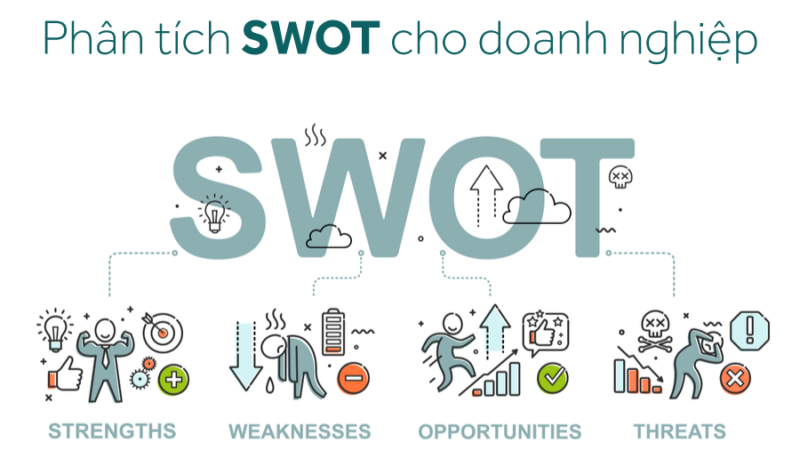
SO (Maxi-Maxi): To maximize advantages to create opportunities
WO (Mini-Maxi): Overcome weaknesses to leverage strengths
ST (Maxi-Mini): Use strengths to eliminate threats
WT (Mini-Mini): Hypothesize all negative issues and focus on devising solutions to mitigate risks.
When developing the strategy, the manager will assign tasks to each individual and clearly outline the specific roles and responsibilities of each person.
4. Create a suitable budget
Budget allocation is always difficult to determine because there will always be additional issues arising, so the budget spending plan drawn up by the manager is only an “estimate” for a certain amount of money. Typically, a complete sales budget will include the following elements:
Fixed costs:
- Depreciation of fixed assets
- Venue rental costs
- Office rental costs
- Warehouse rental costs
- Basic salary fund (fixed salary) and social insurance
- Interest expenses (for medium and long-term loans)
- Research and development, market research costs (if there are specific regulations on annual spending levels).
- Fixed monthly and annual fees and charges (e.g., franchise payments, intellectual property rights payments…)
- Other costs: such as package payment costs, if any. For example, hosting subscription fees, domain maintenance, internet subscription fees, periodic outsourced service package payments (such as vehicle rental, periodic transportation, cleaning services, security services, etc.)
Variable cost budget
Includes costs that change according to sales revenue and volume. Variable costs typically include:
- Advertising costs
- Promotional costs for specific programs
- Performance-based salaries and bonuses
- Commissions paid to agents and sales representatives
- Shipping and handling costs
- Goods insurance, warehouse insurance costs…
- Goods storage costs
- Entertainment and external relations costs
- Market research costs (if these are incurred expenses)
- Working capital costs (for short-term loans)
- Sales force training and coaching costs
- Other costs
5. Product training and internal communication
Sales are only effective when individuals within the same sales team have a good relationship with each other, facilitating convenient information exchange and discussion. Additionally, communication helps provide team members with clear direction.
6. Determine the company’s marketing plan
As mentioned above, a sales plan combines the business plan and the marketing plan to help the company achieve its goals. Determining the marketing plan will help the Sales department staff understand the product/service promotions and ongoing marketing campaigns so they can advise and answer customer questions. Typically, a marketing plan will also include incentives for word-of-mouth marketing by consumers.
For example: 20% off for groups of 2 or more, 10% off the next use.
7. Define an action plan, build a contingency plan
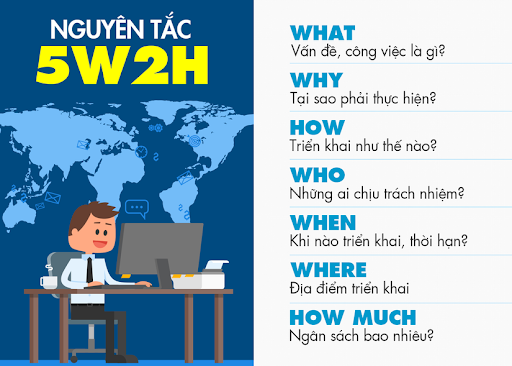
Summarize the plan to achieve each specific goal; activities can be described using the 5W – 2H model
Build a contingency plan in case issues arise: Typically, in small-scale businesses, building a contingency plan is often overlooked. A contingency plan must meet the following requirements:
- Refer to the risk assessment matrix and select the scenarios that are most likely to cause damage or are most likely to occur that you want to plan for. Then, outline what will happen in each case
Aim for a range of scenarios – for example: cyber attacks, prolonged employee absence, IT failures, loss of a supplier, a major power outage, or structural issues with the business premises.
- What will trigger the execution of your contingency plan? If there is a plan for heavy snowfall, will it be triggered by a severe weather warning or only by the actual snowfall? An event can also have multiple triggers, each initiating a different part of the plan.
- A brief overview of the strategy you will follow to respond to the event. This provides context for the actions you require people to take. Identify who needs to know what has happened
- Key responsibilities: Identify who is responsible for each element of the plan, who will be in charge at each stage, and what you expect them to accomplish.
See more: FREE DOWNLOAD: Detailed sample sales plan for all industries
8. Measure work performance results
Perhaps the most common performance metric you know is KPIs. To understand more about the KPI Evaluation Sheet, managers must use their management skills to measure individual work results as accurately as possible.
There is no specific planning framework for all businesses. Based on the business situation, model, and products of the company, each organization will have a specific sales plan. Therefore, managers must rely on experience and expertise to build a sales plan framework that is most suitable for their organization.
III. 5 common problems when creating a sales plan
1. Failing to identify customer needs and wants
An effective company is one that clearly understands its customers’ needs. To identify needs and market trends, organizations often collect data based on market signals or through consumer demand surveys: creating online surveys, making phone calls, etc. Once the required amount of data is collected, the business will analyze it and combine it with its sales plan to create the most effective sales campaign possible.
2. Failing to identify the challenges the business faces.
An effective sales plan will outline the issues the organization faces with competitors. In addition, it also points out the difficulties the company will encounter during the sales campaign. A clear understanding of potential and certain challenges will help managers build a more effective strategy.
3. Not getting feedback and evaluations from relevant people to build a suitable strategy
In the process of building a sales plan, creating a draft and seeking feedback from experienced individuals is extremely important. A sales plan is a collection of ideas from various members of the sales and marketing teams. By synthesizing the experience accumulated by individuals during their work, we will have an accurate, specific plan that clearly understands consumer behavior and the customer persona target.
4. Setting unrealistic goals that don’t match the company’s current situation
The tendency to make assumptions is often based on intuition. However, in the current digital era, as consumer demand increases, what businesses need to do is use a data-driven approach to make accurate decisions. Therefore, managers should set “digitized” goals and build them based on the SMART principles mentioned above.
For example: Increase sales by 150% compared to the previous month, not just a sales plan goal of “Increase sales.”
5. Failing to correctly identify the target market
For an effective sales campaign, correctly identifying the market with the target customer segment is extremely important. To have an effective sales campaign, businesses need to correctly identify their “niche market.” Typically, small and medium-sized companies will focus more on their “niche market” because their limited personnel and resources prevent them from competing for the larger market with the “big players” in the industry. Correctly identifying the “niche” market the organization is targeting will help them gradually establish a firm foothold in the market.
For example: The most successful case of targeting a niche market is Roll-Royce – the segment of business people who prefer luxury cars.
IV. Complete Sales Plan Template by Industry
A sales plan should include the following basic content:
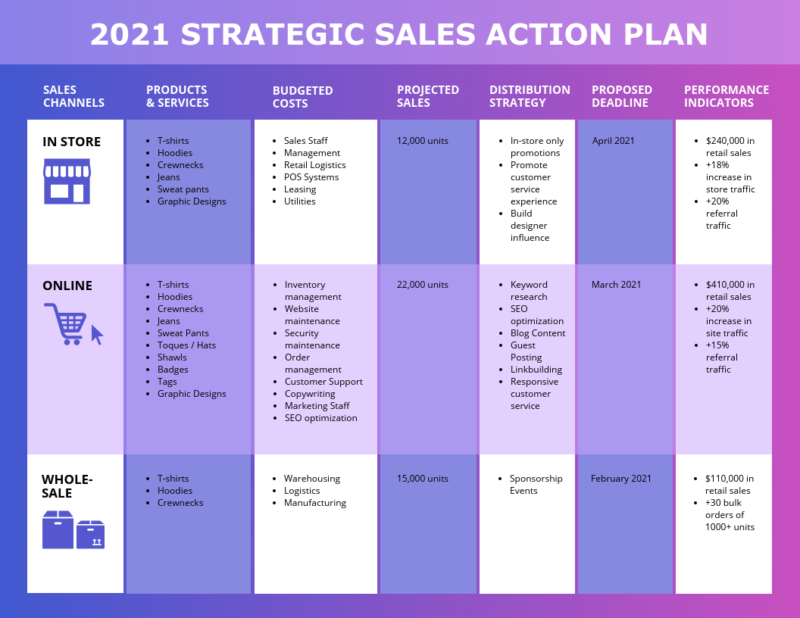
Sample sales plan for the fashion industry
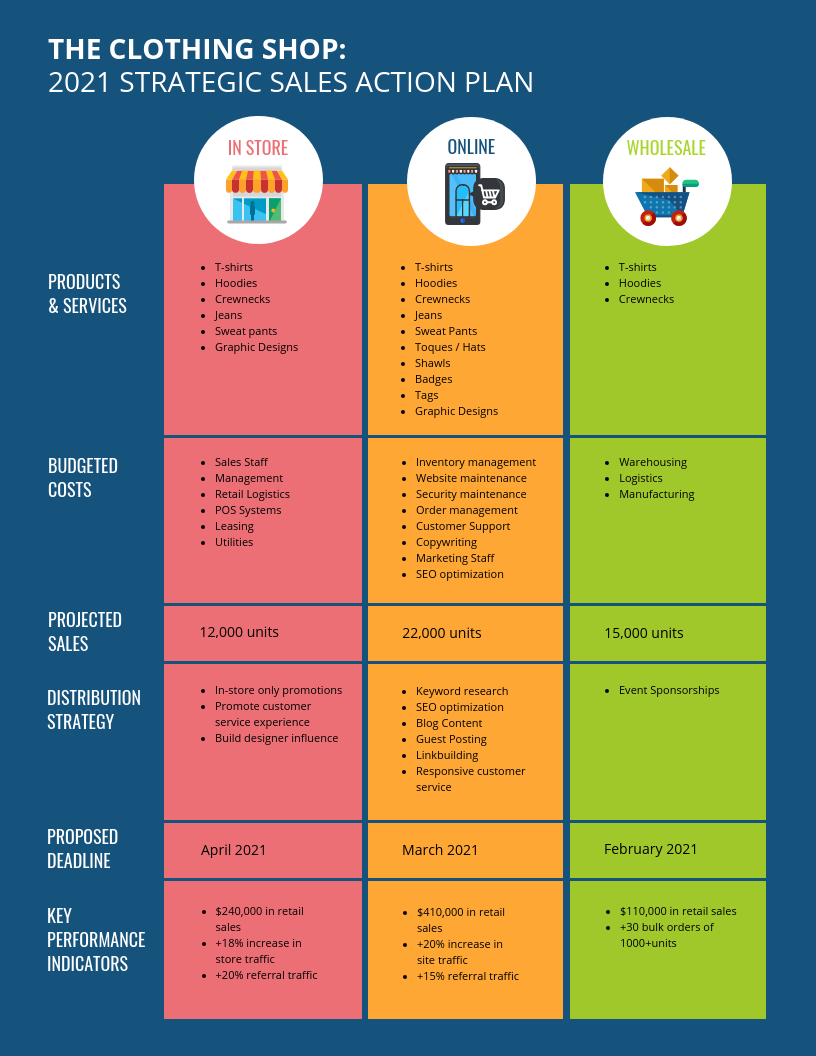
As it is the fashion industry, there will be more sales methods: Direct sales at stores, sales on e-commerce sites, and sales on social media channels. A complete fashion sales plan must include these elements: Products and services, budget for items, projected product quantity, detailed campaign description, proposed deadlines, and key performance indicators.
Sales plan for the food and beverage industry
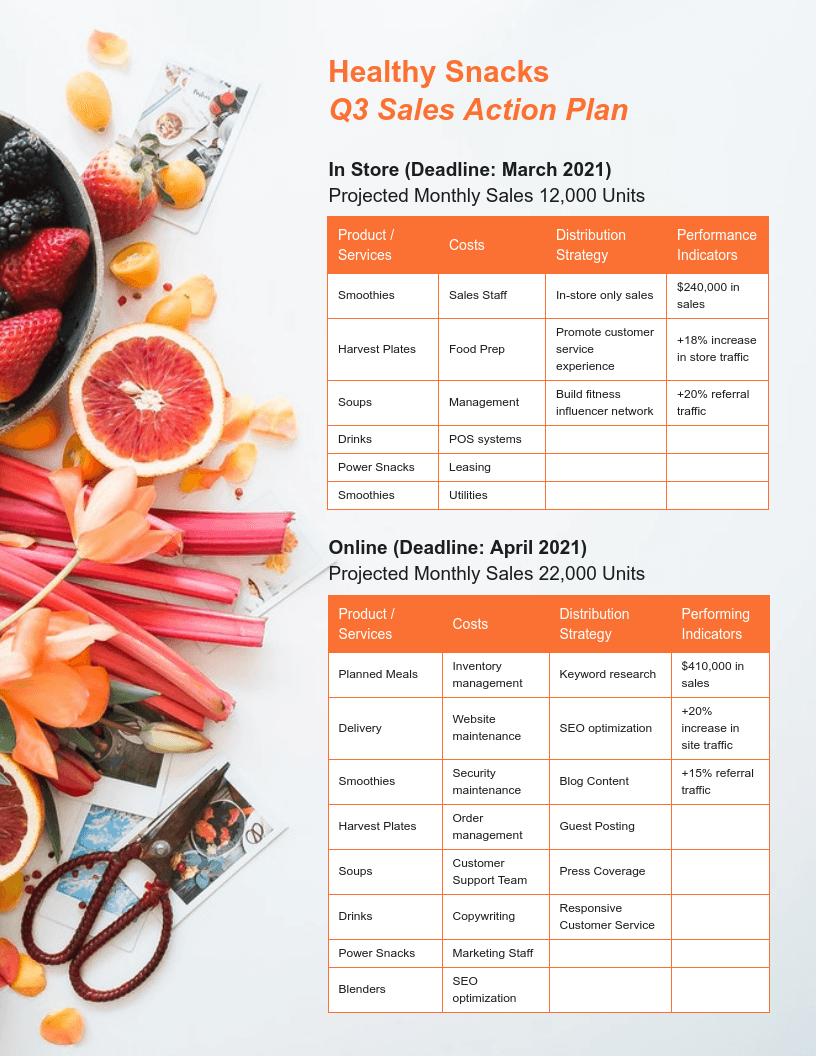
Depending on the specific sales plan, there will be suitable and unsuitable sections. However, to be considered an effective sales plan, it must meet the following requirements:
- Clearly state the objectives to be achieved within a specific timeframe
- The programs and activities needed to achieve the objectives
- The budget required to complete the strategy and objectives
- Clear assignment of tasks to individuals within a sales team
- The metrics and measurements used to evaluate work performance
See more: Business Performance Report – A Guide to Reading and Analyzing Metrics
V. Contact 1Office’s CRM Solution
By using the CRM feature of the 1Office work management software, your business will gain the following benefits:
<iframe title="
- Manage all customer information
- Provide better customer care
- Manage the sales process more effectively
- Detailed reporting on business activities
By using the sales CRM software from 1Office, your organization can track the progress of assigned tasks, monitor customer data, and review past business performance.
To register for a trial of the CRM software that helps manage information, data, and optimize professional customer care processes, please leave your phone number. The 1Office team of experts will contact you for a consultation today.
For more detailed information, please see:
- Hotline: 083 483 8888
- Fanpage: https://www.facebook.com/1officevn/
- Youtube: https://www.youtube.com/channel/UCeTIRNqxaTwk0_kcTw6SxmA




