


 10/05/2026
  161 views
Upsell (selling an upgraded product) and Cross-sell (selling related products) are two of the sales skills often used by businesses. These two techniques not only help businesses increase profits but also build customer loyalty. However, these two techniques are very easily confused with each other. So, what are Upsell and Cross-Sell, and how can they be applied to business most effectively? Let’s find out with 1Office in the article below.
Mục lục
- I. What are Upsell and Cross-Sell?
- II. Why do businesses need to apply Upsell – Cross-sell techniques in their business operations?
- III. Core principles of Upsell and Cross-sell techniques
- IV. Some strategies for implementing Upsell and Cross Sell
- V. Common Mistakes When Implementing Upsell & Cross-Sell
- V. Conclusion
I. What are Upsell and Cross-Sell?
Upsell and Cross-Sell are easily confused, but in reality, these two concepts are completely different.
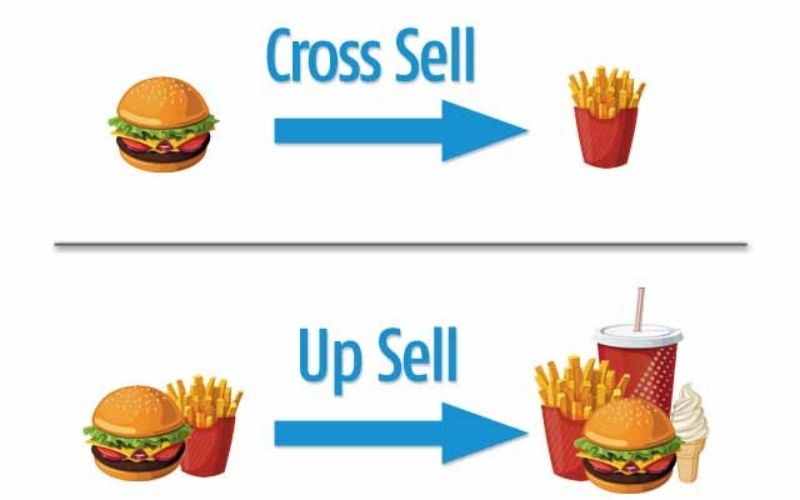
- Upsell: is understood as upselling, a technique aimed at selling a higher-value version of a product that the customer is buying or intends to buy by adding features or functionalities to that product.
- Cross-Sell: is understood as cross-selling, a technique aimed at selling other related products alongside the product the customer wants to buy.
Upsell and Cross-Sell are two techniques used extensively in business, so what makes these two techniques so widely adopted by companies?
II. Why do businesses need to apply Upsell – Cross-sell techniques in their business operations?
Buyers often tend to trust products they have previously purchased from a store. According to research in the book “Marketing Metrics”:
- The profit margin from new customers is 5% – 20%
- The profit margin from selling to loyal customers is up to 60% – 70%
These are significantly different figures and represent a valuable target that businesses always aim for. With the value these two techniques bring, every business wants to apply them in their operations. Specifically, cross-sell and upsell help businesses:
1. Increase profits

Obviously, when customers buy more, your business earns more profit. Maintaining business growth is not just about focusing on customer retention; it’s also essential to encourage and “allocate the wallet share” of existing customers to other products of the business/store.
To calculate your business’s profit, do you have a suitable tool to assist you? Refer to the information in this article for a suitable method: Business Reports.
2. Increase customer loyalty
In fact, upsell and cross-sell are closely related to customer satisfaction with a business’s products. With the aim of providing users with suitable products so they can make the best choice, both techniques convey a powerful message: “You care about the customer’s needs and ability to pay.”
Clearly, being attended to in terms of product value and affordability will make customers feel respected and much more connected to the business. Furthermore, besides helping to increase the number of loyal customers, up-selling & cross-selling techniques are also an effective form of free marketing. Customer satisfaction is the most useful form of advertising.
3. Increase ROI with Upsell and Cross-sell
Acquiring new customers is quite costly. Meanwhile, upsell & cross-sell allow you to increase revenue without having to worry too much about the costs of advertising and customer acquisition activities. Try to offer customers products related to what they are looking for to gain as much profit as possible.
4. Provide convenience and flexibility for customers
Not only do they bring great benefits to the business, but upsell and cross-sell also provide convenience and flexibility for customers. In fact, these two techniques work very well for businesses because they work well for customers. By offering customers more choices and relevant add-ons, they don’t have to take a risk with a new company to get what they need. When you apply up-selling or cross-selling techniques for customers, you are providing them with convenience when they purchase from you.
III. Core principles of Upsell and Cross-sell techniques
These two strategies are the secrets to increasing revenue for any service industry. However, if you apply them too much, they can be a double-edged sword. When you constantly try to introduce products to customers, inviting them to buy your product at all costs, sometimes the product’s benefits will be exaggerated, leading to disappointment when customers buy it and don’t receive the benefits as advised.
So what is the key to applying these two techniques effectively?
1. Trust is the most important thing to build first

Every relationship you build with customers is about trust. The best way to build trust is to clearly understand the customer’s needs and wants. Once you understand, you can easily predict their needs and, from there, provide them with suitable products/services.
To understand customers, the way you communicate is one of the most important weapons. You must be the one who proactively talks and seeks information about consumers’ wants and expectations.
2. Track the customer’s journey
To ensure you are selling the right product to the right customer at the right time, you need to engage with customers at effective touchpoints in their customer journey.
Customers often tend to communicate through multiple channels if they are serious about making a purchase, so track them through a CRM. An integrated CRM software will allow your business to understand customers in a specific, detailed way while also allowing any employee to participate in the customer’s journey.
A CRM software is suitable when you apply the two techniques of Upsell & Cross Sell in the sales process. But how do you choose a CRM software with a price that fits your business? Join 1Office to learn more in the article: CRM Software Pricing
3. See yourself as a consultant, not a salesperson
Instead of simply aiming to sell a product to the customer, you can suggest other products that are more suitable by explaining how they can serve your customer. You need to clearly understand the customer’s problem and find ways to advise them on effective solutions using the products you are selling.
This means you must position yourself as a consultant with in-depth knowledge of products and solutions, rather than just a salesperson with common tactics to lure customers. This is the art of persuasion that every salesperson needs to master.
Consulting is a higher level than regular selling. To have effective consulting and sales techniques, you can find more information in this article: 7-Step B2B Sales Process
4. Everything must start from the customer’s needs
Although Upsell and Cross Sell both aim to increase revenue, they also have a downside. If you are too pushy and try to force customers to buy things they don’t need, you should instead pay attention to their needs and provide them with things that are truly suitable.
>> See more: Top 5+ LATEST Project Management Software in 2026
IV. Some strategies for implementing Upsell and Cross Sell
1. Upselling
1.1. Appeal to customer psychology: Upsell with a bargain price
We can see this at McDonald’s. After a customer agrees to their order, the employee will add, “Would you like fries with that?” for every order. The truth is, they sell an extra 4 million kg of fries every day.
Sellers always intentionally create a “bargain” feeling for their Upsell packages. The principle is as follows: The upsell price should be less than or equal to 50% of the amount the customer intends to pay. Some sellers even “spread out” the value of the upsold product by allowing installment payments, causing customers faced with this attractive offer to quickly agree to invest in a product/service with a higher price than they originally planned.
1.2. Storage limits
“Limitation” is one of the very smart and effective upsell techniques. This technique is often applied by companies in the technology sector, especially management software or video game developers. When customers use a product, it may be completely free or at a corresponding price, but if users want to use it more “in-depth,” they are required to pay more to remove those limitations.
This way, the seller does not create a feeling of “forcing” the customer to pay more; the customers realize their own needs and happily “open their wallets” for the value they will receive.
2. Cross-selling
This is a technique that can be applied across multiple channels, both in direct sales and online. Here are a few tips to help you be more skillful in bringing value to your customers:
2.1. Have enough products ready before you ask
Ensure that you always have products available to meet customers’ additional needs, and then simply ask if they need anything else. For example, if a customer buys a laptop, you can suggest they also purchase a mouse, mouse pad, laptop cleaning kit, or an external keyboard. Note that the add-on products must be suitable and related to the main product the customer is buying.
2.2. “Physical presence drives awareness”
Place supplementary products at a bargain price near the checkout area or in a location that easily attracts customers. This is a common practice in convenience stores. For online sales on a website, related products are displayed. This display can sometimes remind customers of items they intended to buy but forgot, prompting them to see, remember, and purchase immediately.
2.3. Update your website regularly
To effectively cross-sell on your website, you need to regularly update your supplementary product offerings. Choose a prominent display location for them, such as on the checkout page or below the product description.
This is a strategy that taps into the trust of a customer segment with shared interests. Slogans like “A product trusted by many,” or “Trusted by…” are examples. This is a very effective cross-selling method where customers don’t feel bothered by sales pitches.
2.5. Offer more promotional deals
Phrases like “Free shipping for all orders over 100,000 VND!” are a popular method that Shopee is using very successfully. Using vouchers, discount coupons, loyalty cards, etc., is also a way to stimulate customer demand.
2.6. Sell in combos
Calculate and find a price point that is both profitable for you and makes the customer feel they are getting a good deal. You might notice small text on products like “This product is better when paired with…” or “For best results, use with…”.
2.7. Offer a discount on the second purchase
This method is not much different from the “combo” approach, but it’s executed differently. With this approach, customers buy additional items they want but may not necessarily need. However, you still need to calculate a profit margin that is acceptable to both you and the customer.
V. Common Mistakes When Implementing Upsell & Cross-Sell
Upsell and Cross-Sell are techniques that help sustainably increase revenue if implemented correctly. However, in practice, many businesses fail not because they misunderstand the concepts, but due to a lack of strategy, customer understanding, and performance measurement. Below are the most common mistakes to avoid.
1. Overselling that makes customers uncomfortable
One of the most serious mistakes in Upsell and Cross-Sell is trying to sell too much, too aggressively at the same time. When a customer has just made a purchase decision, they want confirmation that they made the right choice, not to be ‘bombarded’ with a series of additional purchase suggestions.
Constantly introducing upgraded products, higher-tier packages, or accompanying accessories can make customers:
-
Feel pressured to buy
-
Lose focus on their initial decision
-
Develop a negative perception of the brand
-
Even cancel their order
Effective Upsell & Cross-Sell is not about selling as much as possible, but about selling the right quantity – at the right time – for the right need. Businesses need to limit the number of suggestions, prioritizing products that offer clear value and are genuinely necessary for the customer.
Another common mistake is suggesting products that are not suitable for the purchasing context or the customer’s current needs. This often happens when businesses:
-
Lack customer behavior data
-
Lack customer segmentation
-
Upsell & Cross-Sell based on intuition or inventory levels
For example: suggesting a more premium product that doesn’t fit the budget; cross-selling accessories unrelated to the main product; or making generic recommendations to all customers.
As a result, customers feel:
-
The suggestion offers no value
-
The business doesn’t truly understand them
-
Upsell & Cross Sell are only for sales purposes, not for support
To avoid this mistake, businesses need to rely on purchase data, usage behavior, and real-world context to provide highly personalized and clearly complementary suggestions.
3. Upselling too early before building enough trust
Trust is the foundation of all purchasing decisions. A common mistake is to upsell at the very first touchpoints, when the customer:
-
Doesn’t fully understand the product/service
-
Hasn’t experienced its actual value
-
Doesn’t yet trust the brand
In this case, upselling is not only ineffective but also counterproductive, making customers feel that the business is only interested in revenue, rather than solving their problems.
The right strategy is to:
-
Let customers experience the core value first
-
Prove the effectiveness of the initial product/service
-
Build satisfaction and trust
Once trust is established, Upsell and Cross Sell will be received by customers as reasonable advice, rather than a pure sales action.
V. Conclusion
The above is all the information about Upsell and Cross Sell that 1Office wants to bring to you. Upsell and Cross-sell are strategies that help businesses grow well. To effectively upsell and cross-sell, the first starting point is to understand customers and their wants and needs to propose suitable products and services.
In addition, using a suitable CRM software will help you create, store, and analyze customer data completely and in detail, and carry out sales directly on the software. If you are looking to learn about a suitable CRM software, register for a free consultation right here:
For more details, please see:
Fanpage: https://www.facebook.com/1officevn/
Youtube: https://www.youtube.com/channel/UCeTIRNqxaTwk0_kcTw6SxmA
















