


 11/05/2026
  554 views
Current assets are a crucial factor reflecting a company’s liquidity and operational efficiency. Proper management of current assets such as cash, inventory, or accounts receivable will help businesses optimize cash flow and reduce financial risks. In this article, 1Office will help you understand the concept, characteristics, and 5 effective ways to manage current assets.
Mục lục
- 1. What are current assets?
- 2. What do current assets include?
- 3. Formula for calculating current assets on the balance sheet
- 4. Regulations on codes for short-term assets according to Circular 200
- 5. The role of current assets in financial statements
- 6. Distinguishing between current assets and long-term assets
- 7. A Guide to 5 Ways to Manage Current Assets
- 8. Conclusion
1. What are current assets?
Current assets are highly liquid assets that can be easily converted into cash, used, or consumed within one operating cycle or one year, whichever is longer. They include cash, short-term investments, accounts receivable, inventory, and prepaid expenses.
Key characteristics include:
- High liquidity: Can be quickly converted into cash without significant loss.
- Short turnover period: Current assets are used in the production and business process and are converted back into cash in a short period.
- High volatility: The value can change rapidly due to the influence of economic and market factors.

Additionally, according to Article 112 of Circular 200/2014/TT-BTC, the regulation regarding current assets on a company’s balance sheet is as follows:
Current assets reflect the total value of cash, cash equivalents, and other short-term assets that can be converted into cash, sold, or used within no more than 12 months or one normal operating cycle of the business at the reporting date. This includes cash, cash equivalents, short-term financial investments, short-term receivables, inventory, and other current assets.
>> See more: What Are Net Assets? Meaning, Classification & Calculation Formula
2. What do current assets include?
Based on the provisions of Circular 200/2014/TT-BTC on corporate accounting standards, current assets include the following items:
- Cash and cash equivalents (Code 110)
Cash and cash equivalents are assets available to the business at the reporting date that can be used for immediate payment. Cash includes cash on hand, non-term bank deposits, cash in transit, etc. Cash equivalents are investments with a maturity of no more than 3 months from the date of purchase and can be quickly converted into cash without significant loss.
- Short-term financial investments (Code 120)
Short-term financial investments are investments with a maturity of no more than 1 year. Short-term financial investments are often classified by the type of investment asset, such as trading securities, held-to-maturity investments, etc.
- Short-term receivables (Code 130)
This is the total value of short-term receivables at the reporting date. Accounts receivable are often classified by their collection period, including customer receivables, advances to suppliers, internal receivables, receivables based on construction contract progress, loans receivable, and other short-term receivables.
- Inventory (Code 140)
Inventory consists of assets held for sale in the ordinary course of business or used in the production process or rendering of services. Inventory is often classified by type, such as finished goods, work-in-progress, raw materials, etc.
- Other current assets (Code 150)
Other current assets are assets that do not fall into the above categories, including short-term prepaid expenses, deductible VAT, taxes receivable, government bond repurchase transactions, and other current assets at the reporting date.
3. Formula for calculating current assets on the balance sheet

Current assets on the balance sheet are presented in descending order of liquidity, meaning items that can be quickly converted into cash are listed first.
Current assets are calculated by summing the total value of the current asset items on the balance sheet. Specifically:
| Line 100 (Current Assets) = Line 110 + Line 120 + Line 130 + Line 140 + Line 150 |
Where:
- Code 110: Cash and cash equivalents are assets that can be used for immediate payment.
- Code 120: Short-term financial investments are investments with a maturity of no more than 1 year.
- Code 130: Short-term receivables are the total value of short-term receivables at the reporting date.
- Code 140: Inventories are assets held for sale in the ordinary course of production, business, and service provision.
- Code 150: Other short-term assets include other assets not belonging to the above categories.
>> Read more: 10+ Important Financial Ratios Every Manager Should Know
4. Regulations on codes for short-term assets according to Circular 200
According to Circular 200/2014/TT-BTC, short-term assets are classified into 5 main categories, with each category assigned a code as follows:
| Code | Main Item | Sub-item |
| 110 | Cash and cash equivalents | Account 111 “Cash on hand”, 112 “Cash in bank” and 113 “Cash in transit”. |
| 120 | Short-term financial investments | Trading securities (Code 121), Provision for diminution in value of trading securities (Code 122), Held-to-maturity investments (Code 123) |
| 130 | Short-term receivables | Short-term trade receivables (Code 131), Short-term prepayments to suppliers (Code 132), Short-term intra-company receivables (Code 133), Receivables from construction contracts (Code 134), Short-term loans receivable (Code 135), Other short-term receivables (Code 136), Provision for short-term doubtful debts (Code 137), Assets pending resolution (Code 139) |
| 140 | Inventories | Inventories (Code 141), Provision for decline in value of inventories (Code 149) |
| 150 | Other short-term assets | Short-term prepaid expenses (Code 151), Deductible value-added tax (Code 152), Taxes and other receivables from the State (Code 153), Government bond repurchase transactions (Code 154), Other short-term assets (Code 155). |
Table of short-term asset codes according to Circular 200
5. The role of current assets in financial statements
Current assets are an important resource for a business to meet its short-term liabilities, such as accounts payable to suppliers, salaries payable, taxes, etc. Therefore, the scale and structure of current assets have a significant impact on the business’s solvency.
In business, current assets can also be used for investment to generate profits for the company. At the same time, these assets help businesses be flexible in adjusting production and business operations to meet market demands, thereby affecting the company’s competitiveness.

Currently, managers can use the following current asset indicators to assess a business’s solvency, profitability, and competitiveness:
- Current assets/current liabilities ratio: This indicator reflects the business’s solvency; the higher the ratio, the better the company’s ability to pay.
- Inventory turnover ratio: This indicator reflects the efficiency of inventory usage; the higher the ratio, the more efficiently the business is using its inventory.
- Accounts receivable turnover ratio: This indicator reflects the efficiency of collecting receivables; a higher ratio indicates that the business is collecting its receivables effectively.
See more: What is Accounts Receivable Turnover? Meaning & Formula
6. Distinguishing between current assets and long-term assets
| Criteria | Current Assets | Non-current Assets |
| Term | Have a lifespan or usage period of no more than 1 year or within one business cycle. | Have a recovery or usage period of over 12 months at the time of reporting. |
| Characteristics | – High liquidity, easily converted into cash. – Fast turnover time and low risk related to value fluctuations. |
– Low liquidity, difficult to convert into cash. – Long turnover time and high risk related to value fluctuations. |
| Classification | – Cash and cash equivalents – Short-term financial investments – Short-term receivables – Inventory – Other current assets. |
– Long-term receivables – Fixed assets – Investment properties – Long-term assets in progress – Long-term financial investments – Other non-current assets. |
| Depreciation | Current assets are not depreciated. | Non-current assets are depreciated according to regulations. |
| Significance | An important resource for the business to meet short-term needs, such as paying short-term debts, daily operating expenses, etc. | The foundation for the business’s long-term production and business development. |
Comparison table of current assets and long-term assets
7. A Guide to 5 Ways to Manage Current Assets
In corporate financial management, current assets always account for a large proportion and directly affect daily operational capabilities. With good management, a business can both ensure stable cash flow and maximize capital for growth.
There are 5 common and most effective ways to manage current assets today, including:
- Cash management.
- Accounts receivable management.
- Inventory management.
- Short-term investment management.
- Accounts payable management.
Each management method has its own characteristics, processes, and benefits. Businesses can choose one or combine several methods to optimize operational efficiency. Below is a detailed guide for each method:
7.1. Cash Management
Cash is the “lifeblood” of a business. A shortage can halt all activities, from paying salaries and importing goods to settling debts. Conversely, holding too much cash is wasteful because the capital is not generating returns. Therefore, cash management is a crucial part of the entire current asset management system.
Steps for effective cash management:
- Create a cash flow plan: Determine weekly/monthly cash inflows and outflows.
- Forecast expenses: Estimate major expenditures such as salaries, raw material purchases, and debt payments.
- Maintain a contingency fund: Typically 1–3 months of operating expenses to handle risks.
- Monitor regularly: Use accounting software or internal reports to stay updated.
Advantages:
- The business remains proactive, avoiding liquidity crises.
- Helps quickly detect overspending against the plan.
Disadvantages:
- Requires accurate forecasting; errors can lead to cash surpluses or shortages.
- Time-consuming to monitor and update continuously.
Cash management is a foundational step that every business, regardless of size, needs to implement. This method is particularly useful for small and medium-sized enterprises or units with fluctuating cash flows. When cash is well-managed, the business will maintain financial security and be ready to seize business opportunities.
7.2. Accounts Receivable Management
Accounts receivable is the amount of money customers owe the business after purchasing goods or using services. It is an important current asset but also carries significant risk: if not collected on time, the business can easily face a “capital crunch” and lose its ability to cycle cash flow.
A guide to effectively managing accounts receivable:
- Establish a clear credit policy: Specify payment terms and maximum credit limits.
- Evaluate customers before offering credit: Check their credit history, reputation, and ability to pay.
- Monitor debts regularly: Frequently update accounts receivable, categorizing them by aging (under 30 days, 30–60 days, over 90 days).
- Send reminders before the due date: Proactively notify customers of upcoming deadlines to avoid forgetfulness or delays.
- Implement debt collection measures: For overdue debts, take steps for negotiation, or even legal action if necessary.
Advantages:
- Helps the business minimize the risk of bad debt.
- Increases the capital turnover rate, keeping cash flow stable.
Disadvantages:
- May cause inconvenience to customers if terms are overly strict.
- The business must invest resources to monitor and control debts.
Managing accounts receivable is a measure to protect cash flow, especially important for B2B businesses or those that sell on credit. This method should be applied in conjunction with cash management to ensure the business does not fall into a situation of “having revenue but no cash.”
7.3. Inventory Management
Inventory accounts for a large proportion of current assets, especially in manufacturing and trading companies. Effective inventory management helps save storage costs, avoid capital tie-up, and ensure timely supply to customers.
A guide to effective inventory management:
- Determine a safe inventory level: Balance sales demand with storage costs.
- Apply management methods:
- FIFO (First In, First Out) – goods received first are sold first.
- LIFO (Last In, First Out) – goods received last are sold first.
- JIT (Just-In-Time) – receive goods only as they are needed.
- Use inventory management software: Helps update data in real-time, reducing manual errors.
- Conduct regular inventory checks: Detect discrepancies, damages, and slow-moving items to take corrective action.
Advantages:
- Helps businesses optimize working capital.
- Reduces the risk of obsolete or expired inventory.
- Ensures customer demand is met accurately and sufficiently.
Disadvantages:
- Requires investment in a management software system and skilled personnel.
- Risks may arise if market demand forecasts are inaccurate.
Inventory management is particularly suitable for manufacturing, distribution, and retail businesses. When applied effectively, it helps businesses save on operating costs while maintaining a competitive edge by supplying goods at the right time.
7.4. Managing Short-Term Investments
Besides cash and receivables, many businesses have idle cash flow in the short term. If left unused, money loses value due to inflation; however, with proper investment, businesses can generate profits while ensuring liquidity. Short-term investments typically include: short-term securities, term deposits under 12 months, and short-term bonds.
Steps for effective short-term investment management:
- Identify idle funds: Clearly distinguish between money needed for operations and money available for investment.
- Choose safe investment channels: Prioritize low-risk products like term deposits and short-term bonds from reputable organizations.
- Assess risk and return: Consider the expected return and risk tolerance.
- Establish a monitoring mechanism: Track regularly and have a plan for timely withdrawal of funds when cash flow is needed.
Advantages:
- Utilize idle capital to generate additional profit.
- Diversify short-term income sources.
- Capital can be withdrawn quickly if high-liquidity products are chosen.
Disadvantages:
- Market risks still exist (especially with securities).
- The business needs a financial manager with expertise.
This method is suitable for businesses with stable and low-risk short-term cash flow. Instead of letting capital sit idle in an account, short-term investment helps businesses increase profits while maintaining financial flexibility. However, only a reasonable portion should be allocated, avoiding investing all capital to prevent impacting daily operations.
7.5. Managing Accounts Payable
Accounts payable is the amount of money a business owes to suppliers, partners, or other short-term financial obligations. If utilized wisely, it can be considered a source of “free” capital to help with cash flow rotation. However, if poorly managed, accounts payable can easily become a burden, affecting the company’s reputation and partnerships.
Steps for effective accounts payable management:
- Negotiate payment terms: Discuss with suppliers to establish reasonable payment deadlines.
- Prioritize important payments: Pay strategic partners or debts linked to your reputation first.
- Create a payment schedule: Ensure it is balanced with incoming cash flow to avoid concentrating financial pressure at one time.
- Track & report periodically: Update the status of accounts payable to avoid missed or late payments.
Advantages:
- Helps businesses leverage supplier capital for cash flow rotation.
- Reduces short-term cash flow pressure.
Disadvantages:
- Excessively late payments can damage reputation and affect partnerships.
- Requires tight management to prevent debts from accumulating into a large amount.
Managing accounts payable is suitable for all types of businesses, especially those that frequently purchase raw materials and goods. When applied reasonably, it becomes a tool for balancing cash flow while maintaining reputation and long-term relationships with suppliers.
8. Conclusion
Above is all the information about the concept of “current assets” that 1Office wants to share with you. We hope that through this article, your business has gained a clearer understanding of the role, calculation formula, and legal regulations regarding current assets in production and business.
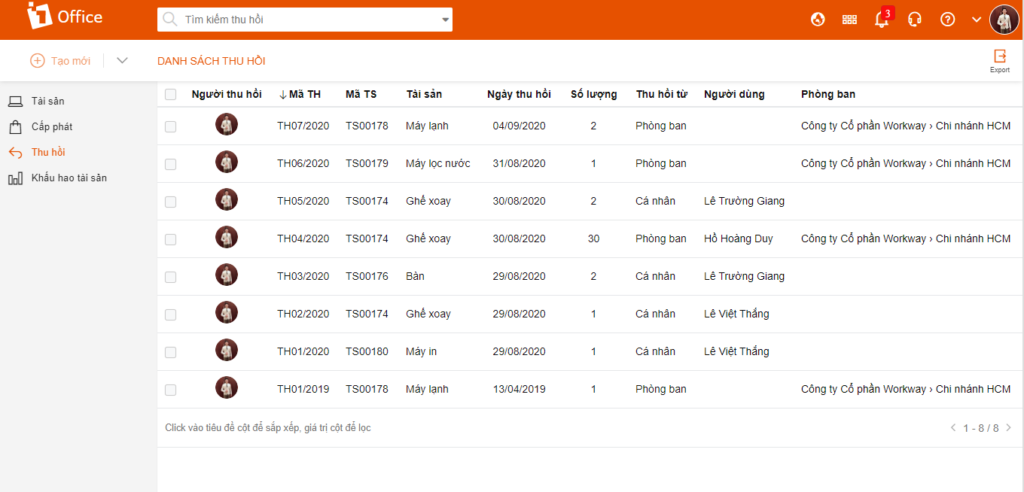
If your business is still struggling with “How to best manage and account for assets,” consider the asset management software 1Office HRM. The platform helps businesses digitize asset management right on the software, allowing you to access information anytime, anywhere, with just a few clicks.
















