


What is basic salary? The latest formula for calculating basic salary


Salary is always a topic of special concern for employees, but not everyone clearly understands the basic salary calculation formula that businesses are applying. If you want to know what basic salary is, what calculation methods exist, and how they are applied in different cases, this article will help you quickly grasp the most common and easy-to-use formulas.
Mục lục
1. What is basic salary?
Basic salary is the amount of money an employer pays you for the time you have spent at the workplace. Basic salary can be expressed as an hourly, monthly, or annual rate for your work at the company. Simply put, it is the standard wage that a business pays you for performing a specific job. Basic salary does not include the following items:
- Social insurance
- Bonuses
- Commissions
- Stock options
Thus, to receive the basic salary, employees must complete all assigned tasks and meet the set work objectives.
In some cases, this is also the salary used as the basis for calculating insurance contributions for employees in the company.
2. Basic salary calculation formulas
Currently, there are many different salary calculation methods; depending on the business, they will apply a salary calculation form (based on time, product, sales revenue, or piece-rate pay…). Below are some common basic salary calculation formulas used in businesses today:
2.1. How to calculate salaries for civil servants and public employees.
For state agencies whose salaries are paid from the government budget, the formula is as follows:
Basic Salary = Base Salary * Salary Coefficient
Where:
-
- Base Salary: This is the minimum salary level used as a reference for salary calculation. Currently, the base salary is 1,490,000 VND/month and will increase to 1,800,000 VND/month on July 1, 2023, according to (Article 3 of Resolution 69/2022/QH15 and Decree 24/2023/ND-CP)
- Salary Coefficient: This is a number that reflects the years of service and commitment of civil servants and public employees.
-

The latest basic salary calculation formulas for businesses

2.2. How to calculate time-based salary
Simply put, time-based salary is salary based on the employee’s working time (hourly, weekly, daily, or monthly). This is a common salary calculation method applied in many chain stores or large companies.
Formula for calculating time-based basic salary:
Hourly wage = Daily wage / Normal working hours.
Daily wage = Monthly salary / Number of working days in the month.
Weekly wage = (Monthly salary x 12 months) / 52 weeks
For monthly salary calculation, businesses can apply one of the two formulas below:
Monthly salary = Basic salary + ((Allowances if any) / standard workdays of the month) * actual working days
Example: The monthly salary of an administrative employee with a basic salary of 9,000,000 VND, a meal and parking allowance of 1,000,000 VND, 26 standard workdays, and full attendance will be:
Monthly salary = 9,000,000 + ((1,000,000 / 26) * 26) = 10,000,000 (VND)
2.3. Formula for calculating product-based basic salary
The product-based payment method is based on the quality, quantity of products, or the percentage of work completed by the employee. Due to its nature of being closely linked to productivity and remuneration, this method is applied to encourage productivity and increase the number of products.
Product-based salary = Unit price per product * Quantity of products
-

Effective product-based basic salary formula for businesses

2.4. Formula for calculating revenue-based basic salary
For sales staff or salespeople, this is a form of payment based on the sales revenue achieved by these departments.
Revenue-based salary = Total revenue * % Commission
Where:
- Total revenue: The revenue achieved in a month or quarter by an individual or team, depending on the company’s regulations.
- % Commission: The amount of money received upon completing KPIs.
2.5. How to pay piece-rate salary
With the method of paying piece-rate salary, payment is made when the employee completes the entire workload agreed upon by both parties.
– Calculation formula:
Salary = Piece-rate amount * % of work completion
2.6. How to calculate special payments
How to calculate overtime pay
Overtime pay (also known as OT pay) is the salary paid to employees for performing extra work outside of regular hours, such as working at night, on holidays, or on weekends. In this case, the employee will be entitled to additional overtime pay as stipulated in Article 97 of the 2012 Labor Code.
Formula for calculating holiday pay
According to Article 112 of the Labor Code, employees are entitled to fully paid public holidays. Specifically, the holiday schedule includes 11 days:
- Lunar New Year (Tet): 05 days
- New Year’s Day: 01 day (January 1st)
- International Labor Day: 01 day (May 1st)
- Reunification Day: 01 day (April 30th)
- Hung Kings’ Commemoration Day: 01 day (the 10th day of the 3rd lunar month)
- Starting in 2021, National Day (September 2nd) will be a 2-day holiday.
Thus, the salary according to the labor contract used to calculate holiday pay includes: the salary rate, allowances, and other additional payments. In addition, allowances as stipulated in Article 104 of the Labor Code include: performance bonuses, allowances for gasoline, phone, etc.
How to calculate the 13th-month salary
The 13th-month salary is a benefit that many businesses use to attract talent. Depending on the size and structure of the business, there will be different ways to calculate the 13th-month salary based on the actual business and production situation of the company and the employee’s performance.
If an employee has not worked for a full 12 months, the 13th-month salary will be paid based on their working period:
13th-month bonus = (M/12) x Average Salary
(Where: M is the working duration, and Average Salary is the average salary during the working period).
> Automatically calculate employee salaries and reduce the pressure on accountants with:
12+ Most Popular Employee Payroll Software – Review of Pros and Cons
3. Basic salary according to the latest regulations
Currently, the law has fully updated the latest methods for calculating basic salary. Specifically, the formula for calculating basic salary is regulated as follows:
3.1. For employees working in private enterprises
The current basic salary includes salary allowances used for social insurance contributions and other additional payments. In addition, the basic salary in private enterprises is calculated based on the regional minimum wage set annually by the Government. Specifically, the basic salary for employees in private companies by region is:
- Region I: 4,420,000 VND/month.
- Region II: 3,920,000 VND/month.
- Region III: 3,430,000 VND/month.
- Region IV: 3,070,000 VND/month.
3.2. For employees working in state agencies
For employees working in state agencies, the salary is based on the salary coefficient x the base salary. However, the state salary will be based on graduation level, qualifications, and professional position, which results in different salary coefficients. Currently, the base salary regulated for state agencies is as follows:
- Before July 1, 2023: 1,490,000 VND/month (Article 3, Decree 38/2019/ND-CP).
- After July 1, 2023: 1,800,000 VND/month (According to Article 3, Resolution 69/2022/QH15 and Decree 24/2023/ND-CP).
| Read more: 6 steps to standardize the process of creating a payroll policy professionally in your business |
4. How to effectively apply basic salary in business administration
Basic salary is the foundation of the compensation system, not only reflecting the value of the job but also serving as a strategic tool to help businesses manage personnel effectively, optimize costs, and motivate employees. Applying basic salary correctly means the business both complies with the law and optimizes productivity and operational efficiency.
Effectively applying basic salary involves determining appropriate salary levels for each position and rank, combined with transparent bonus and penalty mechanisms, ensuring fairness, work motivation, and employee development, while maintaining financial stability and legal compliance within the organization.
4.1 Linking basic salary with employee rank and competency
- Determine salary grades based on job level, responsibilities, and employee experience.
- Assess professional competence, soft skills, and work attitude to determine a reasonable salary, creating fairness and transparency.
- Illustrative example:
-
-
-
Junior employee: basic salary of 7 million, basic professional skills.
-
Mid-level employee: basic salary of 10 million, with good project management and communication skills.
-
Senior employee: basic salary of 15 million, with leadership and strategic orientation capabilities.
-
-
4.2 Using KPIs and OKRs for transparent bonus and penalty adjustments
-
Link bonuses to work performance (KPIs) or strategic objectives (OKRs) so employees clearly know the goals to achieve and the behaviors being evaluated.
-
Establish a transparent bonus calculation formula to ensure there are no subjective factors and to maintain fairness among employees.
-
Illustrative example:
-
Sales employee achieves revenue ≥ 100 million/month → receives a 5% bonus on the excess revenue.
-
Project employee completes the project on time with high quality → receives a bonus of 2 million VND/month.
-
4.3 Automate payroll to reduce errors and save time
- Use HRM/Payroll software to automatically calculate basic salary, allowances, personal income tax, and social insurance.
- Minimize errors from manual calculations while generating transparent reports for management and employees.
- Illustrative example:
-
-
-
The HR department uses software to automatically input basic salary and KPI data → the software automatically calculates bonuses, allowances, and taxes, reducing errors by 40%.
-
-
4.4 Link basic salary with career development paths and compensation policies
- Basic salary should be integrated into the promotion policy, defining conditions for grade increases, salary raises, or bonuses based on competency and work results.
- Illustrative example:
-
-
-
An employee who achieves a leadership competency level of 4/5 and a KPI of ≥ 90% → is eligible for a salary grade increase and promotion.
-
A Junior employee who completes a professional skills training course → will have their basic salary raised to the Mid-level.
-
-
4.5 Continuous monitoring and adjustment
- Review basic salary levels against the market and legal regulations to ensure the company does not fall behind and employees are not disadvantaged.
- Adjust basic salary in line with economic fluctuations, the company’s budget, and HR strategy.
- Illustrative example:
-
-
-
Each year, HR checks the basic salary against the minimum wage and the market → adjusts it by 5–10% if necessary.
-
When the company expands to new projects, the basic salary for new employees is designed to match the job requirements and position.
-
-
5. 1Office – Automated Payroll and Timekeeping Software
1Office timekeeping and payroll management software is an effective, professional payroll solution trusted by 5,000 businesses and over 450,000 users. As a module within the 1Office HRM software, it stands out with many smart and superior features, helping HR automatically calculate salaries and process payments through bank accounts on the system. This helps managers save maximum time on processes like data consolidation, leave requests, fingerprint logs, etc., and reduces printing costs for the business.
Key features of the 1Office payroll software:
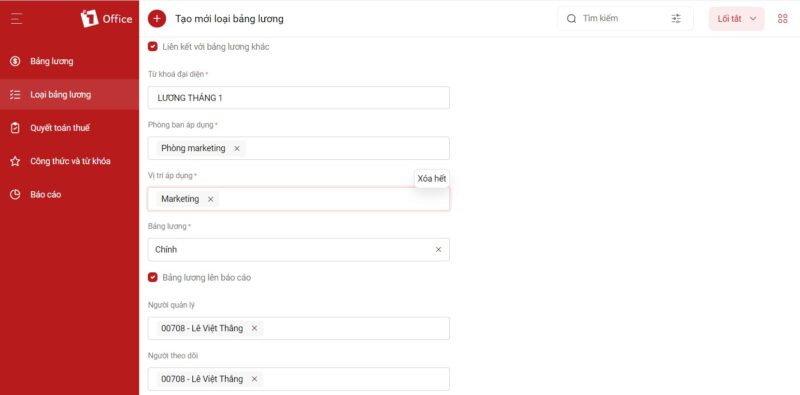
Payslip Setup
- Easily customize payslips, flexibly define various types of payslips suitable for the business
- Integrates Excel formulas for timekeeping and payroll calculation, suitable for all modern businesses
- Allows easy setup of permissions for viewing and editing salaries/allowances in the employee profile section
-

1Office Payroll Software – Intuitive payslip setup
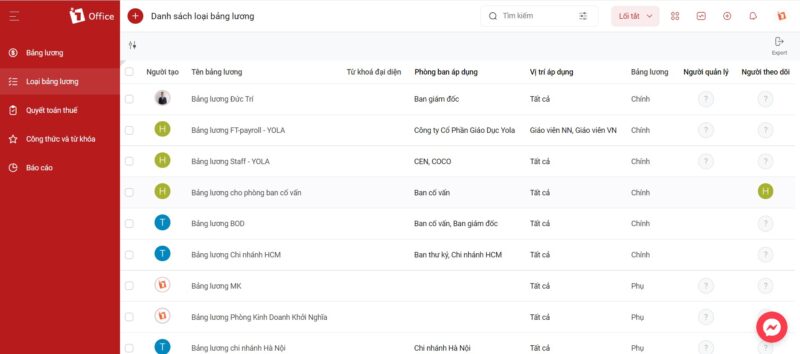
Automated Salary Calculation & Approval
- The software automatically generates the configured payslip at the beginning of each month
- Allows for automatic line splitting if an employee receives multiple different salary levels within a single month
- Directors and accountants can quickly review and approve payslips directly 24/7
-

Automated basic salary calculation with 1Office
Pay employees via bank account
- Easily connect with other modules to retrieve data for payroll calculation, such as: KPIs, SALES…
- Links with MB Bank (Military Commercial Joint Stock Bank) to process salary payments for staff 24/7 via bank accounts
- Supports accountants in transferring money directly through MB bank accounts and quickly issuing payment orders for other bank accounts
Thus, the content above has covered the latest basic salary calculation formulas for
document.getElementById(“currentYear”).textContent = new Date().getFullYear();
and introduced an effective, automated payroll solution with 1Office. If you are looking for a professional payroll solution, then 1Office – Business Management Software is the most useful solution for you. For consultation and support, please leave your information, and the 1Office team of experts will advise and assist you today.
For more detailed information, please contact us via:
- Hotline: 083 483 8888
- 1Office Fanpage: https://www.facebook.com/1officevn
- Youtube: https://www.youtube.com/c/1OfficeNềntảngquảnlýtổngthểDoanhNghiệp




