


 10/05/2026
  188 views
What is business scale? This is a term that reflects the operational scale of an organization, based on factors and indicators such as the number of employees, annual revenue, charter capital, and market scope.
More than just a number on paper, business scale plays a crucial role in shaping competitive capabilities and development strategies.
For example, large corporations like Vingroup or Viettel have advantages in financial resources and the ability to optimize costs due to economies of scale—something that small and medium-sized enterprises (SMEs) can hardly achieve.
Mục lục
- 1. What is business scale?
- 2. Criteria for classifying business scale
- 3. Organizational Structure by Business Size
- 3.1. Micro-enterprises (<10 employees, revenue <3 billion VND/year)
- 3.2. Small enterprises (10-100 employees, revenue <50 billion VND/year)
- 3.3. Medium-sized enterprises (100-200 employees, revenue <200 billion VND/year)
- 3.4. Large enterprises (>200 employees, revenue >200 billion VND/year)
- 3.5. Summary Table of Organizational Structures by Size
- 4. How does business size affect competitiveness?
- 5. How business size affects the establishment of growth strategies
- 6. What Should a Business Do When Its Scale Changes?
- 7. Conclusion
1. What is business scale?
Business scale is a concept used to classify enterprises based on quantitative criteria such as the number of employees, charter capital, annual revenue, or total assets. This classification helps the government apply appropriate support policies (taxes, credit, land, etc.) and allows businesses to assess their own market position.
2. Criteria for classifying business scale
Business scale can be assessed through various indicators, depending on the industry and the purpose of the analysis. Below are 5 main criteria to help you determine the scale accurately:
2.1. Number of employees
According to Decree 80/2021/ND-CP (guiding the Law on Support for Small and Medium-sized Enterprises) and related documents (Law on Enterprises 2020, Circular 132/2018/TT-BTC on micro-enterprises), businesses are divided into 4 types:
| Scale | Main criteria (one of the three must be met) | Typical examples |
|---|---|---|
| Micro | – Employees ≤ 10 – Revenue ≤ 3 billion VND/year – Total assets ≤ 3 billion VND | Grocery stores, small online shops |
| Small | – Employees ≤ 100 – Revenue ≤ 50 billion VND/year – Total assets ≤ 20 billion VND | LLC with 20-50 employees, small coffee shop chains |
| Medium | – Employees ≤ 200 – Revenue ≤ 200 billion VND/year – Total assets ≤ 100 billion VND | Medium-sized manufacturing plants, tech companies with 100-200 employees |
| Large | Exceeds one of the above criteria | VinGroup, Viettel, FPT, listed corporations |
This indicator is particularly useful in service industries such as restaurants, hotels, or education, where the human element plays a central role.
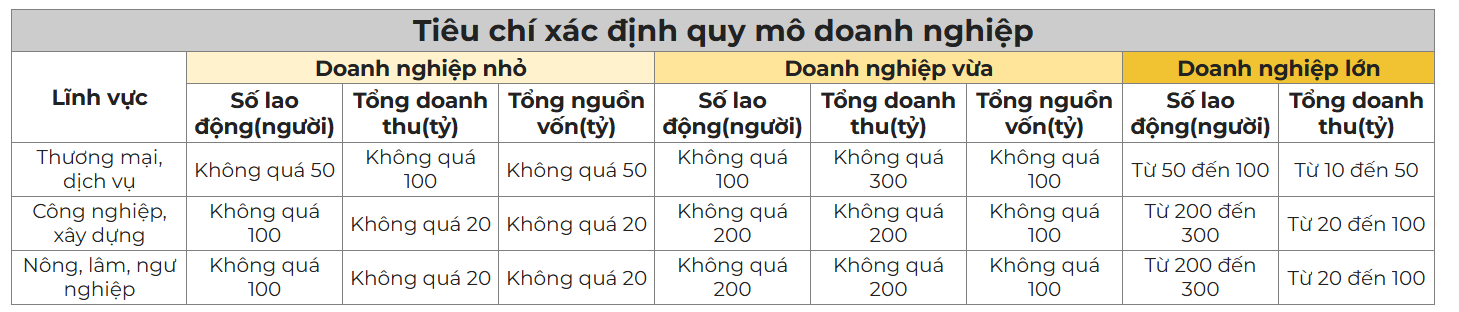
Each industry and sector will also have its own method of determination. Below is how to determine business size by sector for your reference:
2.2. Revenue
According to Decree 80/2021/ND-CP (guiding the Law on Support for Small and Medium-sized Enterprises):
| Size | Previous year’s revenue ≤ (VND billion) | Labor and Capital Criteria |
|---|---|---|
| Micro | 3 | Employees ≤10, capital ≤3 billion |
| Small | 50 | Employees ≤100, capital ≤20 billion |
| Medium | 200 | Employees ≤200, capital ≤100 billion |
| Large | >200 | Exceeds one of the criteria |
Note: Criteria vary slightly by industry (agriculture is higher than commerce).
2.3. Production output
There are no uniform legal regulations, but they are often classified according to annual production capacity:
| Scale | Example Production Volume (industry-dependent) | Real-world Example |
|---|---|---|
| Micro | <10,000 products/year or <100 tons/year | Family-owned sewing workshop |
| Small | 10,000 – 100,000 products/year | Small footwear factory |
| Medium | 100,000 – 1 million products/year | Automotive parts factory |
| Large | >1 million products/year or millions of tons | VinFast, TH True Milk |
2.4. Investment Capital
According to Decree 80/2021/ND-CP (total capital):
| Scale | Total Capital ≤ (billion VND) |
|---|---|
| Micro | 3 |
| Small | 20 |
| Medium | 100 |
| Large | >100 |
- Project investment capital (FDI or large-scale projects): Usually classified according to the Law on Investment:
-
- Small: <300 billion VND.
- Medium: 300 – 3,000 billion VND.
- Large: >3,000 billion VND (national key projects).
2.5. Market Capitalization

According to the classification of HOSE/HNX/UPCoM and investment funds (2025):
| Size | Market Capitalization (billion VND) | Example (2025) |
|---|---|---|
| Small Cap | <1.000 | Small UPCoM companies |
| Mid Cap | 1.000 – 10.000 | Many mid-sized HOSE companies |
| Large Cap | >10.000 | VCB (~500.000), VHM, VIC |
| Mega Cap | >100.000 | Vietcombank, VinGroup |
- Bluechip: Usually large-cap, stable, with high liquidity.
3. Organizational Structure by Business Size
An organizational structure is the way departments, divisions, positions, and reporting relationships are arranged within a business. This structure changes significantly according to the business size (micro, small, medium, large) to ensure effective management, responsibility allocation, and growth support. Below is an analysis of typical organizational structures for each size (based on the reality in Vietnam in 2025).
3.1. Micro-enterprises (<10 employees, revenue <3 billion VND/year)
- Structure: Flat or directly managed by the business owner.
- Characteristics:
- The business owner holds multiple roles (sales, accounting, human resource management).
- No or very few specialized departments.
- Employees are multi-skilled and report directly to the owner.
- Examples: Grocery store, online shop, family workshop.
- Advantages: Flexible, quick decision-making. Disadvantages: Easily overloaded during expansion.
3.2. Small enterprises (10-100 employees, revenue <50 billion VND/year)
- Structure: Functional or flat with a slight hierarchy.
- Characteristics:
- Has basic departments: Business/Sales, Accounting – Finance, Administration – Human Resources, Production (if any).
- Directly managed by the business owner/CEO, possibly with 1-2 deputy directors or department heads.
- Reporting follows functional lines (each department reports to the director).
- Examples: Small trading company, marketing agency, medium-scale manufacturing plant.
- Advantages: Clearer division of labor, specialization. Disadvantages: Prone to bottlenecks at the senior leadership level during rapid growth.
3.3. Medium-sized enterprises (100-200 employees, revenue <200 billion VND/year)
- Structure: Advanced functional or matrix.
- Characteristics:
- Has a full range of departments: Business, Marketing, Production, Accounting, Human Resources, IT, R&D (if needed).
- Board of Management (Director + Deputy Directors in charge of specific areas).
- Has department heads/deputy heads for each unit, reporting to a deputy director.
- Middle management level begins to appear.
- Examples: Food processing plant, medium-sized technology company, retail chain.
- Advantages: High specialization, good decentralization. Disadvantages: Can be slightly bureaucratic, requires good coordination between departments.
3.4. Large enterprises (>200 employees, revenue >200 billion VND/year)
- Structure: Divisional, matrix, or holding (for corporations).
- Characteristics:
- Multi-layered structure: Board of Directors → Board of Management → General Directors/Deputy General Directors (in charge of divisions) → Department Heads/Deputies → Employees.
- Division by product/service, geographical area, or function.
- Has subsidiaries/independent branches.
- Uses an ERP system for management.
- Examples: VinGroup, Viettel, FPT, Masan.
- Advantages: Strong decentralization, in-depth specialization, easy international expansion. Disadvantages: Bureaucratic, high management costs, complex coordination.
3.5. Summary Table of Organizational Structures by Size
| Size | Typical Structure | Management Layers | Key Characteristics |
|---|---|---|---|
| Micro | Flat | 1 layer | Directly managed by the owner |
| Small | Functional/Flat | 2 layers | Basic department heads |
| Medium | Functional/Matrix | 3 layers | Deputy directors + department heads |
| Large | Divisional/Holding | 4+ layers | Board of directors + specialized divisions/departments |

4. How does business size affect competitiveness?
Business size plays a crucial role in shaping competitive strategy. Here’s how size impacts a company’s ability to compete:
4.1. Advantage from Economies of Scale
Large enterprises often benefit from economies of scale, allowing them to produce goods or services at a lower cost per unit due to their ability to make bulk purchases.
Imagine a company purchasing raw materials in massive quantities.
They can negotiate significantly lower prices compared to a small business buying in small amounts.
Additionally, large companies can invest in efficient production processes, such as automated assembly lines, which help reduce the production cost per unit.
This cost advantage allows them to compete more effectively on price against smaller rivals.
For example: A large clothing manufacturer can offer lower prices due to economies of scale, making it difficult for small fashion brands to compete on price.
However, small businesses can still find ways to compete by focusing on a niche market or offering unique, handcrafted products.
Meanwhile, large companies can reinvest profits from economies of scale into growth initiatives, such as expanding their product portfolio or entering new markets.
4.2. Resource Advantage
Large enterprises typically possess abundant resources, enabling them to implement competitive strategies more effectively.
These resources include:
- Financial: Investing in research and development (R&D), and technological improvements.
- Marketing: Large budgets to launch extensive advertising campaigns and build brand recognition.
- Human Resources: Attracting top talent with competitive salaries and attractive benefits.
For example: A major technology corporation can invest hundreds of billions of VND in R&D to create breakthrough products, giving them a significant competitive edge over small companies with limited budgets.
Furthermore, large companies can launch marketing campaigns on a national or global scale, helping them build strong brand recognition. This makes it more difficult for small businesses to reach potential customers.
With abundant financial resources, large companies can attract top talent by offering competitive salaries, attractive benefits packages, and career development opportunities. This helps them build strong teams and develop innovative solutions.
5. How business size affects the establishment of growth strategies

The size of a business is a critical factor influencing the growth strategies it can effectively implement. Here’s how businesses of different sizes can approach promoting scale growth:
5.1. Large Enterprises: Leveraging scale and resources for growth
Large enterprises possess significant advantages in driving growth. The effect of scaling up allows them to produce goods or services at a lower cost per unit, thereby generating abundant capital to invest in other business strategies such as:
- Product Portfolio Expansion: Thanks to economies of scale, large enterprises can invest in research and development (R&D) to create new product lines, enter new markets, or expand their portfolio in existing markets. This helps them attract more customers and diversify revenue streams.
- Technological Innovation: With strong financial resources, large enterprises can invest in R&D to develop advanced technologies, improve existing products, or create entirely new ones. These breakthroughs help them maintain a competitive edge and attract new customer segments.
- Global Marketing Campaigns: Large companies have the capability to launch extensive advertising campaigns across multiple media platforms, helping to build brand recognition on a national or global scale. This significantly expands their customer reach.
- Strategic Mergers and Acquisitions: Large corporations can pursue inorganic growth strategies by acquiring smaller companies or merging with competitors. This helps them consolidate market share, access valuable resources and expertise, and eliminate potential rivals.
5.2. Small Businesses: Smart growth strategies with limited resources
While large enterprises leverage their advantages in scale and resources, small businesses need to approach growth creatively and flexibly. Here are some effective strategies:
- Attracting Customers through Focused Marketing: Small businesses can leverage digital marketing tools and social media platforms to launch targeted marketing campaigns aimed at specific customer segments. By focusing on niche markets and personalizing messages, they can compete effectively with large companies.
- Developing Products for Niche Markets: Small businesses can create products that meet the specific needs of a niche market by thoroughly understanding their target customers. This focus on specialization helps them build a loyal customer base that values unique products.
- Expanding Regional Presence: Small businesses can grow by expanding their operations within a specific geographical area, such as opening additional stores or enhancing their online presence to reach more local customers.
- Strategic Partnerships with Other Small Businesses: By collaborating with small businesses in complementary industries, they can combine resources and expertise to expand their product offerings, enter new markets, or leverage each other’s customer bases for cross-promotion.
6. What Should a Business Do When Its Scale Changes?
Changes in scale—whether rapid expansion, steady growth, or downsizing for restructuring—directly impact how a business operates and makes decisions. Without a suitable adjustment strategy, scaling up can become a burden rather than a competitive advantage.
When a business’s scale changes, the key is not just to get “bigger” but to manage better. Here are three core groups of actions that businesses need to take.

6.1. Adjust the Organizational Model
As a business grows in scale, its old organizational model often becomes unsuitable. An overly simple structure can overload leadership, while a cumbersome one slows down decision-making.
Businesses need to:
-
Review the organizational chart to ensure each department has clear functions and responsibilities
-
Delegate authority and decentralize reasonably, reducing dependence on a single individual or management level
-
Transition from a centralized model to a controlled decentralized model as the scale grows
During the growth phase, a flexible yet disciplined organizational model will help the business expand its scale while maintaining operational efficiency.
6.2. Upgrade the Management System
A change in scale means an increase in workload, data, and internal relationships. If management continues with manual methods or disparate tools, the business can easily lose control.
Businesses should:
-
Standardize management processes from HR, finance, and work to reporting
-
Apply technology and management software to synchronize data and ensure information transparency
-
Establish a real-time reporting system to support leaders in making fast and accurate decisions
A management system upgraded at the right time will help the business leverage its scale advantage, rather than being slowed down by it.
6.3. Restructure Processes and Personnel
When the scale changes, not only the organization but also the processes and people need to be adjusted accordingly. Many processes that were suitable for a small business will become inefficient as the number of employees and projects increases.
Necessary actions include:
-
Standardize and optimize work processes, eliminating redundant steps that no longer add value
-
Re-evaluate personnel capabilities to ensure the right person is in the right position at the right stage of development
-
Invest in training and developing the middle management team to help the organization operate stably during expansion
Restructuring is not about drastic cuts, but about reorganizing to operate more efficiently, in line with the business’s new scale.
Changing scale is an inevitable stage in a business’s lifecycle. However, only businesses that proactively adjust their organizational model, upgrade their management system, and restructure processes and personnel can turn growth into a sustainable advantage.
7. Conclusion
In summary, a business’s scale not only reflects the number of employees, revenue, or investment capital but also directly affects its growth strategy and competitiveness in the market.
Whether it’s a large enterprise leveraging economies of scale or a small business focusing on a niche market, the most important thing is to choose a suitable strategy for sustainable development.
In a constantly changing economic landscape, flexibility in scaling the business and effectively utilizing resources will be the key to helping a business go far.
















