11/05/2026
  323 views
Mass recruitment is currently adopted by many businesses because this method not only saves time but also optimizes resources for the company very effectively. However, many businesses that have applied mass recruitment are still vague about the concept, standard process, and often encounter many errors during the hiring process. So, what is mass recruitment? Which businesses should apply it and when? What mistakes should be avoided? Let’s explore the details with 1Office in the article below.
Mục lục
- I. What is mass recruitment?
- II. Pros and cons of mass recruitment
- III. Which businesses are suitable for applying mass recruitment?
- IV. When should businesses use mass recruitment instead of regular recruitment?
- V. The effective mass recruitment process
- VI. Common mistakes in mass recruitment and how to fix them
- VII. Conclusion
I. What is mass recruitment?
Mass recruitment (high-volume hiring) is the process of finding and selecting a large number of personnel in a short period to meet the expansion or workforce replacement needs of a business, often applied to positions such as general labor, sales, customer care, or production. This process requires a clear strategy, an optimized procedure, and the use of technology to ensure the right people are hired at the right time and cost-effectively.

One of the key features of mass recruitment is the ability to reach a large number of candidates in a short time. Businesses can easily promote job openings through social media channels, job websites, or personal connections. Additionally, the interview process is often conducted quickly, helping to minimize waiting time for both the company and the candidates.
However, mass recruitment also requires businesses to prepare thoroughly in terms of human resources and finances. Selecting suitable candidates from a large pool can be challenging without clear criteria. Therefore, businesses need to accurately define their needs before proceeding with mass recruitment.
II. Pros and cons of mass recruitment
Every recruitment method has its own pros and cons, and mass recruitment is no exception. Businesses need to clearly understand the benefits and limitations that mass recruitment brings to make the right decision.
| Advantages | Disadvantages |
|
|
III. Which businesses are suitable for applying mass recruitment?
Mass recruitment (large-scale recruitment) is not suitable for all types of businesses, but is mainly for organizations with large personnel needs in a short period or specific industries that require a high number of workers. Below are the types of businesses most suitable for applying mass recruitment:
- Newly established businesses: Newly established businesses often need a large number of personnel to launch their business operations. Applying mass recruitment helps you quickly build the necessary team without spending too much time and money.
- Seasonal industries: Industries such as agriculture, tourism, and retail often have seasonal hiring needs. Therefore, mass recruitment is a suitable choice to ensure sufficient manpower for peak periods.
- Rapidly scaling businesses: During the phase of expanding branches, production, or markets, businesses often face pressure to add personnel in a timely manner. Mass recruitment is an effective tool to quickly fill necessary positions, ensuring uninterrupted operations.
- Businesses needing to boost operations during peak season: Many large companies, especially in the service industry, often face a peak season when demand increases. In this case, mass recruitment is an effective solution to help them meet market demand in a timely manner.
- Businesses in the manufacturing/service/logistics industries: The nature of these industries requires a large number of assembly line workers or general laborers to maintain continuous operations. Mass recruitment helps businesses quickly supplement the necessary workforce, especially during periods of increased capacity or production expansion.
IV. When should businesses use mass recruitment instead of regular recruitment?

Regular recruitment may be suitable for strategic positions or those requiring deep expertise, but it cannot meet the demand when a business needs a large number of personnel in a short time. In this case, mass recruitment becomes the optimal solution, helping businesses quickly supplement the necessary resources to maintain and expand their business operations.
However, applying mass recruitment is not always appropriate. Therefore, businesses should consider using the mass recruitment method in certain cases such as
- When the business is scaling or opening new branches: Expanding the market, launching a new production line, or opening a new branch requires a large number of personnel to meet immediate operational needs.
- When needing to meet peak season demand: Businesses in the service, retail, or logistics sectors often need to increase staff during holidays, Tet, or major campaigns to ensure timely customer service.
- When implementing short-term or seasonal projects: Temporary jobs such as event organizing, market research, or large-scale production projects all require personnel quickly and do not require long-term commitment.
- When needing general labor or positions that do not require high professional skills: Positions such as production workers, delivery staff, cashiers, or service staff are easy to train and deploy quickly, making them suitable for the mass recruitment method.
- When the turnover rate is high or there is a need for large-scale personnel replacement: In industries with high-pressure jobs or high turnover rates like call centers or sales, mass recruitment helps businesses continuously replenish their workforce and maintain stable operations.
- When needing to save time and optimize recruitment costs: Compared to regular recruitment, mass recruitment helps businesses reduce the time and cost of hiring for individual positions, especially when applying automation tools.
- When wanting to build a basic team quickly: For newly established or recently launched businesses, mass recruitment is the fastest way to build a foundational team without spending too much time on screening.
V. The effective mass recruitment process
The mass recruitment process includes several important steps that businesses need to implement systematically to ensure recruitment quality.
Step 1: Identify needs and plan
Businesses need to clearly define their recruitment needs. This includes forecasting the number and types of jobs to be filled, as well as creating a detailed recruitment plan. Businesses should create a personnel forecast for each department and consider the timing and specific skills required. Then, build a timeline for the recruitment stages, determine the projected budget, and prepare detailed job description documents.
Step 2: Promote recruitment information

Businesses need to use various channels to promote recruitment information, such as social media, websites, email marketing, and job boards. It’s necessary to diversify recruitment channels by building targeted promotional campaigns, like using paid advertising to increase reach. More importantly, create engaging recruitment content using images and videos to introduce the corporate culture and the benefits of working at the company.
Step 3: Attract candidates
Businesses can organize recruitment events or job fairs to attract candidates. This can include hosting events like career days, online recruitment seminars, and setting up attractive booths at events to draw attention.
Additionally, it’s important to create a friendly and appealing environment to make candidates feel interested. Businesses should share photos and videos of the work environment, team-building activities, and internal events to impress candidates.
Step 4: Select and interview candidates
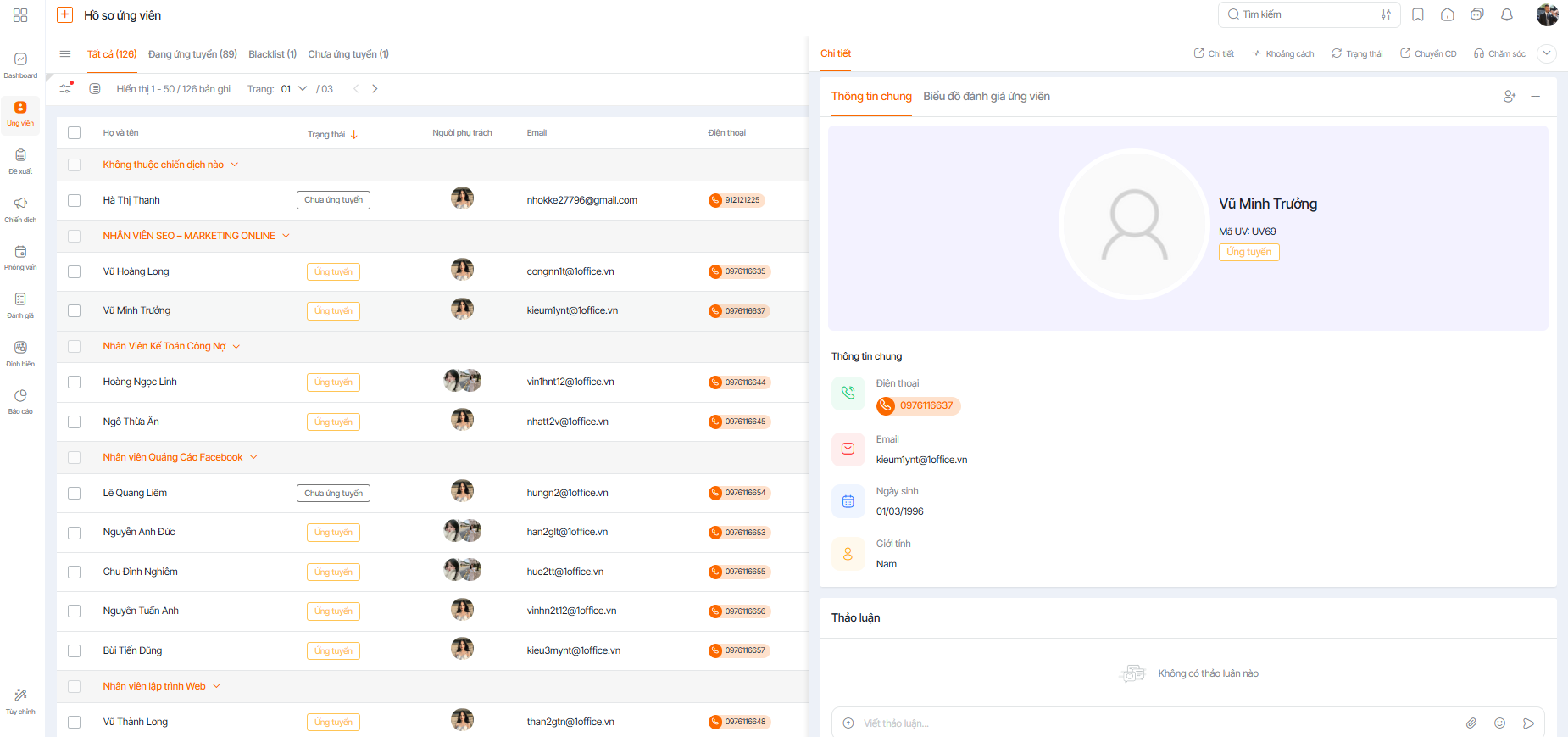
Select candidates based on predefined criteria. Interviews can be conducted in groups or via video call, depending on the company’s conditions. Beforehand, the business needs to establish a clear and transparent set of criteria and use software with ATS (Applicant Tracking System) support, such as 1HRM by 1Office, to help automatically screen resumes, saving time and effort for the HR team.
Register for a free 1HRM Demo account!
Step 5: Final evaluation and selection
After completing the interviews, it’s necessary to evaluate the candidates based on the previously established criteria. Businesses should use a scoring rubric with specific criteria and scores to summarize interview results and organize evaluation discussions with the participation of relevant stakeholders.
Finally, select the most suitable candidates to join the company’s workforce. The final decision should be based on evaluation and interview results, while also considering the candidate’s potential for growth and their ability to fit into the corporate culture.
VI. Common mistakes in mass recruitment and how to fix them

Inaccurate needs assessment
A common mistake in the mass recruitment process is inaccurately determining hiring needs. This often happens when a business lacks a clear plan or doesn’t rely on actual data analysis to determine the number and type of positions to be filled. This error usually occurs in the very first step, causing subsequent steps to be ineffective. When needs are inaccurate, the business may over-hire or under-hire, leading to a waste of resources and affecting work performance.
The solution is to conduct a thorough analysis of personnel needs based on specific data and continuously update the plan according to the actual situation. Businesses need to create a workforce forecast for each department and consider the timing and specific skills required to ensure an accurate recruitment plan.
Lack of preparation for recruitment events
When organizing recruitment events or job fairs, some businesses do not prepare thoroughly, leading to ineffective events. This mistake often occurs during the candidate attraction stage, when events are organized superficially without a detailed plan. The consequence is that the event fails to attract quality candidates or create a good impression of the company.
The solution is to create a detailed plan for each event, from selecting the venue, creating a schedule, and preparing introductory materials to training the staff participating in the event. A successful recruitment event requires thorough and professional preparation.
Ineffective interviews

Ineffective interviewing is a common mistake when a business lacks clear criteria or recruiters are not well-trained in interview techniques. This occurs during the candidate selection and interview stage, leading to an incorrect assessment of a candidate’s potential and abilities. As a result, the business may miss out on excellent candidates or hire the wrong person.
To fix this, it’s necessary to build a specific set of criteria and train recruiters on behavioral interviewing techniques. Additionally, use support tools like an ATS to automatically screen resumes and ensure the interview process is effective.
Incomprehensive candidate evaluation
Incomprehensive candidate evaluation occurs when a business relies on only a few factors for assessment without fully considering various other aspects, such as soft skills and cultural fit. This mistake happens at the final evaluation and selection stage, leading to the selection of unsuitable candidates and affecting long-term work performance.
To address this, businesses should use multi-criteria evaluation scorecards and organize discussion sessions with relevant stakeholders to get a comprehensive view of each candidate. This helps ensure the selection of the most suitable candidates, based not only on skills but also on their potential for growth and cultural fit.
VII. Conclusion
Mass recruitment is an effective method for attracting and selecting personnel in a short period. Although it presents many challenges, if implemented correctly, it can bring significant benefits to a business. We hope this article has helped you better understand what mass recruitment is, its benefits and limitations, so you can apply it effectively in your business.