


 11/05/2026
  390 views
MBTI is a well-known tool for classifying personality types, but its value extends beyond the individual level. In this article, you will understand what MBTI is and how to apply it in business management.
Mục lục
I. What is MBTI?
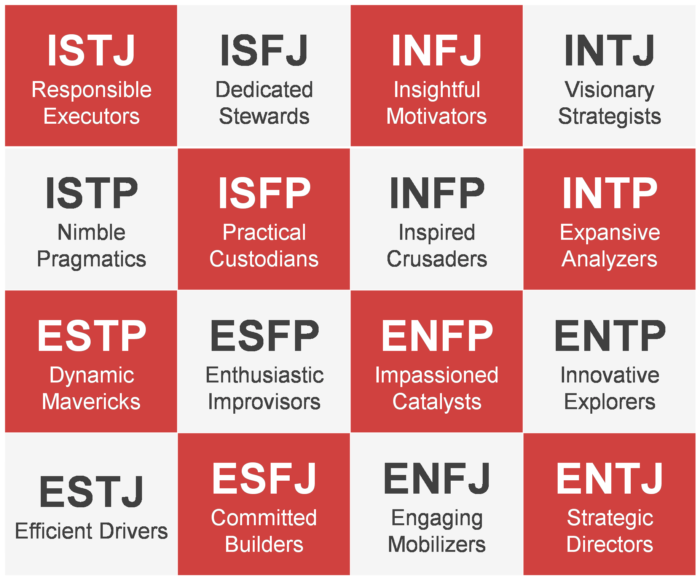
Today, the MBTI (Myers-Briggs) personality test is a familiar term not only to recruiters and managers but also to young people who want to better understand their personalities. It is a method of discovering personality through a questionnaire of 16 personality types developed by two scientists, Isabel Myers and Kathryn Briggs.
The MBTI model is based on the foundational development of psychology and has a very high degree of accuracy. It relies on each person’s answers to questions to infer their unique traits and personalities. MBTI has recently become popular, with many people taking this Test and in-depth courses on it emerging.
II. MBTI Assessment Criteria
After understanding what MBTI is, you next need to learn about the MBTI assessment criteria, which are 4 factors revolving around a person’s worldview, used to analyze and evaluate human personality.
1. Natural Tendency: Extraversion / Introversion
Introversion means being oriented towards the inner world, including thoughts, ideas, and imagination.
Extraversion means being inclined towards the external world, including activities, people, and objects.
2. Understanding and Perceiving the World: Sensing / iNtuition
When using intuition to perceive and understand the world, the brain is the unit responsible for exploring, analyzing, interpreting, and explaining patterns of information. It then gathers all data streams, from the past and present, simultaneously, and organizes these patterns and connects them. This requires the brain to work at its full capacity, speculating and predicting the future.
3. Making Decisions and Choices: Thinking / Feeling
In the human brain, the most highly valued part is reason; its role is to understand relevant information based on criteria of right or wrong. It then uses logical reasoning to directly provide a specific, evidence-based, and most scientific answer.
Meanwhile, the feeling part will simultaneously consider and reason about matters based on a whole range of subjective issues like love-hate, and how these factors interact with each other, without clear-cut distinctions. This is the nature of emotion as determined by the brain.
4. Method of Action: Judging (Principled)/ Perceiving (Flexible)
With this approach, a person’s brain will work based on pre-planned principles. To achieve a specific and prepared plan, everything will be approached naturally and clearly. To ensure suitability with the circumstances, people sometimes accept changes to the plan that was previously laid out.
From the 4 criteria above, the 16 personality types in the MBTI test are formed.
- Read more: What is the ASK model? How to effectively apply the ASK model in human resource management
III. The 16 Personality Types in the MBTI Model
The 16 MBTI personality types are a blend of all 4 factors above. Below is a brief overview of these 16 types, including personality traits, the strengths and weaknesses of each type at work, and suggested careers suitable for each type. Not to mention, the MBTI is a test used by recruiters to determine if a candidate is a good fit for the job, environment, or company culture.
1. ENFJ Personality Type – The Giver
ENFJs are a group of people who often have a great influence on those around them because they are typically very charismatic and eloquent. They show sincerity in how they care for people and can easily communicate ideas or opinions to others. However, ENFJs often dislike large crowds and can be quite private compared to other extraverts.
2. ENFP Personality Type – The Inspirer
ENFPs are curious, idealistic, and rather mysterious individuals because they are always searching for meaning and are genuinely interested in others’ motivations. Therefore, they see life as a vast sky full of puzzles where everything is interconnected but not yet deciphered. However, ENFPs need to learn to focus their resources, as there seem to be many interesting things around them to cause distraction. Things can become dull very quickly for an ENFP.
| Read more: 5 Effective Recruitment Interview Skills That HR Can’t Ignore |
3. ENTJ Personality Type – The Commander
ENTJs are natural-born leaders. They enjoy interacting with people and value their careers. ENTJs are not easily swayed by emotions; they need to learn how to work with and listen to others.
4. ENTP Personality Type – The Visionary
ENTPs love to explore the world around them, so they have a very good intuitive understanding of people. ENTPs are good communicators, quick-witted, and always full of ideas. However, ENTPs are not fond of making plans; they prefer a more freestyle approach to work. They can be affected by pressure and obsessed with minor details.
5. ESFJ Personality Type – The Caregiver
ESFJs are characterized by their compassion for others. They are warm and energetic but prefer to work independently. However, this personality type is heavily influenced by emotions, and they should not be the ones making important decisions. They are also not very interested in analyzing complex ideas or discussing cause and effect, which is a complete contrast to the NT personality types.
6. ESFP Personality Type – The Performer
ESFPs love new experiences and enjoy being the center of attention. ESFPs have good communication skills, are optimistic, have a good sense of aesthetics, and are highly perceptive. ESFPs are sociable and always bring joy to others.
7. Characteristics of the ESTJ – The Supervisor
ESTJs are practical people. They are very specific and always take on
Above, 1Office has provided an overview of the 16 personality types in MBTI. Next, we will discuss the applications of MBTI in human resource management. To provide maximum support during the recruitment process, you can use HRM software to help recruiters attract talent quickly.
IV. Applying the Myers-Briggs personality test in business
Typically, the MBTI model is most applied in the human resources field, specifically in the recruitment process and in personnel management. Specifically:
1. Recruitment

MBTI is a tool that helps recruiters predict and analyze a candidate’s personality, thereby understanding their strengths and weaknesses and assessing whether they are a good fit for the company’s environment.
2. Personnel Management
Clearly understanding each team member’s personality can help managers enhance their leadership skills. Knowing which of the 16 MBTI personality types an employee belongs to can help minimize conflicts and gossip within the company. Additionally, some personality types work better together than others; understanding personnel personalities through the MBTI test helps optimize collaboration in the workplace.
Managers can fully apply the results of the Myers-Briggs personality analysis to build effective personnel management methods:
| Read more: 10 Effective Human Resource Management Methods Every Business Needs! |
V. How to evaluate candidates / employees through the MBTI test
Due to its effective application, determining the MBTI of candidates or employees has become very popular, and many methods have emerged to help managers easily classify personality types according to the MBTI test model.
1. Use available test questionnaires
There are many available resources on Google. You just need to type a few keywords related to MBTI such as “MBTI test” or “MBTI Test,” and you will get results for websites with corresponding questionnaires to help you take the test and discover yourself.
2. Use in-house resources
In-house resources here mean that the business creates its own set of personality assessment questions. There are 2 points that businesses should focus on improving when compiling them, which are also the 2 key advantages of this method:
- Improve the user interface: It is better for the business to create a website version of the personality test instead of a paper printout because a website has a better interface and design, is user-friendly, easy to read, and easy to use.
- Optimize the questionnaire for each job position: When creating a job description, the manager certainly has expectations for the candidate they want for the position. After identifying the suitable personality group, the business should intentionally draft more in-depth questions about that personality group to explore their qualities.
VI. Conclusion
The content of the article above shares and analyzes what the MBTI personality test is. By analyzing each person’s personality, business owners can determine appropriate behaviors and develop the most favorable and effective human resource development strategies.
For more detailed information, please see:
- Register for a consultation: 083 483 8888
- Fanpage: https://www.facebook.com/1officevn/
- Youtube: https://www.youtube.com/channel/UCeTIRNqxaTwk0_kcTw6SxmA
















