11/05/2026
  559 views
OKR is one of the goal management models that many businesses apply to help their teams focus on important priorities and measure progress more clearly. But what is OKR, what are its components, and how is it structured? This article will help you quickly understand everything from the concept and benefits to how to implement and score OKRs in a business.
Mục lục
I – A General Overview of the OKR Method
Currently, the OKR method is used by many of the world’s leading organizations such as Google, Uber, Intel, etc., to establish and implement their business strategies.
1. What is the OKR method?
OKR (Objectives and Key Results) is a goal management system. Leaders use the OKR method to quantify and create key results to achieve objectives within a specific timeframe.
2. Components of the OKR Management Model
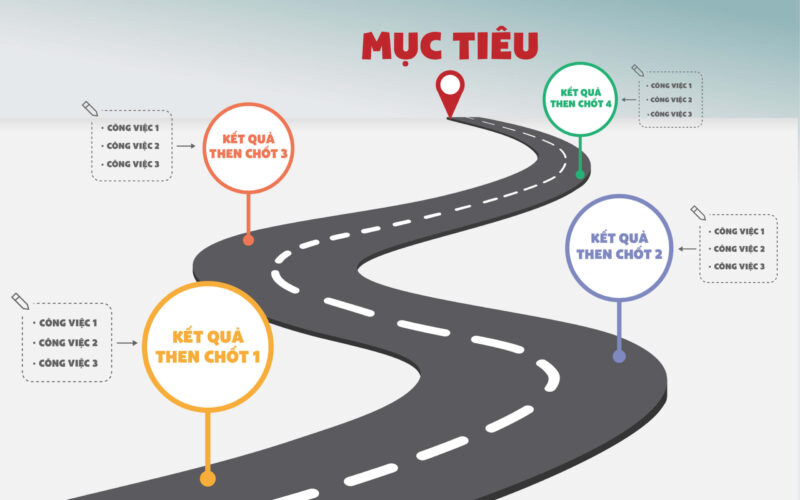
The OKR model consists of three main elements: (1) Objectives, (2) Key Results, and (3) Initiatives. The objective element describes the main goal the company hopes to achieve in the long term, and the results element represents the expected outcomes. The execution plan includes the tasks that need to be done to achieve the set results.
(1) Objectives (Where do I need to go?)
Setting long-term goals for the business helps personnel visualize a clear development roadmap for the company, while also boosting employee motivation. Research shows that work performance is higher when people are committed to their goals.
(2) Key Results (How do I know I’m on the right track?)
Key results are a set of metrics that measure the expected outcomes of an objective. A key result is like the distance a person needs to travel to reach their destination. For each objective, identify 3-4 key results with high expectations that add value to your objective.
(3) Initiatives (What will I do to get there?)
This element involves planning the tasks that each individual and department must do to achieve the objective. If the objective is a destination and the results are the distance to travel, then the plan is the vehicle that person needs to use to reach the destination. Applying an effective work management process is also one of the vehicles that helps a business accelerate to quickly reach its destination.
In addition to these three aspects, the OKR method also forms a set of rules to help employees prioritize and measure the results of their work.
See more: What is Kanban? How to apply Kanban in work management
3. Example of the OKR model in a business:
Suppose a company wants to improve its conversion rate; its main goal is to attract more customers. In that case, the objective the company wants to achieve is: Attract customers. But how to measure whether there is progressive growth in attracting customers? This is when the company needs to establish Key Results.
Objective: Encourage customers to buy the product
Key Results:
- Increase email open rate from X% to Y%
- Increase Web traffic by X%
- Achieve X+ monthly sign-ups
- ….
4. Operating Principles of the OKR Method
OKR operates based on 4 core principles:
- Ambitious: Objectives should be set beyond current capabilities
- Measurable: Key results must be quantifiable and measurable
- Transparent: All members within the company’s organizational structure must know and adhere to the company’s OKRs.
- Not for Performance Evaluation: OKRs are not used to measure employee performance.
| You might be interested in: Overview of the Agile Methodology – Tips to help managers implement Agile more effectively |
II. Benefits of the Goal Management Model
Applying the OKR methodology brings many benefits to a business. John Doerr, who fully developed the theory of OKRs, says that this method offers 5 key benefits:
1. Strong Internal Alignment
Applying the OKR method helps connect employee performance with the company’s overall objectives, thereby increasing engagement while ensuring the entire business is working towards a common goal.
2. Focus on What Matters
The OKR model sets out 3-5 objectives for each level, helping the company and its employees prioritize critical objectives while eliminating non-essential tasks that can hinder focus.
3. Increased Transparency
Transparency is one of the most outstanding benefits of the OKR method, contributing to an open work environment where every member of the organization can understand the work and plans of each individual and department.
4. Employee Empowerment
When there is a clear understanding of company activities, leadership can make accurate decisions while also giving employees the opportunity to track their work results. When empowered, employees become more responsible for their own objectives.
5. Measurable Progress Towards Goals
Through metrics, OKRs reflect the detailed percentage of goal completion for individuals, departments, and the entire company.
III. 4 Steps to Build an OKR Model
For businesses setting up a goal management system for a new quarter or year for the first time, the preparation process should begin about 6 weeks in advance.
1. Define Company Objectives and Key Results
Based on the leadership’s mission and vision or business metrics, the management board will set 3-5 main objectives for the new quarter or year.
After finalizing the objectives, each department will propose the key results necessary to achieve them. Each objective should have 3 to 5 key results. In other words, individuals/departments must focus on 3 to 5 key strategic initiatives to achieve a set objective.
| Read more: What is the SMART model? How to apply SMART goals in business |
2. Define a system to manage OKRs
Companies of different sizes will have different OKR management methods. Some businesses build their own internal toolsets or use familiar applications like Excel.
However, building internal tools or using Excel can be very time-consuming. For businesses setting up a goal system for the first time that require a more efficient and faster tool, this can be a major challenge.
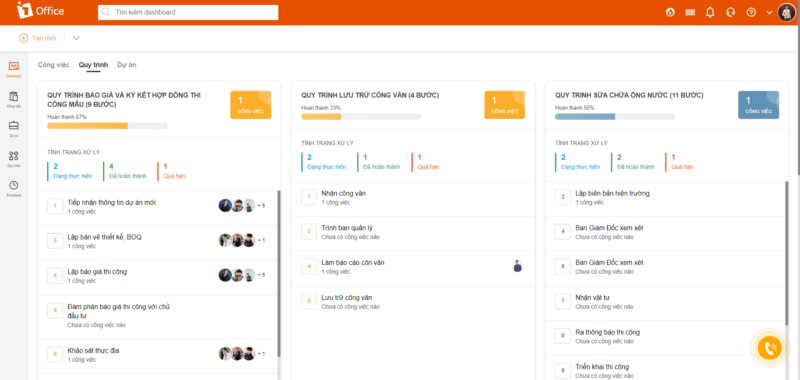
Currently, there are many task management software with features to monitor progress and the quality of work completion. These applications can help businesses better evaluate the quality of their OKR model. One of the software solutions that can thoroughly address the task management process in a business is 1Office. With its comprehensive features, the system helps digitize & standardize all operational processes, thereby building a goal system in the most accurate and effective way.
3. Roll out to department heads
In this step, meet with mid-level management (department heads) to outline the company’s OKR plan and discuss the OKR strategy that the management board has agreed upon (benefits, limitations, proposals, etc.) to gather feedback.
After completing this step, department heads will understand the company’s OKR strategy and establish plans for their department’s Objectives and Key Results.
4. Communicate OKRs to the entire company
Following the discussion with department heads, there will be a company-wide meeting to introduce OKRs. In this meeting, discuss the importance of OKRs and how the company will implement them so that employees will have appropriate expectations when working within the OKR system.
IV. How to score OKRs most accurately
To gain the maximum benefit from the OKR method, we should evaluate performance every 1 – 3 months to make adjustments if necessary.
The OKR scoring scale is from 0.0 to 1.0. Where:
- A score of 0 means no part of the objective was achieved
- A score of 0.6-0.7 means you are on the right track to completing the objective
- A score of 1 means completed.
- The average score of these Key Results will be used as the scale for the Objective’s completion level.
Notes on OKR evaluation:
There are two types of key results
Non-quantifiable activities (such as launching a new website) are graded on a 2-point scale: 0 for incomplete and 1 for complete; while measurable activities (like publishing 10 new website articles) are scored based on the completion rate.
| Objective | Launch a new version of the main product line | 0,7 |
| Key Results | 1) Achieve 10,000 consultation registrations | 0,6 |
| 2) Get the product reviewed on industry-related platforms | 0,6 | |
| 3) Achieve a trial registration rate of over 25% | 0,8 | |
| 4) Finalize product documentation for advertising activities & future technical product improvements | 0,9 |
Example of an OKR scoring table for goal completion
- 0.6 – 0.7 is a success: a score lower than this means the organization is not performing well, while a higher score means the OKR was not set ambitiously enough. Setting goals above current capabilities may create pressure, but when applied correctly, it motivates employees to achieve outstanding results.
- Below 0.4 does not mean failure: a low score could be due to an overly ambitious goal or inefficient work – regardless of the reason, it still serves as a basis for employee grading and prioritizing tasks for the department, as well as for improving strategy in the next quarter.
OKR scores are not a performance evaluation tool:
OKRs can be a factor in evaluating an individual (or organization), but they are certainly not the optimal method for analyzing job performance. If OKRs are used solely for performance evaluation, individuals will tend to set easily achievable goals to be considered successful. This would hinder the effectiveness of the OKR model.
| Read more: Top 12+ OKR Software for Effective Goal Tracking and Management |
V. Scope of OKR Application in Businesses
There are 3 common OKR application models for businesses as follows:
1. Applying OKRs Company-Wide
The entire company will be introduced to and apply the OKR methodology. All members benefit from aligned goals, boosting performance.
2. Applying OKRs for Leadership and Management Levels
Some businesses only apply OKRs at the leadership level. For example, in retail companies, where the majority of employees work at branches or stores, it may only be feasible to implement OKRs for leadership, management, or office staff.
3. Implementing OKRs for Independent Departments
This is the least common application method. In this case, independent departments or member companies of large corporations will implement OKRs as a branch of the organization.
Through this article, we hope you now understand “what the OKR model is” and why goal management models like KPI, OKR, etc., are becoming increasingly familiar in business administration. They help build a more scientific and unified goal system and implement it more effectively across all personnel. We hope this article will help your business successfully apply the goal management model and soon achieve its set objectives. Additionally, if you are looking for a comprehensive business management software, please contact us for the most dedicated consultation.
For more detailed information, please see:
Hotline: 083 483 8888
Fanpage: https://www.facebook.com/1officevn/
Youtube: https://www.youtube.com/channel/UCeTIRNqxaTwk0_kcTw6SxmA