


 10/05/2026
  11095 views
Recruitment is an indispensable process in building and developing a successful organization. Finding and attracting candidates with the right skills, experience, and potential for a job position always requires businesses to be well-prepared. So, what is recruitment? What is the most effective and high-quality recruitment process? Let’s explore with 1Office in the article below!
Mục lục
1. What is recruitment?
Recruitment is the process of finding, attracting, and selecting suitable candidates for job positions to meet the human resource needs of a business from various sources. This process can include identifying staffing needs, sourcing candidates, screening resumes, conducting interviews, and selecting the right personnel to join and work for the organization.
The recruitment process usually begins with the need to expand, supplement, or replace the current workforce in a business, when the organization cannot meet job requirements or when there is new growth and expansion.

The recruitment process can be divided into two main stages: sourcing and selection. Here are the differences between the two stages:
- Sourcing: This is the first stage in the recruitment process, where the business carries out activities to attract and collect candidate resumes. This can be done by advertising job openings, posting information on recruitment channels, collecting candidate resumes, and screening them to select potential candidates.
- Selection: This is the stage following sourcing, where the business conducts activities to evaluate, interview, and select suitable candidates. This involves interviewing candidates, checking references, and performing assessments to make the final decision on choosing the most suitable candidate.
2. The significance of recruitment
For businesses:
- Meets the human resource needs to carry out business activities, serve customers, and achieve business goals.
- Builds a team of candidates with the right skills, experience, and potential to bring a competitive advantage and innovation capability to the business.
- Enhances work performance and quality, allowing the business to achieve efficiency and increase contributions to the organization’s success.

For employees:
- Creates job opportunities for workers while increasing income, developing skills, and providing career advancement opportunities.
- Allows them to find job positions that match their needs, skills, and desires, leading to job satisfaction and engagement.
- Fosters career development and skill expansion by providing access to new learning, training, and experience opportunities within an organization.
For the labor market:
- Creates fair competition among businesses in attracting and retaining talent.
- Contributes to economic development, creates jobs, increases income, and promotes sustainable development in the region.
3. 6 steps for a standard and effective recruitment process
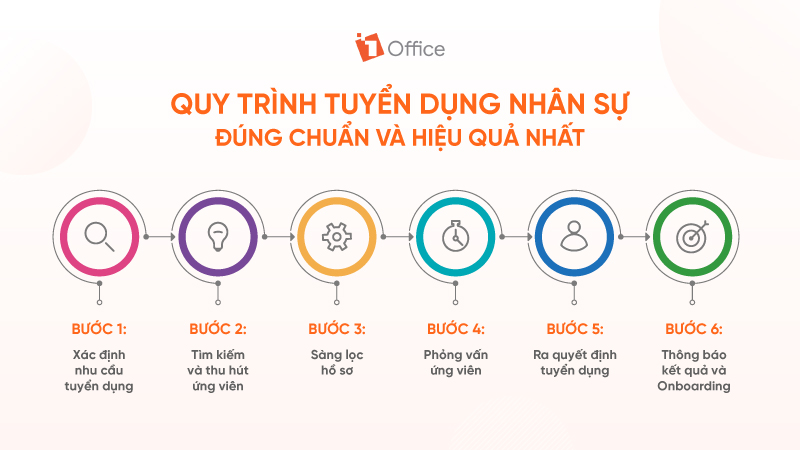
Step 1: Identify recruitment needs
First, the business needs to clearly define its recruitment needs, including specifying the position to be filled, the job description, required skills, necessary experience, and other criteria. To clearly identify these needs, the business can rely on several factors:
- The company’s future goals and strategies, such as business expansion, new projects, or changes in work processes, to meet human resource demands.
- Whether current positions are balanced and suitable for the company’s job requirements, by measuring performance, workload, or completion time.
- The turnover rate for each position and department, short-term or seasonal work, or external factors that may affect human resource needs.
For example: A software company decides to recruit a Back-End developer with some job requirements such as:
- At least 2 years of experience in a similar position.
- Proficient in the Java language.
- Thorough understanding of the entire web development process (design, development, and implementation)
- Basic understanding of databases and systems: MySQL, MongoDB, or PostgreSQL.
Step 2: Sourcing and Attracting Candidates
After identifying the needs and the position to be filled, the company begins to search for suitable candidates from various sources. Some recruitment methods that many businesses prioritize include referrals from friends and relatives, job websites, social media, recruitment services, headhunters, or searching within professional communities.
| Internal recruitment sources | External recruitment sources | |
| Advantages | Saves time and resources, reliable and familiar, promotes internal development and motivation. | Access to a diverse pool of candidates, broadens perspective and creativity, tailored to specific job goals and requirements. |
| Disadvantages | Limited selection, risk of position changes. | Costly in terms of time and resources, risk of selecting the wrong candidate. |
Comparison table of 2 recruitment sources: internal & external
Example: Recruiting senior personnel by using Headhunter services to find quality talent. Recruiting for Specialist positions through recruitment websites such as: TopCV, VietNamWorks, CareerBuilder…
Step 3: Screening Resumes
After receiving candidate resumes, the business proceeds with screening to select the most suitable candidates for the job requirements. This process includes reviewing resumes, checking skills, work experience, or applying technology to help managers screen and classify resumes intelligently and effectively.
Example: A software company reviews and screens candidate resumes using 1OFFICE HRM software to eliminate candidates who do not meet the criteria of having less than 1 year of work experience with the technology the company is using.
Step 4: Interviewing Candidates
Interviews can be conducted through in-person meetings, video calls, or phone calls. During the interview, questions that managers still have and were not answered in the candidate’s resume, such as skills, experience, and cultural fit, will be asked. The main purpose of the interview is to help the business get a more comprehensive view of the candidate, assess their suitability for the job position, and their potential for long-term commitment to the company.

Some questions that may be asked during the interview include:
- Do you have experience working on similar projects before?
- What notable achievements have you made in your previous job?
- When working in a team, what role do you usually play and how do you help achieve the team’s goals?
- Are you able to adapt and learn quickly? Please provide an example.
- Do you have a personal development plan in this field of work? Please share your plan.
- How do you measure success in this job?
- Do you have any questions or requests about the job position or our company?
>> See more: FREE DOWNLOAD: Top 10 most detailed INTERVIEW EVALUATION FORMS
Example: A technology company organizes in-person interviews with candidates who have passed the resume screening stage to ask more about projects they have participated in and to test their Java programming skills.
Step 5: Making the Hiring Decision
After the interview process, the business will evaluate and compare candidates manually or using software to make a hiring decision. The business will prioritize selecting the best candidate who is most suitable for the job requirements and the established criteria. The hiring decision may be the final decision of the recruiter or may need to be approved by higher levels of management in the company.
Example: A media company evaluates candidates based on their performance in the interview, communication skills, work experience, and development potential to select the three most suitable candidates.
Step 6: Announcing the Results and Onboarding

Finally, the business notifies the successful candidate of the result via email or phone and simultaneously conducts the Onboarding process directly at the company. This process includes steps to prepare the candidate before they join, providing information about policies, procedures, and introducing the company culture.
Example: A software solutions company sends an Email job offer letter to the selected candidate, announcing the result and providing information about the start date, necessary documents, and the upcoming training process.
4. Some Risks in Personnel Recruitment
The recruitment process is a crucial task for HR professionals and can face many potential risks. Below are some common risks in the recruitment process that businesses often encounter:
- Errors in assessing skills, experience, and position suitability, leading to the selection of unsuitable candidates or overlooking potential ones.
- Lack of complete and accurate reference information about the candidate, causing recruiters to overlook important and necessary details.
- Ineffective interviews that are not well-prepared, fail to ask relevant questions, or are unable to accurately assess the candidate’s abilities and attitude.
- Lack of honesty from candidates, which wastes the company’s time and resources when the recruitment process has to be continued with other candidates.
- High costs in terms of time and money, from advertising, screening resumes, interviewing, and checking references to implementing all the recruitment steps.
Illustrative example: An entertainment company was recruiting for an Assistant Director position. After the interview, the company sent an email with a start date and proceeded to reject other candidates for the role. However, on the start date, the chosen candidate declined the offer, causing a loss of time and resources and affecting recruitment efficiency.
5. Top 5 Recruitment Tips HR Should Know
To minimize risks in the recruitment process, businesses need to master the recruitment criteria and ensure a fair and accurate assessment process. At the same time, HR professionals need to be aware of several key points when participating in the recruitment process, such as:

5.1 Establish a Detailed Recruitment Process
Recruiters need to plan and establish a detailed recruitment process, from identifying recruitment needs to announcing results and conducting onboarding. A clear, well-prepared process helps ensure consistency and efficiency in personnel recruitment.
5.2 Provide a Clear and Detailed Job Description
Ensure that the job description is written clearly and in detail with the involvement of relevant departments. A complete description should clearly state the job requirements, skills, responsibilities, and authority of the position. This helps recruiters attract suitable candidates and ensures that candidates clearly understand the job.
5.3 Recruit Internally Before Searching Externally
Businesses should consider prioritizing internal recruitment before expanding the search to external candidates. Current employees may already have knowledge of the organization, and an internal priority policy will help motivate and create promotion opportunities for them. This also saves time and resources that would be spent searching for external candidates.
5.4 Screen Candidate Resumes Carefully and Accurately
Carry out the candidate resume screening process carefully and accurately (it is recommended to use software to support the recruitment process). Evaluate important factors such as skills, experience, education, and suitability for the job requirements. Be sure to learn about candidates by checking references and conducting in-person interviews to get a more comprehensive view of their abilities and personality.
5.5 Use a Technology Platform for Recruitment
Using recruitment process management software is a perfect solution to overcome all risks in the recruitment process. The software helps businesses automate the recruitment process, manage candidate profiles, schedule interviews, and provide analytical data to make smart hiring decisions.
6. Recruitment Effectiveness Metrics
To optimize the recruitment process, businesses need to regularly measure and analyze key performance indicators (KPIs) to assess the effectiveness, cost, and quality of new hires.
Common KPIs in Recruitment:
-
Time to Hire:
→ The average time from posting a job to a candidate accepting the offer.
→ Goal: Keeping this metric low helps save costs and ensures staffing timelines are met. -
Cost per Hire:
→ Total costs (advertising, HR personnel, tools, headhunter fees) divided by the number of people hired.
→ Example: If a business spends 100 million VND on a campaign and hires 5 people → cost-per-hire = 20 million VND/person. -
Offer Acceptance Rate:
→ Number of candidates who accepted offers / number of offers sent.
→ This metric reflects the company’s attractiveness and its competitiveness in the market. -
Quality of Hire:
→ Evaluate employee performance after 3–6 months.
→ Combines job KPIs, manager feedback, and retention rate.
Evaluating ROI in Recruitment:
-
Compare recruitment costs with the value generated by new employees (productivity, revenue, initiatives).
-
Track Retention Rate metrics to determine the quality of hiring.
-
Use the recruitment dashboard in HRM software (like 1Office, Workday, BambooHR) to automatically track KPIs and reduce the risk of data discrepancies.
Real-world example:
Company A invests 50 million VND in a marketing recruitment campaign. After 6 months, the new employee contributes 500 million VND in revenue → ROI = (500 – 50) / 50 = 900%, demonstrating outstanding recruitment effectiveness.
Measuring recruitment effectiveness with KPIs and ROI helps HR not only “hire enough people” but also hire the right people, at the right time, with the most optimal cost, creating a solid foundation for the company’s sustainable development.
7. 1Office HRM Recruitment Process Management Solution
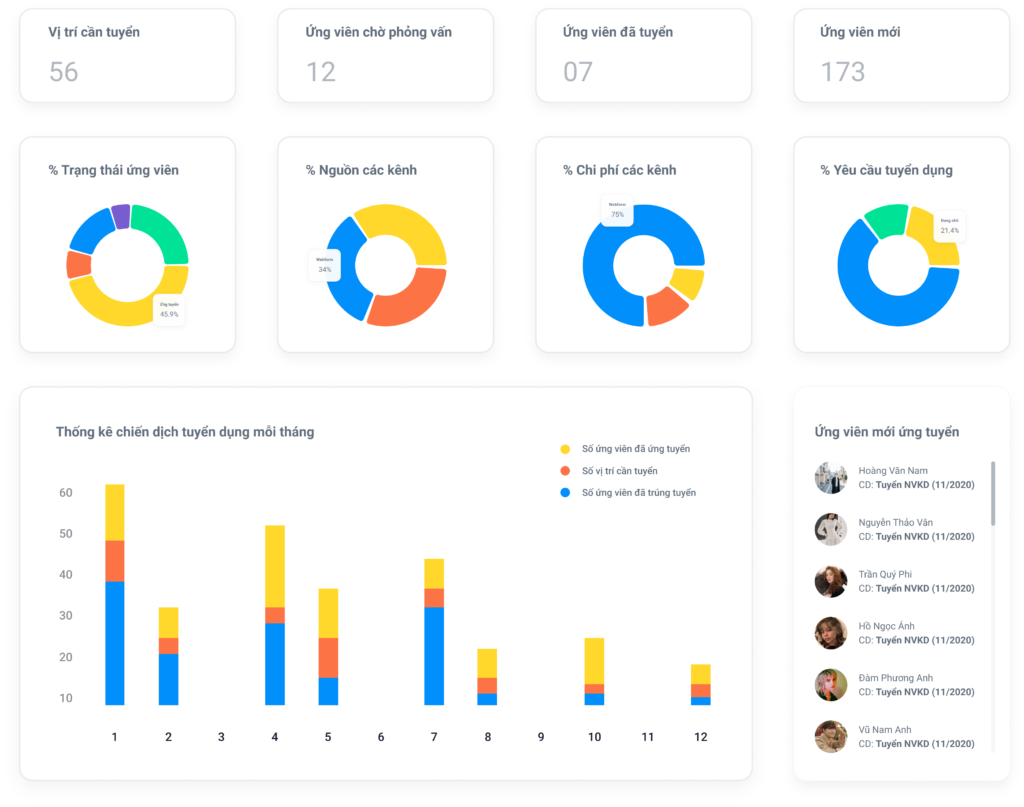
1Office HRM Recruitment Management Software is proud to be a solution within a comprehensive Human Resources Management toolkit, applied in businesses to manage the recruitment process from creating proposals to measuring and reporting recruitment results effectively.
- Create recruitment proposals, manage and store candidate profiles directly on the software.
- Automatically filter and classify candidate profiles according to the company’s proposed criteria.
- Flexibly choose recruitment channels, automatically push candidate CVs to the system
- Efficiently arrange and schedule interviews, enhancing recruitment performance.
- Automatically send interview invitation emails according to the pre-configured process in the software.
- Automated reporting system, measuring the number of candidates, recruitment sources, conversion rates, recruitment costs…
We hope this article from 1Office has helped businesses answer the question: What is HR recruitment? It covers the role and standard process of HR recruitment, as well as some necessary tips for a quality and effective recruitment process. This will help recruiters find the most suitable candidates for their company.
If you are interested in the HR recruitment software trusted by many businesses in Vietnam – 1Office HRM, please contact us via:
- Hotline: 083 483 8888
- Facebook: https://www.facebook.com/1officevn/
- Youtube: https://www.youtube.com/@1office-chuyendoisodn
















