


What is sunk cost? How to identify and avoid the sunk cost trap


In business as well as in personal life, we often face investments that are no longer effective. However, many people still try to “recoup their losses” because they regret the money already spent. This is a manifestation of sunk cost – an important economic concept that is often overlooked. So, what is a sunk cost? How can you identify and avoid falling into the sunk cost trap? This article will help you understand the nature of sunk cost and how to apply this knowledge in practice to make smarter decisions.
- What are operating costs? How to optimize them effectively for your business
- What are financial costs? Analysis, reporting, and calculation methods
- What are hidden costs? Classification & Formula for calculating Implicit Cost
Mục lục
- I. What is a sunk cost?
- II. Differentiating sunk costs from other types of costs
- III. Real-world examples of sunk costs in business
- IV. Characteristics of sunk costs
- V. What types of costs are considered sunk costs?
- VI. The impact of sunk costs in business
- VII. What is the Sunk Cost Fallacy?
- VIII. Causes of the Sunk Cost Fallacy
- IX. How to Avoid the Sunk Cost Fallacy in Management and Investment
- X. Frequently Asked Questions
- XI. Conclusion
I. What is a sunk cost?
A sunk cost is a cost that has already been incurred in the past and cannot be recovered, regardless of current or future business decisions. This is a cost that should not influence subsequent financial decisions because it cannot be changed.

Example: A business has invested a large sum of money to research and develop a product, but the product is not successful. This cost cannot be recovered and is called a sunk cost.
II. Differentiating sunk costs from other types of costs
| Cost Type | Recoverable? | Affects current decision? |
|---|---|---|
| Sunk Cost | NO | NO |
| Opportunity Cost | NO | YES |
| Marginal Cost | YES | YES |
| Fixed Cost | YES | LITTLE |
Correctly understanding this distinction will help you avoid mistakes when evaluating the effectiveness of investments or plans.
Comparison of sunk cost with other types of costs (opportunity cost, fixed cost,…)
| Cost Type | Definition | Characteristics | Example |
| Sunk Cost | Costs that have already been incurred and cannot be recovered or changed. | Does not affect future decisions if managed well. | Ineffective advertising costs. |
| Opportunity Cost | The value of the best alternative forgone when making a decision. | An implicit cost, based on the potential benefits from another alternative. | Rejecting project A to invest in project B. |
| Fixed Cost | Costs that do not change with the level of output or activity in the short term. | Independent of current production or business activities. | Office rent, machinery. |
| Variable Cost | Costs that change with the level of production or activity. | Directly dependent on the company’s level of activity. | Raw material costs, production labor. |
| Direct Cost | Costs directly related to a specific product or service. | Can be accurately measured and easily allocated to each product. | Raw material costs for a product. |
| Indirect Cost | Costs that cannot be directly attributed to a specific product or service. | Needs to be allocated through calculation methods such as revenue percentage or labor hours. | Electricity and water costs for the factory. |
III. Real-world examples of sunk costs in business
1. A startup investing in an obsolete product
A tech startup invested over 1 billion VND to develop a new social media application. After a year, the market changed, and user needs no longer aligned with the initial development direction. Instead of stopping, the management continued to pour more money into the project for the sole reason: “We’ve already invested too much; we can’t give up halfway.” As a result, the project had no users, the company suffered heavy losses, and was forced to lay off staff.
2. A failed marketing campaign
An e-commerce business invested 100 million VND in a Facebook Ads campaign but did not achieve the expected conversion rate. Instead of stopping the campaign, re-analyzing, or changing their approach, they continued to pour more money in, hoping to “salvage” the results. Ultimately, the advertising costs reached 300 million VND without a corresponding increase in revenue, leading to severe financial damage.
3. Ineffective internal training
A company organized an internal training program for all employees at a cost of over 200 million VND. However, after the course, productivity did not change, and employees gave negative feedback. Instead of re-evaluating the content and methods, the company continued to roll out similar courses simply because they had “already signed a long-term contract with the training provider.” This is a classic example of letting sunk costs influence subsequent decisions.
The examples above show the danger of letting the regret of sunk costs dominate management thinking. To succeed, businesses need to be flexible and willing to cut their losses when necessary.
IV. Characteristics of sunk costs
Irrecoverable
- This is the most prominent characteristic of sunk costs. No matter how hard a business or individual tries, this expense has already been spent and cannot be recouped.
Should not affect future decisions
- In theory, sunk costs should not be considered when making future decisions. However, in reality, many people are often influenced by the “we’ve already invested so much” mentality and continue to spend more even when it is not effective.
Exists in the past
- Sunk costs are always expenses that have occurred in the past and cannot be changed.
Unrelated to marginal cost
- Sunk costs are completely different from marginal cost – the additional cost incurred to produce or invest in one more unit of a product/service.
Easily leads to a psychological trap
- Because this cost is irrecoverable, managers often fall into a psychological trap, trying to “salvage” the situation instead of stopping to optimize resources.
V. What types of costs are considered sunk costs?
This type of cost can appear in many aspects of business, from investment, production, and marketing to project management. Identifying and understanding sunk costs will help businesses avoid financial traps and make wiser decisions.
Below are common types of sunk costs:
1. Research and development (R&D) costs

Costs dedicated to researching and developing new products or services are often considered sunk costs, especially when the project does not achieve the expected results.
- Example: A company invests 1 billion VND in researching and testing a new product. However, the product fails to meet market demand, and the project is canceled. The amount spent becomes a sunk cost because it cannot be recovered.
2. Advertising and marketing costs
Money spent on advertising or marketing campaigns that do not yield results is also considered a sunk cost.
- Example: A business invests a large budget in a media advertising campaign, but the results do not meet the objectives. This cost cannot be offset and becomes a waste.
3. Equipment and facility costs
Sunk costs also include expenses for purchasing equipment, machinery, or constructing facilities that are later no longer usable or no longer align with the business’s direction.
- Example: A manufacturing plant invests in a production line based on old technology, but later switches to new technology, rendering the old line useless.
4. Employee training costs

The cost of training or upskilling employees, especially when they leave the company or no longer contribute value, is also considered a sunk cost.
- Example: A company spends a large amount to train an employee, but they later resign to join another company.
5. Legal and consulting fees
Payments to lawyers, consultants, or other legal services for failed lawsuits or transactions are also considered sunk costs.
- Example: A business hires a lawyer to handle a contract dispute but ultimately fails and does not achieve the desired outcome.
6. Unsuccessful project costs
Large projects that are canceled or fail due to infeasibility or market factors often leave behind significant sunk costs.
- Example: A real estate company spends billions of dong to develop a project, but the project is later canceled due to legal issues or failure to attract investors.
7. Inefficient personnel costs
Payments to staff or partners that do not deliver value commensurate with the cost are also a form of sunk cost.
- Example: A company hires a team of consultants to build a strategy, but the strategy proves to be unfeasible and cannot be implemented.
8. Costs arising from strategic mistakes
Costs arising from wrong decisions in business or investment strategy are also unrecoverable, becoming sunk costs.
- Example: A company mass-produces a trendy product, but the market changes rapidly, causing the inventory to become obsolete and unsellable.
VI. The impact of sunk costs in business
1. Causing the “sunk cost fallacy” in decision-making
Sunk costs often lead to a “throwing good money after bad” mentality, causing businesses to continue investing in ineffective projects or strategies simply because they have already spent so much.
Example: A company has invested billions of dong in developing a product that is not well-received by the market. Instead of stopping, they continue to spend more budget to salvage the project, leading to even greater losses. As a result, this irrational decision can waste more resources and negatively affect the company’s operational efficiency.
2. Affecting the psychology of leaders and employees
Sunk costs can create significant psychological pressure on leaders and staff, especially when the outcome of an investment does not meet expectations.
Example: A team has spent months developing a project, but the project fails. The pressure from the lost costs can lower morale and creativity. This can easily lead to a negative work environment, loss of motivation, and reduced productivity.
3. Distorting business strategy
Focusing too much on past costs can distract a business from new opportunities or long-term strategies.
Example: A manufacturing company continues to use an outdated technology line just because it has invested too much in it, instead of switching to newer, more modern, and efficient technology. Falling behind in technology updates causes the business to lose its competitive edge and fail to keep up with market trends.
4. Wasting resources
Maintaining ineffective projects or products means that financial resources, manpower, and time are being wasted.
Example: A business continues to invest in a non-potential market just because it has already built infrastructure there. The business fails to optimize the benefits from its resources and loses out on profit opportunities in other areas.
5. Affecting the company’s image and reputation
Sunk costs related to failed projects can negatively affect a company’s reputation if not handled promptly and properly.
Example: An ineffective advertising campaign with a large budget can lead customers to underestimate the company’s management and creative capabilities. This not only affects current revenue but also erodes the trust of partners and investors in the future.
6. Positive impact if identified correctly
Although sunk costs have many negative impacts, if businesses and managers identify and handle them in a timely manner, they can become valuable lessons for improving future management.
Example: Instead of continuing to invest in a failed project, the business accepts the sunk cost, learns from it, and focuses on new, more promising strategies. This decisive action helps the business optimize resources, avoid repeating mistakes, and open up new opportunities for success.
VII. What is the Sunk Cost Fallacy?
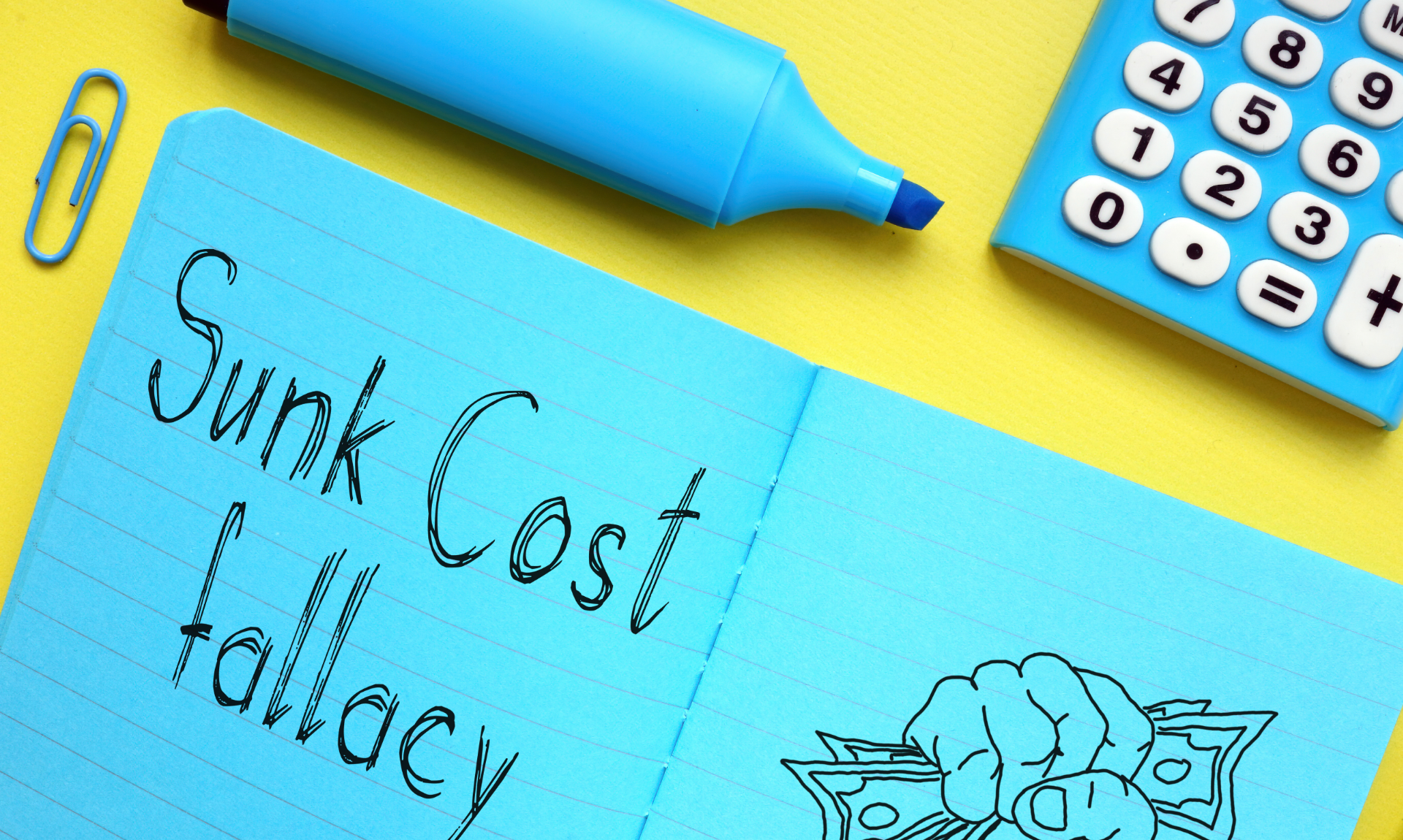
The Sunk Cost Fallacy is the phenomenon where an individual or business continues to pursue a wrong decision simply because they have already invested money, time, or effort. Despite it no longer being effective, people are reluctant to give up due to a sense of regret and fear of admitting failure.
VIII. Causes of the Sunk Cost Fallacy
Instead of making decisions based on future value or effectiveness, people are influenced by costs that have already been incurred, even though these costs are irrecoverable and do not affect future benefits.
Some of the main causes that can lead to the sunk cost fallacy include:
Loss Aversion:
People tend to avoid losses more than they seek equivalent gains. As a result, many are unwilling to accept a guaranteed loss (such as terminating a project with sunk costs), especially if they have a low tolerance for risk. This leads to continued investment in an attempt to “recoup losses,” even though the decision offers no future value.
- Example: A business continues to maintain an old production line despite clearly seeing that profits are not meeting expectations, because it does not want to admit the waste in the initial investment.
Commitment Bias:
Once a plan has been made or an initial decision has been taken, people tend to stick with it, even when it is no longer appropriate. This stems from a psychological desire to maintain consistency, making it difficult for them to change course or abandon a project.
- Example: A management team continues to pursue an ineffective business strategy simply because it was the plan agreed upon in previous meetings.
Waste Avoidance:
The desire to avoid wasting resources, especially large company investments, makes it easy for people to fall into the sunk cost trap. In fields like research and development, this is particularly evident when initial expenditures do not yield expected results, but the project is continued to “preserve” the investment’s value.
- Example: A tech company continues to invest in an outdated product because it doesn’t want to see the millions of dollars from the initial investment become meaningless.
Personal Commitment:
Individuals within a business may feel emotionally attached or responsible for a specific project, especially if they initiated it. This creates an emotional bias, making it difficult for them to objectively assess the project’s effectiveness or actual data.
- Example: A CEO is unwilling to abandon a project they personally proposed, leading to its continuation even when it no longer holds value.
Illusion of “Recovery” Potential:
People often mistakenly believe that with just one more small investment, a project will have a chance to succeed, even when there is no factual basis for this belief.
Groupthink:
Within a team, peer pressure can cause members to continue supporting a poor decision to avoid conflict or isolation.
IX. How to Avoid the Sunk Cost Fallacy in Management and Investment
Evaluate Based on Future Value, Not the Past
One of the key principles to avoid the sunk cost fallacy is to focus on the value that the current decision will bring in the future, rather than looking at the costs already spent. Sunk costs are irrecoverable, so clinging to them only prolongs poor decision-making.
- Solution: Use project evaluation methods based on projected ROI or the actual value it will generate from this point forward.
Regularly Review and Adjust Strategies
Periodically re-evaluating projects and strategies is a way to identify potential problems or risks. If a project is no longer suitable or does not provide value, you must be prepared to make the decision to stop or adjust the plan.
- Solution: Organize regular performance review meetings and use actual data, not intuition, to make decisions.
Separate Emotions from Data
Emotions often lead managers to maintain ineffective decisions, especially if they have invested significant effort and resources. To avoid this, decisions should be based on metrics and analysis rather than personal feelings.
- Solution: Establish a data-driven decision-making process and create an environment where the team can provide objective opinions.
Enhance Transparency and Diverse Opinions
Encouraging transparency in the decision-making process and listening to diverse opinions helps minimize bias or unnecessary commitment.
- Solution: Form independent advisory groups or hire external experts for an objective assessment.
Accept Small Risks and Losses to Avoid Larger Ones
Sometimes, abandoning an ineffective investment or project is the best way for a business to preserve its resources. Managers should not hesitate to accept a small loss if it helps prevent a larger one in the future.
- Solution: Focus on the big picture instead of trying to “salvage” a small part.
Training on financial mindset and risk management
Improving the awareness of management teams and employees about sunk costs through training is an effective way to minimize wrong decisions.
- Solution: Organize courses or workshops on financial management, strategic thinking, and risk analysis.
Apply technology and support tools
Using data analysis and project management tools helps provide a comprehensive overview, thereby supporting more accurate decision-making.
- Solution: Implement project management or financial data analysis software such as: 1Office, Trello, or Tableau.
Reference: 10 Best Project Management Software for Progress Tracking in 2025
X. Frequently Asked Questions
1. Are sunk costs always a bad thing?
No, sunk costs are not always a bad thing because:
- Learning support: Sunk costs can provide important lessons, helping businesses, managers, or individuals avoid repeating mistakes.
- Unavoidable: Some specific industries like research & development (R&D) or marketing require large investments, and accepting sunk costs is part of a long-term strategy.
- Indirect benefits: Some sunk costs can improve brand reputation or customer relationships, bringing value that is difficult to measure directly.
2. How to know if a business/individual/manager is falling into the sunk cost trap?
You can recognize it through the following signs:
Continuing to invest in ineffective projects:
- The project has exceeded its budget or failed to meet its goals but continues to receive more resources because “too much has already been invested.”
Unwillingness to change the initial plan:
- The manager does not consider new options or refuses to change the strategy even when actual data shows that adjustments are needed.
Focusing on the past rather than the future:
- Current decisions are based more on the costs already spent rather than the potential future value.
Fear of admitting mistakes:
- The individual or team is concerned that abandoning a project will affect their reputation or credibility.
Lack of data-driven analysis:
- Decisions are dominated by emotions, not based on an objective analysis of economic benefits.
3. Are salaries a sunk cost?
Salaries are not always a sunk cost. This depends on the specific situation.
Not a sunk cost:
- In most cases, salaries are a variable cost or a fixed cost because they can be controlled or changed as needed.
Is a sunk cost:
- In cases where salaries have been paid but did not generate value (such as salaries paid to employees who have left or for a failed project), this amount can be considered a sunk cost because it cannot be recovered.
Example:
- A company pays monthly salaries to employees even though the project they were working on has been canceled. The salary in this case is a sunk cost.
XI. Conclusion
Understanding and overcoming sunk costs is a crucial turning point that helps individuals and businesses make more rational decisions. By eliminating the sunk cost fallacy and prioritizing a cost-benefit approach, we can limit unnecessary mistakes and losses.




