


 13/05/2026
  327 views
What should a company’s working hours regulation template include? What is the maximum number of working hours for an employee per week? If you are a recruiter and don’t know how to draft this form, you should refer to the following article.

The regulations on employee working hours are clearly stipulated in the Labor Code issued by the National Assembly. This code has created a legal framework for employers and employees to know their rights and obligations (working hours, labor contracts, strikes, overtime…).
Mục lục
1. Some notes when creating a working hours regulation template
The working hours regulation template includes complete information about normal working hours, flexible hours…
1.1 Regulations on working hours
In a working day, an employee’s working time is divided into two frames: Normal working hours and overtime.
1.1.1 Normal working hours
- Normal working hours are limited to 8 hours per day and 48 hours per week;
- Employers have the right to regulate employees’ work by week, day, or hour. If working by the week, normal working hours should not exceed 10 hours in a day. Employers should note that it must not exceed 48 hours in a week;
- The Labor Code also encourages employers to implement a 40-hour work week;
- For those doing particularly arduous, hazardous jobs, working hours must not exceed 6 hours a day. This provision is clearly stipulated in the list issued by the Ministry of Labor, Invalids and Social Affairs in coordination with the Ministry of Health.
1.1.2 Overtime
- With the consent of the employee;
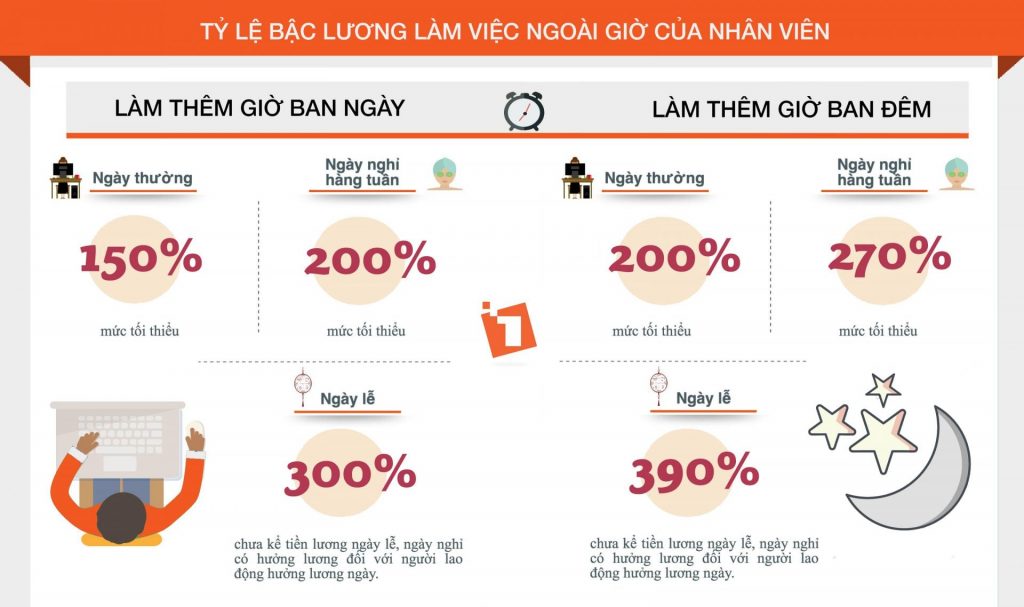
- The number of overtime hours must not exceed 50% of the normal working hours in a day. The total normal working time and overtime hours must not exceed 12 hours per day; not exceed 30 hours per month and a total of not more than 200 hours per year. In some special cases prescribed by the National Assembly, overtime is allowed but not exceeding 300 hours per year;
- A compensatory leave schedule must be arranged for employees after each period of many consecutive days of overtime in a month. This compensates for the time they were not able to rest.
1.2 Regulations on overtime hours
- Not to exceed 12 hours per day when working overtime on public holidays, Tet holidays, and weekly days off;
- After each overtime period (maximum of 07 consecutive days in a month), the employer must arrange for the employee to take compensatory leave for the time they were not able to rest. If the employer does not arrange for compensatory leave, they must pay overtime wages to the employee.
2. Sample working hours policy for businesses
The working hours regulation template should have clear policies to make employees feel secure during their work.
2.1 Purpose of the policy in the working hours regulation template
The working hours adjustment policy will create a favorable and flexible working environment. This policy also supports employees without affecting the Company’s overall plans.
2.2 Scope
- This policy applies to all employees of the Company;
- Based on the nature of the work, some positions will be managed separately from this policy. The list of these positions is attached as part of the policy.
2.3 Policies and procedures in the working hours regulation template
The working policy creates discipline for employees to be responsible for their work.
2.3.1 General policy
The Company’s working hours policy for employees defines the principles of required working hours and provides managers with a guide to managing employee working time.
- The Company arranges employee working hours from Monday to Saturday. Depending on the business plan, the Company may arrange for additional Saturdays off during the month;
- Employee working hours start at 8:00 and end at 17:00;
- Employees are entitled to a one (01) hour lunch break each working day;
- Female employees with children under twelve months of age are entitled to a one-hour reduction in their daily working hours. They can take this time to care for their child while still receiving their full salary. In this case, the female employee can agree with the Company on the 01-hour break, meaning starting work late, extending the lunch break, or leaving early.
2.3.2 Flexible Working Hours
Based on the difference in overtime pay policies for hourly employees, employees on a fixed salary are entitled to the following flexible working hours:

- Addition of the 08:30 – 17:30 working time frame. Not applicable to positions related to health and office reception, such as nurses, receptionists, etc.
- Employees are allowed to start work late/leave early (no more than 15 minutes). A maximum of 02 times per month, provided it does not negatively affect business operations.
2.3.3 General Regulations and Policies on Working Hours
- Employees are not allowed to be absent during working hours without prior approval from their Manager. If an employee needs to take leave for personal reasons, they should refer to the leave policy template from 1Office.
- In cases where work is performed outside the Company, the employee must obtain approval from their Manager;
- Employees (on a fixed salary) who work on a Sunday must have prior approval. They will then be given a compensatory day off on another day as arranged by the Company;
- Department Heads, when applying the 08:30 – 17:30 working time frame, must ensure it does not negatively affect business operations;
- The Company may change this policy depending on the business situation without consulting employees.
2.3.4 Attached Documents
- List of positions eligible for flexible working hours.
A clear and transparent working hours policy is one of the important legal documents for creating order in the workplace and promoting punctuality among employees. We wish you success in applying this policy template!
See more articles at:
Internal Tet holiday announcement template for businesses (with instructions and examples)
Internal labor regulations template for businesses (free download)
















