10/05/2026
  9308 views
Electronic contracts are an increasingly popular concept in today’s digital age. However, to better understand electronic contracts and apply them effectively, we need to learn specifically about their legal validity, characteristics, benefits, and differences compared to paper contracts. Join 1Office in exploring this information in this article!
Mục lục
- 1. What is an electronic contract?
- 2. Legal validity of electronic contracts
- 3. Classification of Electronic Contracts
- 4. Characteristics of Electronic Contracts
- 5. Advantages of using electronic contracts
- 6. Differences between electronic contracts and paper contracts
- 7. Risks of using electronic contracts and how to prevent them
- 8. Regulations on electronic contracts businesses need to know
- 9. 1CA Digital Signature – “Touchless” signing, “paperless” operations
1. What is an electronic contract?
An electronic contract (E-contract) is a type of contract where the participating parties agree on the establishment, modification, or termination of their rights and obligations, which is sent, received, and stored on electronic media such as digital, electronic, optical technologies, and other electronic means.
According to the provisions of the Law on Electronic Transactions 2005, an electronic contract is a contract established in the form of a data message. A data message is information created, sent, received, and stored by electronic means, expressed in the form of electronic data interchange, email, electronic documents, telegrams, faxes, telexes, and other similar forms.

2. Legal validity of electronic contracts
Vietnamese law recognizes the validity of electronic contracts, provided they comply with regulations. This gives businesses the confidence to use this form of agreement to optimize business processes and reduce operating costs.
Electronic contracts have a full legal basis under the law
The Law on Electronic Transactions 2005 stipulates that electronic contracts have the same legal value as traditional contracts. Specifically, the legal validity of this type of contract cannot be denied just because the contract is expressed in the form of a data message.
In addition, according to Article 14 of the Labor Code of 2019, labor contracts can be executed through electronic means, using electronic data in accordance with the law on electronic transactions, and they have the same value as traditional written labor contracts.
Recently, Circular 87/2021/TT-BTC of the Ministry of Finance has regulated electronic transactions in the professional operations of the State Treasury. Accordingly, electronic contracts are recognized and used in these activities with legal validity similar to paper contracts.
In summary, although digital contracts are expressed in the form of electronic data, their legal validity is still recognized and can be used as evidence in case one of the parties fails to comply with the agreed-upon terms.
- What is a public digital signature? Should it be used instead of a handwritten signature?
- Price List for Affordable Digital Signatures for Individuals & Businesses
Basis for determining the legal validity of electronic contracts

For an electronic contract to be legally valid, it must meet the following conditions:
Full electronic signatures of all participating parties
Similar to traditional contracts, electronic contracts must also have the full digital signatures of all participating parties as an authentication of their acceptance of the terms and confirmation of their responsibility to perform:
- For contracts between organizations, there must be digital signatures from all parties involved in the contract.
- For contracts signed between an organization and an individual, at least one digital signature from the organization and one digital signature from the individual are required (depending on the agreement of the participating parties).
Ensuring integrity, uneditable from the moment of signing
Electronic contracts must ensure integrity and that the content and terms cannot be edited after the parties have completed the digital signing process. On electronic signature software, all changes related to the contract, regardless of which party made them, are recorded and stored by the software. Therefore, any edits or changes to the contract’s content are logged in the system.
Once digitally signed, the contract file and signed document become the final, unchangeable version. Electronic contracts are designed with optimal security from the inside out and are equipped with measures to prevent cyberattacks. Attack scenarios are continuously updated to identify and counter them, and high encryption standards are applied. The storage system is also secured with measures to prevent attacks and data loss, and data is stored in data centers that comply with international information security standards.
The digital signature of the contract signer and the digital signature of the business/organization are two important factors for authenticating that an electronic contract is signed by the correct legal entity.
Legally, the digital signature of the contract signer corresponds to the signature of the legal representative, serving to identify the representative of the business/organization entering into the contract. The digital signature of the business/organization replaces the company seal, confirming that the contract’s content aligns with the will of the business/organization.
Depending on the agreement between the parties, only the digital signature of the business/organization may be used. However, to ensure the highest legal validity, a digitized contract should have both of these digital signatures. The parties to the contract need to ensure they sign electronically and accurately on the contract being executed. Incorrect electronic signing can lead to contract disputes, affecting the rights of the parties.
The digital certificate is issued by a licensed provider and is valid at the time of signing
On a legal basis, electronic signatures must comply with the regulations in the 2015 Civil Code, the 2005 Law on Electronic Transactions, along with Decree No. 130/2018/ND-CP on digital signatures and digital signature authentication services, and Decree No. 52/2013/ND-CP on e-commerce. The digital certificate on the contract must be issued by a licensed organization and must be valid at the time the contract is signed.
3. Classification of Electronic Contracts
Depending on the form or purpose of the contract, electronic contracts are often divided into the following types:
Classification by Form
Electronic contracts can be signed in the following forms:
Paper Contracts Uploaded to a Website
This type of contract is usually first created as a paper document, then edited and uploaded to a website for the parties to sign. The contracts are often posted on the website in PDF format, with a confirmation button to indicate agreement with the terms of the contract. Additionally, the website provides two options for the participant: one to agree and one to disagree with signing the contract.
Contracts Signed via Electronic Transactions
The most obvious advantage of this type of contract is that its content is not predetermined but is generated through an automated transaction process. The contract’s content is automatically compiled and processed by a computer based on the information provided by the customer.
When the transaction process is complete, the contract is generated and displayed for the customer to confirm their agreement with the terms and conditions. The seller will receive a notification about the contract and then send a confirmation to the buyer via means such as email, fax, phone number, and other methods.
Contracts Formed via Email
An electronic contract formed via email is a type of contract that is concluded and drafted similarly to a traditional contract, but uses electronic mail (email) for signing. This type of contract has many advantages, such as saving time and costs for the participating parties, as they do not need to meet in person and can simply sign electronically via email.
By Contract Purpose
Electronic contracts are classified by the following purposes:
Commercial Contracts
Economic contracts, also known as electronic commercial contracts, are contracts where one party is a merchant and the other party must have legal status as required by regulations for the contract to be valid in the form of a data message. The data information must comply with the technical conditions and standards stipulated by current law.
The prominent features of economic/electronic commercial contracts are:
- Parties: This contract involves two parties, one being a merchant and the other having legal status.
- Purpose: The main objective of this type of contract is usually to achieve profit.
- Subject: The subject of this type of contract is typically goods. Economic/commercial electronic contracts can include contracts for the sale of goods and contracts for the provision of services.
Labor Contracts
Similar to traditional labor contracts, an electronic labor contract is an agreement between an employee and an employer concerning terms such as salary, benefits, responsibilities, and obligations. The information in an electronic labor contract is stored as electronic data and has the same legal validity as a traditional written labor contract.
The characteristic of this type of contract is that it involves two main parties: the employee and the employer. Common types of electronic labor contracts include:
- Indefinite-term labor contracts.
- Fixed-term labor contracts.
- Seasonal or specific-project labor contracts.
Civil Contracts
An electronic civil contract is an agreement between participating parties regarding the establishment, modification, or termination of civil rights and obligations, expressed in the form of a data message.
According to current Vietnamese law, there are some civil areas where the electronic contract form is not applicable, including:
- Certificates of land use rights, house ownership, and other real estate assets.
- Inheritance documents.
- Marriage registration certificates, divorce decrees.
- Birth certificates, death certificates.
- Bills of exchange and similar documents.
However, electronic contracts still have the same legal validity as traditional contracts and can be used as evidence if one of the participating parties fails to comply with the agreed-upon terms.
4. Characteristics of Electronic Contracts

Electronic contracts have distinct characteristics compared to traditional contracts. The basic features of this type of digital contract are listed below.
Contracts are expressed through electronic messages and data
Electronic contracts do not exist in paper form; instead, they are represented as electronic data, such as PDF files, emails, or messages on messaging apps. Therefore, the first characteristic of online contracts is that the conclusion, offer, execution, and storage of the contract are all done through data messages, unless the parties agree otherwise.
At least 3 parties are involved in the signing process
In a traditional contract, there are only two main parties: the seller and the buyer. However, in an electronic contract, in addition to these two parties, a third entity must be involved – the network service providers or the electronic signature certification authorities.
The electronic signature certification authority plays a crucial role in ensuring the legal validity of the contract. This third party does not participate in the negotiation or signing of the online contract; their task is to help ensure that the digitized contract is considered legally valid and can be effectively executed.
Scope of use for electronic contracts
Electronic contracts do not apply to all types of transactions. The 2005 Law on Electronic Transactions stipulates that electronic contracts are only applicable in civil, business, commercial, and state agency activities. However, electronic contracts do not apply to certain specific transactions, such as those related to land use rights, marriage registration, divorce, birth registration, death registration, etc.
Can be executed anytime, anywhere
A special feature of electronic contracts is that related information is created and stored as electronic data, allowing the two parties to the contract to not have to meet in person. Instead, they can conveniently and quickly execute the signing online from any location and at any time.
5. Advantages of using electronic contracts
The years of combating the Covid-19 pandemic have prompted businesses to change their operating models, shifting from offline to online work. Consequently, the use of electronic contracts and remote digital signatures has become a suitable way to adapt to the situation, helping businesses navigate these challenges and bringing many practical benefits.
Maximize savings on costs, time, and resources
All activities related to the contract signing process, from creation, review, signing, sending, to receiving the contract, are performed online. Clients do not need to print, manage, or store a large volume of contracts, and can also save a significant amount of time by not having to transport contracts or meet in person to sign.
Smart and convenient execution
Since the contract is executed in a digital environment, you can proactively sign it anytime and anywhere, with no limitations on supporting devices. You just need to use smart devices like tablets, phones, laptops, etc., as long as there is an internet connection, without needing to be physically present. This ensures the continuity of the signing process, even when the signer is not at the company office, preventing disruptions to business and operations.
Convenient storage, easy retrieval
Electronic contracts are often stored on contract management software so businesses don’t have to waste effort searching through a “mountain” of stored contracts and documents. Instead, you can simply search the online data repository and easily identify signed contracts, contracts pending signature, or returned contracts accurately and quickly.
Safe and secure
Data security is a top priority when conducting electronic transactions. The electronic contract signing process always adheres to the ISO/IEC 27001:2013 standard – the leading standard for information security management systems. All information is kept with maximum security throughout the transaction process.
6. Differences between electronic contracts and paper contracts
Both electronic contracts and traditional contracts are regulated by the 2015 Civil Code; however, there are some differences between them as follows:
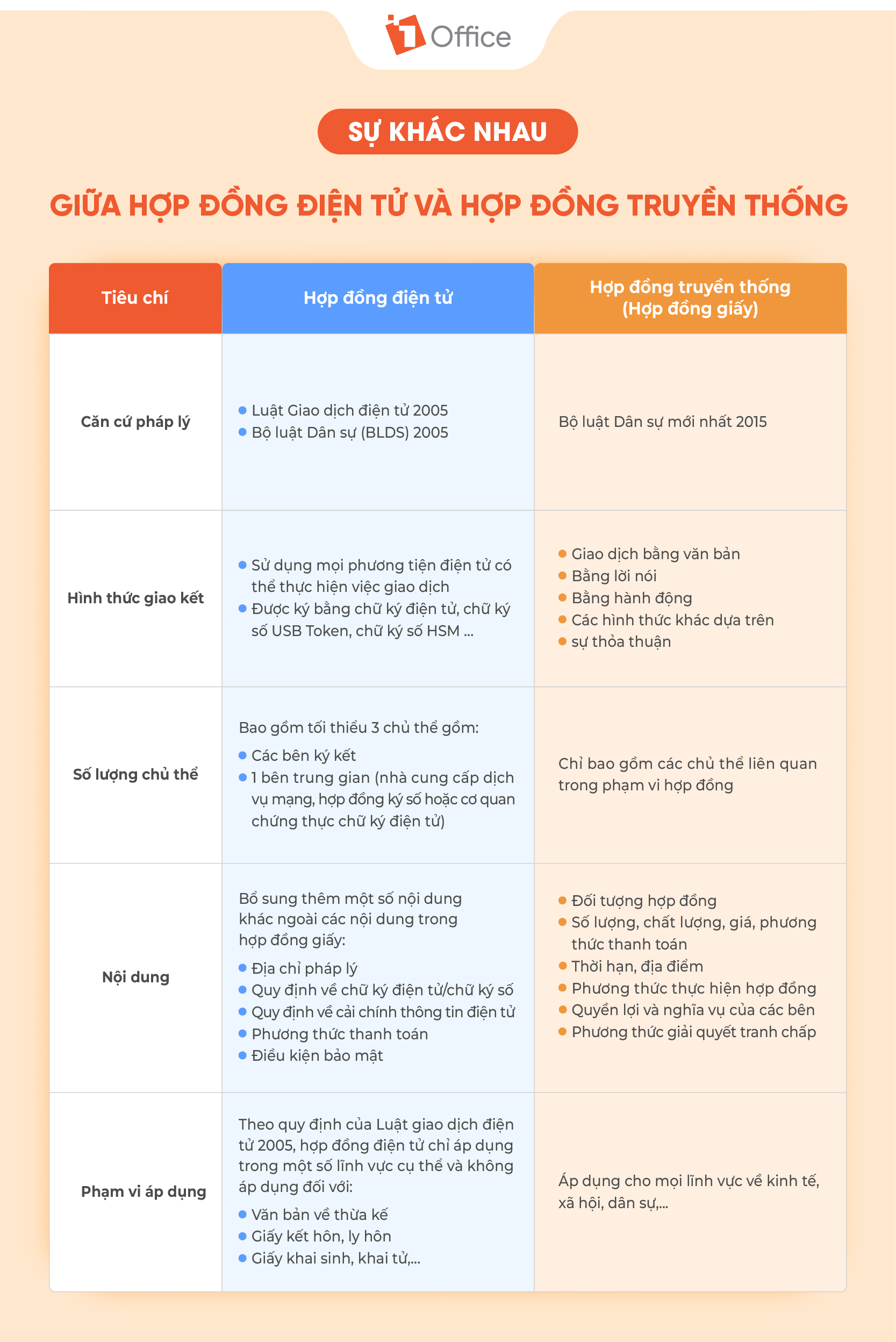
7. Risks of using electronic contracts and how to prevent them
Using electronic contracts offers many benefits but also comes with some potential risks. Businesses need to identify these risks to prevent them and ensure transactions are transparent and secure.
Legal risks and disputes
Electronic contracts, if not properly established, can lead to legal disputes. Some common issues include:
-
Lack of a legally valid electronic signature: If the electronic signature does not meet legal requirements, the contract may be considered invalid.
-
Unclear or erroneous information: If the contract content is not detailed, missing important clauses can lead to misunderstandings and disputes.
-
Signatory lacks representative authority: If the signatory is not a legal representative or is not legally authorized, the contract will lack binding force.
How to prevent:
-
Verify the legality of the electronic signature and digital certificate.
-
Thoroughly review the contract content before signing.
-
Ensure all signatories have representative authority and are legally authorized.
Information security risks
Electronic contract information is stored and transmitted through a digital environment, which can be at risk of intrusion, modification, or theft:
-
Leakage of sensitive information: Information about pricing, commercial terms, or customer data can be exposed if the security system is weak.
-
Data loss or unauthorized modification: Not using a secure platform can lead to data loss or changes to the contract content.
-
Cyberattacks and malware: Hackers can exploit system vulnerabilities to access data.
How to prevent:
-
Use a reputable electronic contract platform with international security standards.
-
Encrypt data and apply multi-factor authentication (MFA).
-
Regularly back up data and check the integrity of the contract.
Risk mitigation solutions
To mitigate both legal and security risks, businesses should implement the following measures:
-
Establish a standardized contract signing and storage process: Ensure that the signing, confirmation, and storage steps are performed consistently.
-
Staff training: Employees need to clearly understand legal regulations, how to use the electronic signing platform, and how to store contracts.
-
Access control and authorization: Only authorized individuals can access and edit contracts.
-
Periodically review systems and processes: Check for security vulnerabilities, update digital certificates and software.
-
Incorporate legal mechanisms: In case of a dispute, one can rely on laws, electronic documents, and transaction logs to prove their rights.

8. Regulations on electronic contracts businesses need to know
When signing contracts online, businesses need to clearly understand the important regulations before entering into an agreement to ensure that the contract is legally valid, not void, and to minimize risks and disputes during its execution.
Contract formation
Principles of electronic contract formation
When forming and executing electronic contracts, the parties must ensure the following principles:
- Voluntary agreement: The participating parties have the freedom to agree on using electronic means to form and execute the contract.
- Compliance with the law: The establishment and formation of the contract must comply with the provisions of the Law on Electronic Transactions and contract law.
- Agreement between parties: The parties have the right to agree on technical requirements, authentication, and conditions to ensure the integrity and security related to the electronic contract.
Regulations on entering into electronic contracts
Based on the principles mentioned above, Article 36 of the 2005 Law on Electronic Transactions clearly stipulates the following regarding entering into electronic contracts:
- Entering into an electronic contract is the use of data messages to carry out part or all of the contract formation process.
- In electronic contract formation, unless otherwise agreed by the parties, the offer and acceptance to enter into a contract can be made through data messages.
Regarding the time and place of sending and receiving electronic contracts
The Law on Electronic Transactions clearly specifies the time and place for sending and receiving digital contracts in Article 19, which is the time and place of receiving data messages, and this is specifically regulated as follows:
Regarding the time and place of sending electronic contracts:
If the parties involved in the transaction have no other agreement, the time and place of sending a data message are regulated in Article 17 of the 2005 Law on Electronic Transactions as follows:
- Time: This is the time when the data message enters an information system outside the control of the originator.
- Place: Determined based on whether the originator is an agency, organization, or individual:
- If the originator is an agency or organization, the place is their headquarters.
- If the originator is an individual, the place is their residence.
In case an agency or organization has multiple headquarters, the place of sending the data message will be the headquarters most closely related to the transaction.
Regarding the time and place of receiving electronic contracts
Regarding the determination of the time and place of receiving an online contract, if there is no other agreement from the parties involved in the transaction, the 2005 Law on Electronic Transactions stipulates the following in Article 19:
- Time:
- If the addressee has designated an information system for the purpose of receiving data messages, receipt occurs at the time when the data message enters the designated information system.
- If the addressee has not designated an information system, receipt of the contract occurs when the data message enters any information system of the addressee.
- Place: The place of receipt is determined based on whether the addressee is an agency, organization, or individual:
- If the addressee is an agency or organization, the place of receipt is their headquarters.
- If the addressee is an individual, the place of receipt is their permanent residence.
In case the addressee has multiple headquarters, the place of receipt of the data message will be the headquarters most closely related to the transaction.
Digital signatures used for signing electronic contracts
To ensure the security of an electronic contract, the electronic signature must meet the following conditions:
- The electronic signature must be uniquely linked to the signatory in the context in which the data is used, and only the contract signatory can create that electronic signature.
- The electronic signature must be under the control of the signatory at the time of signing.
- The electronic signature cannot be altered after signing; if any alteration is made to the electronic signature, that alteration must be detectable.
- The content of the electronic contract must not be altered after signing; if any alteration is made to the content of the electronic contract, that alteration must be detectable.
Contact us to register for a digital signature now!
A digital signature used by a business will be considered to meet the security conditions as regulated if that digital signature is certified by legally recognized certification service providers.
9. 1CA Digital Signature – “Touchless” signing, “paperless” operations
Currently, electronic contract signing software or digital signature service providers on the market only focus on meeting the needs of commercial transactions and government procedural documents. However, they fail to handle internal business documents due to a lack of integration with other operations within the organization.
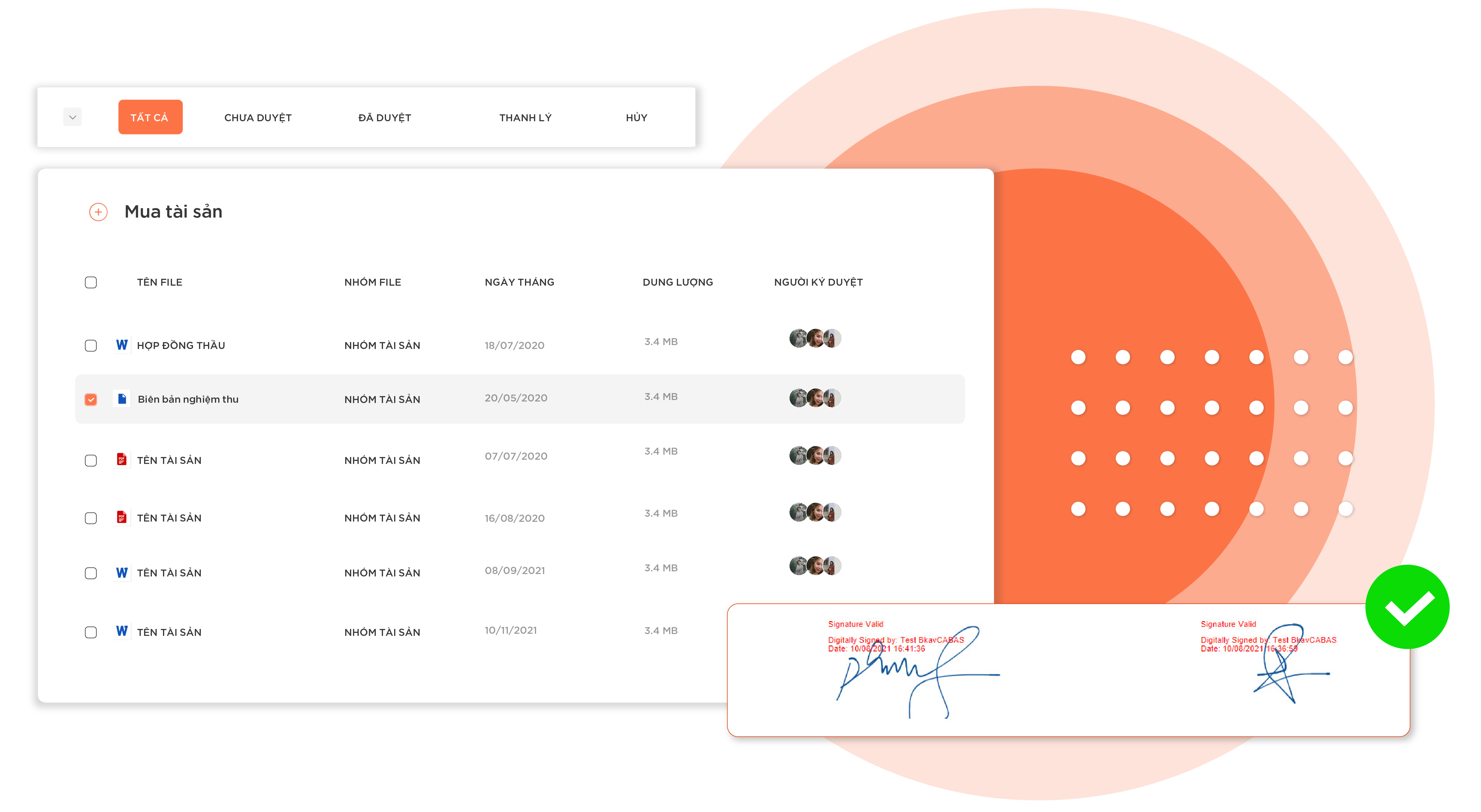
Therefore, the 1CA Digital Signature by 1Office is considered a significant advancement compared to current standalone digital signature applications, thanks to the following outstanding advantages:
- Digitally sign all types of contracts, notices, internal decisions, documents, etc.
- Integrate digital signing into the entire business operation process
- Integrate signing for electronic contracts and labor contracts
- Centralized storage of documents and records on the software
- Supports signing multiple documents at once
- Sign anytime, anywhere, on any device
- Secure and legally compliant
With the digital signing feature integrated into every process, the 1CA digital signature will help businesses thoroughly resolve the limitations of traditional paper-based signing, supporting businesses in “building a paperless office”, ensuring speed, flexibility, and continuity in all administrative, financial, sales, and HR activities.
Contact us to register for a digital signature now!
We hope this article has provided all the necessary information about e-contracts for businesses looking to switch from traditional paper-based signing to digital signing.