


 11/05/2026
  852 views
During the process of buying, selling, transporting, or handing over goods, confirming the full quantity, condition, and time of delivery is a crucial step to limit future disputes. A goods delivery and acceptance record helps all parties have a basis for comparison in case of discrepancies, damage, or shortages. The article below will provide the latest goods delivery and acceptance record template, along with instructions on how to create one and important notes to consider before use.
Mục lục
- 1. What is a goods delivery and acceptance record?
- 2. What is the role of a goods handover record?
- 3. Content and how to write a goods delivery and acceptance record
- 4. Common Goods Delivery and Receipt Record Templates Today
- 4.1. General Goods Handover Record Template 2025
- 4.2. Goods Delivery and Receipt Record cum Warehouse Issue Slip Template
- 4.3. Goods Delivery, Receipt, and Acceptance Record Template
- 4.4. Internal Goods Delivery and Receipt Record Template
- 4.5. 3-Party Goods Delivery and Receipt Record Template
- 4.6 Excel Goods Inventory Record Template
- 4.7 Bilingual Goods Delivery and Receipt Record Word Template
- 4.8 Asset Handover Record Word Template
- 4.9 Materials Handover Record Word Template
- 4.10 Goods Acceptance Record Word Template
- 5. Process for Creating and Signing a Goods Delivery and Receipt Record
- 6. Comparing Goods Delivery and Acceptance Records with Acceptance Test Records
- 7. Common Mistakes When Creating a Goods Delivery Note
- 8. Frequently Asked Questions (FAQs) about Goods Delivery Notes
- 9. Conclusion
1. What is a goods delivery and acceptance record?
A goods delivery and acceptance record is a document that accurately confirms the actual delivery and receipt of goods. In this process, the seller confirms they have completed the delivery to the buyer, and the buyer confirms they have received the goods in full as previously agreed upon by both parties.

1.1 Characteristics of a goods delivery and acceptance record
The key characteristics of the record for both the buyer and the seller are as follows:
- Created immediately after delivery: The record should be created immediately after the delivery process is complete, without waiting for the invoice to be issued or the contract to end.
- Signed upon full receipt of goods: When the buyer inspects and confirms that they have received the full quantity of goods as agreed, they will sign the record to confirm.
- Detailed information: The delivery and acceptance record must contain complete information for both the buyer and the seller, such as company name, address, phone number, email, and representative. Additionally, it must include information related to the goods, such as item code, type, quantity, and the delivery date.
- Accompanied by a delivery/receiving note: The record is often accompanied by a delivery note (from the seller’s side) or a receiving note (from the buyer’s side), depending on each party’s procedures.
> See more: Latest Asset Inventory Record Template 2025 | Free Download
1.2 Regulations on delivery and receipt of goods in a sales contract
According to Article 34 of the 2005 Commercial Law regarding the delivery of goods and related documents:
“Article 34. Delivery of goods and related documents
1. The seller must deliver the goods and documents as agreed in the contract regarding quantity, quality, packaging, preservation, and other provisions in the contract.
2. In the absence of a specific agreement, the seller is obliged to deliver the goods and related documents in accordance with the provisions of this Law.”
Pursuant to Article 56 of the 2005 Commercial Law, the receipt of goods in a sales contract is regulated as follows:
“Article 56. Receipt of goods: The buyer is obliged to receive the goods as agreed and to perform reasonable actions to assist the seller in delivering the goods.”
2. What is the role of a goods handover record?
A goods handover record acts as irrefutable legal evidence to protect the business from financial risks. Instead of relying on trust, this document helps to:
- Ensure information transparency: Accurately records the representatives of the parties along with details of the quantity and quality of goods, eliminating any ambiguity in the delivery and acceptance process.
- Establish solid proof: Serves as evidence confirming that the goods were delivered on time and of the correct type as per the contract; protects the seller from baseless claims of shortages or damage after the handover.
- Provide a supreme legal basis: Acts as the most crucial piece of evidence for authorities to determine right and wrong and to resolve disputes fairly and transparently if conflicts arise.
- Enhance brand reputation: Demonstrates a methodical and professional operational process, helping customers feel secure and remember the seller as a reliable entity.
3. Content and how to write a goods delivery and acceptance record
3.1 Required content
Currently, there are no specific legal regulations on creating a goods delivery and acceptance record. However, to limit potential disputes, the content should include the following elements:
- Name of the selling unit or business
- Date of goods delivery and acceptance
- Delivering party: Full company name, address, phone number, representative, position
- Receiving party: Full company name, address, phone number, representative, position
- Information related to the goods (item code, type, quantity, unit price, etc.)
- Signatures and seals of confirmation from all parties
3.2 Presentation Format
Businesses can prepare the document following these guidelines:
- On the left is the company name, on the right will be the national emblem and motto.
- Below the company name and the national emblem and motto is the title: “GOODS DELIVERY AND RECEIPT RECORD” centered
- Based on the goods purchase contract, based on the agreement
- Date (Day/Month/Year) of record creation
- Personal information of the deliverer and receiver
- Information about the goods being delivered and received
- Confirmation signature, name, and possibly a company seal
The delivery and receipt record should be made in at least two copies, with each party keeping one as proof in case of disputes. This helps ensure transparency and fairness in the delivery process and provides legal evidence when necessary.
4. Common Goods Delivery and Receipt Record Templates Today
4.1. General Goods Handover Record Template 2025
Currently, there is no fixed, regulated template for delivery and receipt records. However, for the convenience of sales, production, and business activities, you can create a general template that suits the specific delivery method and parties involved. This helps accommodate various situations.
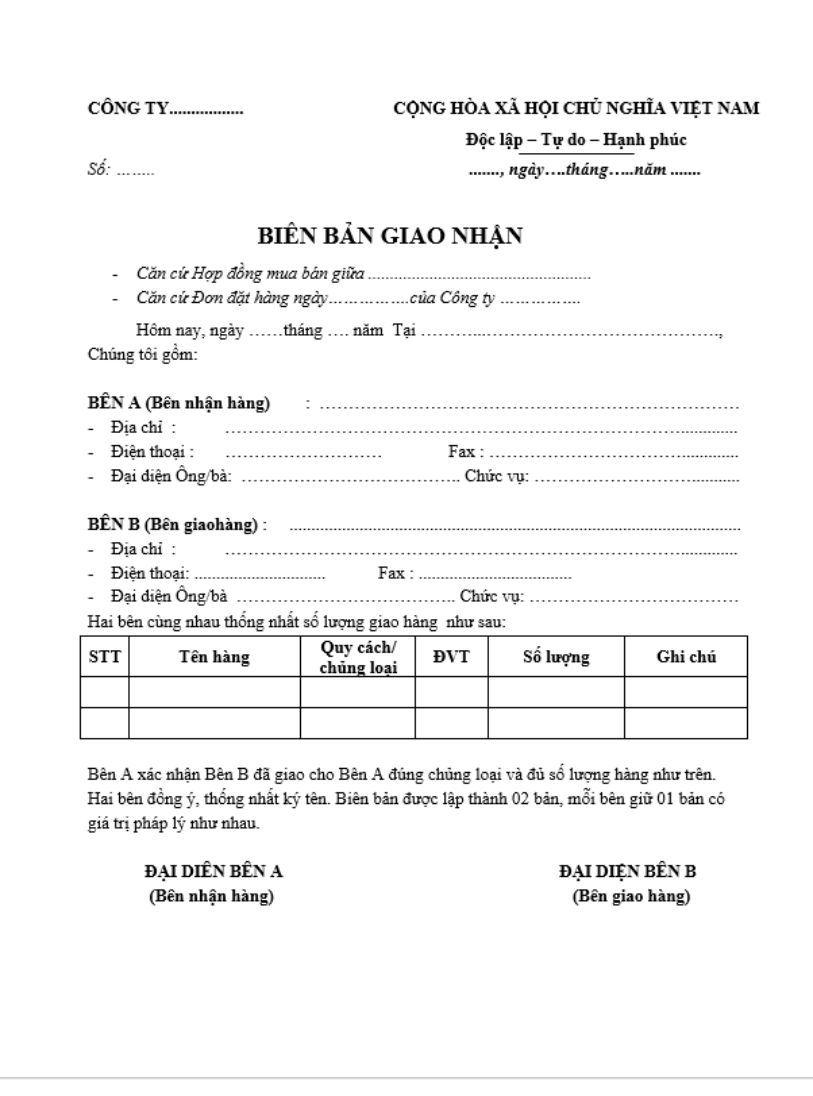
>> Download the goods delivery and receipt record template (Word file) now
4.2. Goods Delivery and Receipt Record cum Warehouse Issue Slip Template
A goods delivery and receipt record combined with a warehouse issue slip is an important document in the process of goods delivery and management. This document typically contains detailed information about the warehouse dispatch process, including items such as the quantity of goods, quality, information about the delivering and receiving units, and any other information related to the transaction.
Combining this delivery record and the warehouse issue slip helps optimize the goods management process while creating concrete and complete evidence for all parties involved.
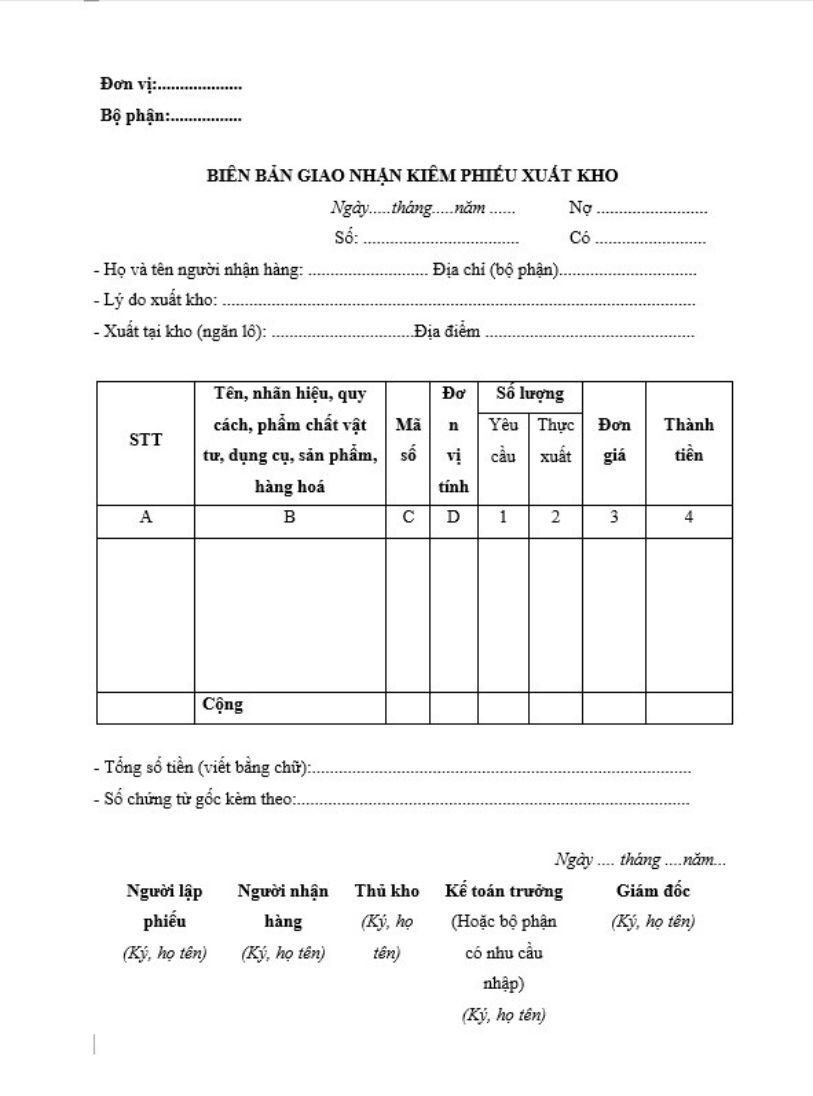
>> Download the goods delivery and receipt record cum warehouse issue slip template now
4.3. Goods Delivery, Receipt, and Acceptance Record Template
In this record, information is recorded in detail, including quantity, quality, and other relevant information. Additionally, this record is often accompanied by the process of inspecting and accepting the quality of the goods.
With a goods delivery, receipt, and acceptance record, both the deliverer and the receiver have evidence of the delivery process and the product’s quality. This helps minimize the risk of disputes and creates transparency in the transaction process.
>> Download the goods delivery, receipt, and acceptance record template (Word file) now
4.4. Internal Goods Delivery and Receipt Record Template
An internal delivery and receipt record typically documents the process of company leadership transferring goods or products to a specific department or between different departments within the same unit. The purpose of this goods handover record is to confirm that the delivery has been carried out as directed by higher management.
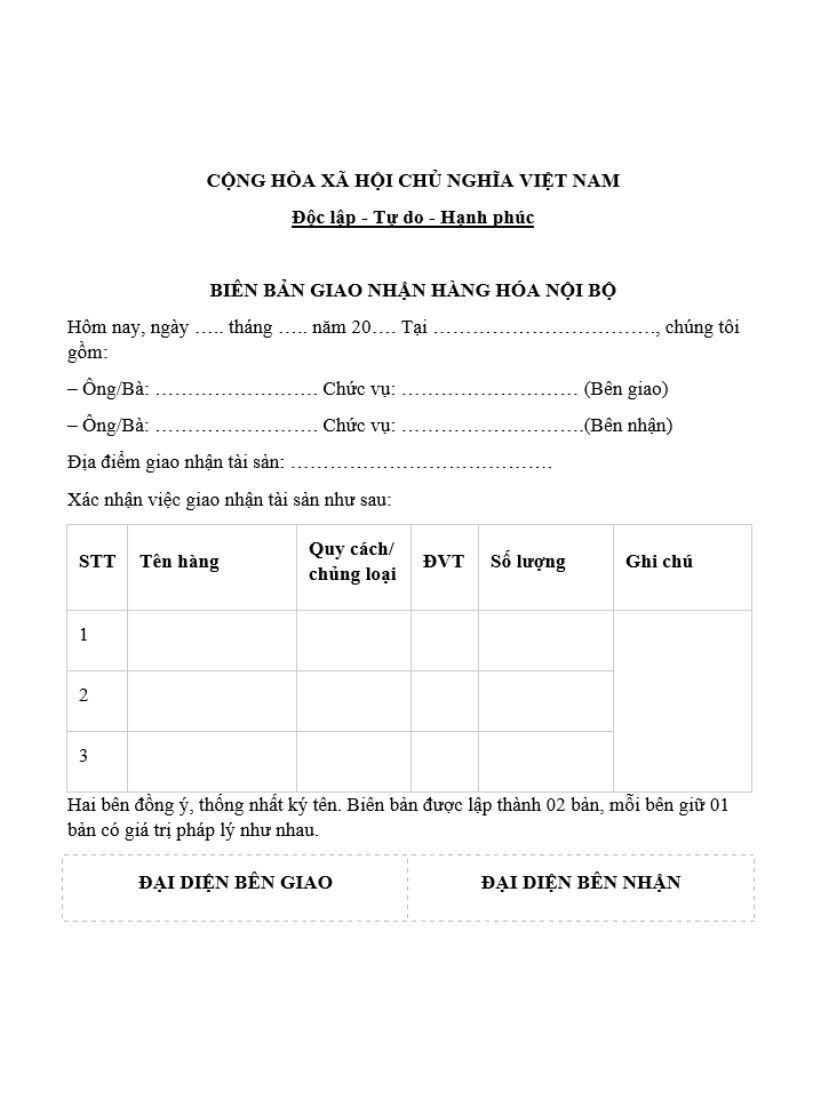
>> Download the internal goods delivery and receipt record template now
4.5. 3-Party Goods Delivery and Receipt Record Template
A 3-party delivery and receipt record is typically created to document the process of transferring goods, products, or materials among three parties. The main content of this record includes information about the parties involved in the handover, the type of goods being transferred, and the time and location of the handover process. This helps ensure transparency and accuracy in the transaction between the three partners.
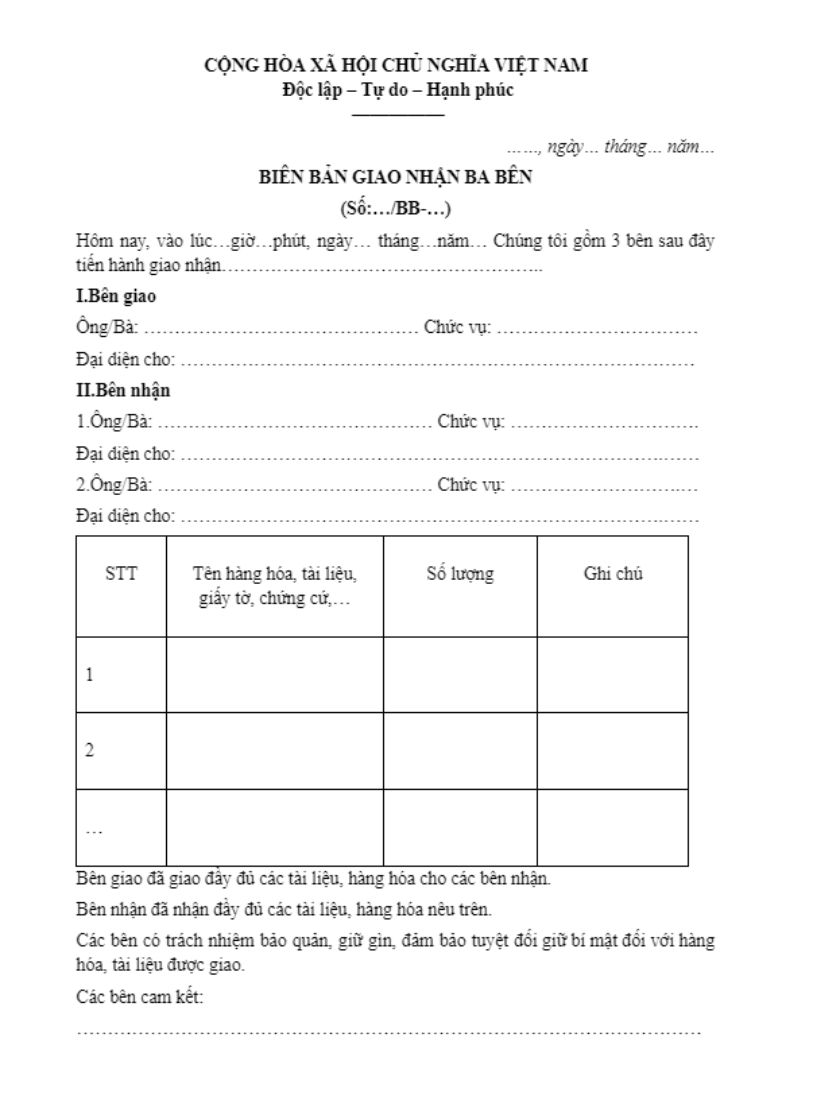
>> Download the 3-party goods delivery and receipt record template now
4.6 Excel Goods Inventory Record Template
An Excel goods inventory record is a tool used to list all types of goods and materials available in the warehouse at a specific time. This record helps businesses gather complete and accurate information about their goods, supporting management, preservation, and decisions on new purchases or handling existing stock.
Download the Excel goods delivery and receipt record template HERE
4.7 Bilingual Goods Delivery and Receipt Record Word Template
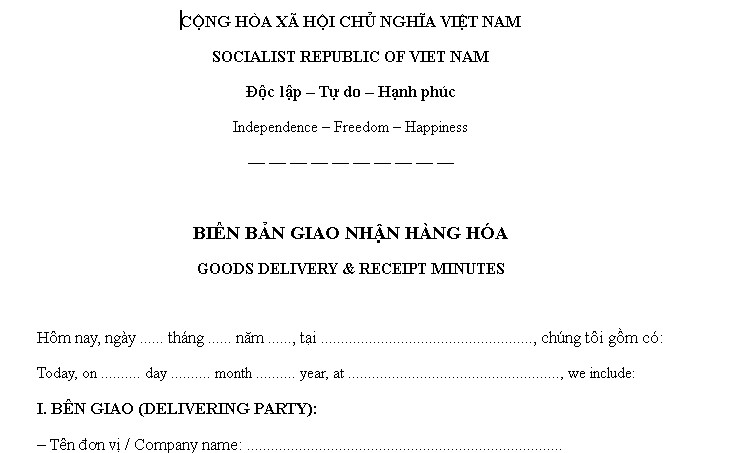
The bilingual (Vietnamese – English) goods delivery and receipt record is a professional document for international transactions, import-export businesses, or FDI companies in Vietnam, ensuring legal validity and clarity for both parties. With a parallel two-language structure, the record clearly documents the quantity, quality, packaging condition, and confirmation signatures, helping to avoid misunderstandings due to language barriers and comply with international trade regulations. This is an essential tool for logistics, e-commerce, or export contracts, bringing transparency and professionalism to all cross-border transactions.
4.8 Asset Handover Record Word Template
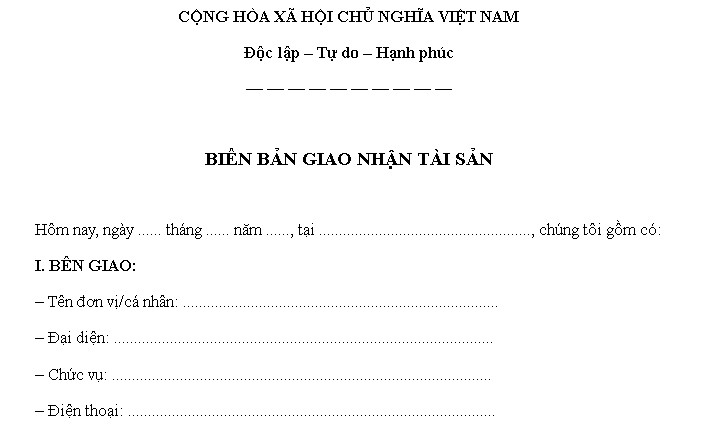
An asset handover record is a legal document that records the transfer of usage or management rights for fixed or movable assets (such as office equipment, machinery, vehicles) between individuals, departments, or organizations, aiming to ensure transparency and accountability in accordance with the Law on Management and Use of Public Property or internal company regulations. With detailed content on the asset list, condition, value, and maintenance commitments, this record helps prevent loss, disputes, and serves as an important basis for periodic inventories. This is a necessary template for businesses, state agencies, or individuals when handing over assets, contributing to effective financial management and legal compliance.
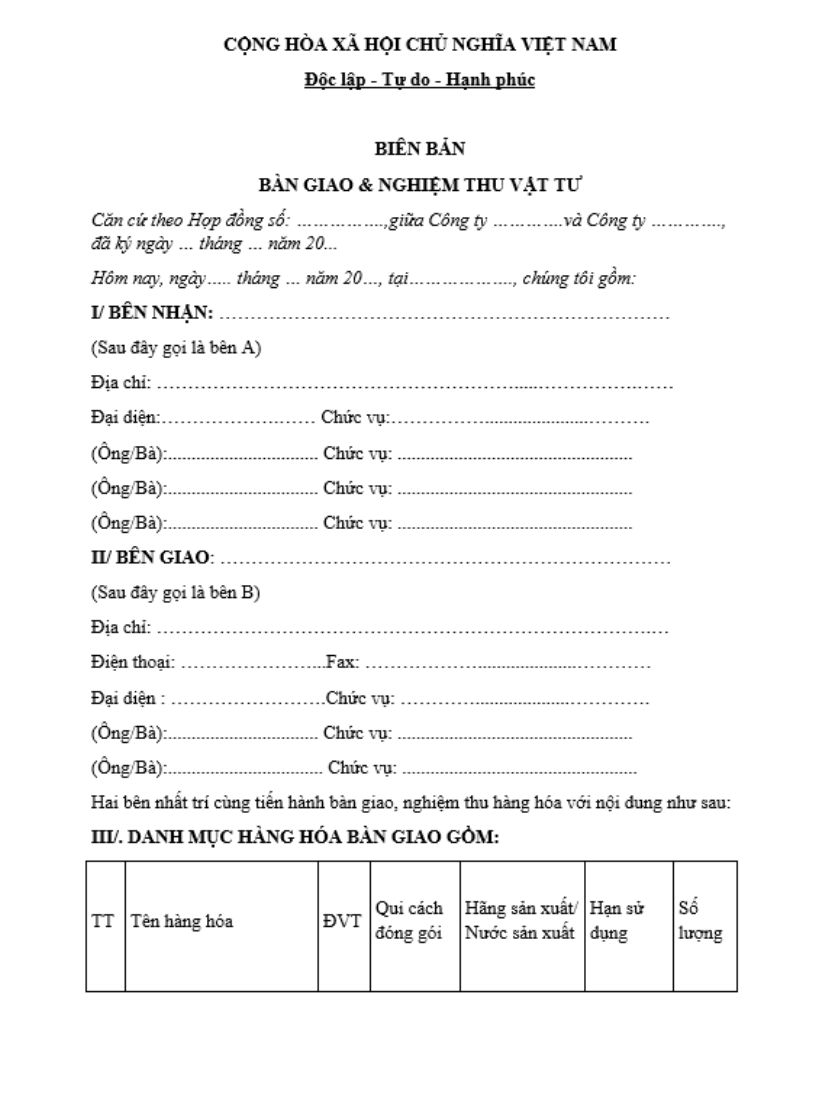
4.9 Materials Handover Record Word Template
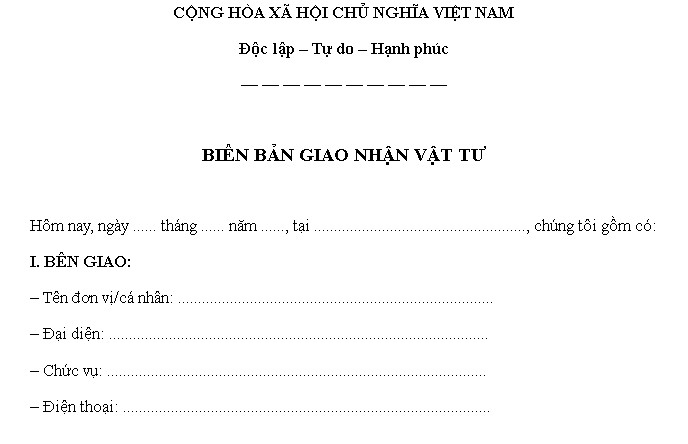
A materials handover record is a crucial legal document in supply chain management, helping to clearly record the transfer of raw materials, equipment, or goods between parties to avoid disputes over quantity, quality, and condition. With a standard structure including information of the delivering/receiving parties, a list of materials, confirmation signatures, and liability clauses, this template ensures transparency and compliance with accounting regulations and Vietnamese law. This is an indispensable tool for manufacturing, construction, or logistics businesses, helping to track inventory effectively and protect the rights of all parties in every transaction.
4.10 Goods Acceptance Record Word Template
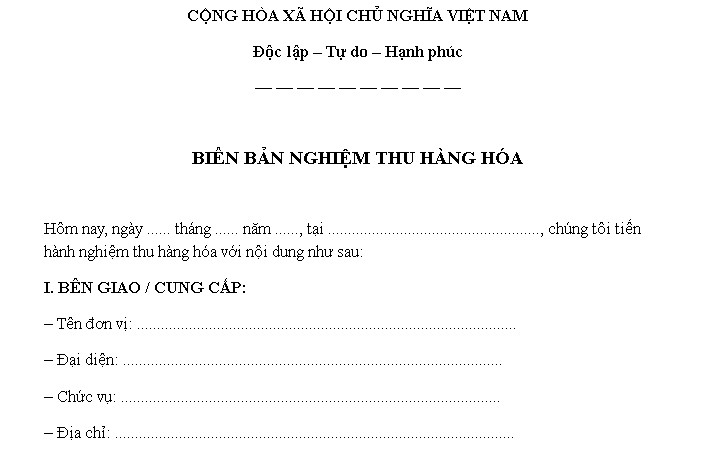
A goods acceptance record is an official document confirming the inspection and evaluation of the quality, quantity, and condition of goods after delivery, in accordance with the provisions of the Commercial Law and Decree 99/2013/ND-CP. This template typically includes contract information, inspection results (pass/fail), opinions from both parties, and confirmation signatures – helping to resolve disputes quickly and serving as a basis for payment or claims. This is an essential document for import, export, or supply chain businesses, ensuring that goods meet standards before being put into use or storage.
5. Process for Creating and Signing a Goods Delivery and Receipt Record
A goods delivery and receipt record is only truly valid when created according to the correct procedure. In reality, many businesses often skip the preparation stage or sign hastily, resulting in a record that lacks legal validity and cannot be used when disputes arise. Therefore, standardizing the process of creating and signing the record not only helps businesses save time but also protects the rights of both the delivering and receiving parties.
The steps in the process of creating and signing a goods delivery and acceptance record typically include:
- Prepare relevant information and documents: contracts, warehouse issue slips, invoices, and inventory lists, if any.
- Draft the record using a standard template: clearly state the time, location, item name, quantity, condition of the goods, and information of all parties.
- Cross-reference and check information: both parties review the quantity, quality, and type of goods to avoid errors.
- Sign and stamp: the signature of an authorized person and the legal entity’s seal are mandatory for the record to be valid.
- Store and manage the record: it should be scanned or digitally signed for electronic storage, allowing for easy retrieval when needed and reducing the risk of loss.
6. Comparing Goods Delivery and Acceptance Records with Acceptance Test Records
In business operations, many people often confuse goods delivery and acceptance records with acceptance test records because both are confirmation documents. However, in terms of their nature and purpose, they serve entirely different situations. Correctly understanding this difference helps businesses use the right type of document, avoid legal risks, and ensure transparency when working with partners.
A goods delivery and acceptance record primarily confirms that the goods have been handed over and received, matching the quantity, type, and condition as agreed in the contract. It focuses on the procedural aspect to ensure the delivery and receipt process is transparent.
An acceptance test record, on the other hand, is more “quality-focused” and is typically used to confirm that a job, service, or project has been completed and meets the requirements. This is the step that affirms the “product has met the standard” before it is put into use or payment is made.
| Criteria | Goods Delivery and Acceptance Record | Acceptance Test Record |
| Purpose | To confirm the handover and receipt of goods | To confirm the quality and completion level of work, services, or projects |
| When to use | When delivering and receiving goods according to the contract | After completing a project, service, or product |
| Key Content | Information of the delivering and receiving parties, item name, quantity, condition | Technical standards, quality, acceptance test results, evaluation |
| Legal Validity | Serves as proof of delivery and receipt as per the agreement | Serves as the basis for acceptance, payment, and commissioning |
| Typical Example | Handing over 500 products from a supplier to a customer | An investor conducts an acceptance test on a construction project before handover and commissioning |
7. Common Mistakes When Creating a Goods Delivery Note
During the goods delivery process, many businesses underestimate the importance of creating a delivery note, viewing it as a mere administrative procedure. This negligence often leads to frequent errors, causing the goods delivery note to lose its legal validity and exposing the business to the risk of disputes. Here are the common mistakes made when creating a goods delivery note:
- Inaccurate Core Information: Discrepancies in date, quantity, type, or unit price compared to the contract and the actual delivery.
- Lack of Legal Confirmation: The note lacks the signature of an authorized person or the company’s official seal.
- Vague Description of Goods’ Condition: Failing to clearly state the actual condition (new, scratched, damaged, missing accessories, etc.) at the time of handover.
- Missing References to Related Documents: Not including the contract number, invoice, or warehouse receipt number for cross-referencing.
- Manual Erasures and Corrections: The note has erasure marks or manually corrected data without a signature confirming the changes.
- Fragmented Paper-Based Storage: Only keeping hard copies, which are easily lost, damaged, and difficult to retrieve quickly.
8. Frequently Asked Questions (FAQs) about Goods Delivery Notes
Is it mandatory for a goods delivery note to be stamped?
According to regulations, the note must be signed by authorized representatives from both parties. For organizations and businesses, affixing the official company seal is necessary to establish the highest legal validity, making the note solid evidence in case of disputes, tax inspections, or audits.
Can a goods delivery note be used in place of a financial invoice?
No. A delivery note only confirms the physical transfer of goods in terms of quantity and condition. A financial invoice is an accounting document used to record revenue and tax obligations. However, the information on both documents must match to ensure valid accounting records.
What should be done if goods are found to be damaged after the delivery note has been signed?
Signing the delivery note implies that you have accepted the condition of the goods at the time of handover. If damage is discovered later, filing a complaint will be very difficult unless you can prove it was a latent defect from the manufacturer. Therefore, the on-site cross-checking process before signing is the most crucial step to protect your interests.
How long is a goods delivery note valid?
The legal validity of the note is often tied to the contract’s effective period and the statute of limitations for commercial disputes (typically 2 years under the Commercial Law). Therefore, businesses should store these notes for at least 5 to 10 years, in accordance with accounting document retention regulations.
How can thousands of delivery notes be managed without getting lost?
Instead of traditional paper storage, businesses should use management software like 1Office. The system helps digitize the signing process with digital signatures, automatically stores documents on a cloud platform, and allows for instant look-up by order code or customer name, completely eliminating the risk of loss.
-
Process Automation (1WORK): Digitizes the entire workflow from creating notes and tracking progress to assigning tasks between departments, ensuring every handover step is smooth and transparent.
-
Delivery Personnel Management (1HRM): Closely monitors the shipping and logistics teams, facilitating seamless coordination and accurately evaluating individual performance.
-
Optimize Productivity & Quality: Minimizes manual errors, accelerates the speed of goods delivery, thereby improving warehouse management efficiency and customer satisfaction.
Digitize your delivery process today to eliminate risks and optimize operations!
Register for a free feature demo!
9. Conclusion
A goods delivery note is a legal shield that helps businesses select reputable partners and ensure transparency in all transactions. To make the handover process sharp and secure, managers need not only a standard template but also technological support.
Switching from paper storage to the platform 1Office helps automate document creation, enables quick digital signing, and ensures absolute data security. With 1Office, businesses not only master the delivery process but also confidently build a professional image, boosting customer trust in the digital age.
















