11/05/2026
  711 views
When evaluating business performance, high revenue doesn’t necessarily reflect that the business is operating well if costs also increase correspondingly. Net profit helps businesses clearly see the remaining profit after deducting all costs related to business operations. This article will help you understand what net profit is, its calculation formula, the significance of this metric, and how to distinguish it from other common types of profit.
Mục lục
What is Net Profit?
Net profit (also known as net income) is the profit a business earns after subtracting all costs related to its operations, including: cost of goods sold, financial expenses, selling expenses, business management expenses, and taxes.
This is a crucial financial metric because it reflects the results of both major activities within a business: the production and sale of goods and services, and financial investment activities. It plays a major role in determining the net income (the final retained earnings) that the business achieves.
Net profit is also known by other terms such as net earnings and profit from production and business activities.

The Role of Net Profit
Net profit plays a crucial role in providing information about a company’s business situation, determining whether the business is profitable or operating at a loss. It is an important metric that helps business owners identify and address issues, and it serves as a basis for building long-term business strategies.
This metric also helps shareholders and investors objectively evaluate the company’s performance and make appropriate decisions. If a company fails to achieve sufficient net profit, its stock value may decline, negatively impacting shareholders. For investors, information from this metric helps predict the company’s ability to generate value and determine the necessary investment level for its stocks or capital contributions.
How Do Net Profit and Gross Profit Differ?
Net profit and gross profit are two concepts that are quite easy to confuse. Many business owners miscalculate these metrics due to this confusion, leading to difficulties in adjusting strategies or making decisions. You can distinguish between these two types of metrics by the following characteristics:
| Net profit | Gross profit | |
| Definition | Net profit is the amount remaining after deducting all business-related expenses from revenue, including production, management, sales, and other costs. | Gross profit is the difference between revenue and the cost of production. It represents the profit a business makes from producing and selling its products or providing its services. |
| Scope of costs | Calculates all types of business expenses. | Only calculates costs directly related to the specific product or service. |
| Overall scope | Measures and evaluates the business performance of the enterprise over a specific reporting period. | Only calculates the profit related to each individual product or service. |
| Importance | Is a key indicator for evaluating the business performance of an enterprise. | Is a key indicator for evaluating the efficiency of the production and sales process for each of the company’s products or services. |
Comparison table of net profit and gross profit
Comparison between net profit and other financial indicators
In financial analysis, net profit is often used as a key metric to evaluate business performance after deducting all expenses, including operating costs, financial expenses, and taxes. However, for a more comprehensive view, managers need to compare net profit with other indicators to fully understand the operational efficiency of the business.
1. Net Profit vs. EBIT (Earnings Before Interest and Taxes)
EBIT, or earnings before interest and taxes, reflects the profitability of core business operations without being affected by capital structure (interest expenses) and tax policies.
-
When should EBIT be used? → EBIT is particularly useful when comparing companies in the same industry with different debt levels. For example, a highly leveraged company may have low net profit due to the burden of interest payments, but a high EBIT, indicating that its core business operations are truly efficient.
-
Key difference: Net profit has already accounted for financial and tax risks, while EBIT measures the ability to generate profit from primary operations.
2. Net Profit vs. EVA (Economic Value Added)
EVA is understood as “economic value added,” calculated by subtracting the cost of capital (including both debt and equity) from the after-tax profit.
-
EVA emphasizes whether a business truly creates value above the cost of capital invested by its investors.
-
For example: A company has a net profit of 200 billion, but if the cost of capital (WACC) for the capital employed is 220 billion, the EVA will be negative, meaning the business is “eroding” investor capital.
-
Therefore, while net profit only measures accounting results, EVA reveals the true extent of value creation for the business in the eyes of investors.
3. Net Profit After Tax vs. Earnings Before Tax (EBT)
The difference between pre-tax profit and net profit (after-tax) helps managers assess the impact of tax policies on business performance.
-
If the effective tax rate is significantly higher than the industry standard, the business needs to review its investment structure, tax incentives, or profit allocation strategy.
-
Conversely, if the difference is small, it indicates that the business is making good use of tax incentives or operates in a sector with supportive policies.
-
In other words, EBT reflects business results before obligations to the state, while Net Profit is the “final amount” the company actually gets to keep.
| Metric | Formula | Meaning | When to use | Difference from Net Profit |
|---|---|---|---|---|
| EBIT (Earnings Before Interest & Taxes) | Revenue – Operating Expenses | Measures profitability from core operations, excluding financial costs & taxes | To compare business performance between companies with different capital structures | EBIT is usually higher than net profit because it does not deduct interest & taxes |
| EBT (Earnings Before Tax) | EBIT – Interest Expense | Reflects business results before tax obligations | To assess the impact of taxes on profit | Net Profit = EBT – Corporate Income Tax |
| Net Profit | EBT – Corporate Income Tax | The final amount a company retains after all expenses | To evaluate overall performance, serves as a basis for dividends and reinvestment | The final “bottom line” metric, including both interest & taxes |
| EVA (Economic Value Added) | After-tax profit – Cost of Capital (WACC × Invested Capital) | Measures the economic value a company creates for its investors | When analyzing capital efficiency & making investment decisions | EVA can be negative even when net profit is positive, if profit is < cost of capital |
Comparison table of net profit and other financial ratios
How is net profit calculated?
To calculate net profit, you need to understand your business’s key financial indicators such as net revenue, expenses, cost of goods sold, etc. Then, you can apply the calculation formula below:
The complete formula for calculating net profit:
Net Profit = Net Revenue – Cost of Goods Sold + Financial Income – Financial Expenses – Selling Expenses – General & Administrative Expenses
The formula above can be simplified as follows:
Net Profit = Gross Profit + Net Revenue – Total Expenses
Where:
- Net Revenue: The total revenue generated from sales and service provision, after deducting revenue reductions such as sales discounts, returned goods, and trade discounts.
- Cost of Goods Sold (COGS): The total cost incurred to produce a product, including direct material costs, direct labor costs, and manufacturing overhead.
- Financial Income: Revenue generated from financial activities, including interest on loans, financial lease interest, as well as income from royalties, dividends, or shared profits during business operations.
- Financial Expenses: The total costs a business incurs for financial activities, including costs related to borrowing capital and other financial transactions.
How is the net profit margin calculated?

2. How to optimize net profit for retail and F&B chains
The retail and F&B model has thin profit margins and is directly affected by the cost of goods sold (COGS) and management-marketing expenses. Therefore, to increase net profit, businesses need to focus on both sides: reducing costs and increasing revenue per customer.
-
Control Cost of Goods Sold (COGS): Establish a centralized procurement process and periodically evaluate supplier performance. For example, a restaurant can contract directly with a farm instead of going through an intermediary to reduce raw material costs by 10–15%.
-
Optimize SG&A (Selling, General & Administrative expenses): Set specific KPIs for each store regarding electricity costs, personnel, and promotions. Large chains often use BI (Business Intelligence) to analyze costs at each point of sale and issue alerts when limits are exceeded.
-
Simplify the menu: Reduce the number of low-selling or low-margin items. Starbucks once cut over 30% of its less popular products to increase supply chain efficiency.
-
Increase revenue per customer (Basket Size): Apply upselling/cross-selling, for example: “buy a value combo” or “add a topping for only +10k.”
For example: A Vietnamese milk tea brand increased its net profit by 18% after streamlining its menu from 50 items to 25, focusing on best-selling products and reducing material waste.

3. How to optimize net profit for service & technology businesses
Service companies, especially in technology, have higher profit margins, but the challenges lie in personnel costs, maintaining SLAs, and the churn rate (customers leaving the service).
-
Increase ancillary revenue (Upsell & Add-on): In addition to the main product, offer value-added services such as maintenance packages, 24/7 support, training, or plugins/add-ons in SaaS.
-
Improve SLA & customer experience: The higher the SLA (Service Level Agreement) → the more loyal the customers → the lower the churn. For example, if a SaaS business maintains an uptime of > 99.9%, the customer churn rate can be reduced by 20–30%.
-
Automate operational processes: Apply RPA (Robotic Process Automation), AI chatbots, or automated workflows to reduce reliance on personnel. An IT company can save 25% on support costs just by implementing a customer support chatbot.
-
Manage personnel performance: In the service industry, personnel costs account for a large proportion. Building a timekeeping and project management system (Jira, 1Office, Asana) helps increase productivity without needing to hire more staff.
For example: A Vietnamese SaaS company increased its net profit by an additional 15% by implementing a system to sell add-on packages (security, AI reports), instead of just selling the basic software package.

4. How to optimize net profit for the Real Estate industry
Real estate offers high profits but has long cycles and high capital requirements, so the challenge of optimizing net profit primarily lies in optimizing capital costs and generating steady cash flow.
-
Optimize capital costs: Negotiate loan interest rates and use multiple capital mobilization channels (bonds, investment funds, joint ventures) to reduce dependence on banks.
-
Utilize land funds effectively: If a project is not implemented immediately, it can be temporarily exploited (leasing space, creating parking lots, organizing events). This helps create a “bridging” cash flow before selling the main product.
-
Accelerate sales speed: Apply pre-sale strategies, combined with digital marketing and VR/AR (virtual model home tours) to sell early and recover capital faster.
-
Reduce project management costs: Standardize construction processes, conduct transparent bidding, and select experienced contractors to avoid cost overruns.
Example: A developer of an urban area in Hanoi utilized an undeveloped plot of land by leasing it to a supermarket chain as a temporary warehouse for 2 years, generating an additional 15 billion VND in profit before the main project commenced.

5. How to optimize net profit for the Healthcare & Wellness industry
The healthcare industry is characterized by very high operating and regulatory compliance costs, along with pressure to maintain service quality. Therefore, optimizing net profit must focus on reducing waste and increasing revenue from high-value services.
-
Manage medical costs & equipment: Medical equipment is very expensive, so a regular maintenance process is needed to extend its lifespan. A hospital can save 20% on replacement costs by implementing a CMMS (Computerized Maintenance Management System).
-
Reduce loss of medicine & supplies: Implement pharmacy inventory management software, with automatic expiration date alerts and regular stock-taking to avoid waste.
-
Develop specialized services: Instead of focusing only on basic medical examinations and treatments, develop additional packages like cancer screening, corporate health check-ups, and VIP services. These are high-margin revenue sources.
-
Apply technology: Telemedicine (remote consultations), AI-powered diagnostic imaging, and electronic health records help increase the number of patients served without a corresponding increase in costs.
Example: A private clinic in Ho Chi Minh City increased its net profit by 22% after implementing a “Corporate Periodic Health Check-up” package, which helped secure a stable customer base with contract-based payments.

6. How to optimize net profit for the Tourism & Hospitality industry
This industry is highly dependent on room occupancy, seasonality, and customer experience. To optimize net profit, it’s necessary to manage fixed costs and maximize revenue per customer.
-
Manage Occupancy Rate: Use a Revenue Management system to adjust prices based on season, events, and actual demand. For example: increase room rates during holidays and decrease them during the low season to maintain occupancy.
-
Upsell & Cross-sell: Suggest additional services (spa, airport transfers, short-day tours). A hotel can increase its net profit by 15% by selling ancillary services.
-
Control operating costs: Apply IoT to manage electricity, water, and air conditioning to reduce energy costs, which typically account for 10–15% of a hotel’s total expenses.
-
Optimize human resources: Train multi-skilled employees (e.g., a receptionist who can also act as a concierge) to reduce staffing while maintaining a good customer experience.
-
Utilize OTA & direct channels: Combine Booking, Agoda, and Traveloka with a direct booking website. Bookings through OTAs incur commission fees (15–25%), so it’s essential to optimize the direct channel with a loyalty program.
Example: A resort in Phu Quoc increased its profit by an additional 18% by implementing a membership program (direct bookings are 10% cheaper than on OTAs), reducing commission costs paid to intermediary platforms.

Principles for effective net profit optimization
Net profit not only reflects the final business results but is also a measure of a company’s sustainability. To optimize this figure, businesses need a comprehensive approach, from controlling costs and increasing operational efficiency to better exploiting revenue sources. However, optimizing profit doesn’t mean cutting costs at all costs, but rather applying sound management principles to both maintain product and service quality and ensure long-term growth.
Always Ensure Revenue > Expenses
The fundamental principle for a business to achieve profit is “Revenue must be greater than Expenses,” or Revenue – Expenses > 0. To implement this principle, businesses need to pay attention to several specific principles:
- Manage revenue and expense sources based on estimates and forecasts, using thorough analysis to clearly understand revenue sources and effectively reduce costs.
- Control receivables and payables regularly and strictly, establishing a serious debt handling policy to avoid the risk of insolvency and increased interest costs.
- Maintain strong control over materials, goods, and inventory management, ensuring that inventory does not tie up capital and optimizing the turnover of working capital.
- Create a clear financial plan to control cash flow and have an effective plan for debt collection and payment.
Cash Flow Management
Financial planning plays a crucial role for a business as it involves defining and achieving set financial goals, as well as effectively using resources to reach those goals.
The financial planning process often uses assumptions such as forecasts for revenue, costs, and other factors, as well as past financial statements. This information is used to create projected financial statements for the future, aiming to achieve the specific goals and priorities of the business.
Leverage the Power of Financial Management Tools
This is one of the key factors in maximizing a company’s net profit. These tools help businesses manage finances and plan spending more rigorously.
For example: Using a cash flow management tool like financial management software can help a business track expenses in detail, thereby identifying unnecessary expenditures and saving costs. Furthermore, this tool also supports businesses in building a spending plan that aligns with their current financial situation.
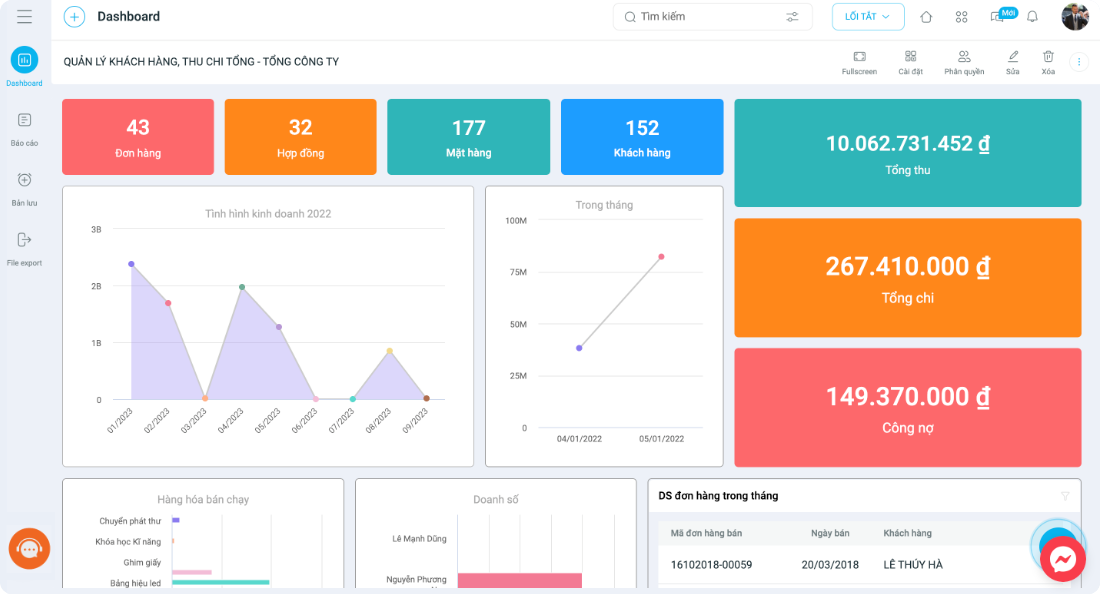
In reality, businesses often seek the support of financial management tools and integrated all-in-one management software, rather than using standalone and fragmented accounting software. The revenue and expense management feature of 1Office can:
- Provide complete metrics on revenue, expenses, and assets on the business performance report, helping businesses easily calculate net profit and make reasonable and effective production and business decisions.
- Provide complete data and reports related to detailed spending for each item and market. This helps CEOs/business owners understand which items and markets are performing effectively, thereby creating a sound business plan.
- Easily monitor the business situation through various devices such as mobile phones and laptops, anytime and anywhere, as long as there is an internet connection.
Register for a free 1Office Demo account