12/05/2026
  507 views
PDCA is one of the continuous improvement models that many businesses apply to standardize processes, reduce waste, and enhance operational efficiency. But what is PDCA, what are its steps, and where should businesses start applying it? This article will help you understand everything from the concept and benefits to practical implementation.
Mục lục
- 1. What is PDCA?
- 2. The Origin of the PDCA Cycle
- 3. What are the 4 main stages of the PDCA model?
- 4. What are the benefits of applying the PDCA model?
- 5. 4 steps to apply the PDCA cycle in a business
- 6. Which phase of the PDCA cycle is the most important?
- 7. Example of the PDCA cycle in a company’s quality management
- 8. 1Office – The Solution to Streamline Processes and Optimize Business Operations
1. What is PDCA?
PDCA is a quality management and improvement method developed by American businessman Walter A. Shewhart in the 1930s and further developed by W. Edwards Deming. The PDCA cycle is designed as a continuous, non-stop loop, consisting of 4 stages: Plan – Do – Check – Act, representing a process of constant improvement in operations, with the spirit of “changing for the better.” Therefore, PDCA is also known as the continuous improvement cycle.
2. The Origin of the PDCA Cycle
PDCA is a popular method that represents the philosophy of Lean Manufacturing – a modern production model aimed at streamlining operational processes, minimizing waste, and enhancing business production efficiency. The PDCA cycle is a crucial tool in quality management, widely applied in various fields such as manufacturing, project management, services, education, healthcare, and more.
3. What are the 4 main stages of the PDCA model?
-

4 stages of the PDCA model
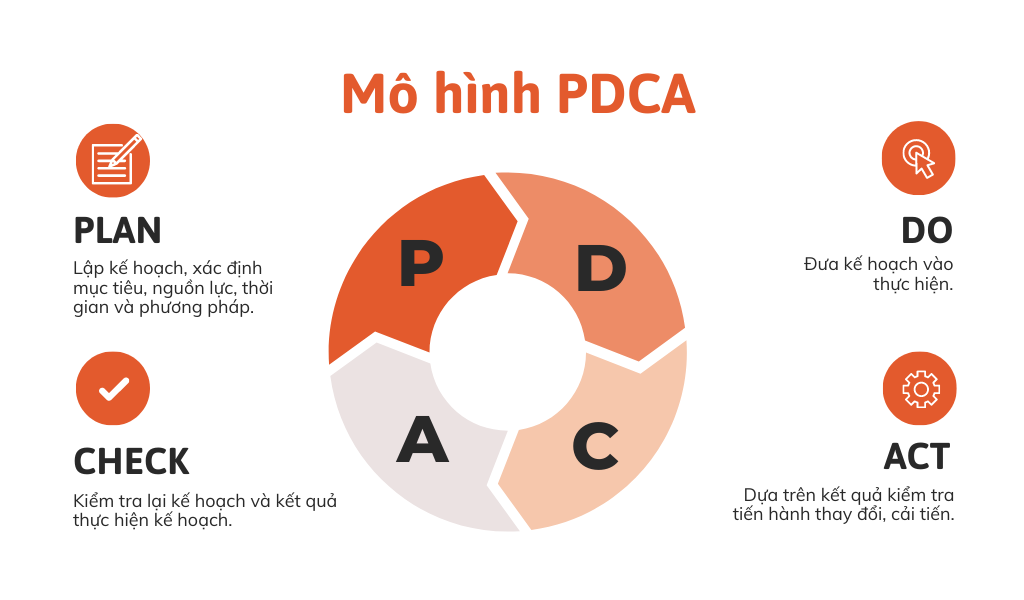
The PDCA continuous improvement cycle includes 4 basic steps, corresponding to the 4 representative letters:
- Plan: Set objectives, identify the activities needed to achieve them, establish an implementation schedule, and define evaluation criteria.
- Do: Implement the plan, collect data and information to evaluate the results.
- Check: Evaluate the results against the objectives, comparing them with standards and the collected data.
- Act: Summarize the results, draw lessons learned, propose improvements, and plan for the next PDCA cycle.
Read more insightful articles on business administration:
4. What are the benefits of applying the PDCA model?
The PDCA model was once considered the secret behind the rapid growth of Japanese businesses. So, what led to this operational leap thanks to the application of PDCA? What are the benefits of implementing the PDCA model? Essentially, the PDCA process focuses on addressing the following 3 aspects:
- Optimize production processes
PDCA helps businesses optimize their production processes by creating specific plans, implementing them, checking the results, and making continuous improvements. As a result, with each cycle, the operational process becomes more complete and streamlined, allowing the business to achieve higher efficiency, reduce production costs, and enhance operational effectiveness.
- Improve product and service quality
PDCA helps businesses improve the quality of their products and services by identifying problems and weaknesses in the production process and devising solutions to overcome them. When product and service quality is enhanced, the business can strengthen its competitive position in the market, attract new customers, and retain existing ones more effectively.
- Minimize waste and save production costs
PDCA helps businesses minimize waste and save production costs by using resources efficiently and streamlining the production system. When waste and production costs are reduced, the business can increase its profitability.
| Read more: What is Kaizen? 6 Steps to Apply the Kaizen Continuous Improvement Method in Your Business |
5. 4 steps to apply the PDCA cycle in a business
Step 1: Plan
This step focuses on defining objectives, planning, and preparing for the improvement process. First, the business needs to define its objectives, including factors such as products or services, market, customers, etc. Then, the business needs to create a detailed plan based on planning principles to achieve those objectives by identifying the necessary activities, resources to be used, time, costs, etc.
The main activities in this stage include:
- Identify the problem to be solved or the objective to be achieved.
- Collect information and data to assess the current situation.
- Analyze the information and data to find the root cause of the problem or the way to achieve the objective.
- Set specific, measurable objectives and a deadline for their completion.
- Plan the improvement activities.
Step 2: Do
In this step, the business will implement the work process according to the plan created in the previous step. This is the practical step to test the plan and check if it works as expected. The business should ensure that all activities are followed in the correct sequence and exactly according to the plan.
The main activities include:
- Carry out the improvement activities planned in step 1.
- Ensure that activities are completed on time and meet quality standards and business efficiency.
Step 3: Check
This step will focus on evaluating the results of the implemented activities. The business needs to collect, analyze, and evaluate the results to see if the PDCA cycle has met the objectives. Business indicators will be compared with the target milestones set in the planning step. If the results do not meet expectations, the business needs to find the cause and propose solutions for improvement.
-
Collect and proceed with result analysis and evaluation

The main activities include:
- Collect data to evaluate the results of the implemented activities.
- Compare the achieved results with the objectives set in step 1.
- Evaluate the effectiveness of the implemented activities and identify any remaining issues.
| Learn more: 6 methods to increase business productivity and how to apply them |
Step 4: Act
In step 4, the business will focus on adjusting and improving activities to achieve better results. After checking the results and making analytical assessments, the business will propose improvement plans to enhance its operations. Improvements can include changing processes, technology, or enhancing the quality of products and services.
Key activities include:
- Developing solutions to address remaining issues.
- Establishing a plan to implement the improvement solutions.
- Implementing the solutions established in the previous step to improve business quality and efficiency.
- Re-evaluating the results after implementing the improvement solutions.
- Repeating the PDCA process to continuously improve and enhance business quality and efficiency.
After completing step 4, the PDCA process will be repeated to continue improving and enhancing business quality and efficiency. Implementing PDCA requires the active participation of all members of the organization. Managers need to ensure that the PDCA process is implemented rigorously and continuously, while also providing suitable and practical solutions to thoroughly resolve the issues raised.
While implementing the quality improvement process, businesses can incorporate certain standards to measure the quality and performance of the improvement process. The Six Sigma method is used to measure the performance or quality results of the improvement process against the initial results and is widely applied by many businesses today.
6. Which phase of the PDCA cycle is the most important?
We all know that in the PDCA cycle, the Plan, Do, Check, and Act phases are the four crucial pillars of the model, and all must be carried out carefully to ensure the process’s success.
However, among these phases, the Plan phase is considered the most important because it lays the foundation for the entire PDCA cycle. In the Plan phase, the business must define specific goals and targets to improve its operations. If the business does not carry out this phase carefully, the entire PDCA process may not achieve the desired results.
-
Plan is the most important phase in the PDCA cycle

During the planning process, the business needs to define what the specific, measurable, and achievable goals of the PDCA process are. This provides direction for the entire cycle, helping the implementation of PDCA focus on the necessary goals, thereby accelerating progress and ensuring the operational system functions effectively.
Additionally, in the Plan phase, the business also needs to assess the root causes of existing problems in its operational processes and propose suitable solutions to address them. Evaluating and identifying the causes of problems is the basis for developing improvement solutions, thereby ensuring the success of the PDCA cycle.
In summary, in the PDCA cycle, the Plan phase is the most important because it establishes the foundation for the entire process. Careful planning and assessment of the root causes of problems are the basis for developing improvement solutions, helping to ensure the success of the PDCA cycle.
Enhance the efficiency of business operations process management 4.0 with 1Office
Get a free consultation & software demo
7. Example of the PDCA cycle in a company’s quality management
The PDCA model is a classic improvement model widely used in many aspects of business operations. For example, the PDCA cycle applied to a company’s customer care process would be implemented as follows:
| Plan | Organize a customer care program and evaluate its effectiveness. The plan includes the following key points:
|
| Do | Implement the customer care program according to the established plan. |
| Check | Evaluate the effectiveness of customer care. This should include key metrics such as the number of customers served, the number of complaints recorded, and customer feedback after the program concludes. |
| Act | Summarize the program. Acknowledge the results achieved, point out any shortcomings to draw lessons learned, and propose corrective measures for improvement in future programs. |
8. 1Office – The Solution to Streamline Processes and Optimize Business Operations
To achieve the highest management efficiency, in addition to understanding what the PDCA cycle is and how to apply it in business, technology and supporting software are indispensable factors. 1Office – The all-in-one business management solution is the key to helping businesses optimize operations and achieve sustainable growth. 1Office provides a superior process management toolkit that helps businesses streamline processes, standardize operations, and enhance internal management efficiency:
- Standardize and create transparency in the task assignment and acceptance process, reducing the time for allocation and review.
- Turn objectives into specific tasks by setting detailed KPIs for each department and individual, and support tracking the KPI implementation process for members.
- Accurately measure work performance with real-time updates. Leaders can use this data to reward employees in a timely manner, motivating them to double their work efficiency.
- Automatically measure efficiency and optimize “hotspots” in the process.
In the article above, 1Office has introduced readers to what the PDCA cycle is, while also providing a technology solution to help streamline operational processes and triple business management optimization. For a consultation and a trial of the market-leading business management software, please contact us using the information below:
- Hotline: 083 483 8888
- 1Office Fanpage: https://www.facebook.com/1officevn
- Youtube Channel: https://www.youtube.com/c/1OfficeNềntảngquảnlýtổngthểDoanhNghiệp
1Office offers you a set of sample processes to optimize business operations
1Office offers you a set of sample processes to standardize business operations, with sample processes for the following departments:
- Sample processes for the HR department
- Sample processes for the administrative department
- Sample processes for the sales department
- Attached forms for each department’s processes
- Bonus documents included