


 13/05/2026
  291 views
Simultaneously receiving countless attractive offers from software developers: Fast implementation, low cost, user-friendly, highly customizable,… does it make you feel confused? The question is: Will the All-In-One comprehensive management model or the Microservice model be the optimal and most suitable choice for businesses?
Mục lục
- The All-In-One Model – The Right, In-depth, and Sustainable Solution for Business Management
- Be a wise CEO—choose the management model that delivers sustainable value to your business!
- 1Office – Vietnam’s Leading All-in-One Business Management Platform
The Microservice Model – A Quick but Shallow Solution for the Business Management Problem
What is the Microservice Model?
Microservice is a form of software architecture, consisting of modules divided into very small services (Microservices). Each service is placed on a separate server to facilitate upgrades and application scaling.
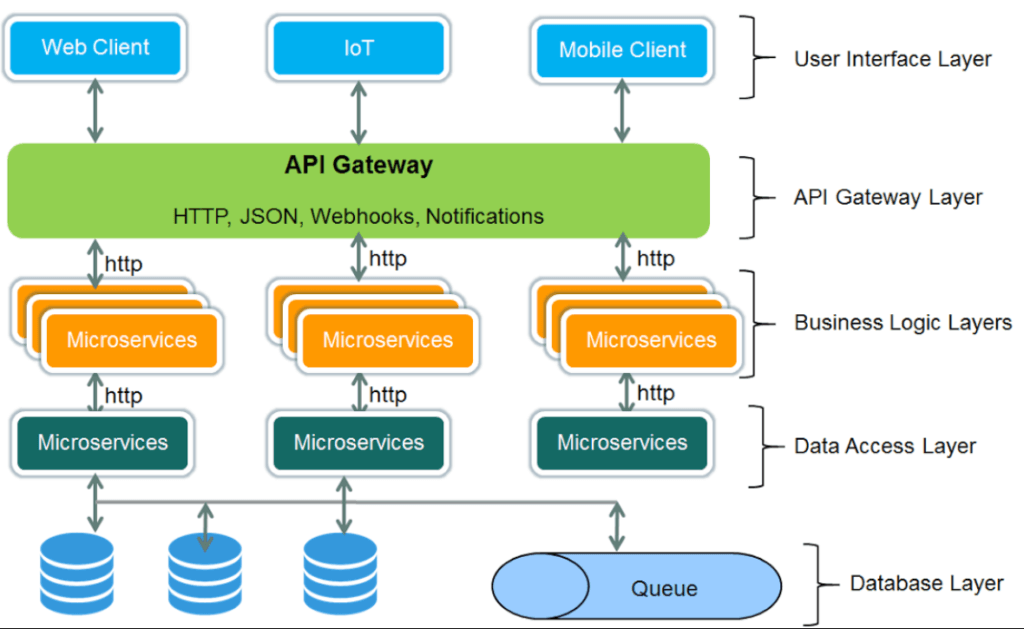
Microservice Software Model
In the business management software market, Microservice is understood as a product development mindset that focuses on building individual software to solve each specific business operation.
For example: Recruitment, timekeeping, and payroll operations have human resource management software; sales, customer care, and inventory management operations… have Sales & Marketing management software. In other words, the Microservice model delves into managing each individual business operation. Each operation that requires software is an application of the Microservice model.
Because it focuses on solving individual problems, the advantages of Microservice are specialization, rapid deployment, and an attractive interface. However, that is just the tip of the iceberg.
The Fatal Flaws of the Microservice Model
1. Inability to Solve the Overall Business Problem
In essence, business management is a comprehensive problem. Each operation is closely linked, using each other’s data to function. For example, calculating salaries requires data on work completion levels, KPIs, sales figures, timekeeping, and leave requests.

Microservice is completely “helpless” against the overall business problem
Therefore, breaking down the overall problem is inherently a lack of data. The consequence is that the management problem appears simple on the surface, but becomes more complex and convoluted the deeper you go. It takes a very long time to completely resolve even the seemingly simplest operations.
The reason is that each software is programmed differently, with different data structure regulations. Therefore, linking data between different software often takes a lot of time.
Let’s take a basic operation as an example. To finalize salaries for the sales team, the accountant still has to manually enter sales data because the accounting software cannot link with the sales software. In other words, the existence of both software in this case is redundant. As a result, businesses using the Microservice model often find themselves in a dilemma – it’s not good to use, but it’s not good to discard either.
2. High Costs
Each software only solves one operation, which means the number of software equals the number of departments in the business. This leads to waste because each software incurs a fixed cost for usage, maintenance, and upgrades. When added up, these costs become a huge number.
Not to mention the opportunity costs that arise when software errors or failures cause disruptions, delays, and even damage to the business.
Read more: Free Work Management Tools – Should You Use Them or Not?
3. Decentralized Data, Difficult to Manage
Since each department uses a different software, and these software cannot be synchronized, the company’s data is scattered across many different platforms and formats. This creates difficulties in consolidating and looking up information, creating reports, and making decisions based on those reports.
Moreover, independently used data also breaks the links between departments, causing difficulties in interaction between departments – a major taboo for any business.
4. The Inconvenience of Working with Multiple Vendors
Another disadvantage that makes using multiple software inconvenient is that you have to work with many vendors at the same time. Each vendor will have a different implementation roadmap, and their product and customer care policies also differ, making it very difficult to manage and track progress.

Working with vendors is a complex, time-consuming process with potential issues
Meanwhile, the minimum time to implement one software is 1-2 weeks, accompanied by a team of technicians as well as a committee to monitor and evaluate the software’s effectiveness. This process is repeated every time the business adopts a new software, which, combined with the vendor’s policies, can easily make implementation chaotic and difficult to accurately assess its effectiveness.
| Conclusion: Microservice is merely a correct and fast answer, but it is by no means a solution with enough “depth” and “endurance” to comprehensively solve a business’s management challenges in the long term. |
The All-In-One Model – The Right, In-depth, and Sustainable Solution for Business Management
What is the All-In-One management model?
Unlike Microservices, the All-In-One model handles all business operations in a single software. All activities, from Sales & Marketing and HR & administration to internal management, are digitized and centrally managed on one platform.
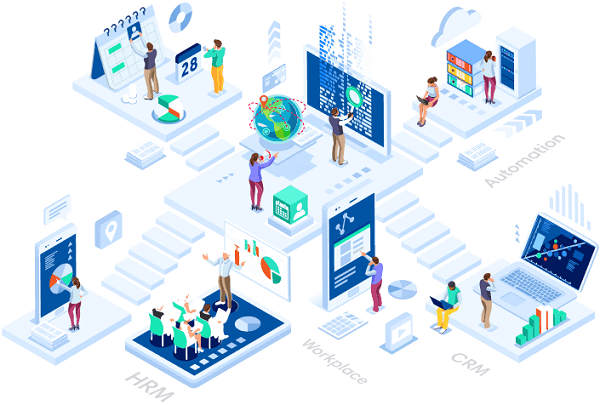
All-In-One software model
In other words, the All-In-One model is a 1-to-1 mapping of the business onto the software. There, each employee is provided with the tools and resources to complete their tasks just as they would in the real world.
How does the All-In-One model overcome the disadvantages of Microservices?
1. Provides a complete solution to the overall business challenge
As discussed, business management is inherently a holistic challenge. Naturally, the solution must also be holistic. While Microservices fail to do this, All-In-One successfully conquers the challenge by digitizing and centrally managing all business data on the software.
With this approach, the business is simulated on the software with a complete structure of departments, personnel information, and operations: Accounting, sales, marketing, internal communications, etc. Most importantly, this data is all tightly interconnected, using each other’s data for calculations. Therefore, almost all operations are automated.
Take a basic operation in any business as an example – Timekeeping and payroll:
| Without using software | Using an All-In-One software model |
| HR must connect the time clock to a laptop to export attendance data. | Automatically syncs data from the time clock to the software. |
| Compiles paper-based requests.
Manually enters request data into timesheets, calculates attendance results using Excel formulas. |
Digitizes requests, eliminating manual paperwork.
Links request data to timesheets and automatically calculates attendance results. |
| Calculates salary using Excel formulas based on attendance data. | Links timesheets to payroll to automatically calculate salaries. |
| HR must go to the bank to transfer salaries to employees. | Bank integration allows for salary disbursement directly from the software. |
| Employees only see their attendance results at the end of the month, making complaints time-consuming. | Linking attendance data with employee profiles allows staff to check their attendance results daily. |
This is the outstanding advantage of the All-In-One model compared to Microservice – Not only digitizing data, but also digitizing the relationships between them. This helps businesses operate as effectively as in the real world without any obstacles.
See more: The Inverted Pyramid Model – The Optimal Business Management Trend
2. Easily Adapts to Any Change in Business Structure
For small and medium-sized enterprises (SMEs), the process of restructuring, expanding, and downsizing departments occurs almost continuously. Therefore, it is essential to have software that can adapt to these changes promptly, minimizing damage caused by work disruptions.
The All-In-One model can fully meet this requirement. The essence of customization is the ability to combine data. The more data, the greater the customization capability. Accordingly, the All-In-One model possesses all business data as well as the links between them, so with any change from the business, the software updates immediately without any issues.
For example: When Employee A – the marketing manager – resigns, Employee B takes their place. Immediately, all processes and tasks related to Employee A are automatically transferred to Employee B because the personnel records are linked to the work module. Any changes in the personnel structure are automatically updated in all departments that use this data. This saves maximum time and enhances work efficiency.

All-In-One model software proves more flexible when the business structure changes
Conversely, when using separate software, businesses will struggle immensely with changes in departmental structure. Returning to the example above, without a link to personnel records, the work software can only assign tasks by employee name. When Employee B takes over, the HR department will have to manually edit every process and task with Employee A’s name to Employee B’s.
Clearly, in this case, the software inadvertently becomes a burden rather than helping to improve the business’s work efficiency. The insufficiently deep data system prevents Microservice from adapting quickly to business changes. And thus, it indirectly creates a barrier to the process of scaling the business.
Read more: Comprehensive Work Management Software Helps Businesses “Break Through”
3. User-Friendly Interface, Simple to Use
Besides the reluctance to change, the fear of technology is also a fundamental factor that makes businesses hesitant to adopt business management software. However, the All-In-One model software has proven the complete opposite.
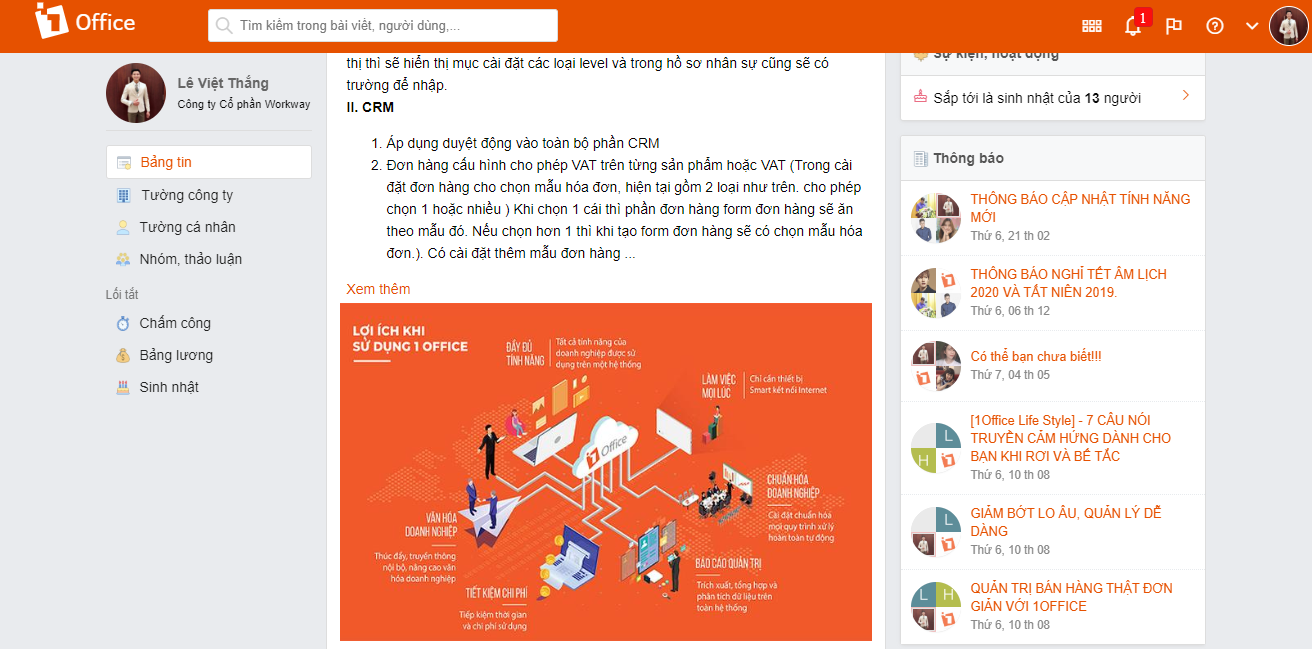
Social screen similar to the Facebook interface
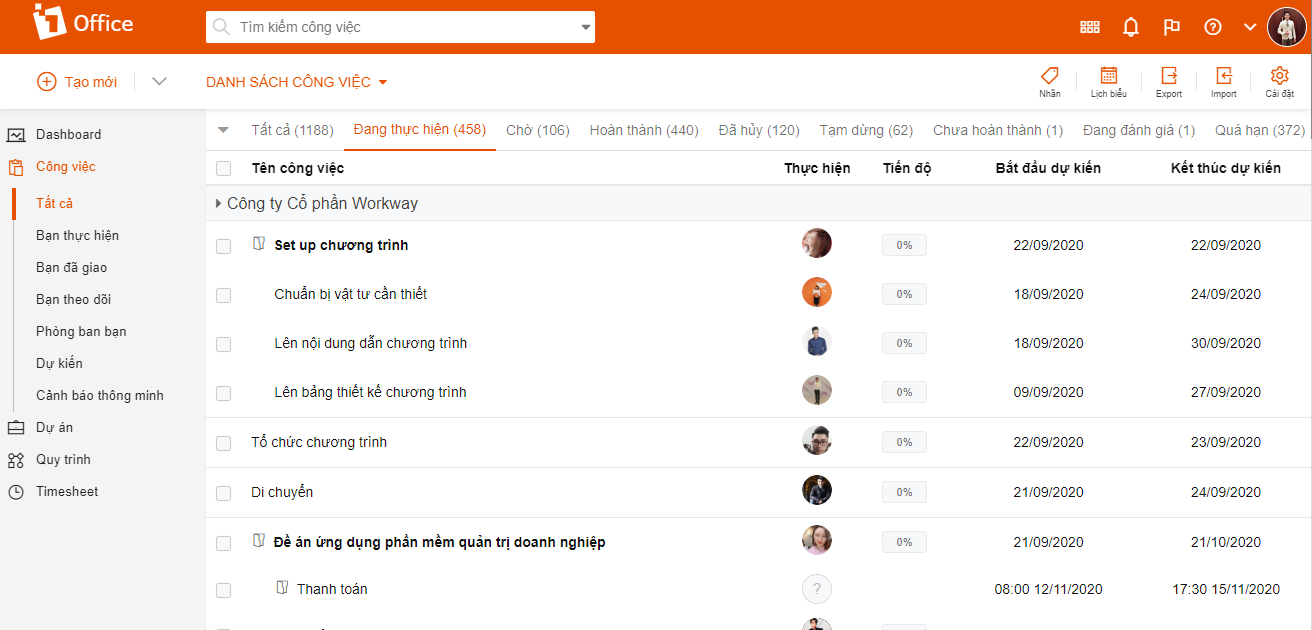
Work and process statistics screen similar to the Gmail interface
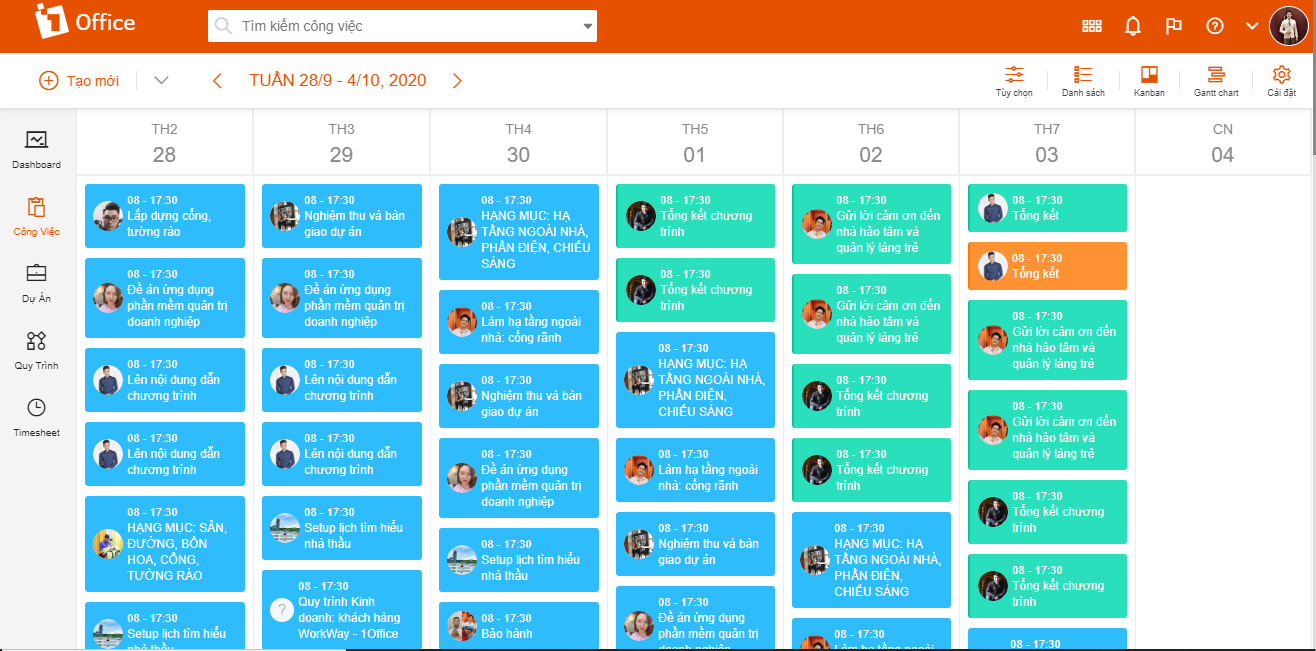
Work progress report screen similar to Google Calendar
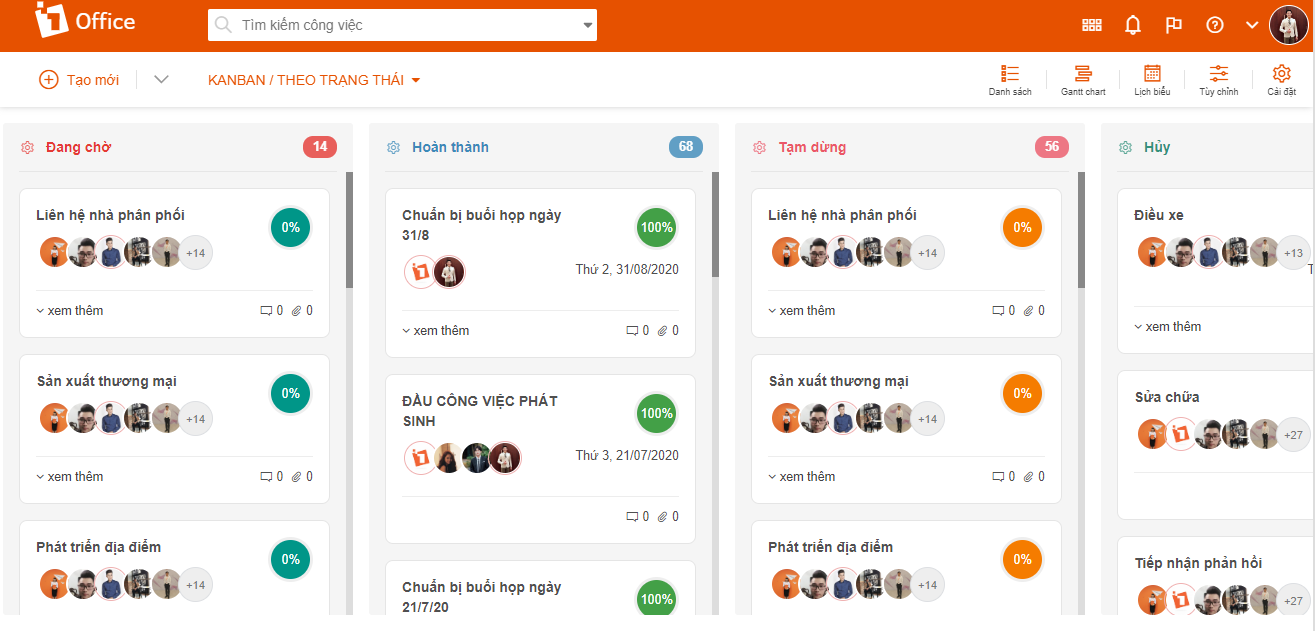
Kanban-style work progress report screen
It’s a fact that businesses are often deceived by flashy interfaces. However, whether software is easy to use depends on its compatibility with the business’s operations. The more data is digitized, the more accurately the software simulates the business, thereby enhancing its ability to perform complex operations.
Consider a beautiful room lacking basic amenities versus a simple room that is fully equipped. The choice is clear, isn’t it?
Read more: Digitizing the Entire Process – The Optimal Operational Solution for Businesses
4. Suitable Cost
What is the cost difference for an SME (with a scale of 30 employees) to pay for Microservice and All-In-One model software over 1 year?
| Microservice Software | All-In-One Software | |
| Cost Calculation | Package for businesses with 30 – 60 employees | Based on the number of users. Pay for what you use |
| Specific Cost | 1,000,000 VND/month | From only 60,000 VND/user/month |
| Total Payable Cost | 12,000,000 VND/year | Depends on business size |
| Features Used | Work | Work + HR |
Clearly, the pricing method above forces businesses to bear a series of unnecessary costs. This is because with 30 employees, a business still has to use a software package equivalent to one for 60 employees.
Meanwhile, the All-In-One software uses a per-user pricing method (pay for what you use). This helps businesses optimize their usage costs.
>> See the detailed price list for the 1Office All-in-one business management software here:

5. Conveniently track multi-dimensional reports
One of a CEO’s priorities is how to get an overview of the company’s operational status in the shortest possible time. This is completely impossible with Microservice software due to limited data, forcing businesses to go through an intermediate data consolidation step before getting an overview report.
However, with All-In-One software, CEOs can easily obtain multi-dimensional reports on every aspect of the business. All-In-One can do this thanks to its massive, tightly integrated data system. Therefore, each subject is not only viewed within its own department’s scope but is also examined in relation to other departments. As a result, the reports generated are more complete, comprehensive, and detailed, allowing CEOs to make the most timely and accurate decisions.
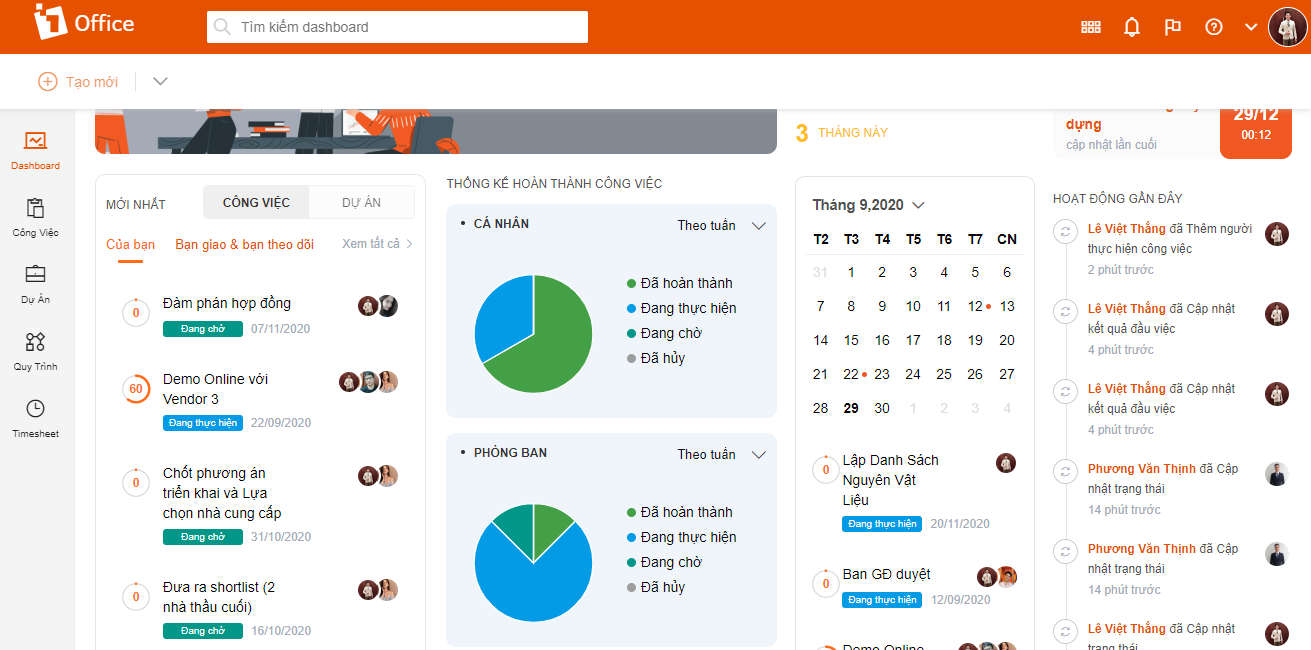
Work progress report dashboard
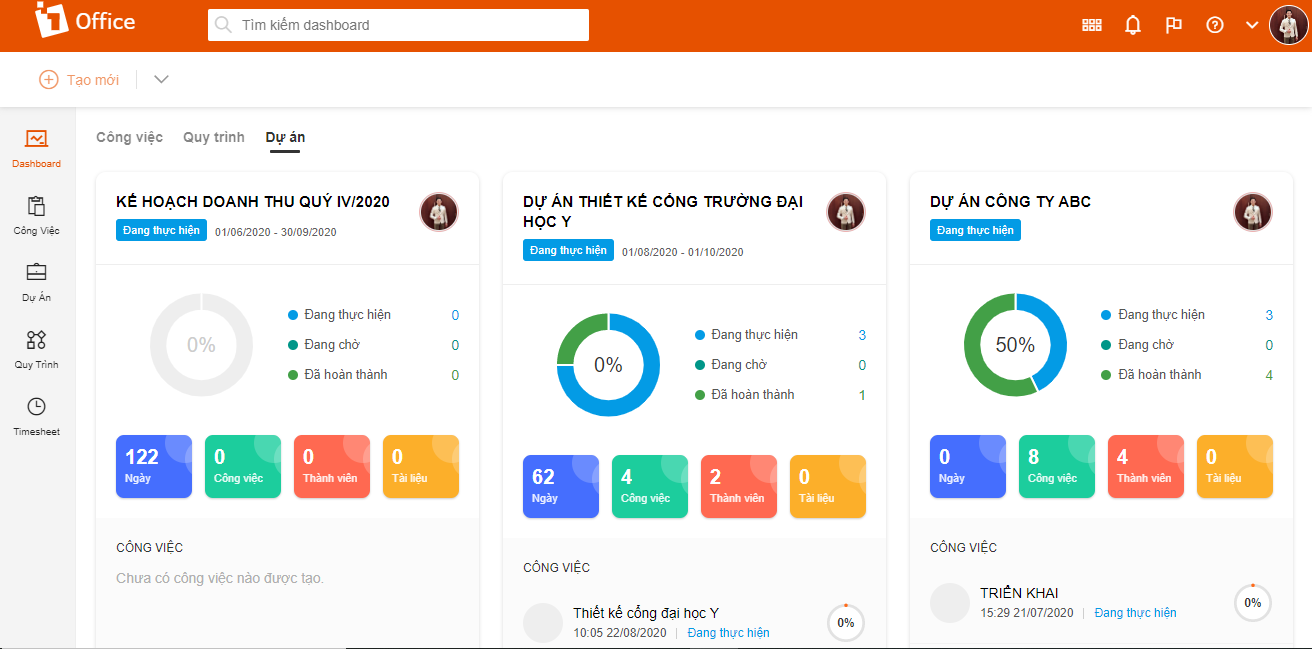
Project progress report dashboard
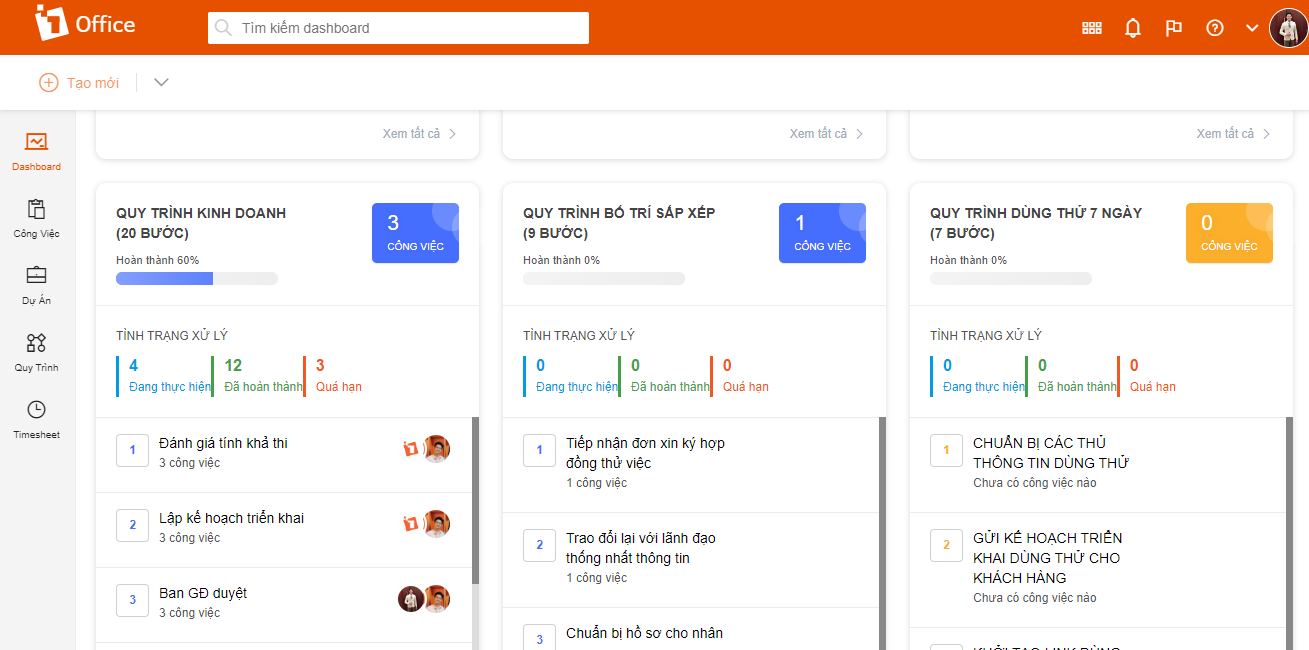
Workflow progress report dashboard
A simple example of this is that CEOs can calculate an employee’s ROI based on information such as: The percentage of tasks completed early, on time, or overdue? The salary the company has paid them? Their length of service with the company? The number of times they’ve arrived late or left early? The seamless flow of information from the work module to the HR module will create the most detailed and accurate profile of an employee. Isn’t that amazing?
| Conclusion: All-In-One provides a solution that, while not yet perfect in implementation, is absolutely correct, comprehensive, and sustainable for the management challenges of every business. |
Be a wise CEO—choose the management model that delivers sustainable value to your business!
Microservice and All-In-One are both leading digital business management solutions today. However, as the two models have different development approaches, businesses need to be extremely careful when making their choice.
| All-In-One Model | Microservice Model | |
| Development Philosophy | Solves the overall business problem within a single software. | Only solves one business problem, using separate, smaller software applications. |
| Implementation Time | Longer (From 2 – 3 weeks) as it involves multiple departments. | Faster (From 1-2 weeks) as it only involves one department. |
| Complexity of Use | Low due to complete data availability. | High due to lack of data to solve problems. |
| Data Management | Easy to manage due to centralized storage in one software. | Difficult to manage as data is scattered across multiple software applications. |
| Security | High due to centralized management and storage. | Low due to distributed data. |
| Flexibility | Highly customizable due to complete data availability. | Low customizability due to lack of data. |
| Cost | Low due to subscription-based pricing. | High due to fixed package pricing. |
| Vendor Service | Simple and time-saving as you only need to work with one vendor. | Complex and time-consuming as you have to work with multiple vendors. |
To put it metaphorically, many businesses, especially SMEs, when they feel pain, only think about how to relieve it as quickly as possible without anticipating that in the future, they will face many other pains. Should they find a new remedy every time they feel pain?
Instead of focusing on short-term benefits, think about long-term gains. Everyone wants their business to grow, but how can it grow quickly and healthily if the “shirt” it wears isn’t big enough? Before looking for a shirt, imagine what your business will be like in 10, 20, or even 30 years.
Don’t let a 20-year-old business wear the shirt of a 5-year-old business!
When faced with choices that affect the destiny of the business, CEOs must be truly wise to make the right decisions!
1Office – Vietnam’s Leading All-in-One Business Management Platform
1Office all-in-one business management software
As a pioneer in digital transformation solutions recognized by the Ministry of Information and Communications, 1Office provides a comprehensive solution to the business management problem. The solution suite includes a set of tools:
- Workplace Toolkit: Manage tasks, processes, projects, and internal communications.
- HRM Toolkit: Manage human resources (Recruitment, timekeeping, payroll, employee records, etc.)
- CRM Toolkit: Manage Sales & Marketing (Marketing, customer care, purchasing – sales, etc.)
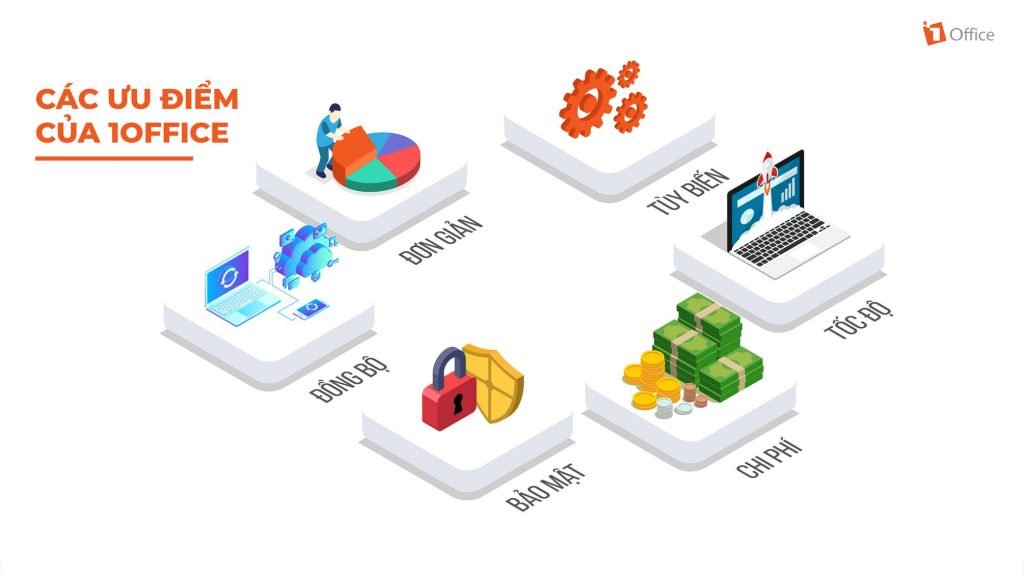
Outstanding advantages of the 1Office all-in-one management software
Thus, it provides a comprehensive solution suitable for all business models. To have earned the trust and partnership of over 5,000++ businesses and 450,000++ customers, 1Office possesses outstanding advantages:
- Seamless data integration between modules: Helps systematize business data, processing tasks accurately and quickly.
- Simple reporting and evaluation: CEOs can easily monitor the overall business situation through reports on work, revenue, recruitment, etc., without waiting for staff to compile them. This allows for accurate evaluation of departments and employees to make policies or timely adjustments.
- Unified storage: Instead of storing records, reports, etc., scattered across Email, Outlook, Facebook, Skype, etc., all documents are now digitized and stored uniformly on one software platform, making them easy to manage and convenient to look up.
- Fostering corporate culture: The internal network allows all company members to post, discuss, send documents, update statuses, etc., on a unified and secure interface.
- Reasonable and cost-effective: Starting from only 40,000 VND/user/month. Eliminates 90% of printing costs as well as hidden costs from meetings, processing forms, and approving reports.
Register here to experience 1Office and receive a consultation on a suitable digital transformation roadmap for your business!
















