


 13/05/2026
  239 views
The year-end evaluation season is here. Accurately assessing job performance helps businesses set clear expectations for employees in the coming year, as well as gradually improve and optimize their operational structure. In this article, we will explore what employee performance evaluation is, its benefits, and how to conduct it accurately and fairly.
Mục lục
1. Definition of performance evaluation
Performance evaluation is the process of systematically reviewing and assessing an employee’s job performance and capabilities, including work results, work methods, qualities, and skills for performing the job.
Evaluations are conducted periodically—monthly, quarterly, semi-annually, or annually—with continuous reviews, with the year-end evaluation being the most important. Typically, the purpose of performance evaluation is to decide whether an employee will continue their employment, or if they are eligible for promotion, salary increases, bonuses, and other benefits.
2. Why is performance evaluation necessary?
Many businesses have suffered serious consequences due to a lack of experience in building a scientific and systematic human resource evaluation system. Some companies have lost customers and seen reduced revenue due to inefficient employees, poor service quality, and customer dissatisfaction. In other businesses, dissatisfied managers have resigned, leaving their subordinates in a state of confusion.
Therefore, it can be said that evaluating employee work results plays a very important role for both the business and each employee.
2.1 For the business:
Proposing effective improvement plans:
Based on job performance results, managers can identify bottlenecks in operations, make adjustments, and set the most suitable expectations for both the team and individual members. From there, the business can allocate human resources reasonably to ensure that collective work is completed on schedule and within the projected budget.
Providing important data for recruitment
A comprehensive overview of employee performance provides deep and detailed insights into the company’s entire recruitment process. Specifically, if a company notices a trend of employees lacking skills in a certain area, they can add screening criteria for that skill set to their recruitment process.

Evaluation results will provide information on the number of employees retained or likely to leave. From this, recruiters can measure the results of their recruitment activities, as well as develop appropriate strategies and improvement plans.
2.2 For the employee:
Development opportunities
The results of a performance evaluation also provide feedback to employees on their level of job performance, allowing them to proactively assess whether they have performed well and are deserving of their salary. It also helps them identify and correct weaknesses and improve their professional skills through training and information sharing with management levels.
Salary increases/bonuses
Some companies have policies for salary increases or bonuses for employees with good evaluation results. Sometimes, it also serves as the basis for making promotion decisions for that employee.
3. How to accurately evaluate employee performance
Conducting performance evaluations is one of the solutions that help managers control the plans they have set. However, in reality, the evaluation process can be influenced by space, time, the evaluator, etc., which can lead to subjective decisions. So, what are the effective job evaluation criteria for this issue?
To accurately and comprehensively evaluate an employee’s work results, it is necessary to understand 3 important metrics (or KPIs):
3.1 Quality metrics:
When it comes to work, the quality factor is valued above all else. Using work quality measures, performance is often based on the employee’s finished product. This can be measured based on the number of errors the employee made, whether there are any defects, etc.
3.2 Efficiency metrics:
Work efficiency is the ability to achieve the most “output” with the least possible “input”. By improving work efficiency, you can get more done in the same amount of time and with the same amount of resources. Work efficiency can be expressed by the formula:
r = P / C (where r = ratio, p = product, and c = cost)
Some common measures of work efficiency are the ability to meet deadlines, how tasks are prioritized, and whether you consistently achieve your goals. Do you have to work a lot of overtime? Review your work methods and find every possible way to improve your current work efficiency.
See more: Effective time management skills to improve work productivity
| “Work smarter, not harder” – This means if you want to increase productivity, think about how to work smarter, not harder. We can’t add more time to each day, but we can always think of better ways to do things, anywhere, anytime.
3.3 Quantity metrics:
Quantity is often easier to measure than quality. The metrics used will depend on the specifics of each industry. For example, for employees in the sales field, their success is measured by the amount of revenue achieved. Salespeople will typically earn a base salary plus a commission for each sale. The more you sell, the better you get paid.
These are the important metrics that businesses need to understand. But how can they be measured effectively and accurately? The common way businesses create and track work efficiency is through Google Sheets. However, when managing and evaluating this way, managers often face issues such as not knowing the exact percentage of work completion, whether there are any obstacles during implementation, etc. That is why managers need software to make it easier to track and evaluate work efficiency, ensuring accuracy and transparency.
4. 1Office work efficiency evaluation software
1Office is an all-in-one business management solution that includes Workplace – a set of work management tools trusted by over 3,500 businesses and more than 300,000 users.
The system of multi-dimensional, visual reports such as Dashboards and dynamic reports with smart filters helps managers measure & evaluate work results effectively.
Get a comprehensive overview of all work
Thanks to the work plan management software, all work-related information such as content, location, assignee, reviewer, approver, and execution time are stored synchronously on the system. Therefore, users can get a comprehensive overview of all work happening in the business, and managers can grasp information about projects and plans from anywhere with an Internet connection.
Closely monitor work completion progress
The work management software can provide maximum support for managers in assigning tasks to each member, tracking work progress, managing completed or ongoing tasks, and identifying unfinished or overdue tasks so that managers can take timely action.
Provide a comprehensive picture of each individual’s efficiency and capabilities
The automated reporting system summarizes the work efficiency of each employee over various periods, helping managers evaluate the performance, capabilities, and skill level of each employee to coordinate work in the most suitable way. For example, evaluating whether an employee often misses deadlines, what percentage of work is completed compared to the plan, and their ability to collaborate with other departments…
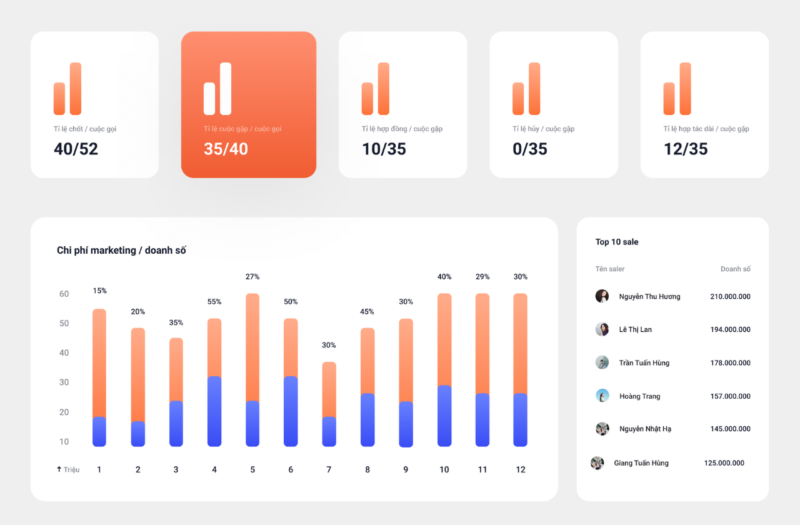
Using software to evaluate employee performance is of great importance that no business can afford to overlook and should implement. This is truly an opportunity for businesses to build a strong workforce and thrive in today’s increasingly competitive environment.
If you are a manager looking for an effective work performance evaluation solution for sustainable business development, the 1Office work management software is the perfect tool for you.
















