


 10/05/2026
  20850 views
Currently, calculating the salary fund based on revenue is a key strategy for businesses to enhance employee productivity and retain talent. This form of payment not only motivates employees to be more proactive and autonomous in their work but also drives business growth. So, what percentage of revenue should the salary fund account for? How can you plan the salary fund to meet target revenue? Let’s explore with 1Office in the following article.
Mục lục
- 1. What is a salary fund based on revenue? Benefits of calculating the salary fund by revenue
- 2. Which departments are suitable for a revenue-based salary fund calculation?
- 3. Guide to calculating the salary fund based on revenue
- 4. Strategy for building a salary fund based on revenue
- 5. How to Calculate Revenue-Based Salary in Excel (Download Sample File)
- 6. Comparing the Revenue-Based Salary Model with Other Payment Models
- 7. Frequently Asked Questions about Calculating Salary Funds Based on Revenue (FAQ)
- 7. 1Office Software – Automating the Revenue-Based Payroll Process
1. What is a salary fund based on revenue? Benefits of calculating the salary fund by revenue
A salary fund based on revenue is the total amount of salary a business pays to its employees during a specific period. In this model, an employee’s salary is calculated based on a percentage of revenue.
Many businesses today apply the method of calculating the salary fund based on revenue, especially for the sales department, because this payment structure offers numerous benefits:
1.1 Enhance employee productivity
Calculating the salary fund based on revenue helps to closely link performance with employee income, thereby contributing to increased employee productivity. When salary and bonuses are set as a percentage of revenue, employees will see it as a goal to strive for and work hard to achieve their desired income.
1.2 Increase employee benefits
By applying a revenue-based salary fund calculation, an employee’s income is not limited to any specific figure. The higher an employee’s productivity and the more revenue they generate for the company, the higher their salary and bonuses will be. This is also an effective strategy for attracting and retaining talent.
1.3 Stimulate revenue growth
Calculating the salary fund based on revenue acts as a lever to stimulate business revenue growth. Once employee productivity is boosted through compensation, the business operates more efficiently. Therefore, calculating bonuses based on sales is applied as a corporate strategy in the effort to achieve target revenue.
2. Which departments are suitable for a revenue-based salary fund calculation?
Depending on the company’s policy, the method of calculating the salary fund based on revenue can be flexibly applied to different departments and employees. However, this model is commonly used for positions that directly impact the company’s recurring revenue, such as:
- Sales staff
- Sales representatives
- Consultants
- Marketing staff
Read more: 6 Steps to Standardize the Process of Building a Transparent and Fair Salary Policy
3. Guide to calculating the salary fund based on revenue
The calculation of the salary fund based on revenue will be based on the revenue the company achieves in a period. Specifically as follows:
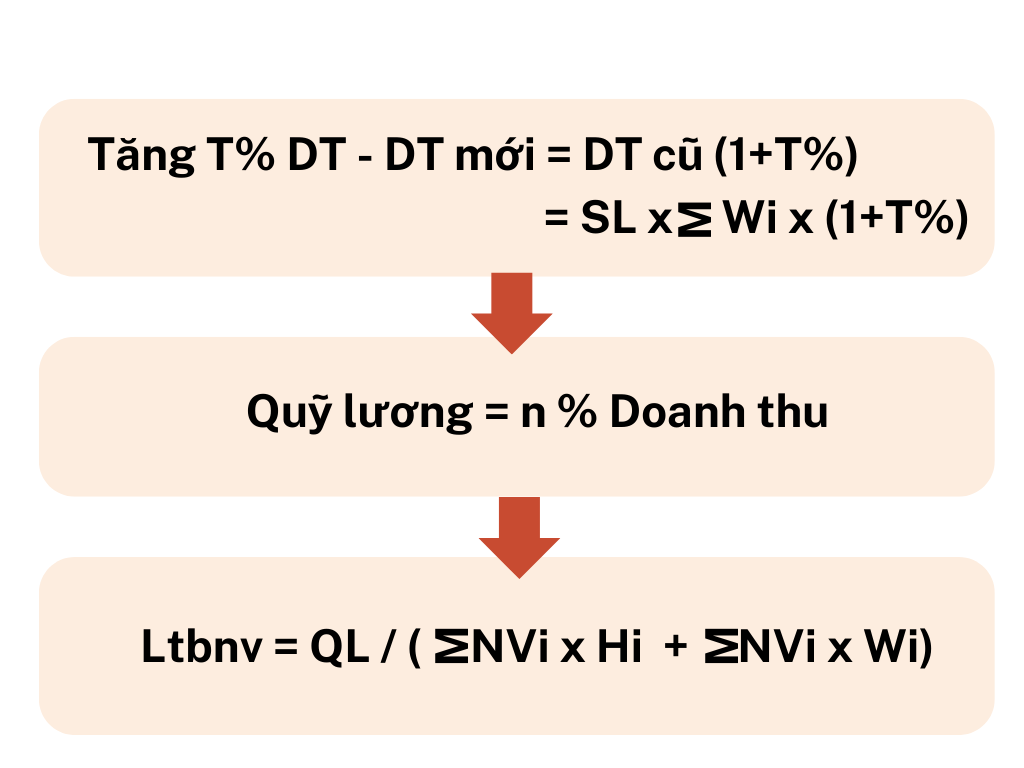
Where:
- T% – Expected % revenue increase
- SL – Number of employees
- Wi – Productivity of employee i
- Hi – Base salary coefficient of employee i (based on rank, qualifications, etc.)
- Lv – Average salary of one employee
From the model above, we can determine how to calculate an employee’s salary based on a percentage of revenue using the formula:
Revenue-based salary = Fixed salary (Tied to a minimum sales quota) + Bonus (Based on % of sales)
Example of calculating salary based on a percentage of revenue:
The salary of a sales employee at company X is determined as follows:
Salary = Base salary (7,000,000/month) + Commission (2% of monthly revenue)
In October, company X recorded a revenue of 500,000,000 VND
Applying the sales-based salary calculation for the employee, the result is: 17,000,000 VND/month
4. Strategy for building a salary fund based on revenue
With a revenue-based salary fund calculation, the monthly salary fund will be directly proportional to the change in revenue achieved from the company’s operations. So, how can the salary fund be adjusted to help the company achieve its target sales? There are 3 ways for a company to increase its salary fund based on the set revenue target:
4.1 Increase the number of employees
To increase the total salary fund and thereby increase the revenue achieved during the period, the first option a company can consider is to increase the number of employees. The number of new hires will be determined based on the set revenue target.
Assuming the productivity of the current team remains constant, the revenue increase needed to achieve the target will be allocated to the newly hired employees. With this approach, the T% increase in revenue will be generated by the newly hired employees.
4.2 Improve training quality
If the company does not want to hire new employees, another option to consider is improving the productivity of the current workforce by enhancing training quality.
In this case, the number of employees remains unchanged, and the T% increase required to meet the revenue target will depend on the productivity and quality of the existing team. This means the company must implement professional training programs to enhance the skills and expertise of its employees. The targeted training effectiveness must correspond to the T% revenue increase needed to achieve the planned goal.
4.3 Combining both increasing the number of employees and improving training quality
This option is a combination of both previous options, meaning an increase in both the quantity and quality of employees. The company will both recruit new labor and improve the skills of its workforce through training. With this approach, the T% revenue increase will be reasonably allocated between these two factors to match the company’s capabilities.
To better understand how to calculate the salary fund based on target revenue, follow the formula below:
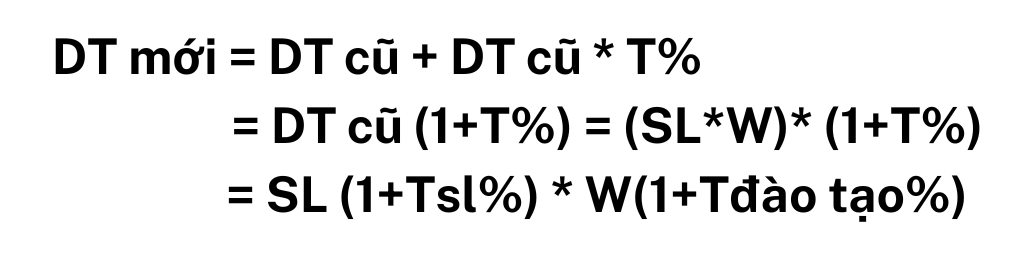
Application example: In 2026, Company X’s revenue was recorded at nearly 47,000 billion VND. The company size at that time was around 15,000 employees. Company X sets a revenue target for 2025 of 55,000 billion VND.
To achieve the target revenue, Company X decides to recruit an additional 4,000 employees. This means the salary fund will have to increase by about 30% to meet the company’s operational strategy.
| See the 13+ most popular employee payroll templates for 2026 |
5. How to Calculate Revenue-Based Salary in Excel (Download Sample File)
The task of calculating revenue-based salary requires absolute accuracy to provide a satisfactory salary for employees. Therefore, even a small discrepancy can make employees feel dissatisfied.
With the desire to help businesses plan their revenue-based salary fund accurately and effectively, 1Office provides you with the most detailed Revenue-Based Salary Calculation Template in Excel.

Download the Revenue-Based Salary Calculation Template in Excel HERE
6. Comparing the Revenue-Based Salary Model with Other Payment Models
Revenue-based salary is one of the most popular variable pay structures today, especially in business and service enterprises. However, to choose a suitable model, managers need to clearly understand the core differences between revenue-based salary and other common payment forms such as: KPI-based salary, time-based salary, and commission-based salary.
Below is a detailed analysis of each model.
6.1 Comparison with KPI-Based Salary
Similarities
-
Both aim to increase work performance.
-
Belong to the group of performance-based variable salaries, not fixed like time-based salaries.
Differences
| Factor | Revenue-based salary | KPI-based salary |
|---|---|---|
| Measurement method | Based on the actual revenue generated by the individual/department | Based on pre-established key performance indicators (KPIs) |
| Flexibility | Flexible according to market conditions – seasonality | Fixed per evaluation period |
| Fairness | Clear and transparent as it’s measured by sales figures | Can easily cause disputes if KPIs are set incorrectly or are difficult to measure |
| Impact on employee behavior | Encourages a focus on revenue | Promotes a balance between multiple objectives (quality, speed, process…) |
-
Revenue-based salary is suitable for: business, sales, telemarketing, and distribution agent departments.
-
KPI-based salary is suitable for: administration – human resources, customer care, marketing, and operations.
6.2 Comparison with time-based pay
Similarities
-
Both can be combined with additional payments such as bonuses, allowances, or revenue.
Differences
| Factor | Revenue-based salary | Time-based salary |
|---|---|---|
| Calculation mechanism | Based on a % of revenue | Based on the number of hours/days worked |
| Work motivation | Very high, as it’s directly linked to results | Lower, can easily create a “just work the hours” mentality |
| Application | Jobs that produce clear output | Jobs that are more repetitive or where revenue cannot be measured |
| Risk | Revenue decreases → salary decreases | Does not accurately reflect work performance |
-
Time-based pay is suitable for: production, maintenance, logistics, and office administration.
-
If the job does not directly generate revenue → revenue-based salary should not be applied.
6.3 Comparison with commission-based pay
Similarities
-
Both are forms of compensation tied to business results.
-
Both encourage employees to increase sales.
Differences
| Factor | Revenue-based salary | Commission-based salary |
|---|---|---|
| Calculation method | Combines a fixed salary + % of revenue | Paid based on a % of the value of products sold |
| Stability | More stable as it’s based on total revenue | Highly volatile, with high and low months |
| Measurement scope | Can be applied to the entire department | Mainly applied to individuals |
| Motivational goal | Grow the company’s revenue | Maximizes focus on the number of products sold |
-
Commissions are suitable for: real estate sales, insurance, finance, retail.
-
Revenue-based salary is suitable for: brokers, sales departments, sales teams, profit centers.
| Model | When to apply? | Income stability | Motivation level |
|---|---|---|---|
| Revenue-based | Jobs that generate clear revenue | Medium | High |
| KPI-based | Departments with multiple targets | Medium – stable | Medium |
| Time-based | Jobs where output cannot be measured | High | Low |
| Commission-based | Pure sales, high-value service industries | Low – volatile | Very high |
7. Frequently Asked Questions about Calculating Salary Funds Based on Revenue (FAQ)
Calculating salary funds based on revenue is increasingly being adopted by businesses to control costs and link employee income to business performance. However, this model also raises many questions regarding its suitability, scope of application, risks associated with revenue fluctuations, and legal factors. Below are detailed answers to the most common questions.
Are revenue-based salary funds suitable for small businesses?
Yes, and in many cases, they are particularly suitable.
For small and medium-sized enterprises, financial resources are often limited, and revenue can fluctuate in different periods. Establishing a revenue-based salary fund helps businesses:
-
Effectively control personnel costs, avoiding the situation of paying excessively high fixed salaries when revenue is unstable
-
Link the employee payroll to business results, thereby enhancing a sense of responsibility
-
Flexibly adjust the salary fund according to the actual financial situation
However, small businesses should implement this simply and cautiously, prioritizing:
-
Determining a reasonable salary fund to revenue ratio
-
Combining revenue-based pay with a minimum base salary
-
Communicating clearly to ensure employee understanding and agreement
This approach helps small businesses ensure financial sustainability while creating motivation for growth.
Should revenue-based salary funds be applied to all employees?
It should not be applied uniformly to all positions.
A revenue-based salary fund is only truly effective for departments that have a clear direct or indirect impact on revenue, such as:
-
Business, sales
-
Marketing linked to revenue generation performance
-
Customer care with conversion or retention metrics
For support departments such as administration, human resources, accounting, internal IT, etc., applying revenue-based pay can cause:
-
Unnecessary pressure
-
Difficulty in measuring actual contributions
-
Internal imbalance
The appropriate solution is to combine multiple pay models, where:
-
Revenue-generating staff: revenue-based pay + KPIs
-
Support staff: time-based pay + performance evaluation
This allocation method helps ensure fairness and efficiency throughout the organization.
How should revenue-based pay be handled when revenue decreases?
When revenue declines, the revenue-based salary fund will automatically decrease, which helps the business reduce cost pressure. However, without a contingency plan, employee income can fluctuate significantly, affecting morale.
To handle this situation, businesses should:
-
Establish a minimum base salary to ensure a basic income for employees
-
Build a safety threshold for the salary fund, not allowing income to fall below an acceptable level
-
Adjust revenue targets to align with market conditions
-
Communicate transparently about the financial situation and future direction
Having a ready-made scenario for periods of decreased revenue helps the business maintain internal stability and retain key personnel.
Does revenue-based pay violate labor laws?
No, if the business establishes and applies it in accordance with legal regulations.
According to Vietnamese labor law, businesses have the right to choose the form of payment, including time-based, product-based, piece-rate, or performance-based pay, as long as they ensure the following mandatory principles:
-
Salary is not lower than the regional minimum wage
-
There is a clear agreement in the labor contract
-
The salary calculation method is transparent and easy to understand
-
On-time salary payment
Therefore, when applying revenue-based salary, businesses need to:
-
Clearly define the structure of fixed and variable salary
-
Fully record it in the labor contract or contract addendum
-
Store revenue data and payrolls transparently
Correctly implementing the above requirements will help businesses optimize personnel costs, comply with labor laws, and avoid unnecessary dispute risks.
7. 1Office Software – Automating the Revenue-Based Payroll Process
Currently, businesses still face many difficulties with payroll calculation in Excel, such as it being time-consuming, having complex manual processes, and being prone to errors. To build an effective revenue-based salary fund and optimize benefits for both the business and employees, applying a tool to automate the payroll process is essential.
1Office HRM is one of the most superior human resource and payroll management software on the market today. 1Office provides a comprehensive solution suite to help businesses resolve all issues in the payroll process, such as:
- Option to configure payrolls to match the company’s salary policy
- Integrate the full set of Excel formulas into timekeeping and payroll operations
- Timekeeping data, salary grades, and KPIs are automatically synchronized on the software, no manual data entry required
- Check and approve payrolls 24/7 right on the software
Through the article above, 1Office has provided you with the most accurate way to calculate a revenue-based salary fund for 2026 and a technology solution to help automate the payroll process in your business. For a free consultation and a trial experience of the 1Office human resource and payroll management software, please contact us using the information below.
For all detailed information, please contact:
- Hotline: 083 483 8888
- 1Office Fanpage: https://www.facebook.com/1officevn
- Youtube Channel: https://www.youtube.com/c/1OfficeNềntảngquảnlýtổngthểDoanhNghiệp
















