13/05/2026
  269 views

The Covid-19 pandemic has just subsided, leaving many industries and businesses of all sizes struggling as the digital transformation storm sweeps across all commercial fronts. Faced with the intense market fluctuations affecting the retail industry and the global economy post-pandemic, businesses have quickly seized the opportunity to comprehensively implement “digital transformation” to survive and thrive in this new era.
Mục lục
The Impact of Covid-19 on the Retail Industry
Post-Covid, the retail industry is one of the sectors that has suffered heavy revenue losses. Some small and medium-sized enterprises have had to resort to various methods to attract customers and offset losses after resuming operations.

The retail industry suffered heavy losses after the COVID-19 pandemic
Therefore, most employees have had to work overtime upon returning to work to keep up with the pace and promote the company’s redevelopment process.
This issue also leads to increased costs as managers have to raise salaries, provide incentives, and reward employees for working overtime.
Challenges Specific to the Retail Industry
Even before the pandemic, the retail industry often faced significant challenges due to some of its specific characteristics:
Difficulties in Human Resource Management in the Retail Industry
- Employees frequently change shifts, work overtime, and have unfixed or unstable work schedules, making it difficult to track and manage human resources and employee schedules.

Retail personnel often face the situation of “more work, less pay” after COVID-19
Read more: Synchronizing Workflows – The Optimal Management Solution
- Many departments do not have fixed workplaces or must travel to various locations. For example, employees of supermarket chains, convenience store chains, fashion boutiques, cosmetic shops, etc., have to go directly to production factories, distribution agents, or work with customs authorities, etc.
For this reason, tracking and evaluating the work progress of these departments is relatively difficult.
Difficulties in Work Quality Assessment in the Retail Industry
- Complex salary calculation formulas. Each level, position, and department has a completely separate calculation formula. Additionally, timekeeping and payroll processing at the end of the month are quite arduous due to data overload or errors in aggregated data leading to inaccurate results.
- For stores that rely entirely on sales software, assessing the performance or work quality of individual employees requires direct supervision, as sales software only shows the total revenue and profit of the entire store.

Sales software does not reflect employee performance or work quality
The need for physical presence and direct supervision makes the management process cumbersome, complicated, and time-consuming to accurately assess employee performance and efficiency.
Digital Transformation – A “Survival” Step for the Retail Industry Post-Covid
Applying digital transformation to businesses post-Covid has helped partially resolve the lingering difficulties in the retail industry.
Digital Transformation Helps Standardize and Automate All Existing Processes
- Automatically standardize HR records, from personal profiles, contracts, and insurance to the work history, assets, and schedules of each employee. This reduces the time spent on manual planning or document preparation as was done previously.
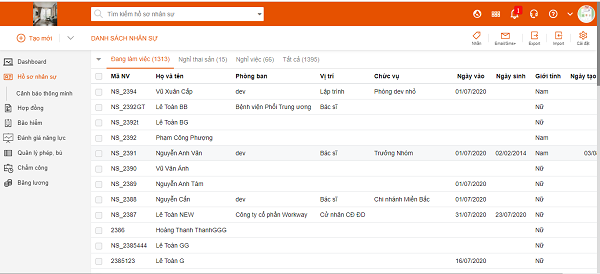
Digital transformation helps standardize employee records
- Departments and divisions can easily and proactively register for work shifts in advance on the software. This helps ensure sufficient headcount and staffing levels for each shift every day.

Digital transformation ensures staffing levels
- With a system that integrates time clocks and leave requests, employees can track their working hours and workdays in real-time to explain to their superiors whenever issues arise.
Digital transformation helps save time and minimize costs
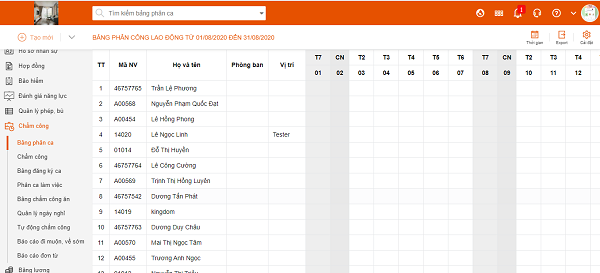
Aggregating timesheet data on the system
- The process of compiling timekeeping data and leave requests for automatic payroll calculation no longer takes as much time and effort from departments as before.
- With just a few simple steps, finalizing and approving salaries can be done quickly, and the process of paying and receiving salaries also takes place on the software. Cumbersome calculation procedures are eliminated, replaced by the convenience and simplicity of comprehensive digital transformation.
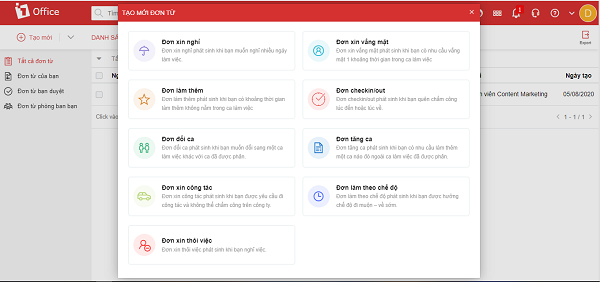
Create requests using available forms – Approve requests directly on the system
1Office – A comprehensive work and human resource management software selected by the Ministry of Information and Communications as a pioneering platform in the national digital transformation program, is a solution that brings sustainable efficiency to retail chains. Learn more here: https://1office.vn/