


TOP 6 most effective CRM models for businesses


Currently, applying and implementing a CRM model has become an essential condition that determines the effectiveness of a business’s customer relationship management. A CRM model places the customer at the center of all business activities, helping to build, strengthen, and maintain effective customer relationships. Join 1Office to learn about the 6 most popular CRM models used today and how to choose the most effective customer relationship management model for your business.
Mục lục
I – What is a CRM model? Differentiating between a CRM model and a CRM system
A CRM model is a process that describes how a business uses and closely coordinates internal resources to serve customer relationship management. This includes customer data management (needs, wants, preferences, purchasing behavior, etc.) and using that information to interact and communicate effectively with customers to build, strengthen, and maintain long-term relationships.
Businesses need to clearly distinguish between the two concepts of a CRM model and a CRM system if they want to implement CRM effectively.
A CRM system is software built to store and manage all customer-related data to support customer relationship management. In other words, a CRM system is the tool a business uses to operate and apply a CRM model.
To better understand CRM systems, read this article:
II – TOP 6 best CRM models for businesses
1. The CRM Value Chain Model
The CRM Value Chain Model was developed by Michael Porter to identify the activities a business needs to perform to deliver value to customers.
The CRM Value Chain Model describes the necessary stages and activities for building customer relationships, divided into 2 parts: 5 primary stages and 5 supporting activities
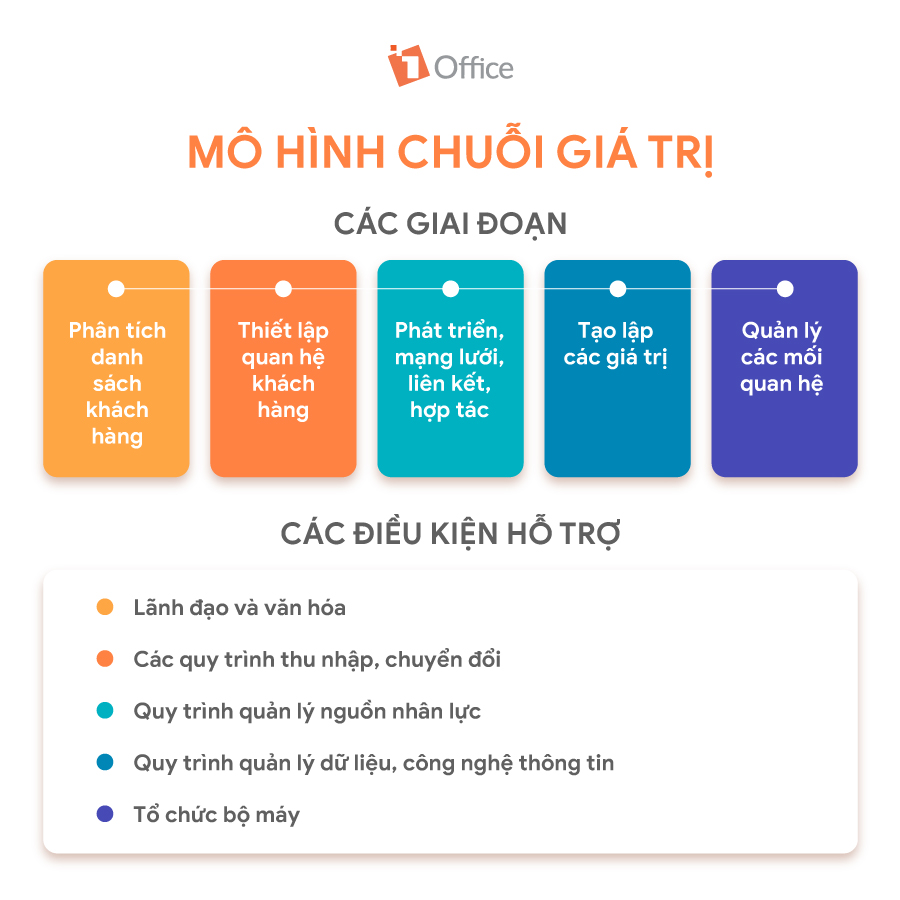
Primary Stages
- Customer Portfolio Analysis: Identify which customers bring the most value. Then, allocate efforts and resources to meet their needs.
- Customer Intimacy: Build close relationships with customers by interacting regularly and collecting & analyzing data after each interaction. From there, adjust services to be suitable and closely follow customer needs.
- Network Development: A business’s network includes all entities involved in the value chain, including suppliers, partners, investors, etc. All these parts will work in parallel to optimize the customer experience.
- Value Proposition Development: From the data and information collected in the three steps above, add value for customers by focusing on personalized services and minimizing costs to deliver more value.
- Relationship Management: Upgrade the customer relationship management process by identifying areas for improvement or change, and then implementing those improvements. This way, the business can optimize customer acquisition and retention activities.
Supporting Activities for the Primary Stages
- Leadership and Culture: Leadership directs activities and sets the operational standards for the customer relationship management model. Corporate culture determines how departments collaborate and work to pursue goals.
- Acquisition Processes: You need an optimized process to convert potential customers into actual buyers.
- Human Resource Management Processes: Build a strong team to effectively resolve internal issues during the operation of the CRM value chain model.
- Data/IT Management Processes: Since CRM is a data-intensive model, IT management must be tightly controlled (security, access permissions, etc.) to ensure the model operates successfully.
- Organizational Structure: Clearly assign personnel responsible for each activity and their reporting scope.
See more: Customer Management Software, the best CRM solution today
2. The IDIC Model
The IDIC model of CRM was developed to assess consumer expectations and the added value they bring to the business. This CRM model is considered a benchmark for identifying customer needs, thereby providing a foundation for the business to build effective customer approach methods.
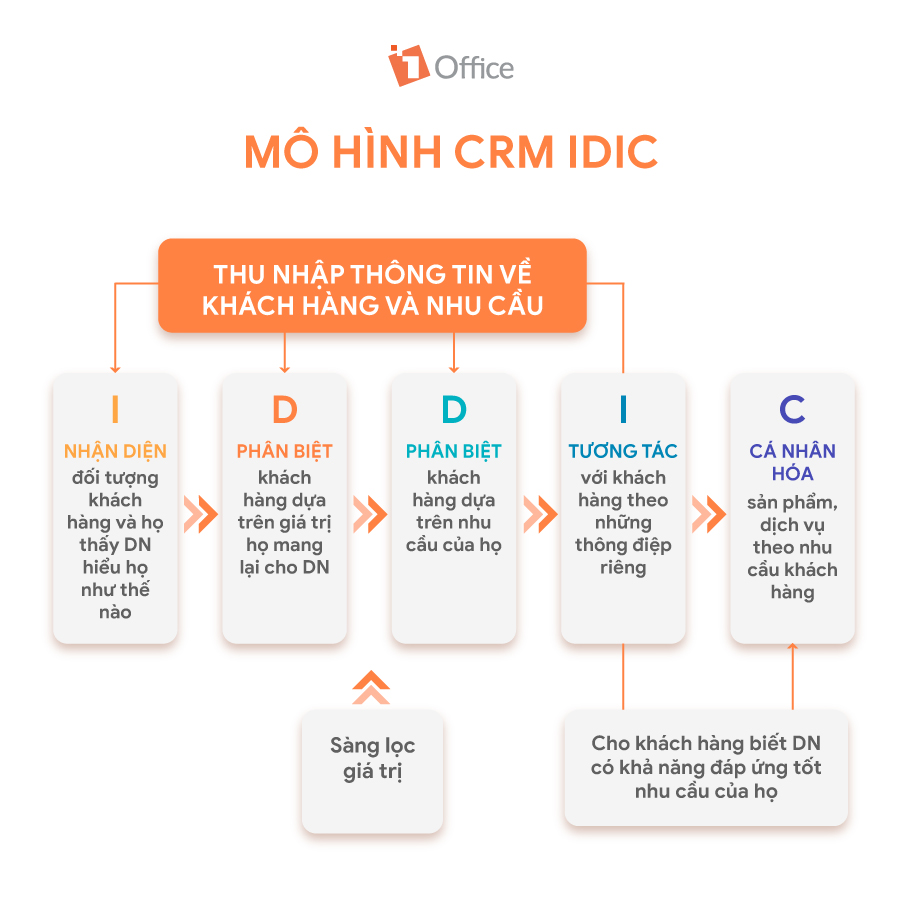
This model helps businesses implement 4 strategies to build, strengthen, and maintain long-term 1-on-1 relationships with customers. Each letter in the IDIC model represents a step in the customer relationship management process:
- Identify: According to the IDIC model, the first step is to identify potential customers. Every business needs to determine who their real customers are and have a deep understanding of them. This helps businesses develop effective customer relationships by organizing them into groups based on their needs, wants, and purchasing behavior to develop strategies tailored to each group.
- Differentiate: After identifying the target customer personas, the business will differentiate them based on 2 main factors:
-
- Value they bring: Differentiate customers based on the long-term value the business expects them to bring, both now and in the future. Note that not all customers bring the same value to the business. Therefore, focus on the customer group that brings the most value.
-
-
-
- Customer needs: Different customers have different needs. Therefore, meeting needs and satisfying customers requires the business to have an understanding of their needs.
-
Differentiating customers will help the business allocate resources reasonably for each different customer segment.
- Interact: The first 2 steps of the IDIC model have established the foundation for the business to develop methods of interacting with customers. Therefore, in this step, your task is to approach and communicate with customers on various channels and provide them with personalized information according to the classified target groups. Let customers know that you understand their needs and wants; this is the key to increasing the purchase rate.
- Customize: The final step in the IDIC model in CRM involves customizing the business’s approach based on what you have discovered about your customers in the previous 3 steps. This means the business needs to adjust its transactions or offers to fully meet the customer’s requirements or budget. The main purpose here is to ensure that all customer expectations and needs are met. Use all the information you have collected about your customers to offer suitable services.
3. The QCI Model
The QCI (Quality Competitive Index) CRM model focuses on managing customers rather than improving relationships with them. This model starts with external environmental factors. Because when customers begin the purchasing process and interact with the organization, the external environment will directly affect their experience.
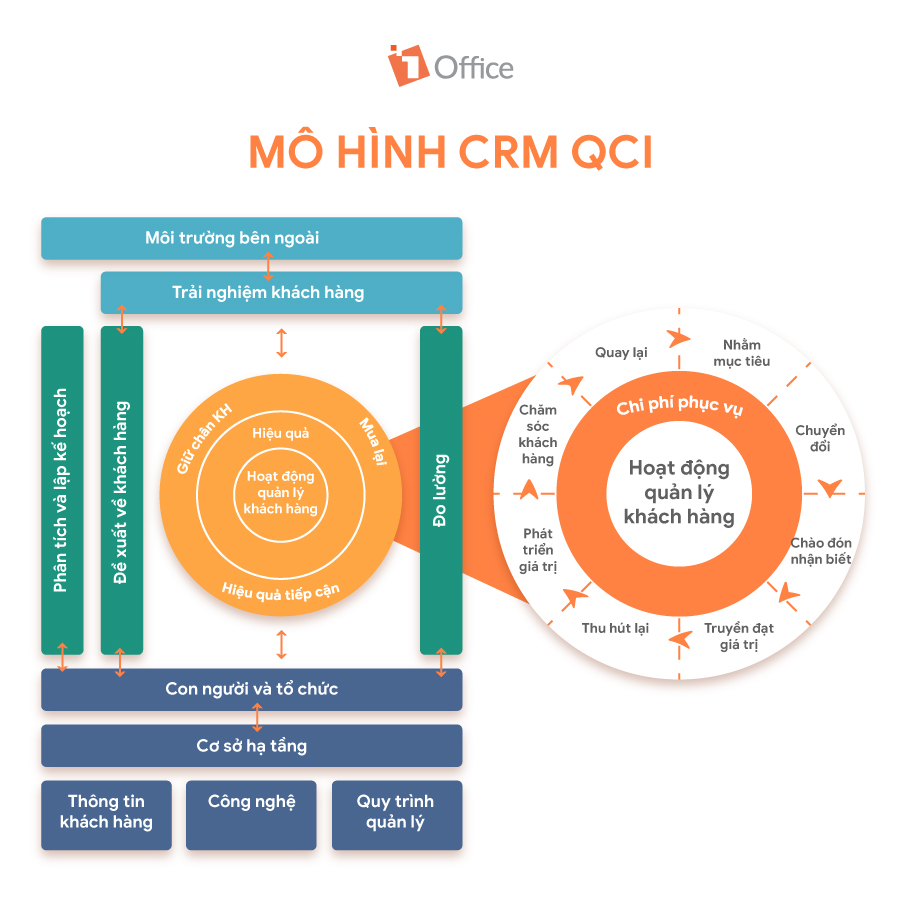
The 8 main components that a business needs to control for effective customer management include:
- Analysis and planning: Collect and process data on the characteristics and behavior of potential customers, thereby identifying the value your company can bring to them.
- Proposition: Use customer analysis data to determine how the business will serve them, then propose methods for approaching and interacting with customers.
- Data information and technology: Apply technology to manage customer data information. Pay attention to continuously improving and upgrading technology to optimize operational efficiency.
- People and organization: Allocate personnel to handle tasks such as interaction, care, and receiving customer feedback, including service inquiries, reviews, complaints, etc.
- Process management: Ensure tight control over the operational processes of the sales, customer care, marketing departments, etc. Identify “gaps” in the process and provide timely solutions.
- Customer management: Includes 3 activities:
-
- Acquisition – Learn information about customers
- Penetration – Approach and connect with customers
- Retention – Stay in contact with customers
-
- Performance measurement: Analyze the performance of departments to determine the impact of groups on the business’s growth. Use metrics such as workload and value brought to the business as a basis for improving and enhancing operational productivity.
- Customer experience: Carry out a similar process to the previous steps, but focus on satisfying customers rather than increasing the number of customers.
4. The Payne & Frow Model
The model developed by Adrian Payne and Pennie Frow is a CRM model that not only focuses on processes but also considers important factors in customer relationship management activities.
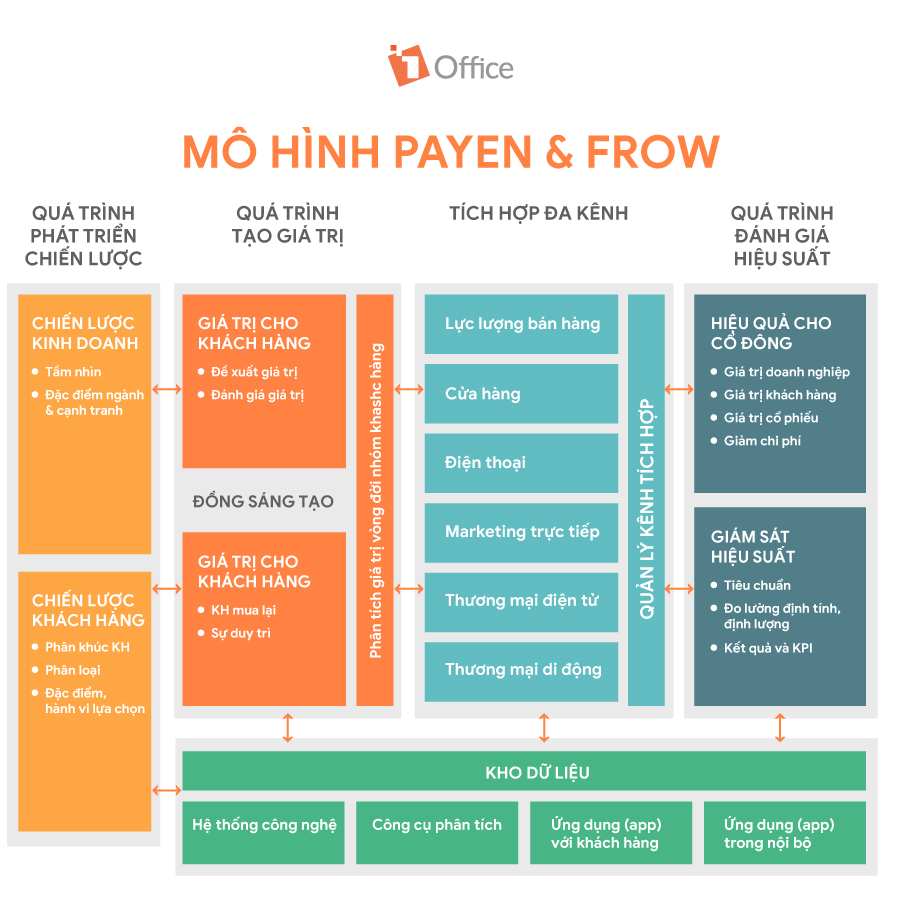
The 5 processes in the Payne & Frow CRM model include
- Strategy Development: The two core strategies of this process are business strategy and customer development strategy. The business strategy includes the vision, mission, and differentiators that create a competitive advantage for the company. The customer strategy involves creating value and qualities that make customers choose you.
- Value Creation: Determine the value the business can bring to customers and vice versa. For example: Organizing an event that provides a unique space consumers can’t find elsewhere—that’s the value the customer receives. The value you receive is customer loyalty.
- Multichannel Integration: After developing your strategy and creating value, you need to communicate it to all departments within the organization, including sales, marketing, customer care, etc., to ensure they clearly understand their responsibilities and functions.
- Performance Assessment: Once your business’s multichannel approach is working effectively, you should re-evaluate your strategy. If your customers are satisfied and departments are meeting their KPIs, the system is running smoothly. If not, change the organization’s strategy and values based on feedback from departments and your customers.
- Information Management: Set up a CRM system to update, store, and manage customer information. Ensure that information flows smoothly and seamlessly to the relevant departments for processing. For example: If a customer calls the customer service department wanting to upgrade their service package, the support staff can enter the information into the CRM and notify the sales and marketing teams to upgrade the customer’s new service package.
The 4 key elements of the Payne & Frow process:
- CRM Readiness: The business needs to build a CRM software system to create a foundation for implementing the CRM model.
- CRM Change Management: Prepare protocols to modify CRM workflows when necessary. This includes the CRM toolset and other software before starting with this model.
- CRM Project Management: It is necessary to clearly understand how projects will be operated and managed on the CRM from start to finish.
- People Management: Clearly assign which personnel are responsible for which tasks in the sales process.
To learn the most effective methods for improving customer retention rates, businesses should refer to the article:
>> What is Retention Rate? Effective Methods to Improve Customer Retention
5. The Gartner CRM Model
This CRM model was developed by Gartner Inc., a leading IT research and advisory company. Gartner defines CRM as a business strategy aimed at maximizing profit, revenue, and customer satisfaction by promoting customer-centric processes.
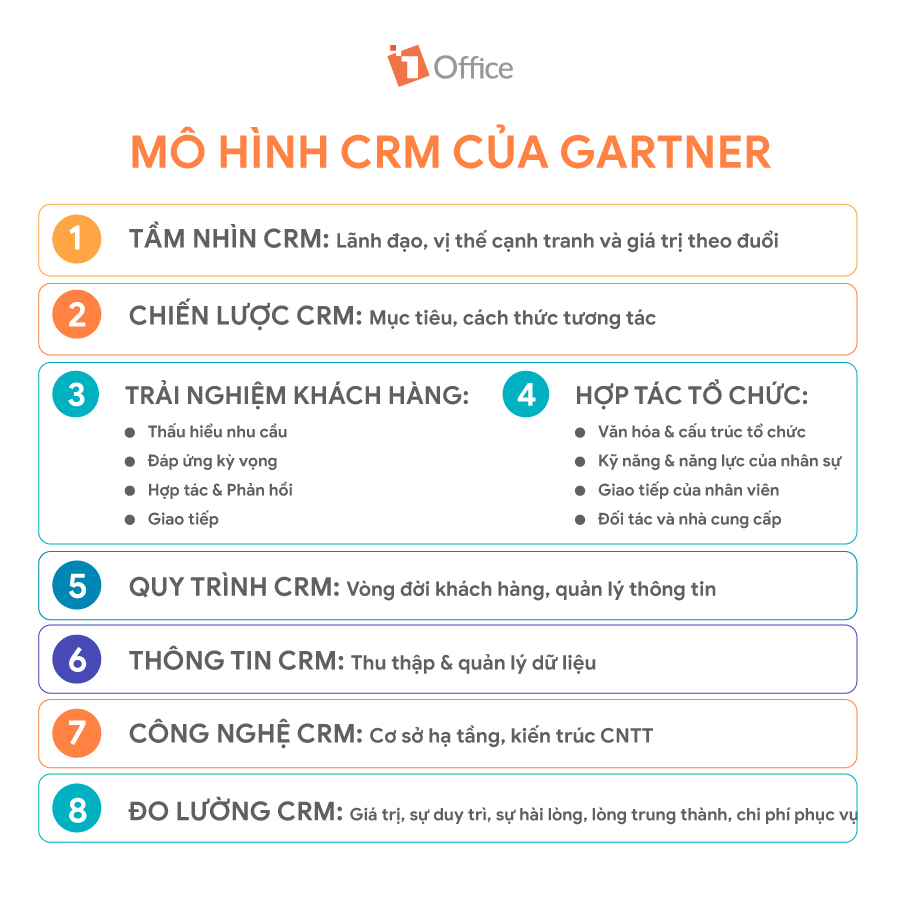
This CRM model emphasizes 8 capabilities that a business should focus on, including:
- CRM Vision: Create a customer-centric big picture to build a competitive position for the business based on defined values. The CRM vision primarily addresses leadership, competitive positioning, and the values the business pursues.
- CRM Strategy: Develop relationships with customers by providing them with added value. This includes setting objectives and determining how resources will be used to interact with customers.
- Customer Experience: Ensure that the business’s offerings and interactions provide seamless value to customers. This element focuses on understanding customer needs and expectations to develop responsive solutions.
- Organizational Collaboration: Change the organizational culture, structure, and behavior to ensure that employees, partners, and suppliers work together to deliver value to customers. It involves culture and structure, personnel skills and competencies, incentives and compensation, and employee communication with partners and suppliers.
- CRM Processes: Effectively manage not only the processes within the customer lifecycle but also the analytical and planning processes aimed at building customer data.
- CRM Information: Collect and tightly manage customer data and information as a resource for various departments to use.
- CRM Technology: Manage data and information, IT infrastructure, and architecture that serve the customer management process and CRM model implementation.
- CRM Metrics: Measure internal and external indicators of the CRM model’s success and failure. The parameters used for measurement include value, retention, satisfaction, loyalty, cost to serve, etc.
6. The CRM Conceptual Model
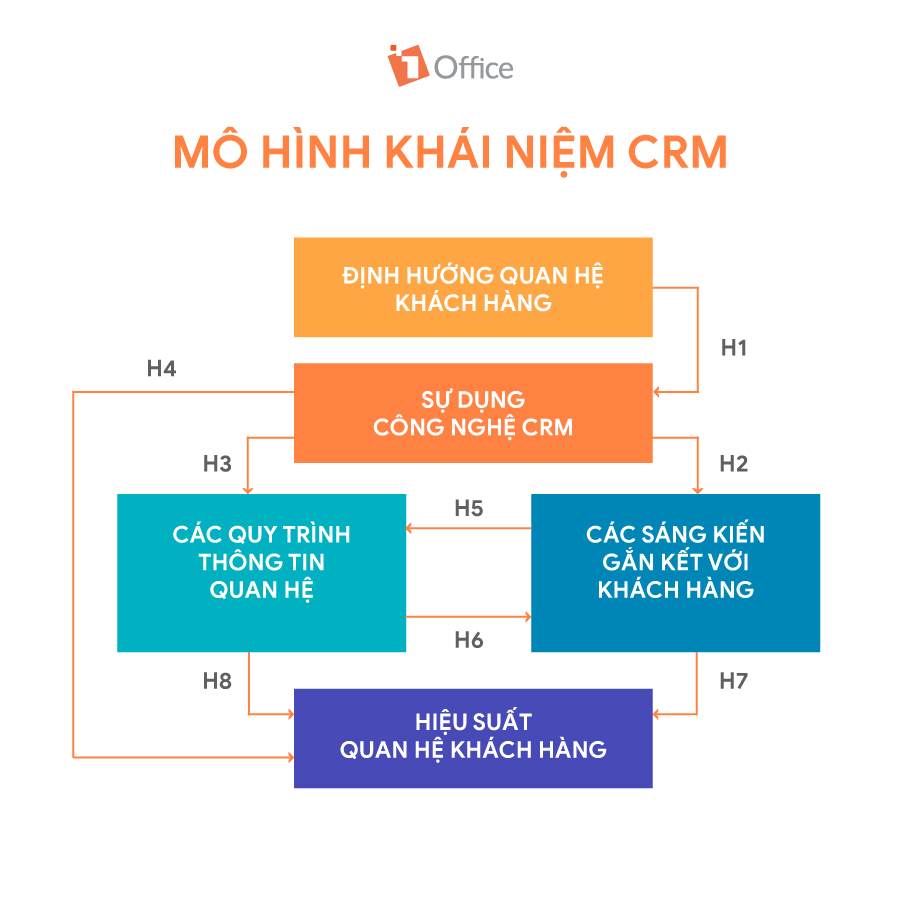
The CRM Conceptual Model is a process that includes 5 elements:
- Customer Relationship Orientation: Refers to the business’s focus on managing relationships with customers.
- CRM Technology: The technologies used to support CRM activities.
- Customer Engagement Initiatives: The processes that businesses implement to build relationships and interact (or engage) with their customers.
- Relationship Information Processes: Refers to the information collection, management, and analysis activities that businesses undertake to build insights about their customers.
- Customer Relationship Performance: Refers to the overall performance related to marketing efforts within the business.
III – How to Choose the Right CRM Model for Your Business
Each CRM model has its own strengths that suit the characteristics and needs of a business. Businesses need to consider and evaluate the following factors to select the most suitable and optimal CRM model to apply:
- Easy interaction between customers and the company, enhancing the ability to respond quickly to customer requests and suggestions.
- Allows customers to easily access company information such as vision, mission, and values. This establishes a beneficial relationship with customers based on mutual trust and respect.
- An abundant source of customer information accumulated and aggregated from various channels.
- Customer information must be categorized to support the business in providing personalized products and services.
IV. Common Mistakes When Applying a CRM Model
Although CRM brings tremendous value in enhancing customer experience and increasing revenue, many businesses still fail in implementation due to fundamental mistakes in perception and operation. Below are the 4 most common mistakes and how to avoid them.
1. Viewing CRM as Software, Not a Strategy
Many businesses believe that purchasing and installing CRM software is enough for “digital transformation in customer care.” In reality, CRM is not just a tool, but a customer relationship management strategy that requires synchronization between people, processes, and technology.
Without a strategic vision, CRM will only be used as a “data repository,” failing to create business value.
- How to fix: Clearly define CRM goals (customer retention, sales growth, process optimization, etc.) and design a CRM model that aligns with the company’s overall strategy.
2. Lack of Leadership Involvement
CRM is a cross-departmental project that requires coordination between marketing, sales, customer care, accounting, and IT. However, if the leadership team is not involved, lacks commitment, or views CRM as just a “sales department project,” the system will quickly be abandoned.
- How to fix: Leadership needs to act as the project sponsor, provide strategic direction, and promote a customer-centric culture throughout the entire organization.
3. Unstandardized Data
CRM is only effective when the data is accurate, complete, and consistent. However, many businesses enter data in a fragmented, non-standardized way (e.g., duplicate customers, incorrect phone number formats, missing contact information, etc.). This prevents the CRM system from analyzing or automating processes correctly.
- How to fix: Before implementation, data needs to be cleaned and standardized. Establish a unified data entry process and periodically check and reconcile customer data.
4. Not Training Employees to Operate the System
One of the common reasons for failure is that employees do not know how to use the CRM, or do not understand the goals behind implementing the system. In such cases, the CRM is easily “shelved,” and data updates become fragmented.
- How to fix: Organize regular internal training sessions, guide employees on data entry processes, customer classification, using CRM reports, and encourage feedback to improve the practical experience.
V – Effectively Implement a CRM Model with 1Office
Managing customer relationships is not a simple task. Businesses not only need to meet customer expectations but also exceed them to make customers want to stay loyal to the product and brand for the long term.
But how can you collect, process, and analyze customer data scientifically and systematically? The CRM software from 1Office will make your business’s customer relationship management easier than ever.
Key features of 1Office CRM
- Customer Information Management: The CRM module provides features that allow users to record customer calls, track emails, and automatically update information in the customer’s profile.
- Easy Data Access: Customer data is stored directly on the CRM system for information retrieval and tracking the customer care process.
- Marketing Automation: The CRM software integrates marketing automation features with supporting platforms to ensure a consistent and seamless customer experience across all channels.
The above article from 1Office has provided readers with information on the most popular CRM models in use today. It also introduces you to a superior CRM software that helps implement CRM models effectively. For a free consultation and to experience a demo of the 1Office sales management software, please contact us using the information below.
For more detailed information, please see:
- Hotline: 083 483 8888
- Fanpage: https://www.facebook.com/1officevn/
- Youtube: https://www.youtube.com/channel/UCeTIRNqxaTwk0_kcTw6SxmA




