


 10/05/2026
  9403 views
Financial statements are one of the most important documents that help businesses clearly see their financial situation, business results, and cash flow in each period. But what are financial statements, what do they include, and why do businesses need to prepare them correctly, completely, and on time? This article will help you quickly grasp the most essential knowledge about financial statements.
Mục lục
- 1. What are financial statements?
- 2. What is the purpose of preparing financial statements?
- 3. What is the significance of financial statements?
- 4. Who are the users of financial reports?
- 5. Classification of financial reports
- 6. What are the basic components of a financial report?
- 7. Deadlines for Preparing and Submitting Financial Statements
- 8. Recipients of financial statements
- 9. Process of preparing financial statements
- 10. What are the common errors when preparing financial statements?
- 10.1 Recognizing revenue in the wrong accounting period
- 10.2 Recording expenses in the wrong category or incompletely
- 10.3 Not clearly disclosing important items
- 10.4 Failure to reconcile books leads to unbalanced figures
- 10.5 Failure to make provisions or making incorrect provisions
- 10.6 Failure to update standards and new tax regulations
- 11. Application of financial statements in corporate governance
1. What are financial statements?
Financial statements are an important document in a company’s business operations. They are prepared to provide information about the company’s financial situation to interested parties such as: owners, shareholders, investors, banks, tax authorities, and other business partners.

Thanks to financial statements, stakeholders can assess the financial health of the business and make appropriate business decisions, helping the company manage its finances more effectively. By analyzing the financial ratios in the reports, businesses can implement measures to improve their financial situation and strengthen their financial health.
2. What is the purpose of preparing financial statements?
The main purpose of preparing financial statements is to provide information about a company’s financial situation over a specific period. From this, stakeholders can assess the company’s financial health and make appropriate decisions.
In addition, preparing financial statements also serves the following purposes:
- Evaluating business performance: Financial statements provide information on revenue, profit, and other financial indicators to help businesses evaluate their operational efficiency.
- Supporting financial management: Financial statements provide information about the current financial situation and forecasts for the future, helping businesses manage their finances more effectively.
- Providing information to stakeholders: Financial statements are a tool to provide information about the company’s financial situation to stakeholders such as shareholders, banks, tax authorities, and other business partners.
3. What is the significance of financial statements?
Financial statements play a crucial role in business management and provide important information to regulatory agencies as well as external parties like investors or other interested individuals. Through financial statements, investors can analyze the following issues in detail:
- Business and production situation: Financial statements clearly reflect the company’s business and production situation, especially information about profitability and fluctuations in operations. This helps readers assess potential changes in the financial resources the company can control in the future and predict its ability to generate cash flow.
- Changes in financial position: Indicators such as the status of assets, capital sources, business performance results, and cash flow situation of the company are detailed in the financial statements.
Based on this information, financial statements have different meanings and roles for each user group, providing different analytical value and information:

3.1 For business management
They provide a comprehensive overview of the situation regarding assets, capital sources, business results, and cash flow. This helps the Board of Management assess the business and financial situation, thereby making timely and appropriate management decisions for the company’s development. By now, you surely understand the benefits of financial statements for a business.
3.2 For state management agencies
State management agencies use information from financial statements to inspect and supervise the business and production activities of companies and ensure compliance with the State’s economic and financial policies.
- Tax Authorities: To check the fulfillment of obligations and compliance with tax laws by the business, accurately determine the tax amount, and finalize the company’s taxes.
- Finance Agencies: To inspect and evaluate the efficiency of capital use by the business, determine the return on capital, and check compliance with financial management policies.
- Business Registration Agencies: To check the implementation of the business license by the company, ensuring compliance with the State’s economic and financial policies.
3.3 For statistical agencies
Through financial reports, statistical agencies can compile data to provide information on the nation’s economic growth and determine GDP, supporting the government in making economic policy decisions.
3.4 For other parties
The information in financial reports is provided to investors, creditors, and customers, helping them assess the company’s financial situation and make investment decisions or decisions regarding interest rates applicable to the business.
4. Who are the users of financial reports?
Financial reports are used by various parties in business operations. The main users include:
- Owners and shareholders: Owners and shareholders are those who own and invest in the business. They use financial reports to evaluate business performance and consider investing in the company.
- Banks and credit institutions: Banks and credit institutions use financial reports to assess a company’s financial capacity and decide whether to grant loans or credit.
- Regulatory authorities: They check whether the business complies with regulations and laws, and also assist financial agencies in auditing the company’s operations. This process helps determine the amount of tax the business needs to pay, including corporate income tax and value-added tax.
- Business partners: Business partners such as suppliers, customers, and joint venture partners also review a company’s financial reports to assess its financial health and make appropriate business collaboration decisions.
5. Classification of financial reports
Based on the classification and how they are prepared according to the content they reflect, there are two main types of financial reports:
- Consolidated financial statements: These summarize the financial position and business operations of the entire enterprise, including the parent company and its subsidiaries within the ecosystem, as well as associated companies.
- Separate financial statements: These show the financial and business situation of a specific, individual company.
Based on the reporting period, there are two main types:
- Annual financial statements: These are prepared and calculated based on the calendar year or an annual accounting period, ensuring a full 12 months after notification from the tax authorities. A business can change between two consecutive fiscal year accounting periods.
- Interim financial statements: These include reports for the four quarters of the year as well as semi-annual financial reports. This type of report is created in a summarized format but still ensures complete information. For state-owned enterprises or listed companies, preparing interim financial statements is mandatory, while it is not required for other types of businesses.
6. What are the basic components of a financial report?
A financial reporting system includes the following types of documents:
- Income statement
- Balance sheet
- Cash flow statement
- Notes to the financial statements
- Statement of business performance
- Statement of changes in equity
Each type serves a purpose and reflects an aspect of the company’s financial health and operational situation.
6.1 Income statement
The income statement is a document that summarizes a company’s revenues, expenses, and profits over a specific period. This report is considered the most detailed compared to others, as it reflects the results of the company’s financial activities. The income statement needs to be presented and arranged in a specific order, from general to detailed, to help readers easily understand the company’s financial situation.

An income statement may contain the following information:
- Revenue: The total amount of money received from the company’s business and sales activities. Revenue is classified into revenue from sales, services, financial activities, and other activities.
- Expenses: The total amount of money spent to support the company’s business operations. Expenses can be divided into cost of goods sold, financial expenses, selling expenses, and general and administrative expenses.
- Profit, Loss: This is the difference between revenue and expenses. A profit occurs when revenue exceeds expenses, while a loss occurs when expenses are higher than revenue.
6.2 Balance Sheet
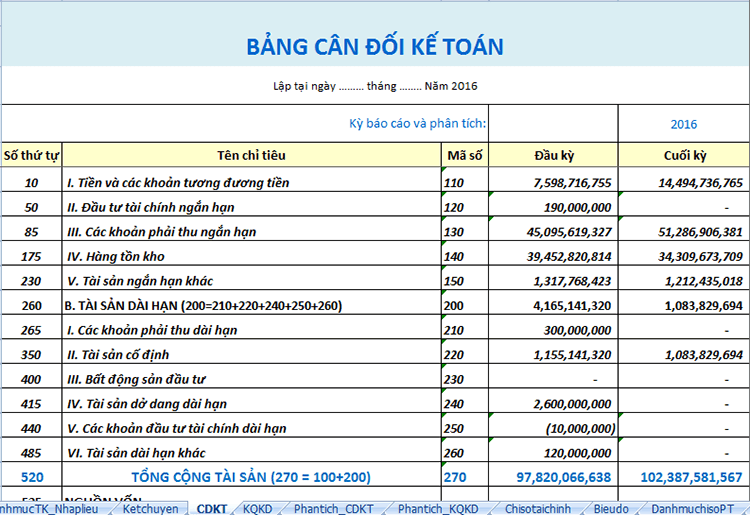
The balance sheet is a comprehensive financial report of a business, summarizing and presenting an overview of its existing assets and capital sources to form the company’s financial structure at a specific point in time.
The balance sheet provides a snapshot of a company’s financial resources at a specific moment, as it reflects the total value of all existing assets and capital sources up to the time the financial statements are prepared.
Preparing the balance sheet is a task of the accounting department to complete the company’s set of financial statements.
6.3 Cash Flow Statement
The cash flow statement reflects information about how much cash enters and leaves the business over a specific period. Typically, only companies using the accrual accounting method prepare a cash flow statement. Due to accrual accounting, the income statement may include revenue the company has earned but not yet received and expenses it has incurred but not yet paid.
In practice, the cash flow statement is one of the most challenging reports within the system of financial statements.
6.4 Notes to the Financial Statements
The notes to the financial statements are a document that explains and supplements information about the company’s operational and financial situation during the reporting period, as well as the company’s accounting policies that other reports cannot describe clearly and in detail. Investors can better understand the figures presented in the financial statements and get a clearer view of the company’s actual operating situation.

Businesses applying the accounting regime under Circular 200 will include the following financial statements:
- Balance Sheet (Form B01-DN)
- Income Statement (Form B02-DN)
- Cash Flow Statement (Form B03-DN)
- Notes to the Financial Statements (Form B09-DN)
Meanwhile, businesses applying the accounting regime under Circular 133 will include the following financial statements:
- Statement of Financial Position (Form B01 – DNNKLT or Form B01 – DNSN)
- Statement of Production and Business Results (Form B02 – DNN or Form B02 – DNSN)
- Cash Flow Statement (Optional report)
- Notes to the Financial Statements
6.5 Income Statement
The income statement, also known as the profit and loss statement, is a financial document that reflects a company’s business performance over a specific accounting period. This report provides information on the company’s revenue, expenses, profits, and losses, helping managers, investors, and other stakeholders assess the company’s business situation.
The income statement compares the revenue a company earns with the expenses related to its business operations to calculate net profit or loss. At the same time, this report is also used as a guide to assess how the company is expected to perform in the future.
6.6 Statement of Changes in Equity

The statement of changes in equity concisely and detailedly shows the fluctuations in equity over a specific period. In this report, equity can increase or decrease for the following reasons: an increase may come from owner investments and net income during the period, while a decrease may result from owner withdrawals or a net loss during the period.
The statement of changes in equity provides detailed information about the changes in a company’s equity over a specific period. This information helps users of the financial statements better understand the sources of equity and the company’s financial situation.
See more: Download 30+ Latest Financial Statement Templates under Circulars 200, 133, and 99
7. Deadlines for Preparing and Submitting Financial Statements
The deadline for submitting financial statements for businesses is regulated as follows:
7.1 For state-owned enterprises
Quarterly financial statement submission deadline:
- Accounting units must submit quarterly financial statements no later than 20 days from the end of the quarterly accounting period.
- For parent companies and State-owned General Corporations, the deadline is 45 days.
Annual financial statement submission deadline:
- Accounting units must submit annual financial statements no later than 30 days from the end of the annual accounting period.
- For parent companies and State-owned General Corporations, the deadline is 90 days.
7.2 For other types of enterprises
Annual financial statement submission deadline:
- Accounting units belonging to private enterprises and partnerships must submit annual financial statements no later than 30 days after the end of the annual accounting period.
- For other accounting units, the latest deadline is 90 days.
- Subordinate accounting units: Submit annual reports to the superior accounting unit according to the deadline set by the superior accounting unit.
8. Recipients of financial statements
Financial statements are submitted to competent authorities such as the tax agency, the Department of Planning and Investment, etc. In addition, businesses can also provide financial statements to relevant parties such as shareholders, banks, business partners, etc.

9. Process of preparing financial statements

Preparing accurate, truthful, and timely financial statements is a mandatory requirement for all businesses. The process of preparing financial statements includes the following steps:
- Step 1: Consolidate and organize accounting documents
- Step 2: Record arising economic transactions
- Step 3: Allocate depreciation and prepaid expenses
- Step 4: Record estimates and adjustments
- Step 5: Check and reconcile book figures
- Step 6: Perform closing entries
- Step 7: Prepare financial statements
10. What are the common errors when preparing financial statements?
Preparing financial statements (FS) requires accuracy, consistency, and compliance with accounting standards. However, in practice, many businesses—especially small and medium-sized enterprises—still encounter common errors that make reports unreliable, leading to incorrect analysis or scrutiny from tax authorities. Below are the most common errors and how to fix them.
10.1 Recognizing revenue in the wrong accounting period
The business recognizes revenue before fulfilling its obligations or records it later than when it actually occurred.
-
Consequence: “Phantom” profits, figures do not accurately reflect the business operations of each period.
-
Solution: Adhere to the accrual principle, cross-reference contracts – acceptance records – invoices.
10.2 Recording expenses in the wrong category or incompletely
Production costs are recorded as administrative expenses, or depreciation, interest expenses, and prepaid expenses are omitted.
-
Consequence: Inaccurate profits, affecting tax calculations and performance analysis.
-
Solution: Establish clear cost norms, use accounting software for automatic classification.
10.3 Not clearly disclosing important items
Financial notes are sketchy, lacking explanations for data fluctuations, accounting policies, or major transactions.
-
Consequence: Readers do not understand the nature of the data, and auditors are likely to request adjustments.
-
Solution: Standardize the notes template, add details about calculation methods, and reasons for balance changes.
10.4 Failure to reconcile books leads to unbalanced figures
Total assets do not equal total equity and liabilities; subsidiary ledgers do not match the general ledger; the cash flow statement is inconsistent with the income statement.
-
Consequence: The financial statements are deemed unreliable.
-
Solution: Periodically reconcile accounts (cash, receivables/payables, inventory, fixed assets).
10.5 Failure to make provisions or making incorrect provisions
Forgetting to make provisions for bad debts, inventory write-downs, or over-provisioning.
-
Consequence: Asset values and profits are misstated.
-
Solution: Adhere to VAS regulations and periodically review at-risk items.
10.6 Failure to update standards and new tax regulations
Many businesses still apply old regulations, failing to update new Circulars and Decrees on tax, accounting regimes, or applicable VAS/IFRS standards. This often leads to methods of recognizing revenue, expenses, depreciation, corporate income tax, etc., that are no longer compliant with current regulations.
-
Consequence: Reports are non-compliant with the law, and the business may be fined or required to restate its financial statements.
-
Solution: Update VAS and new circulars from the Ministry of Finance and the General Department of Taxation.

11. Application of financial statements in corporate governance
Financial statements are not just mandatory documents to be submitted to regulatory agencies, but also a strategic tool that helps leadership manage the business more effectively. When analyzed correctly, financial statements become a “financial map” that helps the business make accurate decisions, control risks, and optimize resources.
11.1 Assessing overall financial health
Financial statements help determine whether a business is in a state of safety, stability, growth, or risk based on:
-
Liquidity
-
Debt ratio
-
Profit and profit margin
-
Actual cash flow
This helps leadership know if the business has the financial capacity to expand or needs to scale back.
11.2 Analyzing the operational efficiency of each department
Income statements and expense reports by department help the business:
-
Identify high- and low-performing departments
-
Evaluate the effectiveness of marketing and sales campaigns
-
Cut wasteful expenses or inefficient activities
This is a crucial foundation for cost optimization and operational restructuring.
11.3 Supporting investment decisions and capital allocation
From metrics like ROA, ROE, and gross profit margin, the business can:
-
Make decisions on investing in production lines, technology, or market expansion
-
Calculate project efficiency
-
Prioritize capital allocation to high-profit activities
This helps optimize long-term profits.
11.4 Cash flow management and budget planning
The cash flow statement helps businesses:
-
Anticipate cash shortages
-
Plan debt payments
-
Control cash inflows and outflows for each cycle
This helps businesses avoid cash flow imbalances — the leading cause of bankruptcy for many companies, even when they are “profitable”.
11.5 Increase transparency when working with partners, banks, and investors
A clear and transparent financial statement helps businesses:
-
Easily obtain bank loans
-
Attract investors
-
Enhance credibility when collaborating with major partners
Financial statements are direct proof of operational capacity and business performance.
>>> Read more: 7 simple and accurate steps to prepare financial statements | Template included
—————————————-
The information above provides a basic overview of what a financial statement is, including its purpose, significance, required contents, and the standard preparation process. We hope this content will help investors and managers quickly assess a company’s overall financial situation from its reports, enabling them to make sound operational and investment decisions.
















