


 10/05/2026
  153 views
In business, setting sales objectives is a crucial factor for achieving success. However, not everyone knows how to establish and build effective sales objectives. In this article, let’s explore common types of sales objectives and how to build smart sales objectives with 1Office!
Mục lục
- 1. What are sales objectives?
- 2. Common types of sales objectives
- 3. How to set sales goals using the SMART model
- 4. What is the secret to building long-term sales goals?
- 5. Secrets to Building Accurate and Practical Sales Goals
- 6. Common mistakes when setting sales goals
- 7. Comparing individual sales goals and corporate goals
- 8. Smart Sales Goal Management with the OKR Method
- Frequently Asked Questions about Setting Sales Goals
- 10. Conclusion
1. What are sales objectives?
Sales objectives are business goals that a company aims to achieve within a specific period. To ensure clarity and measurability, each sales objective must be specifically defined and measurable by indicators and metrics.

Sales objectives should be set realistically and broken down for easy execution and management. In particular, they should aim for long-term results such as market expansion, new product launches, and other goals. Managers should focus on the following objectives:
- Increase revenue and profit.
- Increase the number of new customers.
- Enhance the capabilities of the sales staff
- Improve the sales process.
- Customer care & retention.
Sales objectives help direct sales activities, motivate employees, and ensure the business operates towards sustainable development. Having sales objectives helps employees execute them effectively and allows managers to easily monitor business results in each phase.
Sales objectives can be divided into long-term and short-term goals. Before starting each campaign, managers need to define long-term objectives for the sales team. Then, during the campaign implementation, short-term objectives will be set for each corresponding phase.
2. Common types of sales objectives
In a business plan, sales objectives are divided into many different types, with the specific goals below being typical examples.
Increase revenue and profit
All objectives are aimed at generating profit. The goal of increasing revenue is to raise the total value of sales transactions. This can be achieved by increasing the average value of each transaction, increasing the number of transactions, or developing new services/customers to create new revenue streams.
Sales objectives aimed at increasing revenue must be specifically defined for a fixed period, measured by metrics, and should be broken down into smaller parts. In addition to setting revenue targets, businesses can also define goals for sales volume within a specific timeframe.
When setting objectives, managers need to base them on several fundamental factors such as the previous period’s sales results, the company’s potential, the competitive landscape in the industry, and market fluctuations. Internal information is usually sourced from within the company, and market reports can be gathered from other research organizations.
Enhance the capabilities of the sales staff
In sales, the sales team is primarily responsible for bringing profit to the business. Therefore, improving the capabilities of the sales team is one of the key objectives that business managers need to focus on. A highly capable sales team will ensure the feasibility of sales objectives.
Short-term objectives aimed at this goal include:
- Reducing the time sales staff spend on data collection (typically, a business can establish an SEO and marketing team to handle this task).
- Optimizing time and effort spent on non-potential customers, instead focusing more on the target customer group. This can be done more easily through the use of CRM management software.
- Improving the quality of telesales calls, including effective information delivery and optimizing customer interaction time.
- Shortening the time and process required to complete the sales cycle.
Customer care & retention
Everyone probably thinks that acquiring new customers is much more expensive than retaining existing ones. In reality, retaining customers will cost much more than acquiring new ones, although existing customers are much more valuable than we think.
Statistics show that existing customers spend over 67% more than new customers. This means that retaining existing customers can yield higher profit margins for the business.
Building sales objectives around customer acquisition and retention can mean targeting high-spending customers, creating processes to resolve issues that current customers are dissatisfied with, or focusing on caring for customers who have already purchased or used your product.
Objectives related to customer acquisition and retention may include:
- Developing a loyal customer database to enhance interaction and customer retention.
- Increasing the time dedicated to caring for existing customers.
- Building a post-sale care program that includes upselling, cross-selling, etc., to encourage customers to spend more.
3. How to set sales goals using the SMART model
As a manager, you need to understand the difference between setting sales goals and setting sales goals “effectively.” Planning something doesn’t mean executing it. This is why, for any sales goal to be successful, it needs to be carefully constructed and established step by step. For sales goals to be effective, we need to define and set them according to the SMART model.
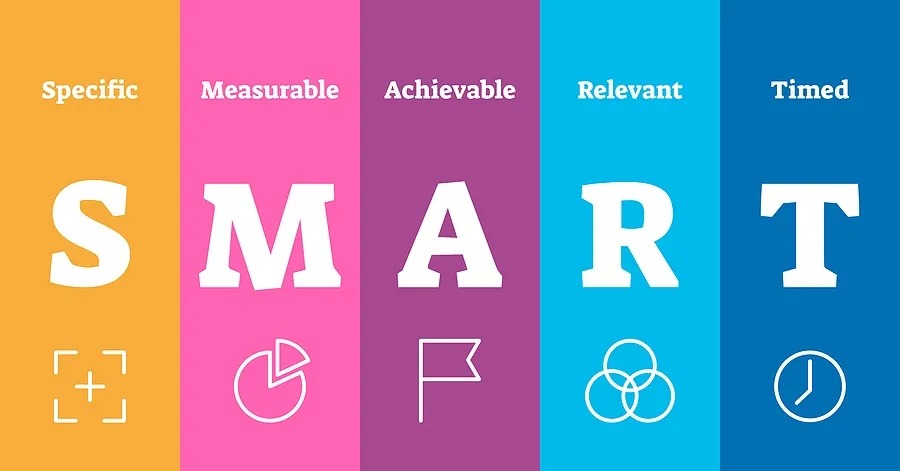
The SMART goal-setting method is explained as follows:
- Specific (S): Clearly explain the goal and the steps to achieve it.
- Measurable (M): Ensure there are established metrics to measure the completion of the goal.
- Actionable (A): The goal must be realistic, but not so easy that it fails to motivate completion.
- Relevant (R): Ensure that the goal aligns with the overall objectives and strategy of the business, as well as your team.
- Time-Bound (T): Establish a specific and clear time frame for the goal.
Suppose a company has a sales goal to increase the number of new customers each month. Here are some specific goals and examples using the SMART model.
- Specific: The goal is to acquire 100 new customers each month. This helps to clearly define the company’s specific objective.
- Measurable: To measure progress toward the goal, the company needs to determine how many new customers each team member needs to reach out to daily or weekly to achieve the number 100.
- Achievable: The company needs to assess whether, with 4 salespeople on the team, each person is capable of bringing in 25 new customers per month. This ensures the team has the necessary capabilities and skills to achieve the goal.
- Realistic: The feasibility of increasing the customer count by 100 per month must be considered. The company needs to check if this is achievable in a real-world context or if it is an unrealistic goal.
- Time-bound: Instead of vaguely saying we need to attract new customers, the company should set a specific goal of bringing in 100 new customers each month. This way, the sales team will have a clear deadline for this goal and a fixed target to pursue.
4. What is the secret to building long-term sales goals?
To successfully build long-term sales goals, managers need to establish a priority roadmap based on urgency and importance, while ensuring the goals are aligned with the team’s actual capabilities to avoid excessive pressure.
This is why leaders need to determine which goals should be prioritized. Managers should review each sales goal on the list and make decisions based on the following factors:
- Urgency of the goal: Are there any goals that need to be addressed urgently? Goals that can significantly impact business performance should be prioritized to ensure the company doesn’t miss important opportunities.
- Time frame of the goal: Which are long-term goals, such as building a customer care culture for the sales staff, and which are short-term goals, like boosting sales for the next quarter? Managers need to define a specific time frame for each goal.
- Importance of sales goals to the company’s overall objectives: It’s necessary to consider whether the goal is directly related to the company’s overall objectives and its level of importance in achieving them.
- Impact of not setting the goal immediately: If the goal is not set immediately, can the company’s business objectives still be achieved? What significance will that goal have for the sales team, and is it important for the overall success of the group?
Prioritizing sales goals by overall importance will also help them be achieved without putting too much pressure on the sales staff. At the same time, ensuring that team members are involved in the process of setting priority goals is crucial, as they are the ones who determine whether the goals can be realized. This is especially important when:
- They believe the goals are realistic and achievable.
- They are confident they have the necessary skills to achieve the goals.
- They may face some challenges in the process of achieving the goals.
- They need more training and support to achieve the goals.
Here are four tips that managers can apply to successfully achieve their sales goals:
Tip #1: Assess the capabilities of your team
Before setting long-term sales goals, you need to assess the capabilities of your current team. This helps you understand the team’s strengths and weaknesses, thereby clearly defining the necessary development direction and setting appropriate goals.
No matter how specific the goals set by a manager are, if their employees lack the skills or the goals exceed the team’s capabilities, those goals become meaningless. Therefore, when setting sales goals, managers need to carefully consider the team’s capabilities to ensure that the proposed goals are feasible and can motivate the staff to strive for them.
Tip #2: Continuously Monitor & Evaluate During Goal Implementation and Make Appropriate Adjustments
Most sales goals are typically set at the beginning of the year to create a 12-month roadmap. However, just because goals have been set doesn’t mean they cannot or should not be changed.
Managers also need to meticulously and regularly monitor their team’s sales goals. If the goal is to increase the productivity of sales staff, the manager should actively track the following metrics:
- The number of products/services sold.
- Win/loss rate.
- The time employees spend on prospecting for potential customers.
Tip #3: Reward Employees for Achieving Goals
Every sales team usually has members who perform more effectively than the rest. These are the high-performers who contribute significantly to achieving the company’s sales goals. Therefore, recognizing them is essential and important to boost everyone’s morale.
What about those who don’t achieve their goals? In this case, the first thing a manager should do is to understand the reasons by asking the question, “Why?“.
Regardless of the outcome, treat team members with positivity and an encouraging attitude—because negative feedback will not benefit overall sales performance. Encouraging and rewarding employees for achieving goals will help motivate and build employee commitment, while also strengthening morale and positive interactions within the organization.
Tip #4: Create a Response Plan for Failed Goals
During the process of achieving goals, failures are inevitable. Developing a plan to deal with unsuccessful goals allows managers to update their plans quickly. Ask yourself the following questions:
- What difficulties did your team encounter that led to the unsuccessful goal?
- Is the current sales team a good fit for the goal? Do their existing skills align with the goal’s requirements?
- Was your team equipped with the necessary tools to achieve the goal from the start?
Once you have identified the reasons why the goal was not achieved, focus on addressing those difficulties and try to pursue the goal again.
5. Secrets to Building Accurate and Practical Sales Goals
To build accurate and practical sales goals, you can apply the following secrets:
Set Short-Term Sales Goals
When setting sales goals for individuals or teams, managers need to make specific and detailed calculations for each department or employee. These goals should be reviewed and evaluated periodically over short intervals, such as monthly or even weekly. This allows the business to closely manage business activities, promptly detect and resolve emerging issues, and propose improvement plans.
Setting short-term sales goals helps us focus on specific stages and activities in the business process. This helps reduce pressure and motivate employees.
Build Waterfall-Style Goals
The waterfall goal method is an effective way to build sales targets. With this method, you need to break down a large goal into smaller ones to make them easier to track and achieve. This is how businesses build individual sales goals for each employee to ensure that the target for the next period is higher than the previous one. This will motivate and encourage sales staff to perform their work better.
For example, if your salesperson currently sends only 50 emails a week and you want to increase the target to 100, my advice is not to increase the target so suddenly. Instead, gradually increase the target, for example, to 60 emails for the next week, 70 emails for the week after, and continue to increase it incrementally.
This approach is better for employee morale, as setting a goal that is too large in a short period can create fear and pressure, making it impossible for them to achieve it. This gradual approach also helps ensure that your employees can maintain a higher quality of work. This also helps avoid tension within the team due to a sudden increase in workload.
Building a chain of sales goals
Building sales goals in a chain is a logical approach that maximizes time and prioritizes completing the most important goals first. This helps create connection and consistency in business operations, thereby ensuring the efficiency and feasibility of the entire process.
A chain here means that even if your salespeople cannot meet all the goals, they can still achieve some goals that are important for the company’s profits or their own professional development.
Flexibility in building and implementing goals
In the process of building and implementing sales goals, flexibility is a crucial factor to ensure feasibility and effectiveness. With a general goal set by upper management, lower-level managers can flexibly break it down into different targets to easily control them, and employees can execute them to achieve the best results in line with the overall goal.
Creating incentive goals
To enhance employee motivation and commitment, we need to create incentive goals, such as offering an additional commission percentage for exceeding KPIs. These goals should be accompanied by benefits related to increased income, career advancement, or receiving special rewards. This will create strong motivation for employees to strive their best to complete, and even exceed, the goals you set.
6. Common mistakes when setting sales goals
Setting sales goals is the foundation for directing business strategy, evaluating effectiveness, and boosting team performance. However, many businesses still face difficulties due to improper goal setting, leading to results that do not meet expectations. Below are some common mistakes made during the process of building sales goals.
Goals are too general and difficult to measure
Some businesses only go as far as defining general goals like “increase revenue” or “expand the market” without specific quantitative indicators. In such cases, the sales team cannot clearly determine the course of action, evaluation criteria, or level of completion.
Solution: Apply the SMART model to set specific, measurable, achievable, relevant, and time-bound goals. For example: “Increase Q3 sales by 20% compared to Q2.”
Not allocating goals clearly to each level
Another common mistake is that goals are only defined at the corporate level and are not cascaded down to teams or individuals. This lack of breakdown makes it difficult for employees to see their roles and responsibilities in the overall goal.
Solution: Implement goal cascading by level, from the company, to departments, teams, and individuals. This helps ensure cohesion and synchronization throughout the entire business system.
Setting unachievable goals
When goals exceed the team’s actual capabilities, employees can quickly lose motivation, leading to decreased performance.
Solution: Build goals based on historical data, personnel capacity, and market conditions. Combine a flexible reward mechanism to encourage effort and improve results.

8. Smart Sales Goal Management with the OKR Method
Sales goal management is a crucial aspect for every business, especially in today’s competitive business environment. To achieve success and sustain growth, effectively setting and managing sales goals is essential. Therefore, the OKR (Objectives and Key Results) method has become a useful tool to help businesses manage goals intelligently and with clear guidance.
As one of the leading OKR management software, 1HRM is confident in helping businesses manage sales goals comprehensively and effectively, suitable for today’s Industry 4.0 business management ecosystem. 1HRM helps businesses digitize the entire work process and manage everything centrally on one system. This allows managers to easily allocate, track, and evaluate goals.

The main features of the OKR management feature in the 1HRM module include:
- The Dashboard screen displays the entire process, helping users track the total number of processes and the progress of each one.
- Report by % of work completion: For each completed task, a percentage from 10% to 100% efficiency will be displayed.
- Report by the completion rate of workload: The completion level is expressed based on the number of tasks performed.
- Report by category of work performed: The completion level is indicated based on the number of tasks performed.
Frequently Asked Questions about Setting Sales Goals
What is a reasonable percentage to increase sales goals compared to the previous period?
The ideal growth rate typically ranges from 10% – 20%. This figure should be based on historical data, market growth rate, and the team’s actual capacity to ensure feasibility.
How to set sales goals for new, inexperienced employees?
You should focus on activity-based goals (number of calls, number of appointments) instead of immediate sales targets. Then, apply a “waterfall-style goal” approach to gradually increase sales targets according to the training roadmap.
When the market is highly volatile, should we lower the established sales goals?
Yes. Businesses need to be flexible in adjusting goals (re-forecasting) to accurately reflect reality. Maintaining excessively high goals in an unfavorable context will discourage employees and lead to inaccurate financial forecasts.
How can employees be encouraged to voluntarily commit to goals without feeling forced?
Apply a two-way (Bottom-up) goal management method: Allow employees to participate in setting their individual targets based on the company’s overall goals, combined with an attractive policy for exceeding KPIs. To manage and track sales goal progress visually, businesses should use 1Office CRM software, which helps automate reports, allocate KPIs, and accurately evaluate employee performance in real-time.
What is the biggest difference between Sales Goals and Sales Quotas?
- Objectives (Goals) are strategic and long-term oriented (e.g., capturing market share).
- Targets (Quota) are specific, quantitative figures that must be achieved in a short period (e.g., 500 million VND in monthly sales).
10. Conclusion
To set reasonable sales goals, managers need foresight and the ability to think outside the box. They must also know how to prioritize sales goals to avoid putting excessive pressure on the sales staff. Through this article, you have understood the nature of sales goals and received suggestions for building effective ones to achieve outstanding sales growth.
















