12/05/2026
  307 views
In the rising era of digital technology, the term Digital workplace has emerged, completely redefining how organizations operate and communicate. More and more businesses are starting to adopt the Digital workplace to accelerate their digital transformation race and keep up with market trends. However, not every organization is on the right track to establishing a comprehensive digital workspace. So, what exactly is a Digital workplace? How can you build a true digital office? Let’s find out in the following article.
Mục lục
- 1. What is a Digital Workplace? An Accurate Perspective on a Digital Office
- 2. Why do businesses need to undergo a Digital workplace transformation?
- 3. The 3 Core Elements of a Digital Workplace Transformation
- 4. 5 Steps to Build a Digital Work Environment for Your Business
- 5. 1Office – The Solution for Creating a Digital Workplace for Businesses
1. What is a Digital Workplace? An Accurate Perspective on a Digital Office
Today, digital tools and platforms like Skype, Zoom, and Office 365 are familiar to every business. An employee’s workday begins with checking work messages and emails or participating in online meetings. However, does simply applying digital tools to daily operational processes truly transform an organization into a genuine digital enterprise? Let’s re-examine this familiar yet strange definition to find the answer:
A Digital workplace, or e-office, is a work environment based on a digital technology platform that allows businesses to shift their operating systems to a virtual space.
A digital work environment provides employees with access to all the digital tools they need to handle their daily tasks without having to come to the office or meet in person.
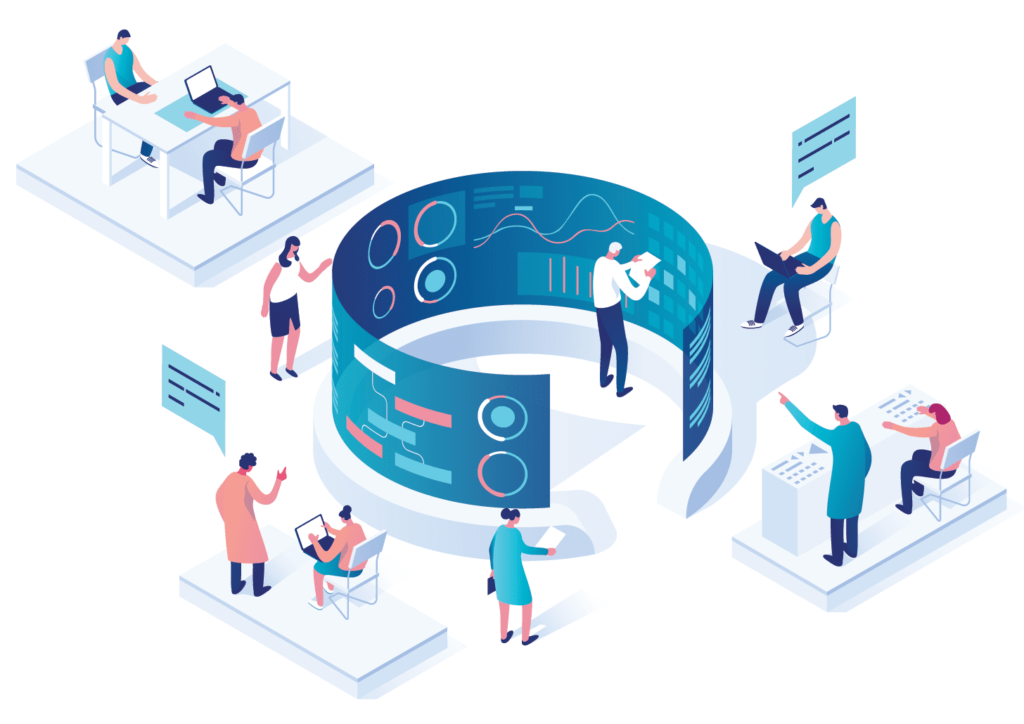
However, a Digital workplace is not just a collection of separate, disparate tools for different tasks. The mission of a Digital workplace is to solve a larger problem – the overall picture of corporate governance. This is because the nature of an organization is a unified operational machine where every link is tightly connected. A Digital workplace integrates all the different applications used within the organization and places them on a single platform to create a seamless, uninterrupted work experience for employees.
2. Why do businesses need to undergo a Digital workplace transformation?
Promote a collaborative culture
By integrating the technologies employees use (from email and messaging to work management applications and online meetings), the digital workplace breaks down communication barriers and promotes collaboration within the organization. All employees can connect and coordinate on tasks through their computer screens, allowing the business to optimally harness collective strength.
Increase flexibility
With a Digital workplace, an employee’s work environment is no longer confined by four walls. Their daily tasks can be performed anytime, anywhere. Geographical distance is no longer an issue for impromptu meetings or a packed schedule. Furthermore, the digital office promotes the work-from-anywhere trend, giving employees more autonomy in their work and increasing their satisfaction levels.
Improve work performance
Thanks to the flexibility and seamlessness of digital tools, businesses can improve productivity manifold by automating manual tasks, saving time on searching for and accessing information, and thereby reducing waste in the workflow.
Reduce operational costs
Transitioning to a digital office model is an ideal solution for optimizing a business’s operational costs. For example, travel expenses between branches can be completely eliminated thanks to online meetings. Additionally, choosing SaaS solutions can help businesses free up costs for on-premise server operation, storage, and IT resources.
Enhance customer experience
Traditionally, providing a quality customer experience required significant resources and manpower. However, with the power of digital tools, the customer care process can be automated while still ensuring service quality.
3. The 3 Core Elements of a Digital Workplace Transformation
People
The transition from a traditional to a digital work model heavily depends on the human element, as people are the main subjects of the work environment. A digital work environment empowers employees by providing them with all the necessary tools to master their work, including:
- Business support applications that help employees identify sales opportunities more quickly
- Tools and technologies that accelerate the research, development, and delivery of new products
- Allowing employees to find necessary information with just a single click instead of spending hours sifting through paper documents
Tools
Digital tools are powerful assistants that help employees perform tasks and solve problems in the quickest and most optimal way. Digital tools and technology can solve any problem related to business operations, from managing tasks and projects to complex processes. However, to ensure these tools are effective in a digital work environment, the prerequisite is that they must be interconnected and aligned with the company’s culture and goals.
Culture
Transitioning to a digital work environment is not just about investing in modern technology or providing employees with the latest tools. Above all, it must be the cultural foundation of a business. Organizational culture plays a role in shaping how employees leverage the digital work environment to connect, communicate, and collaborate. This means that organizational leaders must clearly understand employee needs and develop a digital transformation strategy that aligns with the culture, considering three aspects:
- Collaboration: To operate effectively in a digital work environment, organizations need to gather collective knowledge using collaboration and teamwork tools.
- Communication: To ensure accurate information reaches the right audience, employees need tools that support two-way communication and content personalization.
- Connection: Employees need tools that allow them to connect and communicate. The digital workplace achieves this goal by facilitating cultural development and building a strong community through an internal social network.
4. 5 Steps to Build a Digital Work Environment for Your Business
Step 1. Define the Vision
The process of creating a digital work environment for a business must begin with defining a clear vision. This vision must be derived from a thorough analysis of the needs and operational situation within the organization. Take a comprehensive look at the company’s operational structure and ask questions: Are traditional working methods still effective? What tools do employees need to work better? The best way to find the answers is to survey the entire staff and have direct discussions with managers and digital transformation consultants to establish a clear direction.
Step 2. Create an Implementation Plan
So, how do you create a detailed plan for your digital workplace transformation strategy? Survey all departments in the organization—those who will be part of the digital office—and ensure that every employee has the opportunity to participate in the process and contribute their opinions. An implementation plan needs to clarify the following issues:
- How will you use technology to improve the employee work experience and enhance performance?
- How can you create a workspace that increases employee creativity and collaboration?
Step 3. Build a Digital Toolkit
The digital toolkit includes all the tools and technologies that employees need to complete their work. However, remember that digital tools are only truly effective if they meet the requirements of the strategic vision you defined earlier. Otherwise, the new tools may only benefit certain departments or groups—or worse, benefit no one at all.
So, what should a complete digital toolkit include? In most organizations, digital tools are divided into 8 categories with specific functions and purposes:
- Communication – allows employees to connect and communicate quickly: email, messaging
- Productivity – helps employees work efficiently: word processors (Word, Docs), spreadsheet software (Excel, Sheets), presentation software (PowerPoint)
- Collaboration – allows employees to work together: groups, web conferencing
- Internal Communications – supports sharing internal information: blogs, intranet
- Management Software – ERP, CRM, HRM, etc.
- Crowdsourcing – allows the organization to collect employee feedback and ideas: polls, forums, surveys
- Connectivity – makes it easy to contact any member of the organization: employee directory, organizational chart.
- Mobile Devices – enable remote work: laptops, smartphones, remote scanners.
Step 4. Implement the Plan
Before implementing any changes in your organization, you need to address all issues related to risk management and resolve potential problems that may arise when adopting new technology. An ideal digital workplace model will maximize connectivity and collaboration while minimizing risks. Ensure a smooth implementation phase by:
- Closely monitoring information to analyze and predict potential risks related to security and data safety.
- Training employees, ensuring that all personnel clearly understand how the digital workplace operates to avoid confusion and awkwardness when approaching a new work environment.
- Providing a unified communication model for the organization and preventing the formation of isolated groups.
Step 5. Evaluate and Improve
Review the digital workplace implementation to identify any shortcomings in the operational process. Concurrently, evaluate the results of the implementation to improve and optimize any areas that are not yet streamlined.
5. 1Office – The Solution for Creating a Digital Workplace for Businesses
The Digital Workplace is the core of business digital transformation. The digital transformation of the work environment has now become a vital factor determining the survival and development of a business. In the race to enter the digital era, more and more businesses are choosing to invest in management software to build an electronic office for their organization.
As a pioneering management solution in digital transformation, 1Office provides businesses with an all-in-one platform equipped with all the necessary toolkits to build a comprehensive digital workplace, including:
- HRM – Human Resource Management module
- CRM – Customer Relationship Management module
- WORKPLACE – Work Management module
- ADVANCE – Advanced toolkit, automation
Through the article above, 1Office has provided readers with the most comprehensive perspective on the Digital workplace. We also offer a superior technology solution to help leaders effectively digitize their work environment. For a free consultation and to experience a trial of the leading business management software today, please contact us using the following information:
- Hotline: 083 483 8888
- Fanpage 1Office: https://www.facebook.com/1officevn
- Youtube Channel: https://www.youtube.com/c/1OfficeNềntảngquảnlýtổngthểDoanhNghiệp