


 12/05/2026
  298 views
In Vietnam’s current economy, capturing the market is becoming a challenge for businesses. Some businesses choose the “blue ocean strategy” to create niche markets where they can hold a monopoly. Meanwhile, other businesses decide to compete directly with rivals in the “red ocean” to enhance their competitiveness. So, what are the differences, and what is the optimal choice for managers? Why do businesses prioritize the Blue Ocean Strategy? Let’s find out in the article below by 1Office.
Mục lục
- 1. What is the Blue Ocean Strategy?
- 2. The difference between Blue Ocean and Red Ocean strategies
- 3. A 6-Step Framework for Building a Successful Blue Ocean Strategy
- 4. When is it time to adjust the Blue Ocean Strategy?
- 5. Examples of how large enterprises build a Blue Ocean Strategy
- 6. Prospects and challenges in implementing the Blue Ocean Strategy
1. What is the Blue Ocean Strategy?
<img class="aligncenter wp-image-34981 size-large" title="Blue Ocean Strategy – Red Ocean. The optimal choice for businesses” src=”https://1office.vn/wp-content/uploads/2023/04/chien-luoc-dai-duong-xanh-dai-duong-do-1-1024×511.png” alt=”Blue Ocean Strategy – Red Ocean. The optimal choice for businesses” width=”1024″ height=”511″ />
Blue Ocean Strategy is a business method focused on developing and expanding new markets, creating products and services that do not yet exist in the market. The key feature of market segmentation in the Blue Ocean Strategy is that there is little to no competition.
This strategy was proposed by W. Chan Kim and Renée Mauborgne in their 2005 book, “Blue Ocean Strategy: How to Create Uncontested Market Space and Make Competition Irrelevant”. The key characteristics of the Blue Ocean Strategy include:
- Customer focus: This strategy places the customer at the center and focuses on their needs and wants to create new, different value and products compared to existing ones on the market.
- No direct competition: The blue ocean creates a new market space, which means not competing directly with existing rivals, avoiding price wars, and minimizing the risks of direct competition.
- Product differentiation: It focuses on differentiating products or services, creating additional value for customers, which helps create a significant difference from existing products and services on the market.
- Cost reduction: By eliminating unnecessary factors or optimizing production and service delivery processes, it helps increase the product’s competitiveness.
- Creating new value: This is value that other competitors cannot provide, helping to create a new market space and maintain a pioneering position in the market.
- Strategy adjustment: The Blue Ocean Strategy can be adjusted and adapted to market changes and customer needs, helping businesses maintain their competitiveness in the market.
>> See more: 8+ most effective strategies to attract potential customers – Double your conversion rate
2. The difference between Blue Ocean and Red Ocean strategies
The red ocean is a large and crowded market where all companies and businesses in a field compete with each other to win a share of that market. Meanwhile, the blue ocean is a small, new niche market, focusing on a specific target customer group that no competitor has yet exploited.
| Evaluation Criteria | Blue Ocean Strategy | Red Ocean Strategy |
| Objective | The Blue Ocean strategy focuses on exploiting development potential and creating new value. This strategy emphasizes tapping into undeveloped market factors and creating new products and services to increase sales and profits. | The Red Ocean strategy focuses on optimizing production efficiency and reducing costs to achieve quick profits. It is often applied in traditional industries. |
| Target Audience | The Blue Ocean strategy focuses on a new customer segment that the business has researched. | The Red Ocean strategy focuses on the business’s existing customer base. |
| Vision | It requires the business to have a long-term strategic vision and effective skills in managing staff and finances. | The Red Ocean strategy is applied by businesses when they want to manage costs and optimize production efficiency to generate profits. |
| Scope | The Blue Ocean strategy requires investment and thorough research into the market, customers, and products. | This strategy is often applied in traditional industries in Vietnam. |
| Competitors | Creates a market space with no or few competitors. | Fierce competition within the existing market space. |
In other words, the red ocean is like a large, existing cake, and all companies compete with each other for a slice. Meanwhile, the blue ocean is like a cake created by a business, targeting only a specific group of customers.
| >> Read more: What is STP? Applying the STP Strategy in Marketing to Help Businesses Conquer the Market |
3. A 6-Step Framework for Building a Successful Blue Ocean Strategy
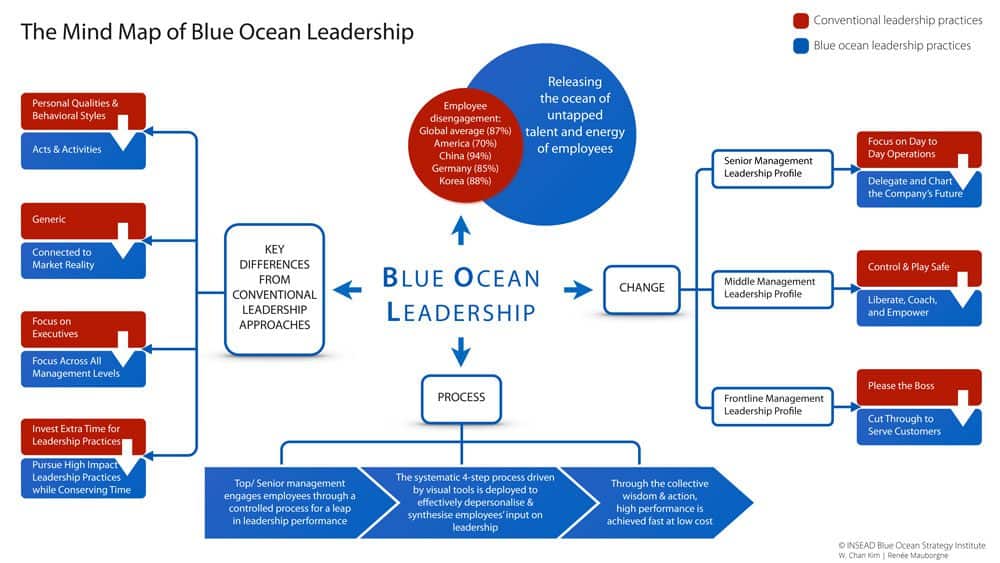
Step 1: Identify Potential New Markets
First, you need to analyze and understand potential new markets that the business can approach, including untapped or developing markets. To do this, the business needs to:
- Research and analyze the current market to identify industry problems and challenges. This helps the business recognize untapped markets with potential for growth.
- Search for new markets by examining the latest market trends, industry policies and regulations, customer needs and requirements, and upcoming future events.
- Assess the business’s ability to enter new markets by considering available resources, the skills and experience of the staff, and potential supporting partners.
>> See more: An Accurate and Effective Target Market Strategy for Businesses
Step 2: Set the Strategic Direction
After identifying potential markets, you need to set the strategy map by defining specific business objectives and the plan to achieve them.
- Define specific business objectives and measure the results to achieve them.
- Identify the key factors necessary to achieve business objectives and build specific plans to attain them.
- Identify potential risks and challenges and create plans to mitigate their impact.
- Establish key performance indicators (KPIs) to measure business effectiveness and manage these metrics over time to ensure the strategy achieves its set business goals.
Step 3: Focus on the Customer
To successfully implement the Blue Ocean Strategy, businesses need to clearly understand customer needs, identify their problems and challenges, and provide the best solutions to meet those needs.
- Research and analyze the market to clearly understand customer needs, wants, and preferences.
- Find ways to solve customer problems and offer solutions to address them.
- Develop new products or services to meet customer needs.
Step 4: Create a New Product or Service
Based on customer needs and requirements, you need to design and develop a new product or service to meet these demands. This product or service should focus on solving existing problems in those markets.
- Develop new product or service ideas by considering the latest market trends, customer needs, and other barriers to create a unique and effective product or service.
- Test the new product or service to ensure it meets customer wants and needs.
- Improve and refine the new product or service based on customer feedback and business performance metrics.
Step 5: Implement the Strategy
After the product or service has been developed, you need to implement the strategy by focusing on brand building, customer outreach, and product or service promotion.
- Identify the resources and implementation plan to ensure the strategy can be executed effectively.
- Create a detailed execution plan with specific steps and metrics to measure results.
- Provide adequate resources, support, and training for the staff to implement the strategy.
- Monitor and manage the progress of the strategy’s implementation to ensure that goals and results are achieved.
Step 6: Evaluate and Improve
Finally, you need to evaluate the effectiveness of the Blue Ocean Strategy and improve it to enhance efficiency and meet customer needs. The evaluation can include business performance metrics, customer feedback, and feedback from relevant partners.
- Measure results and compare them against the set targets to evaluate the strategy’s effectiveness.
- Collect and analyze customer feedback to better understand the necessary changes to improve the product or service.
- Evaluate and analyze the strategy implementation activities to identify its strengths and weaknesses and make necessary adjustments.
- Regularly update and improve the Blue Ocean Strategy to respond to market changes and customer needs and wants.
- Plan for improvement activities and re-implement the strategy to achieve better results.
In summary, to successfully implement the Blue Ocean Strategy, a business must perform a series of steps from identifying potential new markets, setting the strategic direction, focusing on customers, designing new products or services, implementing the strategy, and evaluating and improving it. This process requires significant investment and focus from the business, but it also brings many opportunities and great benefits for the sustainable development of the business and the world.
4. When is it time to adjust the Blue Ocean Strategy?
During the digital transformation process, most Blue Oceans will gradually turn into Red Oceans due to rapid copying and imitation by competitors. To maintain the strategy’s value, businesses need to constantly improve, adjust, and innovate to keep the strategy groundbreaking and relevant to the market. So, when is it necessary to improve and adjust the strategy?

- When the market changes: Businesses need to adjust their strategy to meet customer demands. This change may include modifying products/services or adjusting the pricing strategy.
- When competition emerges: If new competitors appear or existing ones improve their products/services, businesses need to adjust their strategy to cope with this competition.
- When internal business issues arise: If internal problems affect the ability to execute the Blue Ocean Strategy, businesses need to adjust their strategy to resolve these issues.
- When customer needs change: If customers change their needs or requirements, businesses need to adjust their strategy to meet these new demands.
To cope with competition and ensure continued success with the Blue Ocean Strategy, businesses need to focus on exploiting and delving deeper into business activities, expanding their territory, and improving processes to capture more market share before competitors intensify and become more focused.
5. Examples of how large enterprises build a Blue Ocean Strategy
5.1 Samsung’s successful example with the Galaxy Fold
To create differentiation and a breakthrough in the mobile phone manufacturing industry, Samsung developed the Galaxy Fold – the world’s first foldable screen smartphone. This is an example of the Blue Ocean Strategy, where Samsung developed a unique and different product, offering a new solution to customer needs and creating a competitive advantage in the market.
5.2 Viettel’s Blue Ocean Strategy example
Military Telecommunications Group (Viettel) has developed a Blue Ocean Strategy focused on developing information technology and communication services by using advanced technology products that meet customer needs and have minimal environmental impact. Viettel’s projects include using solar energy to power base stations and implementing the Smart City model.
5.3 Starbucks’ successful example of the Blue Ocean Strategy
Starbucks’ Blue Ocean Strategy focuses on creating environmentally sustainable stores, minimizing waste, and using recycled materials. Starbucks has implemented programs to reduce the use of plastic bags, use paper cups and bags instead of plastic, and use Fair Trade coffee beans. These activities help Starbucks attract a large number of customers who are concerned about environmental issues while also creating a positive brand image.
6. Prospects and challenges in implementing the Blue Ocean Strategy

6.1 Prospects of the Blue Ocean Strategy
Create new value for customers by creating unique and different products or services compared to competitors in the market. This helps increase customer satisfaction and becomes a major point of differentiation for the business.
Create new market space, helping businesses gain a competitive advantage and reach new customer segments. This helps businesses increase sales and profits while reducing competition with existing market rivals.
Increase the long-term sustainability of the business in the market by creating unique and different products or services compared to competitors.
6.2 Challenges of the Blue Ocean Strategy
High initial investment costs because to implement this strategy, businesses need to invest a large amount of money in researching and developing new products and services. It requires the business to have an ambitious vision, creativity, and strong market analysis capabilities.
Complexity in implementation because this strategy requires coordination between departments within the company, a team of employees with high expertise, and leadership’s attention to achieve long-term goals.
Fierce competition with market rivals, especially if another company discovers a similar or improved new approach and competes directly, that market space can be destroyed.
The above is a summary of knowledge about the Blue Ocean and Red Ocean strategies. If you are looking for a solution for your business strategy, please contact 1Office for consultation and support:
- Hotline: 083 483 8888
- Facebook: https://www.facebook.com/1officevn/
- Youtube: https://www.youtube.com/@1office-chuyendoisodn
















