


 12/05/2026
  459 views
Omotenashi What is it? Omotenashi means hospitality in Japanese. Simply put, Omotenashi is the Japanese art of customer care. It ensures every customer is served and cared for with dedication and thoughtfulness. More details about Omotenashi will be revealed in the article below. Read on!
Mục lục
I. What is Omotenashi?
Omotenashi originates from the traditional Japanese tea ceremony. Preparing for a tea ceremony takes a lot of time (it can be up to a year). The meticulousness and detail of the ceremony are evident right from the process of selecting cups, flowers, types of tea, decorations, and more. Everything is tailored to the guest’s preferences.
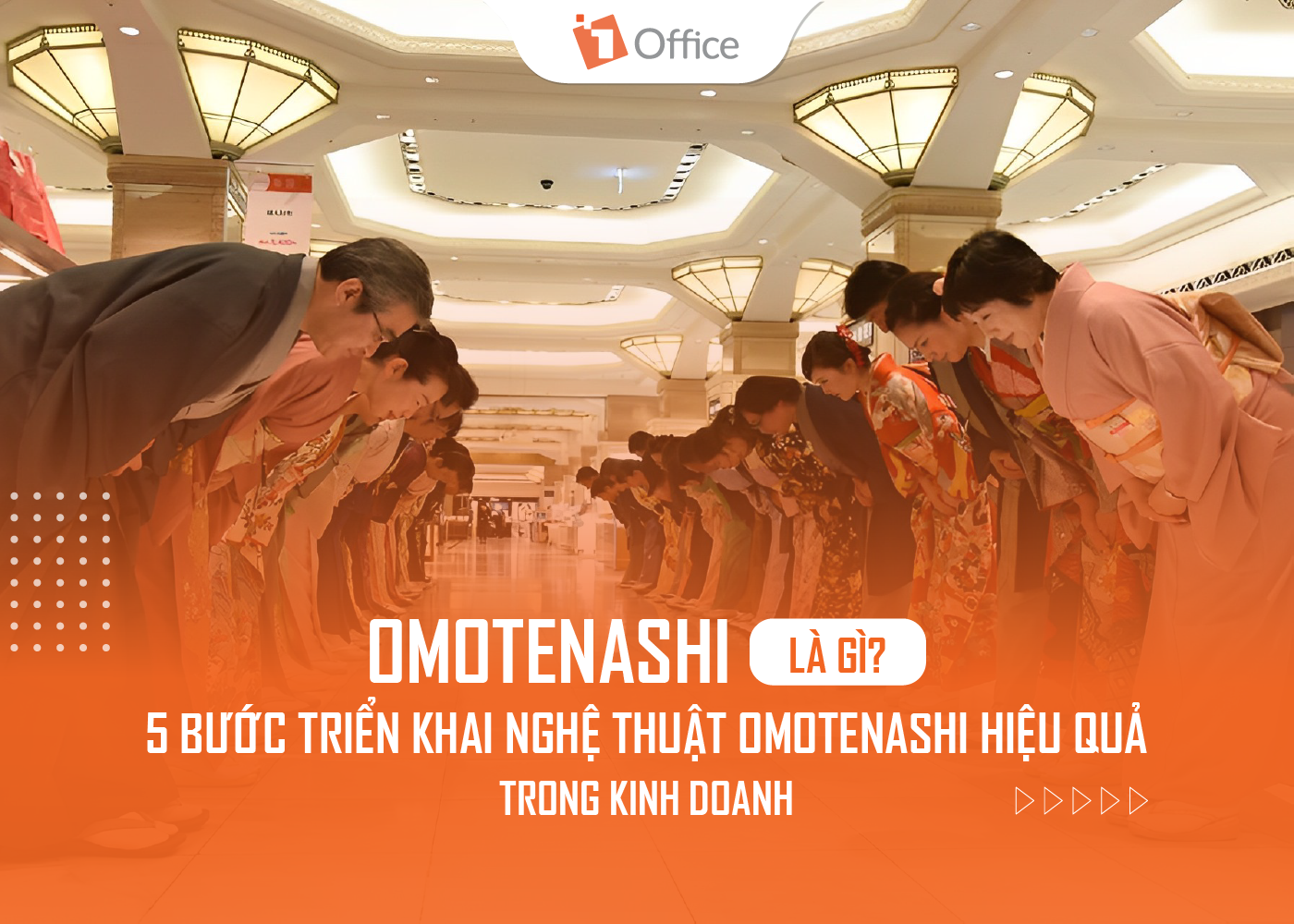
Omotenashi means hospitality in Japanese. Simply put, Omotenashi is the Japanese art of customer care. It ensures every customer is served and cared for with dedication and thoughtfulness. This practice is demonstrated in many aspects, such as:
- The preparation phase before welcoming customers.
- The attire and appearance of the staff.
- The attitude and actions of the staff.
The most prominent features of the art of Omotenashi are dedication and hospitality. The way customers are welcomed and served stems from sincerity, thoughtfulness, and authenticity. This allows businesses to invisibly increase the value customers receive.
II. Benefits of Applying Omotenashi
Every business should pursue the art of Omotenashi customer care. The notable benefits when a business applies Omotenashi include:
- Create a strong impression on customers: Businesses can easily make a good impression from the very first meeting by providing dedicated and thoughtful care. This is also a way to enhance the effectiveness of strategies for attracting potential customers and quickly build trust with them.
- Develop the workforce: By uniformly training and developing the professional expertise and skills of the staff, the business will possess a high-quality workforce, boosting production and business activities.
- Create a competitive advantage: Customer care service is one of the factors that strongly influences a customer’s purchasing decision. Omotenashi will help businesses create a competitive advantage when the price and product quality are similar to those of competitors.
- Enhance product and service value: Customers evaluate a product’s quality not only by its usefulness but also by their shopping experience. Omotenashi will help increase the value and satisfaction customers derive from a product or service.
- Increase customer retention rate: Through the value that the business delivers via its products and Omotenashi-quality customer care, customers will feel valued and enjoy a positive experience. They will tend to continue using the service and even recommend it to others.
- Build corporate culture: In the art of Omotenashi, the customer is always the top priority. When a business applies this art to its customer service, it is also embedding it into its corporate culture. All personnel in the organization will implement and adhere to this principle.
III. The 5 Levels of Japanese Customer Service
Omotenashi is divided into 5 different levels. They include:
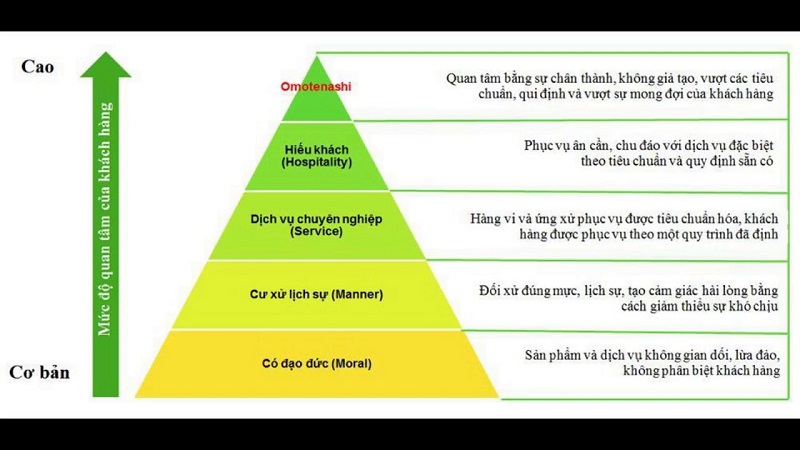
Level 1: Moral – Being Ethical
This level represents transparency in the products and services provided. All value received by the customer must be exactly as committed to and advertised by the supplier/business. Therefore, customers do not need to worry about acts of fraud, deceit, etc.
At the same time, the Moral level also demonstrates equality towards all customers. This means that the business will not discriminate against any customer. Every customer is served and supported in the best possible way throughout the entire process of shopping and using the goods.
Example: Company A sells cosmetic products. They guarantee that all their products are genuine and have a clear origin. All information and images are verified by competent authorities. When customers buy from Company A, they are allowed to inspect the goods before payment. If Company A’s products do not match the commitment, Company A will provide a 200% refund to the customer.
Level 2: Manner – Behaving Politely
Respecting customers is essential for any business. This is clearly demonstrated at the Manner level of Omotenashi. All actions and attitudes towards customers must show respect and courtesy. Depending on the customer segment, businesses should have different customer care methods to ensure customers are always comfortable and satisfied with the quality of service.
For example: When a customer arrives at a fashion store, the security guard will greet them and park their vehicle. Next, a sales associate will open the door, bow, and greet the customer with a phrase like, “Hello. Please come in and have a look.”
Level 3: Service – Professional Service
Service – Professional service is the act of standardizing employee behavior and conduct when serving customers. Building a customer care process is essential so that service staff can use it as a standard for their customer service activities.
For example: When a customer leaves their personal information for a consultation or to make a purchase from company ABC, the process will be as follows:
- The phone number is transferred to the sales department.
- A sales representative is assigned to call the customer.
- If the customer does not answer, call them back at a different time. If necessary, send an SMS message.
- The sales representative provides courteous consultation and support to the customer.
Level 4: Hospitality
Always show attentiveness and thoughtfulness to customers according to a standard process. The business needs to prepare well for pre-sales activities to welcome customers in the best way possible. It’s not just a simple buy-sell transaction; the business also brings a sense of closeness to the customer.
For example: In a coffee shop, once a customer is seated, a staff member politely offers them a glass of tea or water. Then, they present the menu. While the customer is choosing, the staff member skillfully and cheerfully provides advice and introduces the menu items to help the customer select a drink they will enjoy.
Level 5: Omotenashi
The highest level of Omotenashi is caring for customers with genuine sincerity, without pretense. It goes beyond established standards and customer expectations. Every action comes from the seller’s heart, with the desire to bring the best value to the customer.
For example: Customer A reserves 3 tables at Restaurant H. When confirming the reservation, Restaurant H learns that the reservation date is Customer A’s birthday. Therefore, Restaurant H prepares a special space for Customer A. Additionally, the restaurant coordinates staff to surprise Customer A with a birthday cake and fresh flowers. The restaurant also gives Customer A a voucher for a 20% discount on their total bill.
IV. 3 Elements that Create the Art of Omotenashi Customer Care
When applying the art of Omotenashi customer care, businesses cannot overlook the following three elements:
Prepare to Serve Customers Perfectly
To provide the best experiences for customers, businesses must understand their wants and needs. This process requires observation, research, and analysis. Based on the evaluated data, the business prepares the necessary elements to ensure customer care activities are carried out effectively and meet their objectives. For example:

- Staff training
- Service and product preparation
- Designing the service space and environment
- Preparing contingency plans
This can be as simple as how a business identifies its potential customer base. The business needs to create a detailed profile of who these customers are and what they are like.
Always Make a Good Impression and Build Rapport with Customers
Making a good impression and building rapport with customers helps them remember you for a long time, facilitates communication, and shortens their purchasing decision process.

Below are a few simple yet highly effective ways to make an impression and build rapport with customers:
- Offer a friendly smile to customers
- Wear neat and professional attire
- Maintain a confident and calm demeanor
- Give a good initial greeting
- Have good posture when walking
- Make eye contact
- Give a firm, decisive handshake
- Proactively lead the conversation
- Show a sincere attitude
Gestures and actions from the heart
More than just a relationship between a seller and a buyer, in the art of Omotenashi, every action and gesture comes from the heart. This heart-to-heart connection helps businesses and customers understand each other better. Businesses offer the best value to customers, helping them to the best of their ability. This, in turn, creates a sense of closeness and trust for the customer.

Overall, this element delivers services that exceed customer expectations. All of this influences the customer’s purchase intent and long-term loyalty to the business.
>> See more: Customer Service Representative Job Description
V. 5 Steps to Effectively Implement the Art of Omotenashi in Business
Here’s how to implement the art of Omotenashi in 5 simple steps:
Step 1: Change Perception
Perception, in this case, is the ability to recognize, understand, and be aware of Omotenashi. Businesses need to review and re-evaluate the quality of their current services to steer or change them in line with Omotenashi. The process of changing perception must be synchronized across two main groups:
- Leadership: The heads of the organization, they are the ones who set the ideology and strategy to lead and coordinate subordinate staff. Whether the change in perception is effective depends mainly on this group. This is because they are the core members of the business, directly influencing the perception of employees within the company.
- Implementers/Employees: The ones who carry it out
The leadership’s perception must be correct and profound from the very beginning for activities to achieve maximum effectiveness. At the same time, the business must also ensure that the perception of the leadership and the employees are synchronized. Only then will the transition from perception to implementation align with the initial goals.
Step 2: Equip Staff with Skills to Provide Service and Meet Customer Needs
Customer service professionals not only require a high level of expertise and product knowledge but also a wide range of different skills. Specifically:
- Communication skills
- Skills in understanding customer psychology
- Situation handling skills
- Customer persuasion skills
Depending on the situation, the person greeting the customer will apply these skills skillfully and flexibly. This helps customer service staff find appropriate ways to handle customer issues/requests.
In addition, employees must still ensure strict compliance with company regulations.
For example: Employee A is responsible for advising Customer B on phone products. To best serve Customer B, Employee A must first understand all phone models to be able to suggest the most suitable products. At the same time, Employee A needs to know how to gather information, needs, and concerns from Customer B through some sample customer care questions such as:
- Do you use your phone a lot for work or communication? Let me recommend some suitable phone models for you! Currently, models like…
- Are you buying this phone for yourself or as a gift for a loved one?
- I’m also using the ABC model, it’s quite smooth, has 256GB of memory, and the battery life is great. Would you like to take a look at this model?
This process requires Employee A to skillfully use their skills to understand the customer and suggest the most suitable products for them.
Step 3: Equip Staff with Operational Skills
Operational skills are the set of skills and abilities necessary to perform and manage work effectively. They help in proactively carrying out tasks and effectively connecting and interacting with colleagues.
In the art of Omotenashi, operational skills will include many other subFor example: Next weekend, salesperson A has an appointment to meet with customer C to consult and exchange more information about product X. Therefore, employee A must arrange their work in advance to ensure that next week’s tasks are not affected by the meeting with customer C, such as: completing next week’s tasks ahead of time, informing the person in charge of their absence, finding a replacement to work at the store (if necessary), etc. In addition, employee A must prepare important information and documents to discuss with customer C.
Step 4: Develop comprehensive and diverse skills
Comprehensive and diverse skills in the art of customer care mean the ability to understand customers thoroughly and in detail. Employees will clearly understand the characteristics of different customers, such as age, culture, interests, needs, etc. This makes the process of personalized customer care highly effective. This is also what every business aims to achieve.
Comprehensive and diverse skills are formed based on the experience, knowledge, and skills that a person trains for and accumulates. Businesses can enhance these skills by:
- Mastering specialized knowledge and basic skills
- Understanding customers
- Training and developing human resources
Step 5: Build a corporate culture
To successfully apply the art of Omotenashi customer care, businesses need to integrate Omotenashi into their culture. Every employee in the company must be imbued with and follow this common goal. This requires leaders at all levels to clearly understand the role of each staff member to set appropriate objectives. Then, they must implement HR training activities to change perceptions and enhance the capabilities of the company’s human resources.
To make the art of Omotenashi a part of your corporate culture, you can follow these simple methods:
- Organize competitions related to customer care services.
- Test and evaluate staff performance when applying Omotenashi.
- Develop specific reward policies and compensation packages for staff who excel at implementing Omotenashi.
>> See more: Professional After-Sales Customer Care Process
VI. Famous businesses that have successfully applied Omotenashi
Today, Omotenashi is applied by many businesses with extremely high efficiency. When it comes to leading the art of Omotenashi customer care, two giants must be mentioned:
1. Japan’s largest retail group – AEON Mall
AEON Mall has applied the Omotenashi style very effectively in its customer care services. All AEON MALL employees are well-trained and professional, with a spirit of readiness to support customers dedicatedly and sincerely. That’s why when people mention AEON Mall, they often refer to the quality of its service.

AEON Mall’s success in applying Omotenashi has intimidated many giants in the same industry. AEON Mall has demonstrated this right from its unchanging business philosophy: “everything for the customer.”
Here are a few highlights of AEON Mall’s art of Omotenashi customer care:
- Diverse retail models
AEON centers provide a variety of products, services, and amenities to fully serve customer needs in areas such as entertainment, fashion, food, etc. With AEON’s retail model, the products on sale are extremely diverse in both style and quality. It can be said that AEON meets almost all customer needs within its shopping centers.
- AEON’s commitment to product quality assurance
Product quality is AEON’s top priority to ensure customer safety. Therefore, AEON only sells products from partners if they meet the following 6 factors:
– Product quality meets standards
– Business partners have complete documentation and are licensed to operate by competent authorities.
– Delivery vehicles and packaging methods comply with regulations.
– Compliance with Vietnamese regulations on potential sources of pollution.
– Products have a clear origin
– Suppliers must comply with Vietnamese regulations on the use of pesticides, veterinary drugs, antibiotics, food additives/processing aids, etc.
- Professional ‘Japanese-standard’ customer service
When experiencing services at AEON Mall, customers are served “with all our hearts.” All AEON employees are always ready to welcome customers with sincerity.
Many amenities and services at AEON have provided customers with great experiences, such as:
– Multi-channel shopping: Online and Offline
– Home delivery.
– Wi-Fi, phone charging stations: Helping customers access the Internet or stay in touch…
– Various payment methods: bank cards, e-wallets, cash, etc.
– Numerous rest benches set up throughout the shopping center.
In addition, AEON Mall regularly organizes training sessions for its employees and the staff of partner stores to develop its human resources. This has helped make customer care services at AEON Mall more professional, meticulous, and consistent.
2. The most successful pizza brand in Vietnam – Pizza 4P’s
Pizza 4P’s is the most successful pizza restaurant chain in Vietnam with 24 Pizza 4P’s stores. This brand was founded by a Japanese couple.

Not only focusing on product quality, Pizza 4P’s has also left a strong impression on customers by providing customer care using the Omotenashi method.
A thoughtful and sincere attitude
Pizza 4P’s places great importance on the process of impressing customers. Through eye contact, gestures, and attitude, employees can influence customers’ emotions and thoughts. Therefore, Pizza 4P’s has trained and built a well-rounded team of employees, with a special emphasis on helping them express sincere feelings and a respectful attitude towards customers.
- Service staff: Sincere smiles, thoughtful attitude.
- Chefs: Meticulous care in every dish.
Always observing and listening
Pizza 4P’s is always eager to listen to customer feedback. Therefore, the company regularly conducts surveys on the quality of its services and products. These activities are organized publicly on the company’s official Fanpage. All feedback, reviews, and suggestions from customers are listened to by Pizza 4P’s and used to make positive changes.
For example: In a survey on the quality of Pizza 4P’s home delivery service in March 2020, Pizza 4P’s received a lot of positive feedback from customers. The company quickly posted the results along with detailed information about its improvements.
“Pizza 4P’s is honored to continue serving you during this turbulent time with our newly launched home delivery service. We are delighted to receive positive feedback from you, which greatly encourages us to continue improving every day on our journey to bring joy and smiles. Your frank and constructive suggestions are also very valuable to us. We understand that we have another opportunity to self-assess and improve further.
We have received the following feedback:
– Food was not delivered on time
– Food was no longer hot upon delivery
– The call center did not provide adequate support
– The packaging used too much plastic
– The ordering process via the hotline was not optimal
– Chili oil was not provided
We have taken this feedback on board and made improvements:
– Improved the quality of the call center
– Reduced plastic waste
– Provided chili oil
Currently, we are actively working and will soon make improvements with the following measures:
– Implementing our own delivery service without a third party to ensure timeliness
– Launching an online ordering platform
– Providing detailed instructions for preparing and reheating food
– Using insulated bags imported from Australia to keep food fresh and hot
– Using packaging made from biodegradable materials
Of course, we know this is not enough and hope to receive more feedback and reviews from you.”
The 1-minute rule
Pizza 4P’s also established a 1-minute rule for its employees. The 1-minute rule is understood as the things an employee can do for a customer in one minute. The rule is applied by all employees based on 3 factors:
- Anticipate: Understand and predict customer psychology.
- Acknowledge: Devise the best method to serve the customer.
- Act: Coordinate with relevant personnel to implement the chosen method.
For example: Depending on the number of customers at each table, the staff can proactively notify the kitchen to cut the cake into suitably sized pieces. If a customer has to wait for their food, the staff skillfully informs them and serves complimentary drinks. This spirit is demonstrated in the smallest of actions.
Thus, this article has shared with you everything about the art of Omotenashi. A business’s customer service quality will be significantly enhanced by applying Omotenashi. Your business should implement this art of customer care today to see new progress in your business operations! Wishing you success!
















