13/05/2026
  399 views
The AIDA model is one of the most popular tools used in Marketing campaigns. Applying the AIDA model helps businesses “guide” customer psychology through various stages, thereby accelerating the decision-making process and increasing conversion rates. So, what is the AIDA model? How is the AIDA model applied in Marketing? Let’s find out in the article below:
Mục lục
1. Overview of the AIDA model
1.1. What is the AIDA model?
The AIDA model, also known as the AIDA marketing funnel, is one of the classic formulas widely applied in advertising & marketing.
The AIDA model is an acronym for Attention – Interest – Desire – Action, corresponding to the 4 cognitive stages a customer goes through when deciding to purchase a product or service. The business’s task is to encourage customers to take actions that move them to the next stage by creating attractive content and messages to appeal to the psychology of the target audience.
The AIDA model is very flexible and can be applied in most Marketing campaigns through various methods, from online channels (website, social media, paid advertising, etc.) to offline channels (billboards, print materials, etc.)
1.2. The 4 key elements of the AIDA model
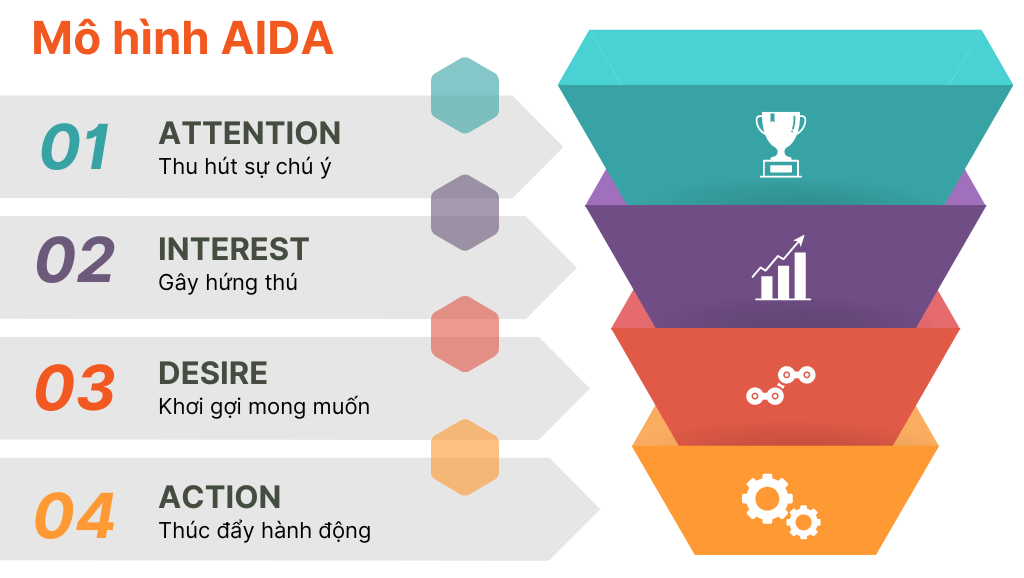
Attention – Attracting customer attention
The first stage of the AIDA model is Attention – which means attracting the customer’s attention. The Attention stage serves as the foundation for the business’s initial approach to target customers, ensuring they are aware of the brand’s and its products/services’ existence.
According to the Corporate Finance Institute, this stage is often overlooked by many businesses who assume customers already know about them. This is a subjective mistake because the initial impression is extremely important; it contributes to building brand awareness in the consumer’s mind and creates interest for them to move deeper into the buying journey.
The best way to attract customer attention is to produce unique and impressive content. Customers are easily attracted by shocking messages, clickbait headlines, or visually stimulating images. Additionally, messages with content personalized to the preferences and tastes of each target group also make customers focus on your brand.
Interest – Creating interest in customers
Once the target audience is aware of your brand and the products/services you sell, capture their interest! To do this, businesses need to understand the difficulties and challenges consumers face and prove that they are the solution they are looking for. By identifying the customer’s pain point, marketers can present content that connects to solutions for their problems.
Additionally, the content conveyed should include specific evidence to increase credibility through case studies, customer stories, and testimonials. This boosts customer interest because it shows that other buyers have achieved their desired results using this product or service.
One of the most important things to remember is that the content must be easy to understand and emotionally resonant with concise, powerful messages; otherwise, consumers will lose interest.
Desire – Arousing customer desire
After maintaining the customer’s interest, it’s time to make them want to buy your product or service. The Desire step involves appealing to the customer’s logical senses and showing why they need your product or service. To excel at this step, focus on the benefits and value the product or service provides rather than its features and functions.
In addition to appealing to logic, businesses also need to create an emotional connection to arouse desire in customers. To do this, use highly expressive language.
Action – Prompting customer action
The final step in the AIDA model is to convert the customer’s thoughts and feelings into concrete actions. Actions that customers can take include making a purchase, contacting for a consultation, scheduling an appointment, signing up for a trial, etc.
The decisive factor for success in the final step is the use of a Call To Action (CTA). A call to action is a short instruction that directs consumers to perform conversion actions. Whatever the CTA is, it needs to be clear and compelling to urge customers to take action immediately.
See more: What is B2B? Characteristics and popular B2B business models
1.3. The Extended AIDA Model
Over several decades, the AIDA model has consistently proven its usefulness due to its flexibility and effectiveness. In the age of information explosion, this model has been improved with various versions to suit the preferences of the target audience. The extended factors from the AIDA model in Marketing include:
- Retention – Customer Retention: Once you have successfully won over a customer, it is crucial to build loyalty to encourage them to return. Providing loyalty programs, promotions, or point systems will help customers stay with the brand longer.
To better understand this factor, read now:
What is Retention Rate? Effective Methods to Improve Customer Retention
- Satisfaction – Ensuring Customer Satisfaction: The customer journey doesn’t end once the customer has the product; a new phase begins as they use it and form perceptions and evaluations compared to their prior expectations. Therefore, you must ensure the best post-purchase experience to keep them satisfied with the product. This can be done through customer care content such as surveys and feedback collection.
2. Strategy for Applying the AIDA Model in Content Marketing
Applying the AIDA model in Marketing to produce content such as SEO articles, emails, or social media posts is a “secret” used by Marketers to reduce bounce rates, increase engagement, and drive customer conversions. So, how do you implement Content Marketing according to the AIDA model? Follow the steps below:
Attention – Create a Unique Headline
To capture the customer’s attention, you first need to create a compelling headline and description that “catches the eye” of the reader. Here are some elements you can use to create an attractive and unique headline:
- Emphasize Urgency: This method uses the FOMO (Fear of Missing Out) effect to tap into the psychology of the target audience. Emphasize urgency in the headline with strong words that make the reader anxious and unwilling to miss out.
For example, some phrases you can use include “Once-in-a-lifetime opportunity,” “Don’t miss out,” “You’ll regret it if you skip this…”
- Personalize Content: A study from Statista revealed that personalized content achieves a 17.5% click-through rate compared to 11.4% for non-personalized content. Therefore, research the characteristics of the target audience you are aiming for.
For example: “…for talented managers,” “what marketers need to know…” are descriptions that will more easily attract the attention of the target audience.
- Arouse Curiosity: You can arouse curiosity by asking the reader questions. Note that the questions should address the current concerns and queries of the customer, and you must ensure you provide the answers in the article.
For example: “Did you know?”, “Which option is for you?”
- Use Offers: Don’t be afraid to use words like “free” or “promotion” to attract the reader’s attention.
For example: “Free trial – experience it now!”
| DO! | DON’T |
|
|
Interest – Cultivating Customer Interest
Once you have successfully captured the reader’s attention, guide them to take an interest in the products/services you sell. There are many different ways to implement content to do this:
- Storytelling: Storytelling is a tried and tested method because it taps into people’s emotions. If people feel connected to your story, they will most likely want to learn more.
Example: “Wishing you the best new year. This Lunar New Year, surprise your loved ones with an inspiring gift to help them work more effectively every day.” – Apple
- Emphasize pain points: As mentioned above, consumers are constantly looking for solutions to their problems. Your job is to help them find those solutions more easily. Therefore, create a connection with customers by highlighting the issues they care about.
Example: If your business helps working parents with convenient, easy meals, one way to capture their interest is to produce content about how difficult it is to get a full dinner on the table after a busy day.
- Use emotionally charged language: To capture customer interest, focus on tapping into their emotions by using highly expressive words.
Example: When you want to emphasize a customer’s “pain point,” phrases like “worried,” “frustrated,” or “confused” will create strong empathy as customers relate to them. Then, you can use words that describe the feeling of satisfaction when customers use your product or service, such as “comfortable,” “free,”…
- Include facts: Using facts is one way to help build customer trust and credibility. You can use an interesting fact or statistics to make readers more engaged and remember it longer.
Example: Did you know – 90% of businesses believe that digital transformation is a matter of survival, determining their position in the market. However, only 56% of businesses digitize their operations effectively.
| DO! | DON’T |
|
|
Desire – Awaken the customer’s desire
At this stage, you must create a desire for the customer to own your product or service. Remember: you must sell the benefits of the product or service, not the features.
Suppose you are promoting a webinar on how to write blog posts. Instead of saying, “This webinar will show you how to write a blog,” you can lead with a question. Example: “Are you struggling to write an engaging blog? Learn the secrets to creating captivating blog content, doubling your conversion rate, and saving time at our webinar.”
| DO! | DON’T |
|
|
Action – Call to Action
In the final stage of the AIDA model, the use of a CTA will determine whether the customer will take the conversion action.
Example: In a print ad, the CTA might be “Visit a store near you”, while on landing pages, the CTA could be “Order now”. In an email, the CTA might include “Visit our website to learn more”, while on social media, the CTA could be “Share this post”.
| DO! | DON’T |
|
|
Read more: What is a Marketing Plan? Steps to Build an Effective Marketing Plan
3. Measuring the Effectiveness of the AIDA Model
- Attention Stage – Helps you know which channels are driving traffic to your website.
Tools used: Impressions and CTR (Click-through-rate) to see if people are paying attention to your content.
- Interest Stage – Measure the overall engagement on your website to see if customers are truly interested in the content you share.
Tools used:
-
- Visits. This is the number of sessions visitors have on the website.
- Average time on page: The amount of time a customer stays on the page to read the article.
- Traffic sources. Search engines, display traffic, referrals from other sites.
- Bounce Rate (BR). The percentage of people who visit your website, don’t click on anything, and then leave. The higher this number, the lower your engagement. Therefore, make sure to keep this metric at a minimum.
- Desire Stage – Measuring at this stage will show whether customers truly desire and spend time learning about your products and services.
Tools used:
-
- Number of returning visitors. This is the number of people who are not first-time visitors. It helps measure audience size.
- On-site search. The number of searches for other internal keywords on your website.
- Action Stage – This stage will help you track your conversion rate. If all other metrics are great but the conversion rate is low, the problem may lie here.
Tools used:
-
- Document downloads
- Number of customers leaving contact information
- Number of messages received in the chat box
4. Examples of Applying the AIDA Model in Marketing
For a more specific look, let’s see how the big names have implemented the AIDA model in their marketing campaigns.
Example of the AIDA Model in an Adidas Campaign

- Attention: The brand’s main motivation is to show people how “amazing” it is to own a pair of Adidas shoes. To create awareness for their new product, they collaborate with celebrities, especially top athletes. The fan base following these athletes, combined with the Adidas brand, is enough to create a buzz for the new product and direct consumers to their website.
- Interest: Adidas created a central theme around the campaign of “seeing possibilities,” which helps the brand connect deeply with its audience. The brand also uses headlines like “save up to 50%” to attract customer interest.
- Desire: The celebrities and behind-the-scenes images of the launch event are what make fans curious. The product’s exclusivity, as portrayed by the brand, is what their customers desire.
- Action: Sales then become simpler for Adidas because of the product’s superior quality and features, combined with promoting the idea “Like your idol, Adidas is the right choice.”
Example of the AIDA Model in a Netflix Campaign
When Netflix came to India, the biggest problem they faced was that Indians already had access to free and continuous content on various platforms with cable TV connections. And here’s how Netflix used the AIDA model to capture this new market:

- Attention: To create awareness, Netflix used traditional advertising methods by placing giant outdoor posters of famous shows familiar to global audiences like Narcos, Friends, etc.
- Interest: Interest was generated by focusing on India’s young population. Customers would receive a 1-month free trial on the Netflix website, which would create curiosity and a desire to try it out.
- Desire: After experiencing Netflix for 1 month, the desire to continue with Netflix would become stronger with Hollywood blockbusters and famous TV series. In addition, Netflix emphasized user-optimized features such as support for all devices and personalized recommendations based on viewers’ watching habits.
- Action: The action step would be achieved when Netflix offered multiple subscription plans depending on the customer’s budget. At this point, customers are connected to a huge library of movies at a suitable price.
5. Optimizing the customer journey with 1Office CRM
For businesses looking to expand their customer funnel and enhance the consumer experience at each stage of the buying journey, in addition to applying the AIDA model, another factor that needs to be emphasized is optimizing marketing campaigns. The Marketing 1Office campaign management software is a superior toolset that helps businesses improve customer conversion rates thanks to:
- 24/7 Customer Care feature, resolving all issues and concerns with a fully supportive chatbox and call center system
- Automating Marketing campaigns by using Marketing Automation for multi-channel care such as SMS, Email Marketing… Open API allows integration with Landing pages, Facebook, and Google to reach customers on multiple platforms.
- Supporting the building and optimization of each customer touchpoint through smart customer data mining, stored on the cloud for analyzing insights and behavior. This helps businesses implement suitable Marketing campaigns.
Through the article above, 1Office has provided readers with a comprehensive view of the AIDA model as well as the skills to effectively apply the AIDA model in marketing. For a free consultation and to experience a trial of the most professional customer management & care software available today, please contact us using the information below:
For all detailed information, please see:
- Hotline: 083 483 8888
- Fanpage: https://www.facebook.com/1officevn/
- Youtube: https://www.youtube.com/channel/UCeTIRNqxaTwk0_kcTw6SxmA